SUBSCRIBE TO OUR FREE NEWSLETTER
Daily news & progressive opinion—funded by the people, not the corporations—delivered straight to your inbox.
5
#000000
#FFFFFF
To donate by check, phone, or other method, see our More Ways to Give page.
Daily news & progressive opinion—funded by the people, not the corporations—delivered straight to your inbox.
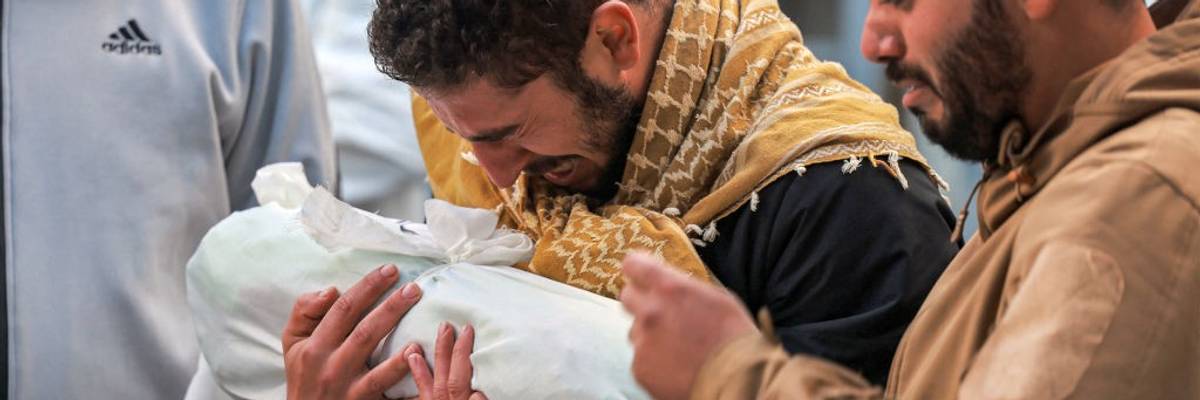
A man mourns as he holds the wrapped body of a Palestinian child who was killed overnight by Israeli bombing at a hospital in Rafah in the southern Gaza Strip on December 19, 2023.
Israel's bombardment and invasion of Gaza have also killed more than 10,000 children in nearly 100 days, or 1% of the 1.1 million children in the besieged enclave.
Israel has killed more people per day in its attack on Gaza than were killed daily in any other major conflict during the 21st century.
Oxfam reported Thursday that Israel has killed an average of 250 Palestinians in Gaza each day since October 7, compared to 96.5 killed daily in Syria, 51.6 in Sudan, 50.8 in Iraq, 43.9 in Ukraine, 23.8 in Afghanistan, and 15.8 in Yemen.
"The scale and atrocities that Israel is visiting upon Gaza are truly shocking," Oxfam Middle East director Sally Abi Khalil said in a statement. "For 100 days the people of Gaza have endured a living hell. Nowhere is safe, and the entire population is at risk of famine."
"The situation in Gaza is monstrous and a blight on our common humanity."
Also on Thursday, Save the Children reported that Israel's bombardment and invasion of Gaza had killed more than 10,000 children in nearly 100 days, or 1% of the 1.1 million children living in Gaza before the war began. More than 40% of the total number killed in Gaza were children.
"There can never be any justification for killing children," Jason Lee, Save the Children's country director for the occupied Palestinian territory, said in a statement. "The situation in Gaza is monstrous and a blight on our common humanity."
On October 7, Hamas launched an attack on southern Israel that killed around 1,100 people and took around 240 hostages. Israel then launched its assault on Gaza in retaliation. Before Hamas' attack, however, Israel had blockaded Gaza for 16 years and occupied the Palestinian West Bank for 56 years. Since October 7, Israel has killed 330 Palestinians in the West Bank, according to Oxfam.
Both Oxfam and Save the Children's statements came the same day that a South African legal team appeared before the International Court of Justice to argue that Israel is committing genocide in Gaza. It is asking the court to take "provisional measures" to stop the violence. Several other countries, including Brazil, Bolivia, and Pakistan, have supported South Africa's efforts, but the United States dismissed its case as "meritless."
Oxfam and Save the Children criticized the wider international community for failing to stop the bloodshed.
"It is unimaginable that the international community is watching the deadliest rate of conflict of the 21st century unfold, while continuously blocking calls for a cease-fire," Khalil said.
Lee stated: "Despite the record number of children killed and maimed, the international community has failed to act again and again. One grave violation committed against children is one too many. For the last three months, children in Gaza have faced grave violations every day, while conditions to provide them with the humanitarian assistance they need are simply not there. All parties must agree to a definitive cease-fire now."
The two non-governmental organizations also emphasized the danger civilians in Gaza now face not only from military action, but also from hunger and disease. Israel only allows 10% of the necessary food aid to enter Gaza's borders, according to Oxfam. The colder weather increases the risk of illness, especially as people displaced by the conflict are forced to shelter in smaller and smaller spaces. More than 1 million people are now crowded together in Rafah, and Oxfam partner Palestinian Agricultural Relief Committees said conditions for people living in tents was "worse than anything you could imagine."
"The rain was going down from all sides of the tent," displaced engineer named Mutaz told Oxfam. "We had to sleep lying over the bag of flour to protect it from the rain. My wife and three of my daughters use one blanket at night. There are only enough blankets for four people to share. We have nothing."
Save the Children pointed out that these hardships took a toll on children especially.
"For children who have survived, the mental harm inflicted and the utter devastation of infrastructure including homes, schools, and hospitals has decimated their futures," Lee said.
The organization counted a record number of violations against children by both Israel and Hamas, including the destruction or damaging of 370 schools in Gaza, the attacking of 94 hospitals and healthcare facilities, the denial of humanitarian aid to all of Gaza's 1.1 million children, and Hamas' taking of children as hostages and killing of 33 children in Israel.
"The war has affected us so badly," Lana, an 11-year-old girl living in Rafah, told Save the Children. "We had to leave our homes and couldn't do anything. We learned many things during the war, like how important it is to save water. I hope the war ends, and we live in peace and safety."
In a statement on Sunday, Save the Children said that, each day of the conflict, more than 10 children in Gaza had lost one or both of their legs. Amputations are also often performed without anesthetic, as Gaza's hospitals and healthcare system are overwhelmed by the violence, with a shortage of doctors and nurses and only 13 out of 36 hospitals partially functioning.
“Unless action is taken by the international community to uphold their responsibilities under international humanitarian law and prevent the most serious crimes of international concern, history will and should judge us all," Lee said Sunday. "We must heed the lessons from the past and must prevent 'atrocity crimes' from unfolding."
Dear Common Dreams reader, It’s been nearly 30 years since I co-founded Common Dreams with my late wife, Lina Newhouser. We had the radical notion that journalism should serve the public good, not corporate profits. It was clear to us from the outset what it would take to build such a project. No paid advertisements. No corporate sponsors. No millionaire publisher telling us what to think or do. Many people said we wouldn't last a year, but we proved those doubters wrong. Together with a tremendous team of journalists and dedicated staff, we built an independent media outlet free from the constraints of profits and corporate control. Our mission has always been simple: To inform. To inspire. To ignite change for the common good. Building Common Dreams was not easy. Our survival was never guaranteed. When you take on the most powerful forces—Wall Street greed, fossil fuel industry destruction, Big Tech lobbyists, and uber-rich oligarchs who have spent billions upon billions rigging the economy and democracy in their favor—the only bulwark you have is supporters who believe in your work. But here’s the urgent message from me today. It's never been this bad out there. And it's never been this hard to keep us going. At the very moment Common Dreams is most needed, the threats we face are intensifying. We need your support now more than ever. We don't accept corporate advertising and never will. We don't have a paywall because we don't think people should be blocked from critical news based on their ability to pay. Everything we do is funded by the donations of readers like you. When everyone does the little they can afford, we are strong. But if that support retreats or dries up, so do we. Will you donate now to make sure Common Dreams not only survives but thrives? —Craig Brown, Co-founder |
Israel has killed more people per day in its attack on Gaza than were killed daily in any other major conflict during the 21st century.
Oxfam reported Thursday that Israel has killed an average of 250 Palestinians in Gaza each day since October 7, compared to 96.5 killed daily in Syria, 51.6 in Sudan, 50.8 in Iraq, 43.9 in Ukraine, 23.8 in Afghanistan, and 15.8 in Yemen.
"The scale and atrocities that Israel is visiting upon Gaza are truly shocking," Oxfam Middle East director Sally Abi Khalil said in a statement. "For 100 days the people of Gaza have endured a living hell. Nowhere is safe, and the entire population is at risk of famine."
"The situation in Gaza is monstrous and a blight on our common humanity."
Also on Thursday, Save the Children reported that Israel's bombardment and invasion of Gaza had killed more than 10,000 children in nearly 100 days, or 1% of the 1.1 million children living in Gaza before the war began. More than 40% of the total number killed in Gaza were children.
"There can never be any justification for killing children," Jason Lee, Save the Children's country director for the occupied Palestinian territory, said in a statement. "The situation in Gaza is monstrous and a blight on our common humanity."
On October 7, Hamas launched an attack on southern Israel that killed around 1,100 people and took around 240 hostages. Israel then launched its assault on Gaza in retaliation. Before Hamas' attack, however, Israel had blockaded Gaza for 16 years and occupied the Palestinian West Bank for 56 years. Since October 7, Israel has killed 330 Palestinians in the West Bank, according to Oxfam.
Both Oxfam and Save the Children's statements came the same day that a South African legal team appeared before the International Court of Justice to argue that Israel is committing genocide in Gaza. It is asking the court to take "provisional measures" to stop the violence. Several other countries, including Brazil, Bolivia, and Pakistan, have supported South Africa's efforts, but the United States dismissed its case as "meritless."
Oxfam and Save the Children criticized the wider international community for failing to stop the bloodshed.
"It is unimaginable that the international community is watching the deadliest rate of conflict of the 21st century unfold, while continuously blocking calls for a cease-fire," Khalil said.
Lee stated: "Despite the record number of children killed and maimed, the international community has failed to act again and again. One grave violation committed against children is one too many. For the last three months, children in Gaza have faced grave violations every day, while conditions to provide them with the humanitarian assistance they need are simply not there. All parties must agree to a definitive cease-fire now."
The two non-governmental organizations also emphasized the danger civilians in Gaza now face not only from military action, but also from hunger and disease. Israel only allows 10% of the necessary food aid to enter Gaza's borders, according to Oxfam. The colder weather increases the risk of illness, especially as people displaced by the conflict are forced to shelter in smaller and smaller spaces. More than 1 million people are now crowded together in Rafah, and Oxfam partner Palestinian Agricultural Relief Committees said conditions for people living in tents was "worse than anything you could imagine."
"The rain was going down from all sides of the tent," displaced engineer named Mutaz told Oxfam. "We had to sleep lying over the bag of flour to protect it from the rain. My wife and three of my daughters use one blanket at night. There are only enough blankets for four people to share. We have nothing."
Save the Children pointed out that these hardships took a toll on children especially.
"For children who have survived, the mental harm inflicted and the utter devastation of infrastructure including homes, schools, and hospitals has decimated their futures," Lee said.
The organization counted a record number of violations against children by both Israel and Hamas, including the destruction or damaging of 370 schools in Gaza, the attacking of 94 hospitals and healthcare facilities, the denial of humanitarian aid to all of Gaza's 1.1 million children, and Hamas' taking of children as hostages and killing of 33 children in Israel.
"The war has affected us so badly," Lana, an 11-year-old girl living in Rafah, told Save the Children. "We had to leave our homes and couldn't do anything. We learned many things during the war, like how important it is to save water. I hope the war ends, and we live in peace and safety."
In a statement on Sunday, Save the Children said that, each day of the conflict, more than 10 children in Gaza had lost one or both of their legs. Amputations are also often performed without anesthetic, as Gaza's hospitals and healthcare system are overwhelmed by the violence, with a shortage of doctors and nurses and only 13 out of 36 hospitals partially functioning.
“Unless action is taken by the international community to uphold their responsibilities under international humanitarian law and prevent the most serious crimes of international concern, history will and should judge us all," Lee said Sunday. "We must heed the lessons from the past and must prevent 'atrocity crimes' from unfolding."
Israel has killed more people per day in its attack on Gaza than were killed daily in any other major conflict during the 21st century.
Oxfam reported Thursday that Israel has killed an average of 250 Palestinians in Gaza each day since October 7, compared to 96.5 killed daily in Syria, 51.6 in Sudan, 50.8 in Iraq, 43.9 in Ukraine, 23.8 in Afghanistan, and 15.8 in Yemen.
"The scale and atrocities that Israel is visiting upon Gaza are truly shocking," Oxfam Middle East director Sally Abi Khalil said in a statement. "For 100 days the people of Gaza have endured a living hell. Nowhere is safe, and the entire population is at risk of famine."
"The situation in Gaza is monstrous and a blight on our common humanity."
Also on Thursday, Save the Children reported that Israel's bombardment and invasion of Gaza had killed more than 10,000 children in nearly 100 days, or 1% of the 1.1 million children living in Gaza before the war began. More than 40% of the total number killed in Gaza were children.
"There can never be any justification for killing children," Jason Lee, Save the Children's country director for the occupied Palestinian territory, said in a statement. "The situation in Gaza is monstrous and a blight on our common humanity."
On October 7, Hamas launched an attack on southern Israel that killed around 1,100 people and took around 240 hostages. Israel then launched its assault on Gaza in retaliation. Before Hamas' attack, however, Israel had blockaded Gaza for 16 years and occupied the Palestinian West Bank for 56 years. Since October 7, Israel has killed 330 Palestinians in the West Bank, according to Oxfam.
Both Oxfam and Save the Children's statements came the same day that a South African legal team appeared before the International Court of Justice to argue that Israel is committing genocide in Gaza. It is asking the court to take "provisional measures" to stop the violence. Several other countries, including Brazil, Bolivia, and Pakistan, have supported South Africa's efforts, but the United States dismissed its case as "meritless."
Oxfam and Save the Children criticized the wider international community for failing to stop the bloodshed.
"It is unimaginable that the international community is watching the deadliest rate of conflict of the 21st century unfold, while continuously blocking calls for a cease-fire," Khalil said.
Lee stated: "Despite the record number of children killed and maimed, the international community has failed to act again and again. One grave violation committed against children is one too many. For the last three months, children in Gaza have faced grave violations every day, while conditions to provide them with the humanitarian assistance they need are simply not there. All parties must agree to a definitive cease-fire now."
The two non-governmental organizations also emphasized the danger civilians in Gaza now face not only from military action, but also from hunger and disease. Israel only allows 10% of the necessary food aid to enter Gaza's borders, according to Oxfam. The colder weather increases the risk of illness, especially as people displaced by the conflict are forced to shelter in smaller and smaller spaces. More than 1 million people are now crowded together in Rafah, and Oxfam partner Palestinian Agricultural Relief Committees said conditions for people living in tents was "worse than anything you could imagine."
"The rain was going down from all sides of the tent," displaced engineer named Mutaz told Oxfam. "We had to sleep lying over the bag of flour to protect it from the rain. My wife and three of my daughters use one blanket at night. There are only enough blankets for four people to share. We have nothing."
Save the Children pointed out that these hardships took a toll on children especially.
"For children who have survived, the mental harm inflicted and the utter devastation of infrastructure including homes, schools, and hospitals has decimated their futures," Lee said.
The organization counted a record number of violations against children by both Israel and Hamas, including the destruction or damaging of 370 schools in Gaza, the attacking of 94 hospitals and healthcare facilities, the denial of humanitarian aid to all of Gaza's 1.1 million children, and Hamas' taking of children as hostages and killing of 33 children in Israel.
"The war has affected us so badly," Lana, an 11-year-old girl living in Rafah, told Save the Children. "We had to leave our homes and couldn't do anything. We learned many things during the war, like how important it is to save water. I hope the war ends, and we live in peace and safety."
In a statement on Sunday, Save the Children said that, each day of the conflict, more than 10 children in Gaza had lost one or both of their legs. Amputations are also often performed without anesthetic, as Gaza's hospitals and healthcare system are overwhelmed by the violence, with a shortage of doctors and nurses and only 13 out of 36 hospitals partially functioning.
“Unless action is taken by the international community to uphold their responsibilities under international humanitarian law and prevent the most serious crimes of international concern, history will and should judge us all," Lee said Sunday. "We must heed the lessons from the past and must prevent 'atrocity crimes' from unfolding."