SUBSCRIBE TO OUR FREE NEWSLETTER
Daily news & progressive opinion—funded by the people, not the corporations—delivered straight to your inbox.
5
#000000
#FFFFFF
To donate by check, phone, or other method, see our More Ways to Give page.
Daily news & progressive opinion—funded by the people, not the corporations—delivered straight to your inbox.
"This is a devastating day for our state and freedoms," said one Democratic Florida state lawmaker. "This six-week abortion ban is deeply unpopular, dangerous, and un-American."
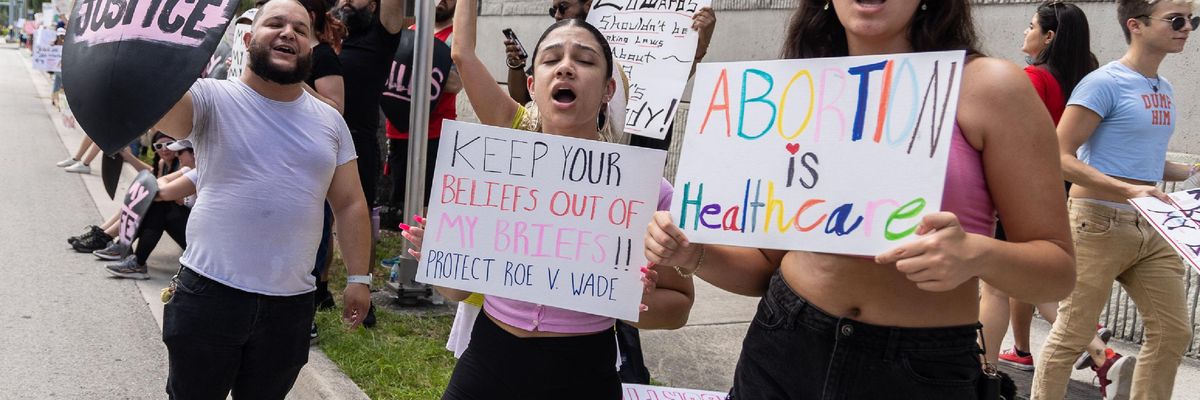
Reproductive rights advocates on Monday angrily vowed to fight back after Florida's Republican-controlled Senate approved a bill banning abortions after six weeks of pregnancy—a point at which many people don't even know they're pregnant.
S.B. 300 would replace a Florida law prohibiting abortions after 15 weeks of pregnancy with a six-week ban containing exceptions for victims of rape, incest, human trafficking, and "devastating" fatal fetal abnormalities; or to save the pregnant person's life.
"Bodily autonomy should not give a person the permission to kill an innocent human being," explained state Sen. Erin Grall (R-54), a sponsor of the bill.
However, Florida state Rep. Anna Eskamani (D-42) asserted that "this was never about life, this is about control."
As state Sen. Alexis Calatayud (R-38)—one of only two Republicans who voted against the six-week ban (she supports a 15-week limit)—spoke during an emotionally heated floor debate on Monday, someone in the visitors' gallery shouted, "People are going to die!"
Kara Gross, the ACLU of Florida's legislative director and senior policy counsel, said in a statement: "This bill is a near-total ban on abortion in Florida. It directly violates our right to bodily autonomy and will virtually eliminate legal abortion care in Florida."
"In a state that prides itself on being free, this is an unprecedented, unconstitutional, and unacceptable level of government overreach and intrusion into our private lives," she continued. "This bill will force pregnant individuals to remain pregnant against their will and endure labor, delivery, and all of the significant medical and financial risks associated with pregnancy and childbirth."
Gross added that the legislation will also "unfairly and disproportionately impact people who live in rural communities, people with low incomes, people with disabilities, and people of color."
"Hundreds of thousands of pregnant people will be forced to travel out of state to seek the care they need," she warned. "Many people will not even know they are pregnant by six weeks, and for those who do, it is unlikely they will be able to schedule the legally required two in-person doctor's appointments before six weeks of pregnancy."
Democratic Miami-Dade County Mayor Daniella Levine Cava said in a statement that "women's rights, freedoms, and access to reproductive care are under continued attack in Florida."
"We must reinforce that private healthcare decisions must be protected and allowed to stay private between a woman, her family, her doctor, and her faith," the mayor continued.
S.B. 300 now heads to the GOP-controlled state House of Representatives for consideration. Florida Gov. Ron DeSantis, a Republican and possible 2024 presidential candidate, supports the measure.
As NBC Miami's Anthony Izaguirre noted:
A six-week ban would more closely align Florida with the abortion restrictions of other Republican-controlled states and give DeSantis a political win on an issue important with GOP primary voters ahead of his potential White House run.According to the Guttmacher Institute, Florida is one of two dozen states that have banned abortion or are likely to do so after the U.S. Supreme Court voided half a century of reproductive rights in last June's Dobbs v. Jackson Women's Health Organization ruling.
The bill would have larger implications for abortion access throughout the South, as the nearby states of Alabama, Louisiana, and Mississippi prohibit the procedure at all stages of pregnancy and Georgia bans it after cardiac activity can be detected, which is around six weeks.
Dear Common Dreams reader, It’s been nearly 30 years since I co-founded Common Dreams with my late wife, Lina Newhouser. We had the radical notion that journalism should serve the public good, not corporate profits. It was clear to us from the outset what it would take to build such a project. No paid advertisements. No corporate sponsors. No millionaire publisher telling us what to think or do. Many people said we wouldn't last a year, but we proved those doubters wrong. Together with a tremendous team of journalists and dedicated staff, we built an independent media outlet free from the constraints of profits and corporate control. Our mission has always been simple: To inform. To inspire. To ignite change for the common good. Building Common Dreams was not easy. Our survival was never guaranteed. When you take on the most powerful forces—Wall Street greed, fossil fuel industry destruction, Big Tech lobbyists, and uber-rich oligarchs who have spent billions upon billions rigging the economy and democracy in their favor—the only bulwark you have is supporters who believe in your work. But here’s the urgent message from me today. It's never been this bad out there. And it's never been this hard to keep us going. At the very moment Common Dreams is most needed, the threats we face are intensifying. We need your support now more than ever. We don't accept corporate advertising and never will. We don't have a paywall because we don't think people should be blocked from critical news based on their ability to pay. Everything we do is funded by the donations of readers like you. When everyone does the little they can afford, we are strong. But if that support retreats or dries up, so do we. Will you donate now to make sure Common Dreams not only survives but thrives? —Craig Brown, Co-founder |
Reproductive rights advocates on Monday angrily vowed to fight back after Florida's Republican-controlled Senate approved a bill banning abortions after six weeks of pregnancy—a point at which many people don't even know they're pregnant.
S.B. 300 would replace a Florida law prohibiting abortions after 15 weeks of pregnancy with a six-week ban containing exceptions for victims of rape, incest, human trafficking, and "devastating" fatal fetal abnormalities; or to save the pregnant person's life.
"Bodily autonomy should not give a person the permission to kill an innocent human being," explained state Sen. Erin Grall (R-54), a sponsor of the bill.
However, Florida state Rep. Anna Eskamani (D-42) asserted that "this was never about life, this is about control."
As state Sen. Alexis Calatayud (R-38)—one of only two Republicans who voted against the six-week ban (she supports a 15-week limit)—spoke during an emotionally heated floor debate on Monday, someone in the visitors' gallery shouted, "People are going to die!"
Kara Gross, the ACLU of Florida's legislative director and senior policy counsel, said in a statement: "This bill is a near-total ban on abortion in Florida. It directly violates our right to bodily autonomy and will virtually eliminate legal abortion care in Florida."
"In a state that prides itself on being free, this is an unprecedented, unconstitutional, and unacceptable level of government overreach and intrusion into our private lives," she continued. "This bill will force pregnant individuals to remain pregnant against their will and endure labor, delivery, and all of the significant medical and financial risks associated with pregnancy and childbirth."
Gross added that the legislation will also "unfairly and disproportionately impact people who live in rural communities, people with low incomes, people with disabilities, and people of color."
"Hundreds of thousands of pregnant people will be forced to travel out of state to seek the care they need," she warned. "Many people will not even know they are pregnant by six weeks, and for those who do, it is unlikely they will be able to schedule the legally required two in-person doctor's appointments before six weeks of pregnancy."
Democratic Miami-Dade County Mayor Daniella Levine Cava said in a statement that "women's rights, freedoms, and access to reproductive care are under continued attack in Florida."
"We must reinforce that private healthcare decisions must be protected and allowed to stay private between a woman, her family, her doctor, and her faith," the mayor continued.
S.B. 300 now heads to the GOP-controlled state House of Representatives for consideration. Florida Gov. Ron DeSantis, a Republican and possible 2024 presidential candidate, supports the measure.
As NBC Miami's Anthony Izaguirre noted:
A six-week ban would more closely align Florida with the abortion restrictions of other Republican-controlled states and give DeSantis a political win on an issue important with GOP primary voters ahead of his potential White House run.According to the Guttmacher Institute, Florida is one of two dozen states that have banned abortion or are likely to do so after the U.S. Supreme Court voided half a century of reproductive rights in last June's Dobbs v. Jackson Women's Health Organization ruling.
The bill would have larger implications for abortion access throughout the South, as the nearby states of Alabama, Louisiana, and Mississippi prohibit the procedure at all stages of pregnancy and Georgia bans it after cardiac activity can be detected, which is around six weeks.
Reproductive rights advocates on Monday angrily vowed to fight back after Florida's Republican-controlled Senate approved a bill banning abortions after six weeks of pregnancy—a point at which many people don't even know they're pregnant.
S.B. 300 would replace a Florida law prohibiting abortions after 15 weeks of pregnancy with a six-week ban containing exceptions for victims of rape, incest, human trafficking, and "devastating" fatal fetal abnormalities; or to save the pregnant person's life.
"Bodily autonomy should not give a person the permission to kill an innocent human being," explained state Sen. Erin Grall (R-54), a sponsor of the bill.
However, Florida state Rep. Anna Eskamani (D-42) asserted that "this was never about life, this is about control."
As state Sen. Alexis Calatayud (R-38)—one of only two Republicans who voted against the six-week ban (she supports a 15-week limit)—spoke during an emotionally heated floor debate on Monday, someone in the visitors' gallery shouted, "People are going to die!"
Kara Gross, the ACLU of Florida's legislative director and senior policy counsel, said in a statement: "This bill is a near-total ban on abortion in Florida. It directly violates our right to bodily autonomy and will virtually eliminate legal abortion care in Florida."
"In a state that prides itself on being free, this is an unprecedented, unconstitutional, and unacceptable level of government overreach and intrusion into our private lives," she continued. "This bill will force pregnant individuals to remain pregnant against their will and endure labor, delivery, and all of the significant medical and financial risks associated with pregnancy and childbirth."
Gross added that the legislation will also "unfairly and disproportionately impact people who live in rural communities, people with low incomes, people with disabilities, and people of color."
"Hundreds of thousands of pregnant people will be forced to travel out of state to seek the care they need," she warned. "Many people will not even know they are pregnant by six weeks, and for those who do, it is unlikely they will be able to schedule the legally required two in-person doctor's appointments before six weeks of pregnancy."
Democratic Miami-Dade County Mayor Daniella Levine Cava said in a statement that "women's rights, freedoms, and access to reproductive care are under continued attack in Florida."
"We must reinforce that private healthcare decisions must be protected and allowed to stay private between a woman, her family, her doctor, and her faith," the mayor continued.
S.B. 300 now heads to the GOP-controlled state House of Representatives for consideration. Florida Gov. Ron DeSantis, a Republican and possible 2024 presidential candidate, supports the measure.
As NBC Miami's Anthony Izaguirre noted:
A six-week ban would more closely align Florida with the abortion restrictions of other Republican-controlled states and give DeSantis a political win on an issue important with GOP primary voters ahead of his potential White House run.According to the Guttmacher Institute, Florida is one of two dozen states that have banned abortion or are likely to do so after the U.S. Supreme Court voided half a century of reproductive rights in last June's Dobbs v. Jackson Women's Health Organization ruling.
The bill would have larger implications for abortion access throughout the South, as the nearby states of Alabama, Louisiana, and Mississippi prohibit the procedure at all stages of pregnancy and Georgia bans it after cardiac activity can be detected, which is around six weeks.