

SUBSCRIBE TO OUR FREE NEWSLETTER
Daily news & progressive opinion—funded by the people, not the corporations—delivered straight to your inbox.
5
#000000
#FFFFFF
To donate by check, phone, or other method, see our More Ways to Give page.
Daily news & progressive opinion—funded by the people, not the corporations—delivered straight to your inbox.
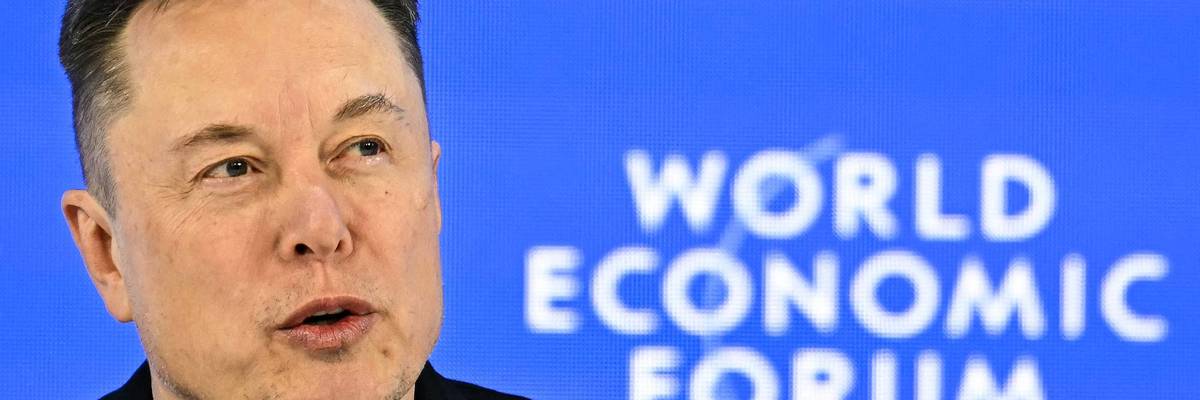
CEO of SpaceX and Tesla Elon Musk speaks during the World Economic Forum (WEF) annual meeting in Davos, Switzerland on January 22, 2026.
The Trump administration and Republicans in Congress "have allowed a hugely profitable corporation to avoid paying even a dime of federal income tax on their 2025 US profits."
Tesla, the electric car company led by former Trump administration special government employee Elon Musk, released its annual financial report Thursday, showing that it doubled its yearly income in 2025 over the previous year and brought in $5.7 billion.
The company, whose CEO spent several months rooting out what he claimed was fraud and waste across the federal government, reported "precisely zero current federal income tax" on the billions it made, according to an analysis by the Institute on Taxation and Economic Policy (ITEP).
The group explained that Tesla used accelerated depreciation, reducing the value of its capital assets, while also slashing its tax bill with tax breaks for its executive stock options.
Research and development tax credits netted $352 million in additional tax savings, and the company used "net operating losses stored up from previous years to offset current year income, although it’s hard to know how much of that affects US income rather than foreign income," said ITEP.
Analyzing the financial report, ITEP found that Tesla received over $1.1 billion in federal income tax breaks, paid for by US taxpayers, last year alone—after paying 0.4% of its US profits in federal income taxes over the previous three years.
Over that time period, said ITEP, "the Elon Musk-led company reported $12.58 billion of U.S. income on which its current federal tax was just $48 million... The company reported an effective federal income tax rate of 0.4%. This is a tiny fraction of the 21% tax rate profitable corporations are supposed to pay under the law."
The most it paid in taxes over the past three years was in 2023, when Tesla paid $48 million, at the federal effective tax rate of 1.2%. That was still just a fraction of the $823 million it would have paid if it had paid the federal corporate tax rate. In 2023, the company enjoyed $775 million in tax breaks.
The company's income tax payments worldwide in 2025 totaled $1.2 billion, with more than $1 billion going to China and other foreign governments. Tesla paid $28 million to the US government, "presumably related to tax years before 2025," said ITEP.
The organization noted that the "billion-dollar tax break" enjoyed by Tesla does not appear to be illegal.
However, ITEP said, it illustrates how the Trump administration and Republicans in Congress, by passing changes to corporate tax laws in the One Big Beautiful Bill Act (OBBBA) last summer, "have allowed a hugely profitable corporation to avoid paying even a dime of federal income tax on their 2025 US profits."
The organization warned last summer that special business tax breaks included in the OBBBA, including a reinstatement of bonus depreciation and new international rules, would cost the US government $165 billion in revenue in 2026.
Dear Common Dreams reader, It’s been nearly 30 years since I co-founded Common Dreams with my late wife, Lina Newhouser. We had the radical notion that journalism should serve the public good, not corporate profits. It was clear to us from the outset what it would take to build such a project. No paid advertisements. No corporate sponsors. No millionaire publisher telling us what to think or do. Many people said we wouldn't last a year, but we proved those doubters wrong. Together with a tremendous team of journalists and dedicated staff, we built an independent media outlet free from the constraints of profits and corporate control. Our mission has always been simple: To inform. To inspire. To ignite change for the common good. Building Common Dreams was not easy. Our survival was never guaranteed. When you take on the most powerful forces—Wall Street greed, fossil fuel industry destruction, Big Tech lobbyists, and uber-rich oligarchs who have spent billions upon billions rigging the economy and democracy in their favor—the only bulwark you have is supporters who believe in your work. But here’s the urgent message from me today. It's never been this bad out there. And it's never been this hard to keep us going. At the very moment Common Dreams is most needed, the threats we face are intensifying. We need your support now more than ever. We don't accept corporate advertising and never will. We don't have a paywall because we don't think people should be blocked from critical news based on their ability to pay. Everything we do is funded by the donations of readers like you. When everyone does the little they can afford, we are strong. But if that support retreats or dries up, so do we. Will you donate now to make sure Common Dreams not only survives but thrives? —Craig Brown, Co-founder |
Tesla, the electric car company led by former Trump administration special government employee Elon Musk, released its annual financial report Thursday, showing that it doubled its yearly income in 2025 over the previous year and brought in $5.7 billion.
The company, whose CEO spent several months rooting out what he claimed was fraud and waste across the federal government, reported "precisely zero current federal income tax" on the billions it made, according to an analysis by the Institute on Taxation and Economic Policy (ITEP).
The group explained that Tesla used accelerated depreciation, reducing the value of its capital assets, while also slashing its tax bill with tax breaks for its executive stock options.
Research and development tax credits netted $352 million in additional tax savings, and the company used "net operating losses stored up from previous years to offset current year income, although it’s hard to know how much of that affects US income rather than foreign income," said ITEP.
Analyzing the financial report, ITEP found that Tesla received over $1.1 billion in federal income tax breaks, paid for by US taxpayers, last year alone—after paying 0.4% of its US profits in federal income taxes over the previous three years.
Over that time period, said ITEP, "the Elon Musk-led company reported $12.58 billion of U.S. income on which its current federal tax was just $48 million... The company reported an effective federal income tax rate of 0.4%. This is a tiny fraction of the 21% tax rate profitable corporations are supposed to pay under the law."
The most it paid in taxes over the past three years was in 2023, when Tesla paid $48 million, at the federal effective tax rate of 1.2%. That was still just a fraction of the $823 million it would have paid if it had paid the federal corporate tax rate. In 2023, the company enjoyed $775 million in tax breaks.
The company's income tax payments worldwide in 2025 totaled $1.2 billion, with more than $1 billion going to China and other foreign governments. Tesla paid $28 million to the US government, "presumably related to tax years before 2025," said ITEP.
The organization noted that the "billion-dollar tax break" enjoyed by Tesla does not appear to be illegal.
However, ITEP said, it illustrates how the Trump administration and Republicans in Congress, by passing changes to corporate tax laws in the One Big Beautiful Bill Act (OBBBA) last summer, "have allowed a hugely profitable corporation to avoid paying even a dime of federal income tax on their 2025 US profits."
The organization warned last summer that special business tax breaks included in the OBBBA, including a reinstatement of bonus depreciation and new international rules, would cost the US government $165 billion in revenue in 2026.
Tesla, the electric car company led by former Trump administration special government employee Elon Musk, released its annual financial report Thursday, showing that it doubled its yearly income in 2025 over the previous year and brought in $5.7 billion.
The company, whose CEO spent several months rooting out what he claimed was fraud and waste across the federal government, reported "precisely zero current federal income tax" on the billions it made, according to an analysis by the Institute on Taxation and Economic Policy (ITEP).
The group explained that Tesla used accelerated depreciation, reducing the value of its capital assets, while also slashing its tax bill with tax breaks for its executive stock options.
Research and development tax credits netted $352 million in additional tax savings, and the company used "net operating losses stored up from previous years to offset current year income, although it’s hard to know how much of that affects US income rather than foreign income," said ITEP.
Analyzing the financial report, ITEP found that Tesla received over $1.1 billion in federal income tax breaks, paid for by US taxpayers, last year alone—after paying 0.4% of its US profits in federal income taxes over the previous three years.
Over that time period, said ITEP, "the Elon Musk-led company reported $12.58 billion of U.S. income on which its current federal tax was just $48 million... The company reported an effective federal income tax rate of 0.4%. This is a tiny fraction of the 21% tax rate profitable corporations are supposed to pay under the law."
The most it paid in taxes over the past three years was in 2023, when Tesla paid $48 million, at the federal effective tax rate of 1.2%. That was still just a fraction of the $823 million it would have paid if it had paid the federal corporate tax rate. In 2023, the company enjoyed $775 million in tax breaks.
The company's income tax payments worldwide in 2025 totaled $1.2 billion, with more than $1 billion going to China and other foreign governments. Tesla paid $28 million to the US government, "presumably related to tax years before 2025," said ITEP.
The organization noted that the "billion-dollar tax break" enjoyed by Tesla does not appear to be illegal.
However, ITEP said, it illustrates how the Trump administration and Republicans in Congress, by passing changes to corporate tax laws in the One Big Beautiful Bill Act (OBBBA) last summer, "have allowed a hugely profitable corporation to avoid paying even a dime of federal income tax on their 2025 US profits."
The organization warned last summer that special business tax breaks included in the OBBBA, including a reinstatement of bonus depreciation and new international rules, would cost the US government $165 billion in revenue in 2026.

