SUBSCRIBE TO OUR FREE NEWSLETTER
Daily news & progressive opinion—funded by the people, not the corporations—delivered straight to your inbox.
5
#000000
#FFFFFF
To donate by check, phone, or other method, see our More Ways to Give page.
Daily news & progressive opinion—funded by the people, not the corporations—delivered straight to your inbox.
Patriotic Millionaires, an organization that lobbies for higher taxes on the wealthy, said the report was a "reminder of how unfair our tax code is."
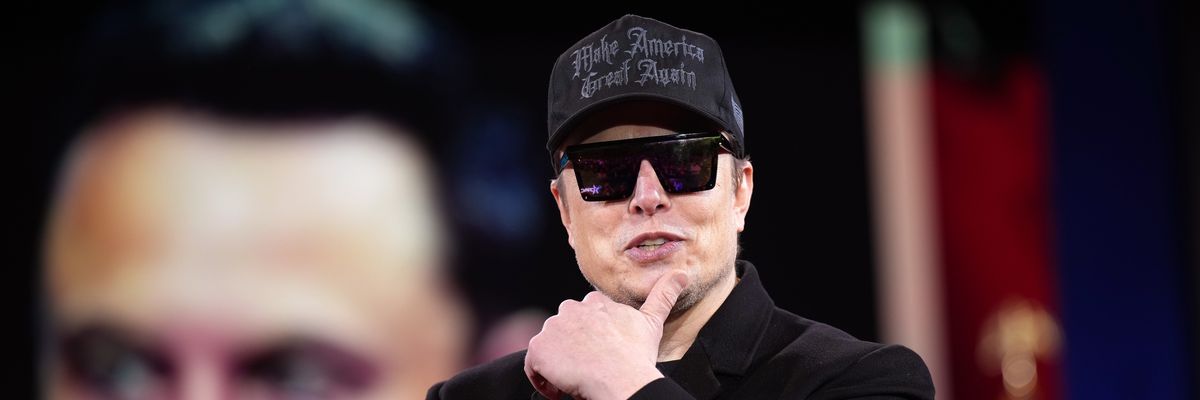
Although Elon Musk's space exploration company SpaceX has benefited over the years from several lucrative government contracts, it has largely avoided paying any taxes to the federal government.
The New York Times reports that SpaceX has "most likely paid little to no federal income taxes since its founding in 2002 and has privately told investors that it may never have to pay any."
The reason that the company has gotten away with paying practically no taxes, writes the Times, is that it takes advantage of a tax benefit commonly referred to as a net operating loss carryforward "that allows it to use the more than $5 billion in losses it racked up by late 2021 to offset paying future taxable income." This tax benefit was initially limited in its scope, but congressional Republicans and US President Donald Trump in 2017 scrapped its expiration date for all companies, thus letting SpaceX and other firms take advantage of it indefinitely.
Danielle Brian, the executive director of the Project on Government Oversight, told the Times that this tax benefit was intended to help struggling firms weather tough times to stay in business, but that it was "clearly not intended for a company doing so well" as SpaceX.
In its review of SpaceX's internal documents, the Times found that SpaceX had paid a small amount of taxes over the years, although none of them were to the federal government.
"In one document, the company said it expected to pay $483,000 in income tax to foreign governments and $78,000 in state income tax in 2021," writes the paper. "Separately, it reported paying $6,000 for income taxes in 2020 and 2021, but did not disclose if the payments were for federal, state or local governments."
What makes SpaceX's tax avoidance particularly noteworthy is its own dependence on the federal government for business. In 2020, the Times found, federal contracts accounted for nearly 84% of the firm's total revenues.
Patriotic Millionaires, a group of wealthy Americans who advocate for higher taxes on the rich, wrote on X that SpaceX's almost total lack of tax payments to the federal government was yet another piece of evidence about the tax system being rigged for the big corporations.
"SpaceX has secured billions in government contracts over the years," they wrote. "In return, it has likely paid... $0 in federal income taxes—and may never have to. Just in case you needed a pre-weekend reminder of how unfair our tax code is!"
Dear Common Dreams reader, It’s been nearly 30 years since I co-founded Common Dreams with my late wife, Lina Newhouser. We had the radical notion that journalism should serve the public good, not corporate profits. It was clear to us from the outset what it would take to build such a project. No paid advertisements. No corporate sponsors. No millionaire publisher telling us what to think or do. Many people said we wouldn't last a year, but we proved those doubters wrong. Together with a tremendous team of journalists and dedicated staff, we built an independent media outlet free from the constraints of profits and corporate control. Our mission has always been simple: To inform. To inspire. To ignite change for the common good. Building Common Dreams was not easy. Our survival was never guaranteed. When you take on the most powerful forces—Wall Street greed, fossil fuel industry destruction, Big Tech lobbyists, and uber-rich oligarchs who have spent billions upon billions rigging the economy and democracy in their favor—the only bulwark you have is supporters who believe in your work. But here’s the urgent message from me today. It's never been this bad out there. And it's never been this hard to keep us going. At the very moment Common Dreams is most needed, the threats we face are intensifying. We need your support now more than ever. We don't accept corporate advertising and never will. We don't have a paywall because we don't think people should be blocked from critical news based on their ability to pay. Everything we do is funded by the donations of readers like you. When everyone does the little they can afford, we are strong. But if that support retreats or dries up, so do we. Will you donate now to make sure Common Dreams not only survives but thrives? —Craig Brown, Co-founder |
Although Elon Musk's space exploration company SpaceX has benefited over the years from several lucrative government contracts, it has largely avoided paying any taxes to the federal government.
The New York Times reports that SpaceX has "most likely paid little to no federal income taxes since its founding in 2002 and has privately told investors that it may never have to pay any."
The reason that the company has gotten away with paying practically no taxes, writes the Times, is that it takes advantage of a tax benefit commonly referred to as a net operating loss carryforward "that allows it to use the more than $5 billion in losses it racked up by late 2021 to offset paying future taxable income." This tax benefit was initially limited in its scope, but congressional Republicans and US President Donald Trump in 2017 scrapped its expiration date for all companies, thus letting SpaceX and other firms take advantage of it indefinitely.
Danielle Brian, the executive director of the Project on Government Oversight, told the Times that this tax benefit was intended to help struggling firms weather tough times to stay in business, but that it was "clearly not intended for a company doing so well" as SpaceX.
In its review of SpaceX's internal documents, the Times found that SpaceX had paid a small amount of taxes over the years, although none of them were to the federal government.
"In one document, the company said it expected to pay $483,000 in income tax to foreign governments and $78,000 in state income tax in 2021," writes the paper. "Separately, it reported paying $6,000 for income taxes in 2020 and 2021, but did not disclose if the payments were for federal, state or local governments."
What makes SpaceX's tax avoidance particularly noteworthy is its own dependence on the federal government for business. In 2020, the Times found, federal contracts accounted for nearly 84% of the firm's total revenues.
Patriotic Millionaires, a group of wealthy Americans who advocate for higher taxes on the rich, wrote on X that SpaceX's almost total lack of tax payments to the federal government was yet another piece of evidence about the tax system being rigged for the big corporations.
"SpaceX has secured billions in government contracts over the years," they wrote. "In return, it has likely paid... $0 in federal income taxes—and may never have to. Just in case you needed a pre-weekend reminder of how unfair our tax code is!"
Although Elon Musk's space exploration company SpaceX has benefited over the years from several lucrative government contracts, it has largely avoided paying any taxes to the federal government.
The New York Times reports that SpaceX has "most likely paid little to no federal income taxes since its founding in 2002 and has privately told investors that it may never have to pay any."
The reason that the company has gotten away with paying practically no taxes, writes the Times, is that it takes advantage of a tax benefit commonly referred to as a net operating loss carryforward "that allows it to use the more than $5 billion in losses it racked up by late 2021 to offset paying future taxable income." This tax benefit was initially limited in its scope, but congressional Republicans and US President Donald Trump in 2017 scrapped its expiration date for all companies, thus letting SpaceX and other firms take advantage of it indefinitely.
Danielle Brian, the executive director of the Project on Government Oversight, told the Times that this tax benefit was intended to help struggling firms weather tough times to stay in business, but that it was "clearly not intended for a company doing so well" as SpaceX.
In its review of SpaceX's internal documents, the Times found that SpaceX had paid a small amount of taxes over the years, although none of them were to the federal government.
"In one document, the company said it expected to pay $483,000 in income tax to foreign governments and $78,000 in state income tax in 2021," writes the paper. "Separately, it reported paying $6,000 for income taxes in 2020 and 2021, but did not disclose if the payments were for federal, state or local governments."
What makes SpaceX's tax avoidance particularly noteworthy is its own dependence on the federal government for business. In 2020, the Times found, federal contracts accounted for nearly 84% of the firm's total revenues.
Patriotic Millionaires, a group of wealthy Americans who advocate for higher taxes on the rich, wrote on X that SpaceX's almost total lack of tax payments to the federal government was yet another piece of evidence about the tax system being rigged for the big corporations.
"SpaceX has secured billions in government contracts over the years," they wrote. "In return, it has likely paid... $0 in federal income taxes—and may never have to. Just in case you needed a pre-weekend reminder of how unfair our tax code is!"