
5
#000000
#FFFFFF
To donate by check, phone, or other method, see our More Ways to Give page.
Daily news & progressive opinion—funded by the people, not the corporations—delivered straight to your inbox.
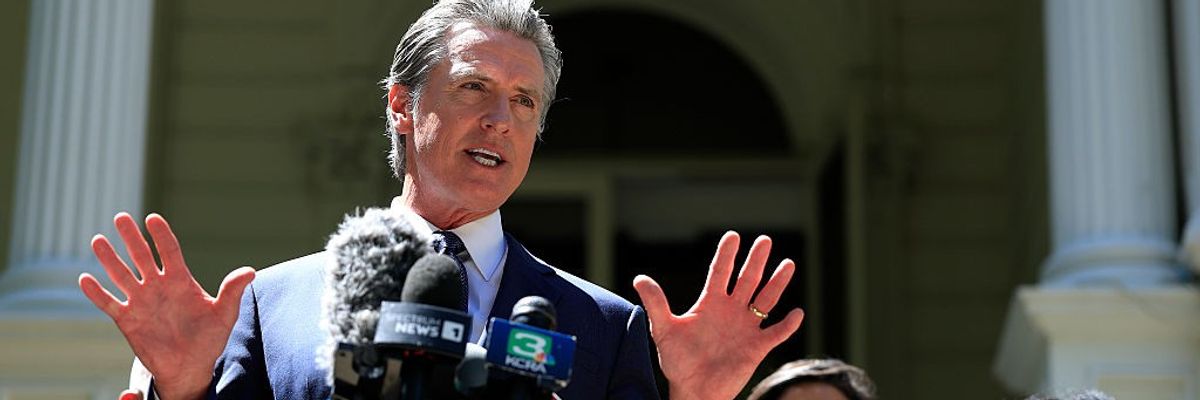
Democratic California Gov. Gavin Newsom speaks during a uly 25, 2025 press conference in Sacramento.
"Regulating AI is winning issue for Democrats, but their own party leaders are too complicit with Silicon Valley to use it," said one observer.
Polls show that a majority of US voters—and especially Democrats—want more robust guardrails on artificial intelligence, but Democratic governors' silence on President Donald Trump's directive banning states from regulating AI has some observers asking if lobbying by the powerful industry is to blame.
Sludge's David Moore and Donald Shaw reported Friday that tech titans including OpenAI and Meta last week sent a small army of lobbyists to meet with attendees of the Democratic Governors Association’s annual meeting, held this year at the swanky Biltmore Hotel in Phoenix.
According to the report, lobbyists and governors—some of whom "are teasing White House bids in 2028 or rumored to be in the mix"—gathered for a closed-door meeting. California Gov. Gavin Newsom, Michigan Gov. Gretchen Whitmer, Kentucky Gov. Andy Beshear, and Maryland Gov. Wes Moore were among those who reportedly met with the lobbyists.
Trump signed an executive order trying to prevent states from regulating AI and following through on the safety laws they enacted, but there was little public pushback from Democratic governors.AI lobbyists descended on the DGA winter meeting last weekend in Phoenix, per a list we obtained:
[image or embed]
— David Moore (@davidrussellmoore.bsky.social) December 12, 2025 at 11:15 AM
The meeting preceded Trump's Thursday signing of an executive order aimed at limiting states' ability to regulate rapidly evolving AI technology. The order directs the US Department of Justice to establish an AI Litigation Task Force empowered to sue states that enact “onerous and excessive" AI regulation. The edict also threatens to withhold federal funding from states that implement AI regulations that the Trump administration finds objectionable.
Democratic governors have been relatively muted on the order, especially given the overwhelming support for regulation of AI—which many experts say poses threats to humanity that may equal or outweigh its benefits—across the political spectrum.
As Moore and Shaw wrote:
While Democratic governors were silent, their Republican counterparts have been loudly arguing for months against the federal government preempting state AI policies. In June, 17 Republican governors sent a letter to Senate Majority Leader John Thune [R-SD] and House Speaker Mike Johnson [R-La.] warning them against preempting their states’ protections on AI use. Over the past couple months, a trio of Republican governors—Spencer Cox (Utah), Ron DeSantis (Fla.), and Sarah Huckabee Sanders (Ark.)—continued to make known their opposition to the Trump administration’s executive order.
Newsom, who many observers believe is eyeing a 2028 White House run, especially disappointed proponents of AI safeguards last year when he vetoed what would have been the nation's strongest AI safety regulations.
It's not just Democratic governors—congressional Democrats have increasingly partnered with an industry expected to soon be worth trillions of dollars. Some Democrats, like Rep. Josh Gottheimer of New Jersey, are personally invested in AI stocks. The AI industry also made record contributions to political campaigns during the 2024 cycle.
Other Democrats, including some who may have their sights set on higher office—notably Congresswoman Alexandria Ocasio-Cortez of New York—advocate stronger guardrails on AI development.
The public is worried about AI. Regulating AI is winning issue for Democrats but their own party leaders are too complicit with Silicon Valley to use it. www.thenation.com/article/poli...
[image or embed]
— Jeet Heer (@jeetheer.bsky.social) December 12, 2025 at 7:24 AM
"Voters want the party to get tough on the industry. But Democratic leaders are following the money instead," Jeet Heer, national affairs correspondent for The Nation, wrote Friday.
Citing voters' desire for stronger regulation, Heer argued that "Democrats have a tremendous opportunity to use the AI backlash for wedge politics," adding that "it's a way to win back working-class voters who are already disillusioned with the GOP and Trump."
Dear Common Dreams reader, The U.S. is on a fast track to authoritarianism like nothing I've ever seen. Meanwhile, corporate news outlets are utterly capitulating to Trump, twisting their coverage to avoid drawing his ire while lining up to stuff cash in his pockets. That's why I believe that Common Dreams is doing the best and most consequential reporting that we've ever done. Our small but mighty team is a progressive reporting powerhouse, covering the news every day that the corporate media never will. Our mission has always been simple: To inform. To inspire. And to ignite change for the common good. Now here's the key piece that I want all our readers to understand: None of this would be possible without your financial support. That's not just some fundraising cliche. It's the absolute and literal truth. We don't accept corporate advertising and never will. We don't have a paywall because we don't think people should be blocked from critical news based on their ability to pay. Everything we do is funded by the donations of readers like you. Will you donate now to help power the nonprofit, independent reporting of Common Dreams? Thank you for being a vital member of our community. Together, we can keep independent journalism alive when it’s needed most. - Craig Brown, Co-founder |
Polls show that a majority of US voters—and especially Democrats—want more robust guardrails on artificial intelligence, but Democratic governors' silence on President Donald Trump's directive banning states from regulating AI has some observers asking if lobbying by the powerful industry is to blame.
Sludge's David Moore and Donald Shaw reported Friday that tech titans including OpenAI and Meta last week sent a small army of lobbyists to meet with attendees of the Democratic Governors Association’s annual meeting, held this year at the swanky Biltmore Hotel in Phoenix.
According to the report, lobbyists and governors—some of whom "are teasing White House bids in 2028 or rumored to be in the mix"—gathered for a closed-door meeting. California Gov. Gavin Newsom, Michigan Gov. Gretchen Whitmer, Kentucky Gov. Andy Beshear, and Maryland Gov. Wes Moore were among those who reportedly met with the lobbyists.
Trump signed an executive order trying to prevent states from regulating AI and following through on the safety laws they enacted, but there was little public pushback from Democratic governors.AI lobbyists descended on the DGA winter meeting last weekend in Phoenix, per a list we obtained:
[image or embed]
— David Moore (@davidrussellmoore.bsky.social) December 12, 2025 at 11:15 AM
The meeting preceded Trump's Thursday signing of an executive order aimed at limiting states' ability to regulate rapidly evolving AI technology. The order directs the US Department of Justice to establish an AI Litigation Task Force empowered to sue states that enact “onerous and excessive" AI regulation. The edict also threatens to withhold federal funding from states that implement AI regulations that the Trump administration finds objectionable.
Democratic governors have been relatively muted on the order, especially given the overwhelming support for regulation of AI—which many experts say poses threats to humanity that may equal or outweigh its benefits—across the political spectrum.
As Moore and Shaw wrote:
While Democratic governors were silent, their Republican counterparts have been loudly arguing for months against the federal government preempting state AI policies. In June, 17 Republican governors sent a letter to Senate Majority Leader John Thune [R-SD] and House Speaker Mike Johnson [R-La.] warning them against preempting their states’ protections on AI use. Over the past couple months, a trio of Republican governors—Spencer Cox (Utah), Ron DeSantis (Fla.), and Sarah Huckabee Sanders (Ark.)—continued to make known their opposition to the Trump administration’s executive order.
Newsom, who many observers believe is eyeing a 2028 White House run, especially disappointed proponents of AI safeguards last year when he vetoed what would have been the nation's strongest AI safety regulations.
It's not just Democratic governors—congressional Democrats have increasingly partnered with an industry expected to soon be worth trillions of dollars. Some Democrats, like Rep. Josh Gottheimer of New Jersey, are personally invested in AI stocks. The AI industry also made record contributions to political campaigns during the 2024 cycle.
Other Democrats, including some who may have their sights set on higher office—notably Congresswoman Alexandria Ocasio-Cortez of New York—advocate stronger guardrails on AI development.
The public is worried about AI. Regulating AI is winning issue for Democrats but their own party leaders are too complicit with Silicon Valley to use it. www.thenation.com/article/poli...
[image or embed]
— Jeet Heer (@jeetheer.bsky.social) December 12, 2025 at 7:24 AM
"Voters want the party to get tough on the industry. But Democratic leaders are following the money instead," Jeet Heer, national affairs correspondent for The Nation, wrote Friday.
Citing voters' desire for stronger regulation, Heer argued that "Democrats have a tremendous opportunity to use the AI backlash for wedge politics," adding that "it's a way to win back working-class voters who are already disillusioned with the GOP and Trump."
Polls show that a majority of US voters—and especially Democrats—want more robust guardrails on artificial intelligence, but Democratic governors' silence on President Donald Trump's directive banning states from regulating AI has some observers asking if lobbying by the powerful industry is to blame.
Sludge's David Moore and Donald Shaw reported Friday that tech titans including OpenAI and Meta last week sent a small army of lobbyists to meet with attendees of the Democratic Governors Association’s annual meeting, held this year at the swanky Biltmore Hotel in Phoenix.
According to the report, lobbyists and governors—some of whom "are teasing White House bids in 2028 or rumored to be in the mix"—gathered for a closed-door meeting. California Gov. Gavin Newsom, Michigan Gov. Gretchen Whitmer, Kentucky Gov. Andy Beshear, and Maryland Gov. Wes Moore were among those who reportedly met with the lobbyists.
Trump signed an executive order trying to prevent states from regulating AI and following through on the safety laws they enacted, but there was little public pushback from Democratic governors.AI lobbyists descended on the DGA winter meeting last weekend in Phoenix, per a list we obtained:
[image or embed]
— David Moore (@davidrussellmoore.bsky.social) December 12, 2025 at 11:15 AM
The meeting preceded Trump's Thursday signing of an executive order aimed at limiting states' ability to regulate rapidly evolving AI technology. The order directs the US Department of Justice to establish an AI Litigation Task Force empowered to sue states that enact “onerous and excessive" AI regulation. The edict also threatens to withhold federal funding from states that implement AI regulations that the Trump administration finds objectionable.
Democratic governors have been relatively muted on the order, especially given the overwhelming support for regulation of AI—which many experts say poses threats to humanity that may equal or outweigh its benefits—across the political spectrum.
As Moore and Shaw wrote:
While Democratic governors were silent, their Republican counterparts have been loudly arguing for months against the federal government preempting state AI policies. In June, 17 Republican governors sent a letter to Senate Majority Leader John Thune [R-SD] and House Speaker Mike Johnson [R-La.] warning them against preempting their states’ protections on AI use. Over the past couple months, a trio of Republican governors—Spencer Cox (Utah), Ron DeSantis (Fla.), and Sarah Huckabee Sanders (Ark.)—continued to make known their opposition to the Trump administration’s executive order.
Newsom, who many observers believe is eyeing a 2028 White House run, especially disappointed proponents of AI safeguards last year when he vetoed what would have been the nation's strongest AI safety regulations.
It's not just Democratic governors—congressional Democrats have increasingly partnered with an industry expected to soon be worth trillions of dollars. Some Democrats, like Rep. Josh Gottheimer of New Jersey, are personally invested in AI stocks. The AI industry also made record contributions to political campaigns during the 2024 cycle.
Other Democrats, including some who may have their sights set on higher office—notably Congresswoman Alexandria Ocasio-Cortez of New York—advocate stronger guardrails on AI development.
The public is worried about AI. Regulating AI is winning issue for Democrats but their own party leaders are too complicit with Silicon Valley to use it. www.thenation.com/article/poli...
[image or embed]
— Jeet Heer (@jeetheer.bsky.social) December 12, 2025 at 7:24 AM
"Voters want the party to get tough on the industry. But Democratic leaders are following the money instead," Jeet Heer, national affairs correspondent for The Nation, wrote Friday.
Citing voters' desire for stronger regulation, Heer argued that "Democrats have a tremendous opportunity to use the AI backlash for wedge politics," adding that "it's a way to win back working-class voters who are already disillusioned with the GOP and Trump."