SUBSCRIBE TO OUR FREE NEWSLETTER
Daily news & progressive opinion—funded by the people, not the corporations—delivered straight to your inbox.
5
#000000
#FFFFFF
To donate by check, phone, or other method, see our More Ways to Give page.
Daily news & progressive opinion—funded by the people, not the corporations—delivered straight to your inbox.
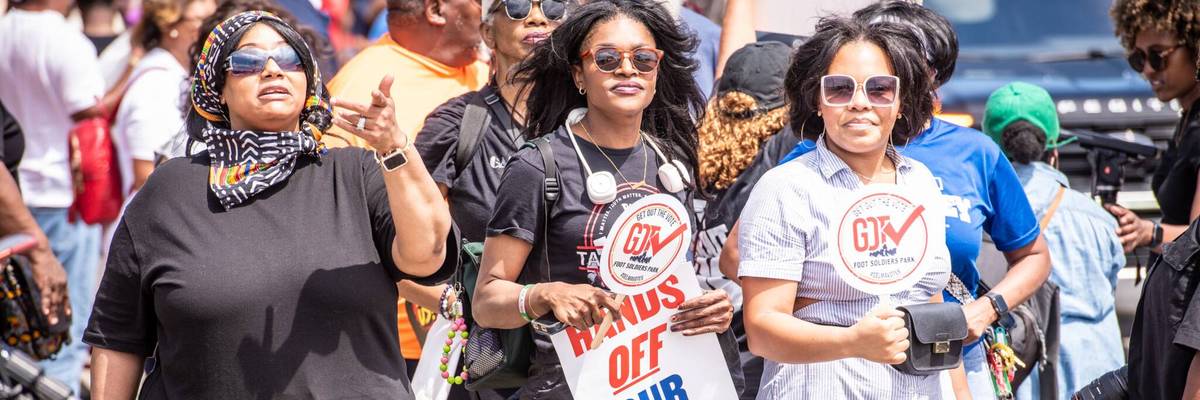
Voting rights defenders march in the All Roads Lead to the South rally in Selma, Alabama on May 16, 2026.
“We reject in the strongest possible terms the state’s attempt to finish its intentional decision to dilute minority votes with a veneer of legislative regularity," said the panel of three judges—two of them Trump appointees.
A three-judge panel on Tuesday temporarily blocked Alabama from using a Republican-drawn congressional map created to effectively disenfranchise Black people, who make up more than one-quarter of the population of a state that, by GOP design, has just one majority-Black House district.
United States Circuit Judge Stanley Marcus, a nominee of former President Bill Clinton, and District Judges Anna Manasco and Terry Moorer—both of whom were nominated by President Donald Trump—granted a motion by Alabama state Sen. Bobby Singleton (D-24); Black voters, and groups including the national and state ACLU, the Alabama State Conference of the NAACP, Legal Defense Fund, and Southern Poverty Law Center to block the state from using a racially rigged congressional map approved by the GOP-led Legislature in 2023.
The panel unanimously found that Alabama could not use the map because it “represents an intentional effort to crack the Black population in Alabama.”
“Ultimately, we cannot see our way clear to requiring Alabamians to cast their votes in the 2026 elections under a districting plan tainted by intentional race-based discrimination,” the judges wrote.
🧵 The Supreme Court's Callais ruling made it harder to prove in court that a legislative map dilutes minority voting strength.But a three-judge panel today confirmed that intentional racial gerrymanders can still be struck down by federal courts.Here’s what you need to know about Alabama 👇
[image or embed]
— Democracy Docket (@democracydocket.com) May 26, 2026 at 10:31 AM
“Cracking” is the splitting of communities of color to dilute their power in a given district. The related practice of "packing" refers to placing people of color in the same district in order to prevent them from having greater political power in surrounding districts.
The same three-judge panel had blocked a previous attempt by Alabama Republicans to implement a congressional map lacking a second Black opportunity district in defiance of a US Supreme Court ruling affirming a lower court's order to create such a district.
"We do not lightly intrude in state affairs, but our previous review of the undisputed evidence left us in no doubt that Alabama’s legislatively enacted plan (the “2023 Plan”) intentionally discriminated based on race in violation of the Constitution," the three judges wrote in Tuesday's decision. "Our re-examination in light of Callais yields the same conclusion."
Last month, the US Supreme Court ruled 6-3 along ideological lines in Louisiana v. Callais that the Southern state's congressional map is “an unconstitutional racial gerrymander" because race—specifically, ensuring representation for Black voters—was the predominant factor in redistricting. The decision ironically voided the last remaining provision of Section 2 of the Voting Rights Act, which allows voters of color to challenge racially discriminatory electoral maps in court.
Citing Callais, Alabama and other Southern states rushed to redraw their congressional maps to dilute Black voting power and satisfy requests from President Donald Trump for GOP-controlled state legislatures to rig districts for partisan gain ahead of the 2026 midterm elections.
Callais was followed by another 6-3 US Supreme Court ruling earlier this month, which found that Alabama could use the 2023 map, prompting liberal Justice Sonia Sotomayor to dissent and point out that the high court previously found that “Alabama violated the 14th Amendment by intentionally diluting the votes of Black voters.”
That ruling came two days after Republican Alabama Gov. Kay Ivey had signed legislation authorizing new primary elections if federal courts agreed to rescind the creation of the second Black opportunity district. Ivey's signature came despite ongoing primaries in Alabama.
Black voters sought a temporary restraining order against the 2023 map, arguing that the 14th Amendment still banned redistricting that was deliberately discriminatory, regardless of Callais.
“Alabama cannot use Callais to legitimize its pre-Callais decision to double down on the discriminatory vote dilution that we and the Supreme Court found,” the three judges wrote Tuesday. “And it cannot use Callais to legitimize the series of specific and unusual decisions it made to entrench that dilution."
Republican Alabama Attorney General Steve Marshall said the state would immediately appeal the decision to the US Supreme Court.
“Know this—in my mind, it is not a matter of whether we win this case, only when," he asserted.
US Rep. Shomari Figures (D-Ala.), whose House seat would almost certainly be usurped by a Republican under the GOP-redrawn map, said in a social media post following Tuesday's ruling that "this is a significant step in the right direction, but there is still a long way to go before this fight is settled."
NAACP Legal Defense Fund litigation director Deuel Ross told The Associated Press that Tuesday's ruling “again vindicated the constitutional rights of voters in the Black Belt, and our clients look forward to voting under a fair map this fall.”
Marina Jenkins, executive director of the National Redistricting Foundation—an advocacy group supporting fair maps—said in a statement, "Justice prevailed today; Alabama must use its 2023 court-adopted map—a map with two Black opportunity districts—in this year's elections."
"Make no mistake, the fight for justice is far from over in states across the country where politicians are enacting gerrymanders on top of gerrymanders to erase equal representation for communities of color," she continued. "The message from this panel is clear: Courts must fulfill their independent duty to protect voters’ rights, not just rubber-stamp state officials’ efforts to use the Supreme Court’s Callais decision as an excuse to draw Black voters out of a say in our democracy."
"Politicians aiming to enact new gerrymanders in South Carolina, Georgia, and elsewhere should take note," Jenkins added.
Dear Common Dreams reader, It’s been nearly 30 years since I co-founded Common Dreams with my late wife, Lina Newhouser. We had the radical notion that journalism should serve the public good, not corporate profits. It was clear to us from the outset what it would take to build such a project. No paid advertisements. No corporate sponsors. No millionaire publisher telling us what to think or do. Many people said we wouldn't last a year, but we proved those doubters wrong. Together with a tremendous team of journalists and dedicated staff, we built an independent media outlet free from the constraints of profits and corporate control. Our mission has always been simple: To inform. To inspire. To ignite change for the common good. Building Common Dreams was not easy. Our survival was never guaranteed. When you take on the most powerful forces—Wall Street greed, fossil fuel industry destruction, Big Tech lobbyists, and uber-rich oligarchs who have spent billions upon billions rigging the economy and democracy in their favor—the only bulwark you have is supporters who believe in your work. But here’s the urgent message from me today. It's never been this bad out there. And it's never been this hard to keep us going. At the very moment Common Dreams is most needed, the threats we face are intensifying. We need your support now more than ever. We don't accept corporate advertising and never will. We don't have a paywall because we don't think people should be blocked from critical news based on their ability to pay. Everything we do is funded by the donations of readers like you. When everyone does the little they can afford, we are strong. But if that support retreats or dries up, so do we. Will you donate now to make sure Common Dreams not only survives but thrives? —Craig Brown, Co-founder |
A three-judge panel on Tuesday temporarily blocked Alabama from using a Republican-drawn congressional map created to effectively disenfranchise Black people, who make up more than one-quarter of the population of a state that, by GOP design, has just one majority-Black House district.
United States Circuit Judge Stanley Marcus, a nominee of former President Bill Clinton, and District Judges Anna Manasco and Terry Moorer—both of whom were nominated by President Donald Trump—granted a motion by Alabama state Sen. Bobby Singleton (D-24); Black voters, and groups including the national and state ACLU, the Alabama State Conference of the NAACP, Legal Defense Fund, and Southern Poverty Law Center to block the state from using a racially rigged congressional map approved by the GOP-led Legislature in 2023.
The panel unanimously found that Alabama could not use the map because it “represents an intentional effort to crack the Black population in Alabama.”
“Ultimately, we cannot see our way clear to requiring Alabamians to cast their votes in the 2026 elections under a districting plan tainted by intentional race-based discrimination,” the judges wrote.
🧵 The Supreme Court's Callais ruling made it harder to prove in court that a legislative map dilutes minority voting strength.But a three-judge panel today confirmed that intentional racial gerrymanders can still be struck down by federal courts.Here’s what you need to know about Alabama 👇
[image or embed]
— Democracy Docket (@democracydocket.com) May 26, 2026 at 10:31 AM
“Cracking” is the splitting of communities of color to dilute their power in a given district. The related practice of "packing" refers to placing people of color in the same district in order to prevent them from having greater political power in surrounding districts.
The same three-judge panel had blocked a previous attempt by Alabama Republicans to implement a congressional map lacking a second Black opportunity district in defiance of a US Supreme Court ruling affirming a lower court's order to create such a district.
"We do not lightly intrude in state affairs, but our previous review of the undisputed evidence left us in no doubt that Alabama’s legislatively enacted plan (the “2023 Plan”) intentionally discriminated based on race in violation of the Constitution," the three judges wrote in Tuesday's decision. "Our re-examination in light of Callais yields the same conclusion."
Last month, the US Supreme Court ruled 6-3 along ideological lines in Louisiana v. Callais that the Southern state's congressional map is “an unconstitutional racial gerrymander" because race—specifically, ensuring representation for Black voters—was the predominant factor in redistricting. The decision ironically voided the last remaining provision of Section 2 of the Voting Rights Act, which allows voters of color to challenge racially discriminatory electoral maps in court.
Citing Callais, Alabama and other Southern states rushed to redraw their congressional maps to dilute Black voting power and satisfy requests from President Donald Trump for GOP-controlled state legislatures to rig districts for partisan gain ahead of the 2026 midterm elections.
Callais was followed by another 6-3 US Supreme Court ruling earlier this month, which found that Alabama could use the 2023 map, prompting liberal Justice Sonia Sotomayor to dissent and point out that the high court previously found that “Alabama violated the 14th Amendment by intentionally diluting the votes of Black voters.”
That ruling came two days after Republican Alabama Gov. Kay Ivey had signed legislation authorizing new primary elections if federal courts agreed to rescind the creation of the second Black opportunity district. Ivey's signature came despite ongoing primaries in Alabama.
Black voters sought a temporary restraining order against the 2023 map, arguing that the 14th Amendment still banned redistricting that was deliberately discriminatory, regardless of Callais.
“Alabama cannot use Callais to legitimize its pre-Callais decision to double down on the discriminatory vote dilution that we and the Supreme Court found,” the three judges wrote Tuesday. “And it cannot use Callais to legitimize the series of specific and unusual decisions it made to entrench that dilution."
Republican Alabama Attorney General Steve Marshall said the state would immediately appeal the decision to the US Supreme Court.
“Know this—in my mind, it is not a matter of whether we win this case, only when," he asserted.
US Rep. Shomari Figures (D-Ala.), whose House seat would almost certainly be usurped by a Republican under the GOP-redrawn map, said in a social media post following Tuesday's ruling that "this is a significant step in the right direction, but there is still a long way to go before this fight is settled."
NAACP Legal Defense Fund litigation director Deuel Ross told The Associated Press that Tuesday's ruling “again vindicated the constitutional rights of voters in the Black Belt, and our clients look forward to voting under a fair map this fall.”
Marina Jenkins, executive director of the National Redistricting Foundation—an advocacy group supporting fair maps—said in a statement, "Justice prevailed today; Alabama must use its 2023 court-adopted map—a map with two Black opportunity districts—in this year's elections."
"Make no mistake, the fight for justice is far from over in states across the country where politicians are enacting gerrymanders on top of gerrymanders to erase equal representation for communities of color," she continued. "The message from this panel is clear: Courts must fulfill their independent duty to protect voters’ rights, not just rubber-stamp state officials’ efforts to use the Supreme Court’s Callais decision as an excuse to draw Black voters out of a say in our democracy."
"Politicians aiming to enact new gerrymanders in South Carolina, Georgia, and elsewhere should take note," Jenkins added.
A three-judge panel on Tuesday temporarily blocked Alabama from using a Republican-drawn congressional map created to effectively disenfranchise Black people, who make up more than one-quarter of the population of a state that, by GOP design, has just one majority-Black House district.
United States Circuit Judge Stanley Marcus, a nominee of former President Bill Clinton, and District Judges Anna Manasco and Terry Moorer—both of whom were nominated by President Donald Trump—granted a motion by Alabama state Sen. Bobby Singleton (D-24); Black voters, and groups including the national and state ACLU, the Alabama State Conference of the NAACP, Legal Defense Fund, and Southern Poverty Law Center to block the state from using a racially rigged congressional map approved by the GOP-led Legislature in 2023.
The panel unanimously found that Alabama could not use the map because it “represents an intentional effort to crack the Black population in Alabama.”
“Ultimately, we cannot see our way clear to requiring Alabamians to cast their votes in the 2026 elections under a districting plan tainted by intentional race-based discrimination,” the judges wrote.
🧵 The Supreme Court's Callais ruling made it harder to prove in court that a legislative map dilutes minority voting strength.But a three-judge panel today confirmed that intentional racial gerrymanders can still be struck down by federal courts.Here’s what you need to know about Alabama 👇
[image or embed]
— Democracy Docket (@democracydocket.com) May 26, 2026 at 10:31 AM
“Cracking” is the splitting of communities of color to dilute their power in a given district. The related practice of "packing" refers to placing people of color in the same district in order to prevent them from having greater political power in surrounding districts.
The same three-judge panel had blocked a previous attempt by Alabama Republicans to implement a congressional map lacking a second Black opportunity district in defiance of a US Supreme Court ruling affirming a lower court's order to create such a district.
"We do not lightly intrude in state affairs, but our previous review of the undisputed evidence left us in no doubt that Alabama’s legislatively enacted plan (the “2023 Plan”) intentionally discriminated based on race in violation of the Constitution," the three judges wrote in Tuesday's decision. "Our re-examination in light of Callais yields the same conclusion."
Last month, the US Supreme Court ruled 6-3 along ideological lines in Louisiana v. Callais that the Southern state's congressional map is “an unconstitutional racial gerrymander" because race—specifically, ensuring representation for Black voters—was the predominant factor in redistricting. The decision ironically voided the last remaining provision of Section 2 of the Voting Rights Act, which allows voters of color to challenge racially discriminatory electoral maps in court.
Citing Callais, Alabama and other Southern states rushed to redraw their congressional maps to dilute Black voting power and satisfy requests from President Donald Trump for GOP-controlled state legislatures to rig districts for partisan gain ahead of the 2026 midterm elections.
Callais was followed by another 6-3 US Supreme Court ruling earlier this month, which found that Alabama could use the 2023 map, prompting liberal Justice Sonia Sotomayor to dissent and point out that the high court previously found that “Alabama violated the 14th Amendment by intentionally diluting the votes of Black voters.”
That ruling came two days after Republican Alabama Gov. Kay Ivey had signed legislation authorizing new primary elections if federal courts agreed to rescind the creation of the second Black opportunity district. Ivey's signature came despite ongoing primaries in Alabama.
Black voters sought a temporary restraining order against the 2023 map, arguing that the 14th Amendment still banned redistricting that was deliberately discriminatory, regardless of Callais.
“Alabama cannot use Callais to legitimize its pre-Callais decision to double down on the discriminatory vote dilution that we and the Supreme Court found,” the three judges wrote Tuesday. “And it cannot use Callais to legitimize the series of specific and unusual decisions it made to entrench that dilution."
Republican Alabama Attorney General Steve Marshall said the state would immediately appeal the decision to the US Supreme Court.
“Know this—in my mind, it is not a matter of whether we win this case, only when," he asserted.
US Rep. Shomari Figures (D-Ala.), whose House seat would almost certainly be usurped by a Republican under the GOP-redrawn map, said in a social media post following Tuesday's ruling that "this is a significant step in the right direction, but there is still a long way to go before this fight is settled."
NAACP Legal Defense Fund litigation director Deuel Ross told The Associated Press that Tuesday's ruling “again vindicated the constitutional rights of voters in the Black Belt, and our clients look forward to voting under a fair map this fall.”
Marina Jenkins, executive director of the National Redistricting Foundation—an advocacy group supporting fair maps—said in a statement, "Justice prevailed today; Alabama must use its 2023 court-adopted map—a map with two Black opportunity districts—in this year's elections."
"Make no mistake, the fight for justice is far from over in states across the country where politicians are enacting gerrymanders on top of gerrymanders to erase equal representation for communities of color," she continued. "The message from this panel is clear: Courts must fulfill their independent duty to protect voters’ rights, not just rubber-stamp state officials’ efforts to use the Supreme Court’s Callais decision as an excuse to draw Black voters out of a say in our democracy."
"Politicians aiming to enact new gerrymanders in South Carolina, Georgia, and elsewhere should take note," Jenkins added.