SUBSCRIBE TO OUR FREE NEWSLETTER
Daily news & progressive opinion—funded by the people, not the corporations—delivered straight to your inbox.
5
#000000
#FFFFFF
To donate by check, phone, or other method, see our More Ways to Give page.
Daily news & progressive opinion—funded by the people, not the corporations—delivered straight to your inbox.
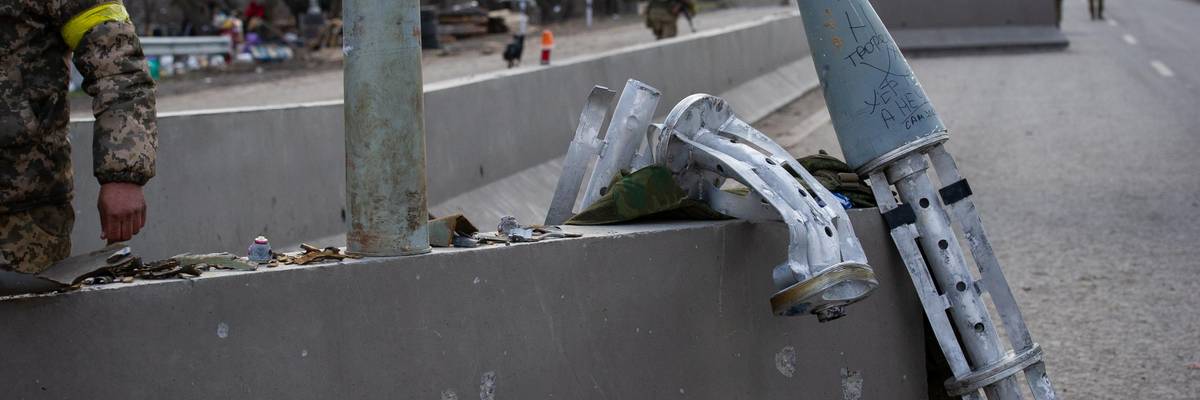
The casing of a Russian cluster bomb rocket is seen near the strategic port city of Mykolaiv, Ukraine, on March 10, 2022. Ukrainian forces reportedly used cluster bombs to target the Russian military in the village of Husarivka in March. (Photo: Scott Peterson/Getty Images)
Arms control advocates on Monday condemned a report that Ukrainian forces deployed cluster munitions in the village of Husarivka in Kharkiv Oblast in March--apparently Ukraine's first verified use of cluster bombs since Russan forces invaded the country in late February.
"Cluster munitions are unacceptable weapons that are killing and maiming civilians across Ukraine."
The New York Times reported that it visited the area and verified that scattered metal fragments from the detonated weapons were the result of strikes launched by the Ukrainians in early March, after the Russians had taken control of Husarivka.
The submunitions reviewed by Times reporters each contained the equivalent of about 11 ounces of TNT. The Ukrainian military likely aimed to strike Russian forces, the Times reported, and there were no fatalities in the initial strike.
Human rights experts condemn the use of cluster bombs because they create de facto landmines scattered throughout an area, with at least 20% of the munitions failing to detonate on impact.
More than 21,000 people have been killed worldwide by cluster munitions strikes and their remnants, according to the Landmine and Cluster Munition Monitor.
Adil Haque, a Rutgers University law professor and editor at Just Security, called the Times report "very alarming.'
More than 120 nations signed the Convention on Cluster Munitions in 2010, banning the use of the bombs due to the civilian harm they cause even if initial strikes are aimed at military targets.
The U.S., Russia, and Ukraine are among the countries that have not signed onto to the treaty.
Russia's use of the munitions in Ukraine has been internationally condemned, with Amnesty International saying earlier this month that the country's "indiscriminate attacks" on civilians constitute war crimes. Regardless of which side launches the munitions, said Jeff Abramson of the Arms Control Association, "all cluster munition use should be condemned."
"It's not surprising, but it's definitely dismaying to hear that evidence has emerged indicating that Ukraine may have used cluster munitions in this current conflict," Mary Wareham, advocacy director of the arms division at Human Rights Watch, told the Times. "Cluster munitions are unacceptable weapons that are killing and maiming civilians across Ukraine."
Reports of the Ukrainains' use of cluster bombs came a day after the country's forces refused to surrender the port city of Mariupol to the Russians and Ukrainian President Volodymyr Zelenskyy warned that ongoing peace talks between the two countries would be terminated if the remaining soldiers in Mariupol were killed.
As of April 12, more than 2,000 civilians have been killed in the conflict and more than 2,800 have been injured, according to the United Nations.
Dear Common Dreams reader, It’s been nearly 30 years since I co-founded Common Dreams with my late wife, Lina Newhouser. We had the radical notion that journalism should serve the public good, not corporate profits. It was clear to us from the outset what it would take to build such a project. No paid advertisements. No corporate sponsors. No millionaire publisher telling us what to think or do. Many people said we wouldn't last a year, but we proved those doubters wrong. Together with a tremendous team of journalists and dedicated staff, we built an independent media outlet free from the constraints of profits and corporate control. Our mission has always been simple: To inform. To inspire. To ignite change for the common good. Building Common Dreams was not easy. Our survival was never guaranteed. When you take on the most powerful forces—Wall Street greed, fossil fuel industry destruction, Big Tech lobbyists, and uber-rich oligarchs who have spent billions upon billions rigging the economy and democracy in their favor—the only bulwark you have is supporters who believe in your work. But here’s the urgent message from me today. It's never been this bad out there. And it's never been this hard to keep us going. At the very moment Common Dreams is most needed, the threats we face are intensifying. We need your support now more than ever. We don't accept corporate advertising and never will. We don't have a paywall because we don't think people should be blocked from critical news based on their ability to pay. Everything we do is funded by the donations of readers like you. When everyone does the little they can afford, we are strong. But if that support retreats or dries up, so do we. Will you donate now to make sure Common Dreams not only survives but thrives? —Craig Brown, Co-founder |
Arms control advocates on Monday condemned a report that Ukrainian forces deployed cluster munitions in the village of Husarivka in Kharkiv Oblast in March--apparently Ukraine's first verified use of cluster bombs since Russan forces invaded the country in late February.
"Cluster munitions are unacceptable weapons that are killing and maiming civilians across Ukraine."
The New York Times reported that it visited the area and verified that scattered metal fragments from the detonated weapons were the result of strikes launched by the Ukrainians in early March, after the Russians had taken control of Husarivka.
The submunitions reviewed by Times reporters each contained the equivalent of about 11 ounces of TNT. The Ukrainian military likely aimed to strike Russian forces, the Times reported, and there were no fatalities in the initial strike.
Human rights experts condemn the use of cluster bombs because they create de facto landmines scattered throughout an area, with at least 20% of the munitions failing to detonate on impact.
More than 21,000 people have been killed worldwide by cluster munitions strikes and their remnants, according to the Landmine and Cluster Munition Monitor.
Adil Haque, a Rutgers University law professor and editor at Just Security, called the Times report "very alarming.'
More than 120 nations signed the Convention on Cluster Munitions in 2010, banning the use of the bombs due to the civilian harm they cause even if initial strikes are aimed at military targets.
The U.S., Russia, and Ukraine are among the countries that have not signed onto to the treaty.
Russia's use of the munitions in Ukraine has been internationally condemned, with Amnesty International saying earlier this month that the country's "indiscriminate attacks" on civilians constitute war crimes. Regardless of which side launches the munitions, said Jeff Abramson of the Arms Control Association, "all cluster munition use should be condemned."
"It's not surprising, but it's definitely dismaying to hear that evidence has emerged indicating that Ukraine may have used cluster munitions in this current conflict," Mary Wareham, advocacy director of the arms division at Human Rights Watch, told the Times. "Cluster munitions are unacceptable weapons that are killing and maiming civilians across Ukraine."
Reports of the Ukrainains' use of cluster bombs came a day after the country's forces refused to surrender the port city of Mariupol to the Russians and Ukrainian President Volodymyr Zelenskyy warned that ongoing peace talks between the two countries would be terminated if the remaining soldiers in Mariupol were killed.
As of April 12, more than 2,000 civilians have been killed in the conflict and more than 2,800 have been injured, according to the United Nations.
Arms control advocates on Monday condemned a report that Ukrainian forces deployed cluster munitions in the village of Husarivka in Kharkiv Oblast in March--apparently Ukraine's first verified use of cluster bombs since Russan forces invaded the country in late February.
"Cluster munitions are unacceptable weapons that are killing and maiming civilians across Ukraine."
The New York Times reported that it visited the area and verified that scattered metal fragments from the detonated weapons were the result of strikes launched by the Ukrainians in early March, after the Russians had taken control of Husarivka.
The submunitions reviewed by Times reporters each contained the equivalent of about 11 ounces of TNT. The Ukrainian military likely aimed to strike Russian forces, the Times reported, and there were no fatalities in the initial strike.
Human rights experts condemn the use of cluster bombs because they create de facto landmines scattered throughout an area, with at least 20% of the munitions failing to detonate on impact.
More than 21,000 people have been killed worldwide by cluster munitions strikes and their remnants, according to the Landmine and Cluster Munition Monitor.
Adil Haque, a Rutgers University law professor and editor at Just Security, called the Times report "very alarming.'
More than 120 nations signed the Convention on Cluster Munitions in 2010, banning the use of the bombs due to the civilian harm they cause even if initial strikes are aimed at military targets.
The U.S., Russia, and Ukraine are among the countries that have not signed onto to the treaty.
Russia's use of the munitions in Ukraine has been internationally condemned, with Amnesty International saying earlier this month that the country's "indiscriminate attacks" on civilians constitute war crimes. Regardless of which side launches the munitions, said Jeff Abramson of the Arms Control Association, "all cluster munition use should be condemned."
"It's not surprising, but it's definitely dismaying to hear that evidence has emerged indicating that Ukraine may have used cluster munitions in this current conflict," Mary Wareham, advocacy director of the arms division at Human Rights Watch, told the Times. "Cluster munitions are unacceptable weapons that are killing and maiming civilians across Ukraine."
Reports of the Ukrainains' use of cluster bombs came a day after the country's forces refused to surrender the port city of Mariupol to the Russians and Ukrainian President Volodymyr Zelenskyy warned that ongoing peace talks between the two countries would be terminated if the remaining soldiers in Mariupol were killed.
As of April 12, more than 2,000 civilians have been killed in the conflict and more than 2,800 have been injured, according to the United Nations.