SUBSCRIBE TO OUR FREE NEWSLETTER
Daily news & progressive opinion—funded by the people, not the corporations—delivered straight to your inbox.
5
#000000
#FFFFFF
To donate by check, phone, or other method, see our More Ways to Give page.
Daily news & progressive opinion—funded by the people, not the corporations—delivered straight to your inbox.
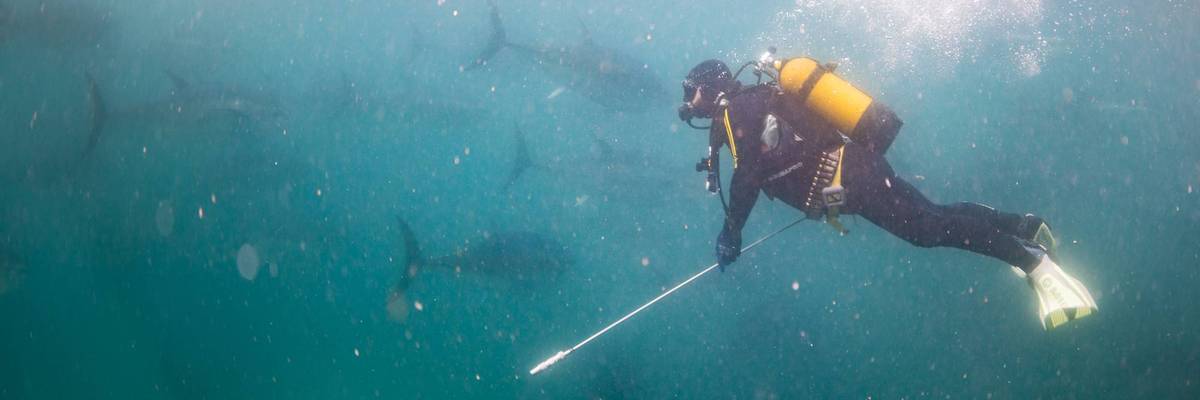
A diver hunts thunnus in Mediterranean Sea near Izmir, Turkey on November 19, 2024.
Noting that species are at risk from not only warming waters but also overfishing, one expert argued that "any management reform must simultaneously address both drivers of change."
Humanity's continued reliance on fossil fuels led to last year being among the hottest on record, and oceans store over 90% of the excess heat from greenhouse gases. A study out Wednesday details how the related long-term heating, warm years, and marine heatwaves "pose serious but poorly quantified threats" to fish species.
"To put it simply, the faster the ocean floor warms, the faster we lose fish," lead author Shahar Chaikin of Spain's National Museum of Natural Sciences (MNCN) told the Guardian. "A 7.2% decline for every tenth of a degree per decade might sound small... But compounded over time, across entire ocean basins, it represents a staggering and deeply concerning loss of marine life."
For the study, published in the journal Nature Ecology & Evolution, Chaikin, his MNCN colleague Miguel B. Araújo and the National University of Colombia's Juan David González-Trujillo analyzed 702,037 estimates of biomass change for 33,990 populations of 1,566 fish species across the Mediterranean, north Atlantic, and northeast Pacific between 1993 and 2021.
"On shorter timescales, warmer years and marine heatwaves were linked to sharp biomass losses of up to 43.4% in populations at the warm edge of the species' range and biomass increases of up to 176% at the cold edge," the study states. Chaikin warned in a statement that the temporary jumps in cooler areas could send misleading signals to managers of fisheries.
"Although this sudden increase in biomass in cold waters may seem like good news for fisheries, these are transient increases," he explained. "If managers raise catch quotas based on biomass increases caused by a heatwave, they risk causing the collapse of populations when temperatures return to normal or when the effect of long-term warming prevails, because these are short-lived increases."
González-Trujillo stressed that "unlike extreme short-term weather fluctuations, which can vary dramatically, this chronic warming exerts a constant negative pressure on fish populations in the Mediterranean Sea, the north Atlantic Ocean, and the northeastern Pacific Ocean."
Specifically, Chaikin said that "when we remove the noise of extreme short-term weather events, the data show that this warming is associated with a sustained annual decline in biomass of up to 19.8%."
Are warmer oceans good or bad for #fish? 🐟 The answer is a dangerous paradox. Our new paper in @natecoevo.nature.com shows how marine heatwaves may create “fake” fish gains that mask a large-scale crash. Read our findings here: www.nature.com/articles/s41...@mncn-csic.bsky.social #ClimateChange
[image or embed]
— Shahar Chaikin (@shaharchaikin.bsky.social) February 25, 2026 at 5:05 AM
Given the findings, Araújo emphasized that fisheries' managers "must balance localized increases with long-term declines extremely carefully to avoid overexploitation."
"As ocean warming continues, the only viable strategy is to prioritize long-term resilience," the study co-author said. "Management measures must plan for the biomass decline expected in an increasingly warm ocean."
Carlos García-Soto is a scientist at the Spanish National Research Council, which manages MNCN. Although not a study co-author, he also highlighted the need for policymakers to understand the "clear risk of misinterpretation" detailed in the new paper.
"In a context of accelerated climate change, policies cannot react solely to extreme events or be based on short-term signals," García-Soto said in a statement. "They need consistency between science, planning, and governance, especially in shared ecosystems or on the high seas."
Also responding to the research on Wednesday, Guillermo Ortuño Crespo of the International Union for Conservation of Nature said that "I believe this is a methodologically sound and valuable study that provides valuable evidence on how different components of ocean warming affect fish biomass."
While recognizing the well-documented and devastating impacts of fossil fuel-driven heating on marine species, Ortuño Crespo also warned that "there is a risk, in my opinion, that climate change will become the main explanation for changes in marine species biomass, leaving aside overfishing."
"Historically, overfishing has been the main determinant of biomass declines in many fisheries around the world," he noted, citing the United Nations Food and Agriculture Organization. "The proportion of overexploited stocks globally continues to increase, indicating that fishing pressure remains a dominant risk factor. The current challenge is that this overfishing crisis is being further exacerbated by ocean warming and deoxygenation."
"In terms of public policy, the study is highly relevant because it emphasizes that fisheries management systems must become more climate-adaptive," Ortuño Crespo said. "Any management reform must simultaneously address both drivers of change: climate and fisheries. Adjusting quotas solely on the basis of climate without reducing overcapacity and the impact of high-impact gear, such as bottom trawling, is likely to be insufficient to recover stocks."
Dear Common Dreams reader, It’s been nearly 30 years since I co-founded Common Dreams with my late wife, Lina Newhouser. We had the radical notion that journalism should serve the public good, not corporate profits. It was clear to us from the outset what it would take to build such a project. No paid advertisements. No corporate sponsors. No millionaire publisher telling us what to think or do. Many people said we wouldn't last a year, but we proved those doubters wrong. Together with a tremendous team of journalists and dedicated staff, we built an independent media outlet free from the constraints of profits and corporate control. Our mission has always been simple: To inform. To inspire. To ignite change for the common good. Building Common Dreams was not easy. Our survival was never guaranteed. When you take on the most powerful forces—Wall Street greed, fossil fuel industry destruction, Big Tech lobbyists, and uber-rich oligarchs who have spent billions upon billions rigging the economy and democracy in their favor—the only bulwark you have is supporters who believe in your work. But here’s the urgent message from me today. It's never been this bad out there. And it's never been this hard to keep us going. At the very moment Common Dreams is most needed, the threats we face are intensifying. We need your support now more than ever. We don't accept corporate advertising and never will. We don't have a paywall because we don't think people should be blocked from critical news based on their ability to pay. Everything we do is funded by the donations of readers like you. When everyone does the little they can afford, we are strong. But if that support retreats or dries up, so do we. Will you donate now to make sure Common Dreams not only survives but thrives? —Craig Brown, Co-founder |
Humanity's continued reliance on fossil fuels led to last year being among the hottest on record, and oceans store over 90% of the excess heat from greenhouse gases. A study out Wednesday details how the related long-term heating, warm years, and marine heatwaves "pose serious but poorly quantified threats" to fish species.
"To put it simply, the faster the ocean floor warms, the faster we lose fish," lead author Shahar Chaikin of Spain's National Museum of Natural Sciences (MNCN) told the Guardian. "A 7.2% decline for every tenth of a degree per decade might sound small... But compounded over time, across entire ocean basins, it represents a staggering and deeply concerning loss of marine life."
For the study, published in the journal Nature Ecology & Evolution, Chaikin, his MNCN colleague Miguel B. Araújo and the National University of Colombia's Juan David González-Trujillo analyzed 702,037 estimates of biomass change for 33,990 populations of 1,566 fish species across the Mediterranean, north Atlantic, and northeast Pacific between 1993 and 2021.
"On shorter timescales, warmer years and marine heatwaves were linked to sharp biomass losses of up to 43.4% in populations at the warm edge of the species' range and biomass increases of up to 176% at the cold edge," the study states. Chaikin warned in a statement that the temporary jumps in cooler areas could send misleading signals to managers of fisheries.
"Although this sudden increase in biomass in cold waters may seem like good news for fisheries, these are transient increases," he explained. "If managers raise catch quotas based on biomass increases caused by a heatwave, they risk causing the collapse of populations when temperatures return to normal or when the effect of long-term warming prevails, because these are short-lived increases."
González-Trujillo stressed that "unlike extreme short-term weather fluctuations, which can vary dramatically, this chronic warming exerts a constant negative pressure on fish populations in the Mediterranean Sea, the north Atlantic Ocean, and the northeastern Pacific Ocean."
Specifically, Chaikin said that "when we remove the noise of extreme short-term weather events, the data show that this warming is associated with a sustained annual decline in biomass of up to 19.8%."
Are warmer oceans good or bad for #fish? 🐟 The answer is a dangerous paradox. Our new paper in @natecoevo.nature.com shows how marine heatwaves may create “fake” fish gains that mask a large-scale crash. Read our findings here: www.nature.com/articles/s41...@mncn-csic.bsky.social #ClimateChange
[image or embed]
— Shahar Chaikin (@shaharchaikin.bsky.social) February 25, 2026 at 5:05 AM
Given the findings, Araújo emphasized that fisheries' managers "must balance localized increases with long-term declines extremely carefully to avoid overexploitation."
"As ocean warming continues, the only viable strategy is to prioritize long-term resilience," the study co-author said. "Management measures must plan for the biomass decline expected in an increasingly warm ocean."
Carlos García-Soto is a scientist at the Spanish National Research Council, which manages MNCN. Although not a study co-author, he also highlighted the need for policymakers to understand the "clear risk of misinterpretation" detailed in the new paper.
"In a context of accelerated climate change, policies cannot react solely to extreme events or be based on short-term signals," García-Soto said in a statement. "They need consistency between science, planning, and governance, especially in shared ecosystems or on the high seas."
Also responding to the research on Wednesday, Guillermo Ortuño Crespo of the International Union for Conservation of Nature said that "I believe this is a methodologically sound and valuable study that provides valuable evidence on how different components of ocean warming affect fish biomass."
While recognizing the well-documented and devastating impacts of fossil fuel-driven heating on marine species, Ortuño Crespo also warned that "there is a risk, in my opinion, that climate change will become the main explanation for changes in marine species biomass, leaving aside overfishing."
"Historically, overfishing has been the main determinant of biomass declines in many fisheries around the world," he noted, citing the United Nations Food and Agriculture Organization. "The proportion of overexploited stocks globally continues to increase, indicating that fishing pressure remains a dominant risk factor. The current challenge is that this overfishing crisis is being further exacerbated by ocean warming and deoxygenation."
"In terms of public policy, the study is highly relevant because it emphasizes that fisheries management systems must become more climate-adaptive," Ortuño Crespo said. "Any management reform must simultaneously address both drivers of change: climate and fisheries. Adjusting quotas solely on the basis of climate without reducing overcapacity and the impact of high-impact gear, such as bottom trawling, is likely to be insufficient to recover stocks."
Humanity's continued reliance on fossil fuels led to last year being among the hottest on record, and oceans store over 90% of the excess heat from greenhouse gases. A study out Wednesday details how the related long-term heating, warm years, and marine heatwaves "pose serious but poorly quantified threats" to fish species.
"To put it simply, the faster the ocean floor warms, the faster we lose fish," lead author Shahar Chaikin of Spain's National Museum of Natural Sciences (MNCN) told the Guardian. "A 7.2% decline for every tenth of a degree per decade might sound small... But compounded over time, across entire ocean basins, it represents a staggering and deeply concerning loss of marine life."
For the study, published in the journal Nature Ecology & Evolution, Chaikin, his MNCN colleague Miguel B. Araújo and the National University of Colombia's Juan David González-Trujillo analyzed 702,037 estimates of biomass change for 33,990 populations of 1,566 fish species across the Mediterranean, north Atlantic, and northeast Pacific between 1993 and 2021.
"On shorter timescales, warmer years and marine heatwaves were linked to sharp biomass losses of up to 43.4% in populations at the warm edge of the species' range and biomass increases of up to 176% at the cold edge," the study states. Chaikin warned in a statement that the temporary jumps in cooler areas could send misleading signals to managers of fisheries.
"Although this sudden increase in biomass in cold waters may seem like good news for fisheries, these are transient increases," he explained. "If managers raise catch quotas based on biomass increases caused by a heatwave, they risk causing the collapse of populations when temperatures return to normal or when the effect of long-term warming prevails, because these are short-lived increases."
González-Trujillo stressed that "unlike extreme short-term weather fluctuations, which can vary dramatically, this chronic warming exerts a constant negative pressure on fish populations in the Mediterranean Sea, the north Atlantic Ocean, and the northeastern Pacific Ocean."
Specifically, Chaikin said that "when we remove the noise of extreme short-term weather events, the data show that this warming is associated with a sustained annual decline in biomass of up to 19.8%."
Are warmer oceans good or bad for #fish? 🐟 The answer is a dangerous paradox. Our new paper in @natecoevo.nature.com shows how marine heatwaves may create “fake” fish gains that mask a large-scale crash. Read our findings here: www.nature.com/articles/s41...@mncn-csic.bsky.social #ClimateChange
[image or embed]
— Shahar Chaikin (@shaharchaikin.bsky.social) February 25, 2026 at 5:05 AM
Given the findings, Araújo emphasized that fisheries' managers "must balance localized increases with long-term declines extremely carefully to avoid overexploitation."
"As ocean warming continues, the only viable strategy is to prioritize long-term resilience," the study co-author said. "Management measures must plan for the biomass decline expected in an increasingly warm ocean."
Carlos García-Soto is a scientist at the Spanish National Research Council, which manages MNCN. Although not a study co-author, he also highlighted the need for policymakers to understand the "clear risk of misinterpretation" detailed in the new paper.
"In a context of accelerated climate change, policies cannot react solely to extreme events or be based on short-term signals," García-Soto said in a statement. "They need consistency between science, planning, and governance, especially in shared ecosystems or on the high seas."
Also responding to the research on Wednesday, Guillermo Ortuño Crespo of the International Union for Conservation of Nature said that "I believe this is a methodologically sound and valuable study that provides valuable evidence on how different components of ocean warming affect fish biomass."
While recognizing the well-documented and devastating impacts of fossil fuel-driven heating on marine species, Ortuño Crespo also warned that "there is a risk, in my opinion, that climate change will become the main explanation for changes in marine species biomass, leaving aside overfishing."
"Historically, overfishing has been the main determinant of biomass declines in many fisheries around the world," he noted, citing the United Nations Food and Agriculture Organization. "The proportion of overexploited stocks globally continues to increase, indicating that fishing pressure remains a dominant risk factor. The current challenge is that this overfishing crisis is being further exacerbated by ocean warming and deoxygenation."
"In terms of public policy, the study is highly relevant because it emphasizes that fisheries management systems must become more climate-adaptive," Ortuño Crespo said. "Any management reform must simultaneously address both drivers of change: climate and fisheries. Adjusting quotas solely on the basis of climate without reducing overcapacity and the impact of high-impact gear, such as bottom trawling, is likely to be insufficient to recover stocks."