SUBSCRIBE TO OUR FREE NEWSLETTER
Daily news & progressive opinion—funded by the people, not the corporations—delivered straight to your inbox.
5
#000000
#FFFFFF
To donate by check, phone, or other method, see our More Ways to Give page.
Daily news & progressive opinion—funded by the people, not the corporations—delivered straight to your inbox.
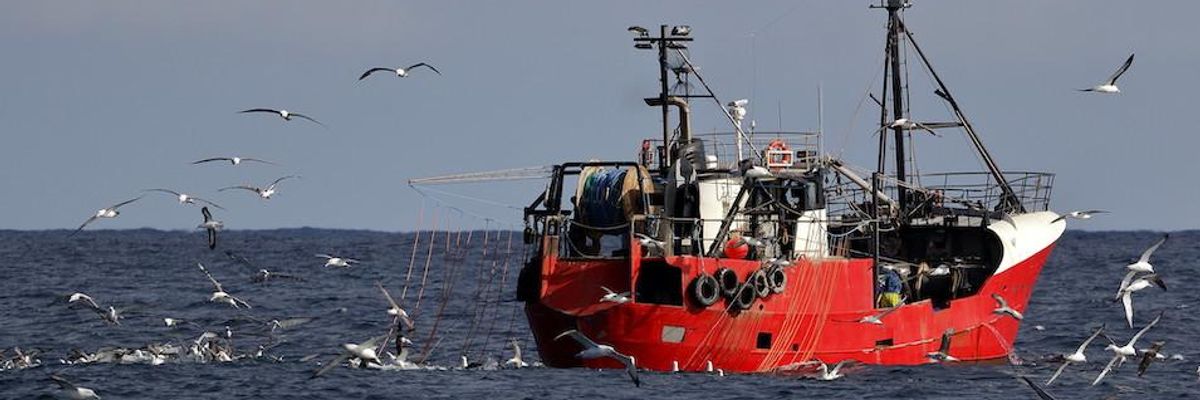
The climate crisis is changing the New England fishing industry, a new report says. (Photo: Ed Dunens/Flickr/cc)
The climate crisis is hurting the New England fishing industry, claims a new report published Monday, with a decline of 16% in fishing jobs in the northeastern U.S. region from 1996 to 2017 and more instability ahead.
University of Delaware researcher Kimberly Oremus' paper, "Climate variability reduces employment in New England fisheries," was published in the Proceedings of the National Academy of Sciences.
"This is an important signal to incorporate into the fisheries management process," Oremus told Science X. "We need to figure out what climate is doing to fisheries in order to cope with it."
Oresmus found that the fishing industry is in trouble due to variations in ocean temperature. Of particular concern is the Gulf of Maine, an area of the ocean warming faster than nearly any other in the world.
"New England waters are among the fastest-warming in the world," said Oremus said. "Warmer-than-average sea-surface temperatures have been shown to impact the productivity of lobsters, sea scallops, groundfish, and other fisheries important to the region, especially when they are most vulnerable, from spawning through their first year of life."
As The New Food Economy explained, the New England fishing industry has been under threat for decades due to overfishing and climate change.
Due to overfishing, cod stocks are nearly depleted. To avert complete collapse, the National Oceanic and Atmospheric Administration now sets limits on fish catches, or quotas. In the past decade, catches have plummeted, from 100 million pounds of cod in the early 1980s to a fraction today.
Oresums told HuffPost's Alexander Kaufman that while her research shows the fisheries' decline is driven by warmer winters, she wasn't able to get a full picture of the crisis.
"This doesn't capture all the anthropogenic climate change," said Oresmus. "There's probably additional warming on top of the variability that I don't account for."
According to Kaufman:
The Gulf of Maine, which stretches from Nova Scotia in Canada to Cape Cod, Massachusetts, has warmed faster than 99% of global oceans, increasing by an average of 0.11 degrees Fahrenheit per year over the past three decades. While temperatures fluctuate, melting Arctic ice is weakening the southward current that once flushed the basin with cold waters from Greenland, putting the basin's temperatures on a firm upward trajectory.
The effects have made the fishing industry even less predictable than in years past. Record lobster hauls over the past decade in Maine now look set to decline, according to two studies published in the past month. The New England fishery for Northern shrimp, once a winter mainstay, is set to remain closed for a seventh consecutive year. An iconic seafood processing firm in Gloucester, Massachusetts, went bankrupt in May.
Ultimately, Oresmus told The New Food Economy, New Englanders have to prepare for a different-looking coastal future.
"The individuals who can't weather these climate shocks are the small mom-and-pop businesses and smaller fishing establishments," said Oresmus. "There are communities that are just not going to be fishing communities anymore."
Dear Common Dreams reader, It’s been nearly 30 years since I co-founded Common Dreams with my late wife, Lina Newhouser. We had the radical notion that journalism should serve the public good, not corporate profits. It was clear to us from the outset what it would take to build such a project. No paid advertisements. No corporate sponsors. No millionaire publisher telling us what to think or do. Many people said we wouldn't last a year, but we proved those doubters wrong. Together with a tremendous team of journalists and dedicated staff, we built an independent media outlet free from the constraints of profits and corporate control. Our mission has always been simple: To inform. To inspire. To ignite change for the common good. Building Common Dreams was not easy. Our survival was never guaranteed. When you take on the most powerful forces—Wall Street greed, fossil fuel industry destruction, Big Tech lobbyists, and uber-rich oligarchs who have spent billions upon billions rigging the economy and democracy in their favor—the only bulwark you have is supporters who believe in your work. But here’s the urgent message from me today. It's never been this bad out there. And it's never been this hard to keep us going. At the very moment Common Dreams is most needed, the threats we face are intensifying. We need your support now more than ever. We don't accept corporate advertising and never will. We don't have a paywall because we don't think people should be blocked from critical news based on their ability to pay. Everything we do is funded by the donations of readers like you. When everyone does the little they can afford, we are strong. But if that support retreats or dries up, so do we. Will you donate now to make sure Common Dreams not only survives but thrives? —Craig Brown, Co-founder |
The climate crisis is hurting the New England fishing industry, claims a new report published Monday, with a decline of 16% in fishing jobs in the northeastern U.S. region from 1996 to 2017 and more instability ahead.
University of Delaware researcher Kimberly Oremus' paper, "Climate variability reduces employment in New England fisheries," was published in the Proceedings of the National Academy of Sciences.
"This is an important signal to incorporate into the fisheries management process," Oremus told Science X. "We need to figure out what climate is doing to fisheries in order to cope with it."
Oresmus found that the fishing industry is in trouble due to variations in ocean temperature. Of particular concern is the Gulf of Maine, an area of the ocean warming faster than nearly any other in the world.
"New England waters are among the fastest-warming in the world," said Oremus said. "Warmer-than-average sea-surface temperatures have been shown to impact the productivity of lobsters, sea scallops, groundfish, and other fisheries important to the region, especially when they are most vulnerable, from spawning through their first year of life."
As The New Food Economy explained, the New England fishing industry has been under threat for decades due to overfishing and climate change.
Due to overfishing, cod stocks are nearly depleted. To avert complete collapse, the National Oceanic and Atmospheric Administration now sets limits on fish catches, or quotas. In the past decade, catches have plummeted, from 100 million pounds of cod in the early 1980s to a fraction today.
Oresums told HuffPost's Alexander Kaufman that while her research shows the fisheries' decline is driven by warmer winters, she wasn't able to get a full picture of the crisis.
"This doesn't capture all the anthropogenic climate change," said Oresmus. "There's probably additional warming on top of the variability that I don't account for."
According to Kaufman:
The Gulf of Maine, which stretches from Nova Scotia in Canada to Cape Cod, Massachusetts, has warmed faster than 99% of global oceans, increasing by an average of 0.11 degrees Fahrenheit per year over the past three decades. While temperatures fluctuate, melting Arctic ice is weakening the southward current that once flushed the basin with cold waters from Greenland, putting the basin's temperatures on a firm upward trajectory.
The effects have made the fishing industry even less predictable than in years past. Record lobster hauls over the past decade in Maine now look set to decline, according to two studies published in the past month. The New England fishery for Northern shrimp, once a winter mainstay, is set to remain closed for a seventh consecutive year. An iconic seafood processing firm in Gloucester, Massachusetts, went bankrupt in May.
Ultimately, Oresmus told The New Food Economy, New Englanders have to prepare for a different-looking coastal future.
"The individuals who can't weather these climate shocks are the small mom-and-pop businesses and smaller fishing establishments," said Oresmus. "There are communities that are just not going to be fishing communities anymore."
The climate crisis is hurting the New England fishing industry, claims a new report published Monday, with a decline of 16% in fishing jobs in the northeastern U.S. region from 1996 to 2017 and more instability ahead.
University of Delaware researcher Kimberly Oremus' paper, "Climate variability reduces employment in New England fisheries," was published in the Proceedings of the National Academy of Sciences.
"This is an important signal to incorporate into the fisheries management process," Oremus told Science X. "We need to figure out what climate is doing to fisheries in order to cope with it."
Oresmus found that the fishing industry is in trouble due to variations in ocean temperature. Of particular concern is the Gulf of Maine, an area of the ocean warming faster than nearly any other in the world.
"New England waters are among the fastest-warming in the world," said Oremus said. "Warmer-than-average sea-surface temperatures have been shown to impact the productivity of lobsters, sea scallops, groundfish, and other fisheries important to the region, especially when they are most vulnerable, from spawning through their first year of life."
As The New Food Economy explained, the New England fishing industry has been under threat for decades due to overfishing and climate change.
Due to overfishing, cod stocks are nearly depleted. To avert complete collapse, the National Oceanic and Atmospheric Administration now sets limits on fish catches, or quotas. In the past decade, catches have plummeted, from 100 million pounds of cod in the early 1980s to a fraction today.
Oresums told HuffPost's Alexander Kaufman that while her research shows the fisheries' decline is driven by warmer winters, she wasn't able to get a full picture of the crisis.
"This doesn't capture all the anthropogenic climate change," said Oresmus. "There's probably additional warming on top of the variability that I don't account for."
According to Kaufman:
The Gulf of Maine, which stretches from Nova Scotia in Canada to Cape Cod, Massachusetts, has warmed faster than 99% of global oceans, increasing by an average of 0.11 degrees Fahrenheit per year over the past three decades. While temperatures fluctuate, melting Arctic ice is weakening the southward current that once flushed the basin with cold waters from Greenland, putting the basin's temperatures on a firm upward trajectory.
The effects have made the fishing industry even less predictable than in years past. Record lobster hauls over the past decade in Maine now look set to decline, according to two studies published in the past month. The New England fishery for Northern shrimp, once a winter mainstay, is set to remain closed for a seventh consecutive year. An iconic seafood processing firm in Gloucester, Massachusetts, went bankrupt in May.
Ultimately, Oresmus told The New Food Economy, New Englanders have to prepare for a different-looking coastal future.
"The individuals who can't weather these climate shocks are the small mom-and-pop businesses and smaller fishing establishments," said Oresmus. "There are communities that are just not going to be fishing communities anymore."