

SUBSCRIBE TO OUR FREE NEWSLETTER
Daily news & progressive opinion—funded by the people, not the corporations—delivered straight to your inbox.
5
#000000
#FFFFFF
To donate by check, phone, or other method, see our More Ways to Give page.
Daily news & progressive opinion—funded by the people, not the corporations—delivered straight to your inbox.
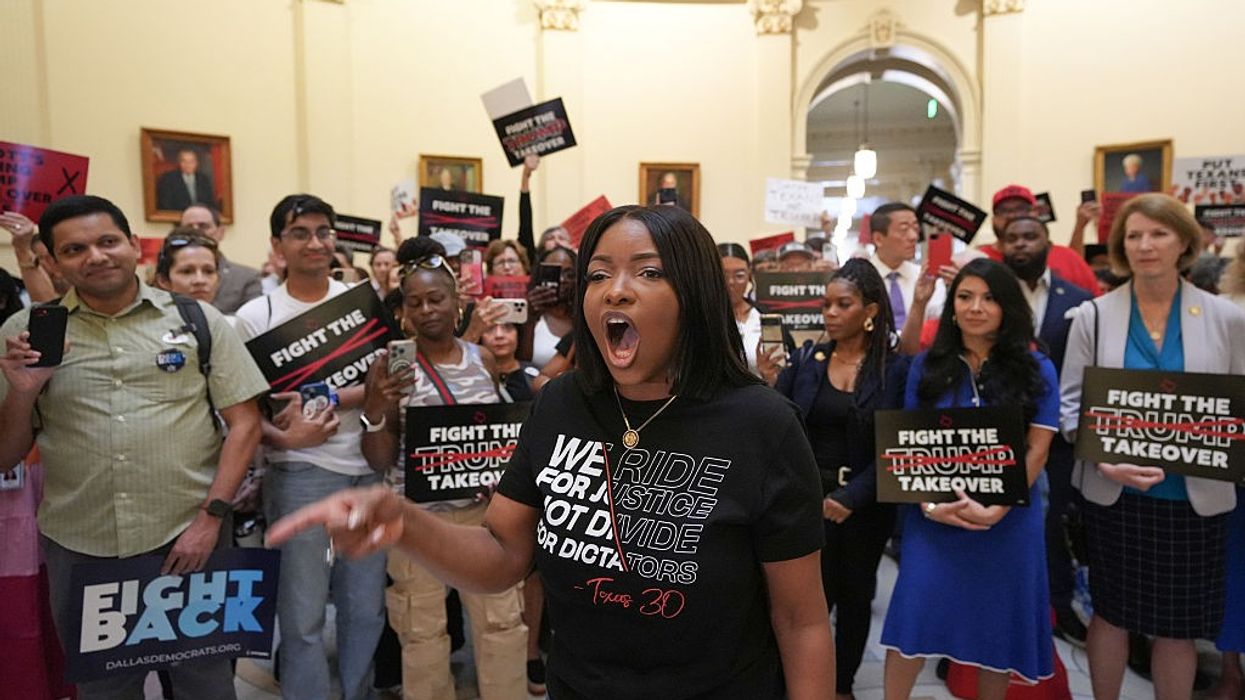
"This fight is bigger than any one state," said the chairman of the Texas House Democratic Caucus.
Nationwide protests against US President Donald Trump's scheme to get Republican state legislatures to redraw their congressional maps are set to kick off this weekend.
The "Fight the Trump Takeover" movement is planning a national day of action on Saturday, August 16 that will feature coast-to-coast demonstrations from as far east as Lubec, Maine, to as far west as Anchorage, Alaska.
"Trump is trying to steal the 2026 election by rigging the system and changing electoral maps," the coalition behind the protests said on its website. "He started in Texas, but he won’t stop there. We are fighting back."
The protests are being done in partnership with several prominent progressive groups, including Indivisible, MoveOn, Human Rights Campaign, Public Citizen, and the Communication Workers of America. Some Texas-specific groups—including Texas Freedom Network, Texas AFL-CIO, and Texas for All—are also partners in the protest.
Axios reports that an "anchor rally" in Austin, Texas will kick off the nationwide events and will feature speakers including Democratic US Reps. Greg Casar and Lloyd Doggett, as well as former Democratic Rep. Beto O'Rourke and labor activist Dolores Huerta.
The location of the Austin rally is symbolically important because Texas is trying to become the first state to redraw its maps to benefit Republicans under Trump's nationwide gerrymandering scheme, which in the coming weeks could include states such as Ohio, Indiana, Florida, and Missouri.
Texas House Democratic Caucus Chair Gene Wu told Axios that "this fight is bigger than any one state" because "we're defending our entire country from the Trump takeover, and I'm honored to stand with every patriotic American who refuses to let extremists rig the system."
Ezra Levin, the co-founder and co-executive director of progressive organizing group Indivisible, told Axios that Trump's plan "is as crooked as it gets" and described it as part of a larger plot to "lock in minority rule for a generation."
Democratic-controlled states, led by California under Gov. Gavin Newsom, have started to fight back against the Trump plan by proposing their own redrawn maps aimed at squeezing out Republicans in their states. Newsom this week held a big rally in Los Angeles with other California Democratic heavyweights where he stressed the need for Democrats to give Republicans a taste of their own medicine.
"It's not enough to just hold hands, have a candlelight vigil, and talk about way the world should be," Newsom said at the rally. "We have got to recognize the cards that have been dealt, and we have got to meet fire with fire!"
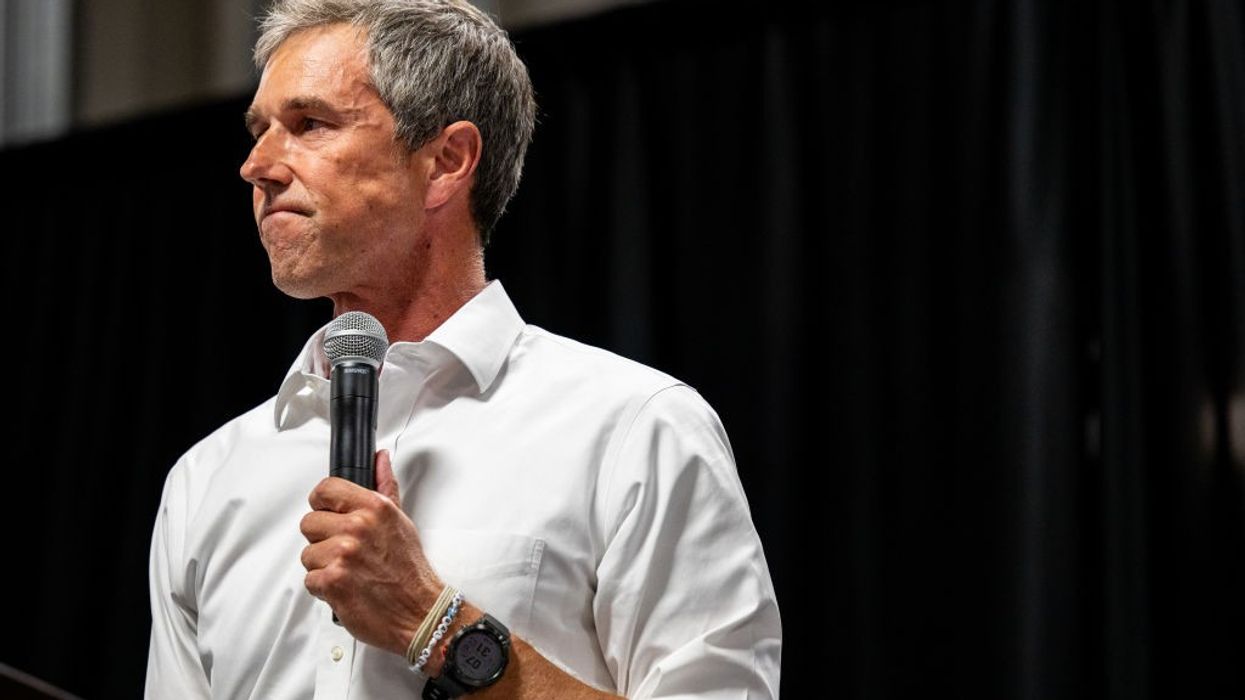
"I think Democrats in the past too often have been more concerned with being right than being in power," O'Rourke said in a CNN interview. "We've seen Republicans only care about being in power regardless of what is right."
As Republicans move forward with an aggressive effort to gerrymander Texas in the coming year, former Rep. Beto O'Rourke called on Democrats Sunday to "match fire with fire" in blue states.
Texas Gov. Greg Abbott said last week he'd follow through on a proposal from President Donald Trump, press legislators to re-draw congressional maps to maximally favor Republicans in the Lone Star State through a highly unusual mid-decade redistricting push.
The effort may net the GOP another five seats in the 2026 midterms. Trump has suggested Republicans push their advantages in "other states" as well, including Ohio.
In response, California Gov. Gavin Newsom said he'd attempt to subvert California's independent state redistricting commission—which seeks to draw maps as fairly as possible—to instead pursue a maximum partisan gerrymander to favor Democrats.
Democrats have tended to be at the forefront of efforts to eliminate partisan redistricting. O'Rourke, a Democrat, has previously called for his state of Texas to have its districts drawn not by political parties but by an independent nonpartisan commission.
But in an interview with CNN's Jake Tapper Sunday, O'Rourke said that while he still disagreed with gerrymandering on principle, as long as Republicans are willing to use it, Democrats need to be willing to play the same game.
"I think Democrats in the past too often have been more concerned with being right than being in power," O'Rourke said. "We've seen Republicans only care about being in power regardless of what is right."
Asked about Newsom's efforts in California, O'Rourke said, "We have to be absolutely ruthless about getting back in power."
He called on Democrats in other blue states to press their advantages as far as possible too.
"In California, in Illinois, in New York, wherever we have the trifecta of power, we have to use that to its absolute extent," he said.
Should Newsom's effort to get around California's redistricting commission succeed, it could net Democrats an additional five to seven seats in the House. With Republicans clinging to just a three-seat majority, it could prove decisive.
However, the plan is a long shot. In 2010, California voters elected to enshrine the independent commission into the state constitution.
Newsom has said that when it comes to stripping the commission of its power, "it's all on the table," including calling a special session of the state legislature and introducing another ballot measure to the public, which he said he thinks they'd win.
He also said there were "other avenues" to consider, like having the legislature draw districts "in between" censuses.
Newsom described this as a legal gray area, since the constitutional amendment only requires the independent commission to create new maps after each census, but says nothing about its role in redistricting mid-decade. However, Dan Vicuña, a redistricting expert at the watchdog group Common Cause, told The Guardian that such an effort was "not lawful in any way."
Newsom said that Republicans, who don't have to worry about redistricting commissions in the states they control, "are playing by a different set of rules."
"From my perspective, if we're going to play fair in a world that is wholly unfair, we may have the higher moral ground, but the ground is shifting from underneath us, and I think we have to wake up to that reality," said the California governor.
The governors of Illinois and New York, meanwhile, have stayed mum on the question of whether they may attempt similar attempts at aggressive redistricting.
Illinois has no rules against partisan gerrymandering and its maps are already heavily weighted in Democrats' favor following the most recent redistricting effort in 2021.
New York's maps are only "slightly" weighted in favor of Democrats and could be made more lopsided. During the most recent redistricting session, which was the subject of a lengthy court battle, Gov. Kathy Hochul agreed to maps that left the seven seats controlled by Republicans intact.
There, the legislature can draw maps, but they must be approved by an independent redistricting committee.
According to reporting by CNN Sunday, Democrats are nevertheless looking into possible efforts to maximize their advantages in New York and other states like New Jersey, Minnesota, and Washington.
In response to Trump's effort to expand Republicans' seats, House Minority Leader Hakeem Jeffries (D-N.Y.) renewed calls for "fair maps" throughout the country, though he declined to comment on Newsom's efforts.
Jeffries is reportedly meeting with Hochul about the possibility of making the maps more "fair," by which he may mean maximizing the Democrats' advantage. This would likely necessitate dispensing with the independent redistricting commission, as Newsom hopes to do.
"If Republicans want to play by these rules, then I think that we shouldn't have one set of rules for one and the other set of rules for another," Rep. Alexandria Ocasio-Cortez (D-N.Y.) told CNN. "I think we need to even the playing board."
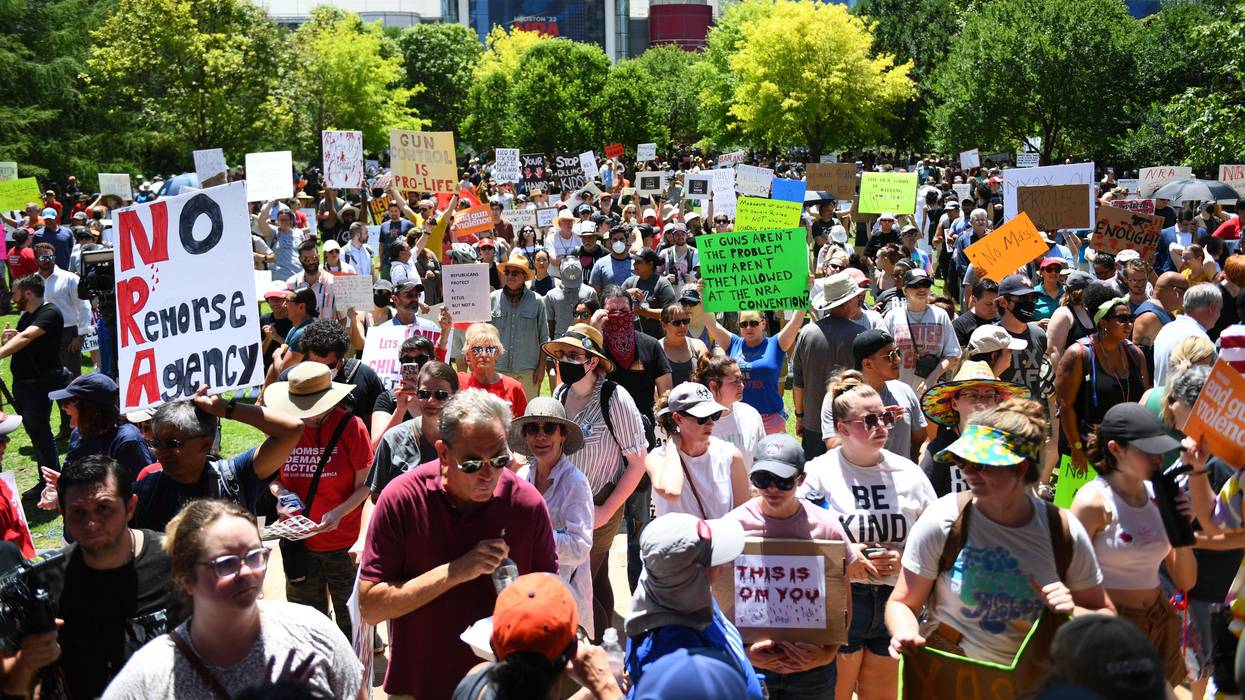
In the wake of Tuesday's massacre of 21 students and staff at Robb Elementary School in Uvalde, Texas, thousands of people protested angrily in Houston Friday to protest outside the National Rifle Association's annual convention to condemn the gun lobby's deep complicity in the nation's mass shooting epidemic.
"We're building space to hold the families of Uvalde, to let them know that we are there for them, that we will stand up for them and we will be fighting for them."
With signs asking "how many more?" and chants proclaiming "enough is enough," demonstrators protested in 95-degree heat outside the George R. Brown Convention Center as NRA officials--who banned guns in the venue due to a scheduled address by former President Donald Trump Friday afternoon--welcomed conference speakers and attendees, who are expected to number around 80,000.
"I'm just tired of the NRA subordinating children's rights for gun rights," Ken Council, a 65-year-old protester, told the Houston Chronicle.
Members of the League of Unified Latin American Citizens, Moms Demand Action, Black Lives Matter, Indivisible, the Houston Federation of Teachers, and other groups took part in the protest.
"When you go and shoot up a school full of kids and teachers... you've taken someone's right to life away," said Ashton Woods, founder and lead organizer of Black Lives Matter Houston. "We're building space to hold the families of Uvalde, to let them know that we are there for them, that we will stand up for them and we will be fighting for them--even when this is over--to make sure we get common-sense gun reform."
Political leaders including Houston Mayor Sylvester Turner (D), U.S. Rep. Sheila Jackson Lee (D-Texas), and Democratic Texas gubernatorial candidate Beto O'Rourke--who interrupted a press conference in Uvalde on Wednesday--were all scheduled to speak.
"The time to stop Uvalde was after a Columbine...and after Sandy Hook," O'Rourke told the large crowd to loud applause. "The time to stop another mass shooting is now."
Lee lamented that "400 million guns, 45% of the guns in the world are in the United States... Will we continue to live in the house of shame?"
Demonstrators took aim at weapons makers, the gun lobby, and the mostly Republican elected officials who collectively receive millions of dollars in campaign contributions from firearms interests while failing to take meaningful action in the face of over 1.5 million U.S. gun deaths--more than the total number of American troops killed in the nation's many wars--over the past half century.
Trump is expected to be joined on stage by South Dakota Gov. Kristi Noem and Sen. Ted Cruz (R-Texas), who, according to OpenSecrets.org, is the top congressional beneficiary of the gun lobby's largesse.
Despite misleading headlines reporting that Republican Texas Gov. Greg Abbott would skip the NRA convention and instead appear in Uvalde, the governor--a five-figure recipient of NRA campaign cash--will still participate via a prerecorded video message to attendees.
Other Republicans not attending the convention but who receive hundreds of thousands of dollars or more in gun lobby funding also came under fire, including Sen. Ron Johnson (R-Wis.), who blamed "wokeness" and critical race theory for the Uvalde massacre and asserted that "the solution is renewed faith."
The NRA protests follow a Thursday demonstration by faith leaders outside the convention center as well as a walkout by students at scores of elementary, middle, and high schools across the country.
On Wednesday, the organizers of March for Our Lives--the nationwide student-led gun control protests first held in the wake of the 2018 Marjory Stoneman Douglas High School massacre in Parkland, Florida--announced they were organizing a second such event for June 11.

Hours after a gunman armed with two AR-15-style rifles massacred 19 children and two teachers at an elementary school in Uvalde, Texas on Tuesday, Republican Gov. Greg Abbott attended a high-dollar fundraiser for his reelection campaign at a private home 300 miles from the site of the shooting.
The Tuesday evening fundraiser took place at the home of Huntsville resident Jeff Bradley, who confirmed that he hosted the closed-door event but did not provide additional details, such as an attendance list.
"He was counting dollars while they were counting bodies," Beto O'Rourke, who is set to face Abbott in the November gubernatorial race, wrote on Twitter in response to news of the fundraiser, which was first reported by the Texas-based outlet Quorum Report.
Mark Miner, a spokesperson for Abbott's cash-flush reelection campaign, said in a statement that "after holding a briefing and press conference on the current wildfires in Taylor County, where he also provided an update on the situation in Uvalde, the governor did stop by a previously scheduled event last night at a private home in Walker County."
"All campaign and political activity, including a scheduled fundraiser for this evening, have been postponed until further notice," added Miner, who didn't explain why Abbott decided to attend the Walker County event.
Abbott is also slated to speak at the National Rifle Association's annual gathering in Houston on Friday alongside former President Donald Trump and other prominent Republicans, but the governor suggested Wednesday that he has not made a final decision on whether to go through with the appearance.
"As far as future plans are concerned, listen, I'm living moment-to-moment right now," Abbott told reporters. "My heart, my head, and my body are in Uvalde right now, and I'm here to help the people who are hurting."
During a press conference with top state and local officials in Uvalde on Wednesday, Abbott suggested that the crisis of gun violence in the U.S. is attributable to mental illness, though the governor also said the gunman had "no known mental health history."
O'Rourke, a former U.S. representative for Texas' 16th Congressional District, interrupted the press conference by walking up to the stage and accusing the state's political leadership of "doing nothing" in the wake of the Uvalde shooting.
"This is on you!" O'Rourke shouted as security attempted to push him back.
After the press conference resumed, Abbott said Texans should "put aside personal agendas and think of somebody other than ourselves"--a comment believed to be aimed at O'Rourke.
Scott Braddock, editor of the Quorum Report, responded that "the same governor who told Beto O'Rourke this isn't the time for politics took the time to stop at a political fundraiser for himself after he knew... kids had been murdered in a Texas elementary school."

Texas gubernatorial candidate Beto O'Rourke on Wednesday interrupted a press conference led by Republican Gov. Greg Abbott, Sen. Ted Cruz, and other top officials, walking up to the stage and accusing the state leaders of "doing nothing and offering us nothing" in the wake of the massacre at Robb Elementary School in Uvalde.
"This is on you, until you choose to do something," O'Rourke said as security attempted to escort him away from the stage.
As Uvalde Mayor Don McLaughlin called O'Rourke a "sick son of a bitch" who "needs to get his ass out of here" and several others--including law enforcement--pointedly told him to leave, at least one person in the crowd could be heard yelling, "Let him speak! Let him speak!"
Watch:
Progressive firebrand Nina Turner praised O'Rourke for disrupting the press conference, saying he's "bringing the correct energy here" as political leaders in Texas and across the country refuse to act in the face of persistent deadly gun violence.
Just before O'Rourke approached the stage in the Uvalde auditorium, Abbott claimed that "more mental health support" is needed to stop mass shootings like the one on Tuesday, which left 19 children and two adults dead.
But moments earlier, Abbott said the gunman--identified as 18-year-old Salvador Ramos--had "no known mental health history." Ramos legally purchased two AR-15-style rifles in the days after his 18th birthday.
Abbott and Cruz are both slated to speak at the National Rifle Association's annual meeting on Friday.
Shannon Watts, founder of the advocacy group Moms Demand Action, said O'Rourke is a "hero" and--pointing to the state officials' furious response to the interruption--added, "If only they'd get this angry about gun violence."
Speaking to the press before crashing Abbott's press conference, O'Rourke said that "it is insane that we allow an 18-year-old to go in and buy an AR-15."
"What the hell did we think he was going to do with that?" O'Rourke asked.
Listen to O'Rourke's comments:

Expect the gun control debate in America to really get hot over the next 12 months as Beto O'Rourke runs for governor of Texas. O'Rourke said, when running for president in 2019, "Hell yes, we're going to take your AR-15, your AK-47!"
And it's entirely time for this debate. America has just a bit more than 4 percent of the world's population, but, with more guns than people in our country, we have more than 40 percent of all the guns in civilian hands in the world.
82 percent of all the human beings living in the world's wealthy countries killed by firearms lived in the USA.
Specifically, as a Swiss-based research group found, there are "approximately 857 million civilian-held firearms in the world's 230 countries and territories" and, as ABC News points out, in America there are "over 393 million firearms in civilian possession" as of 2017. About ten million more have been sold in the US since then: we are the only nation in the world with more guns than people.
When asked recently if Beto O'Rourke stands by his position that, at the very least, we should get weapons of war off our streets like every other developed country in the world has already done, his answer was straightforward.
"Look," he said, "We are a state that has a long, proud tradition of responsible gun ownership. And most of us here in Texas do not want to see our friends, our family members, our neighbors shot up with these weapons of war. So, yes, I still hold this view."
Expect millions to be spent by the gun manufacturers and Beto's Republican opponents on TV ads depicting "jackbooted government thugs" breaking down doors to confiscate guns. (Beto suggested a gun buy-back program like Australia and Canada have done, but since the Supreme Court legalized both political bribery and unaccountable money in elections, all bets are off when it comes to truth in political advertising.)
For every 100 people in America, there are 120 guns. Among developed nations, next highest on the list is Canada, at 34 per 100 people, and all other developed countries are lower down the list than that: South Korea, Taiwan and Japan, for example, all clock in at less than one gun per 100 people.
America not only leads the world in gun ownership but, predictably, we also lead the world in gun deaths. As an exhaustive study of gun deaths in the world's 23 wealthiest countries published in The American Journal of Medicine found:
"US homicide rates were 7.0 times higher than in other high-income countries, driven by a gun homicide rate that was 25.2 times higher. For 15- to 24-year-olds, the gun homicide rate in the United States was 49.0 times higher. Firearm-related suicide rates were 8.0 times higher in the United States... Unintentional firearm deaths were 6.2 times higher in the United States. The overall firearm death rate in the United States from all causes was 10.0 times higher."
Astonishingly, they added, ninety percent of all women killed by firearms in these 23 countries are in the United States, as well as 91 percent of all children killed by firearms. Fully 82 percent of all the human beings living in the world's wealthy countries killed by firearms lived in the USA.
Only ten percent of the wealthy world's firearms deaths occurred in Australia, Austria, Belgium, Canada, Czech Republic, Denmark, Finland, France, Germany, Greece, Hungary, Iceland, Ireland, Italy, Japan, South Korea, Luxembourg, Netherlands, New Zealand, Norway, Portugal, Slovak Republic, Spain, Sweden, Switzerland, England, Wales, Northern Ireland, and Scotland combined.
Other countries have gotten their gun violence under control by simply reducing the number of guns in circulation and requiring gun owners to do two of the three things we do across America for car owners: be licensed and register your weapon. I'd add that we should include mandatory liability insurance, like we do for cars: the insurance companies would then sniff out the "high risk" gun owners and refuse to insure them, thus preventing them from owning a gun.
But Beto, at least in this case, is merely asking that we take weapons of war off the streets and out of our homes. We've already banned fully-automatic weapons, shoulder-fired missiles, sawed-off shotguns and a variety of other things typically only used to kill other human beings: it's not a stretch to join the rest of the developed world and ban Rittenhouse's AR15 and Russian AK47s.
Gallup found last year that 57 percent of Americans, and 85 percent of Democrats, want stricter gun laws in America.
On the other hand, Republican politicians are moving in the opposite direction: Madison Cawthorn said after the Rittenhouse verdict that Republicans should "be armed and dangerous," while Marjorie Traitor Greene said, "[G]un rights are the only thing holding back the Communist Revolution the Democrats are waging."
Because neofascists like these in the Republican Party continue to try to push America toward armed civil war, gun control appears to be an issue that animates Republicans--enthusiastic about seeing Democrats and people of color die at the hands of vigilantes--far more than Democrats.
That recent Gallup poll found "a drop in support [for gun control] among Republicans, from 36% in 2019 to 22% in 2020."
This may complicate things for Beto O'Rourke and other Democrats who are running on the entirely rational position of taking weapons of war off our streets to save American lives.
Republicans' newfound enthusiasm for the murder of Democrats and people of color, as seen splashed across conservative media after the Rittenhouse verdict, could cause an increase in GOP voter turnout when primed with a gun-control debate without a similar increase on the Democratic side.
And that--unless Democrats begin to engage with the gun control debate in a big way--could make both Beto's job of creating a less deadly Texas far more difficult.
Can Beto and other Democrats trying to save American lives through even the most minimal gun control succeed in turning this debate around? Time will tell...
This article was first published on The Hartmann Report.

After reaching a deal less than a day earlier, overnight Sunday Texas state senators debated then passed along party lines a GOP voter suppression bill that was condemned by rights advocates and political figures across the United States--including President Joe Biden--and has sparked calls for Congress to urgently combat Republican attacks on democracy.
"Texas lawmakers would dismantle our democracy in order to keep themselves in power... The U.S. Senate must pass the For the People Act."
--Beto O'Rourke, Texas political figure
"Today, Texas legislators put forth a bill that joins Georgia and Florida in advancing a state law that attacks the sacred right to vote," Biden said Saturday. "It's part of an assault on democracy that we've seen far too often this year--and often disproportionately targeting Black and Brown Americans. It's wrong and un-American. In the 21st century, we should be making it easier, not harder, for every eligible voter to vote."
Sarah Labowitz, policy and advocacy director of the ACLU of Texas, also slammed the state GOP's Senate Bill 7 (pdf) in a statement Saturday, declaring that "S.B. 7 is a ruthless piece of legislation."
"It targets voters of color and voters with disabilities, in a state that's already the most difficult place to vote in the country. The defining message of the 2021 Texas Legislature is clear: Political leaders chose to punish their constituents instead of fixing the electrical grid or providing pandemic or blackout relief," said Labowitz, referencing power issues that impacted the state earlier this year.
"The bill, which was hashed out in a closed-door panel of lawmakers over the past week, was rushed to the State Senate floor late Saturday. In a legislative power play orchestrated by Republican lawmakers and Lt. Gov. Dan Patrick, the Senate moved to suspend rules that required a bill to be public for 24 hours before a final vote," the New York Times reported. "The Texas House did not move to suspend the rules, and is likely to vote on the bill on Sunday."
The Republican-controlled Texas Legislature is set to adjourn on Monday. The Washington Post noted that GOP Gov. Greg Abbott "threatened lawmakers with a special session if they did not pass a voting" and is expected to sign S.B. 7. Abbott is a potential 2024 presidential candidate and a major supporter of former President Trump--who, despite his definitive loss, claimed repeatedly that the 2020 election was "stolen" from him, which a majority of recently polled Republicans still believe.
Critics have called S.B. 7 a clear effort to limit electoral participation in the largely Democratic Harris County because it would outlaw drive-thru and 24-hour voting, which nearly 140,000 county voters used in the 2020 election. Other provisions include barring election officials from sending absentee ballots to all voters, implementing new identification requirements for Texans who request mail ballots, allowing partisan poll watchers additional access, and imposing harsher punishments on election officials who violate state rules.
According to the Post, "In a last-minute addition, language was inserted in the bill making it easier to overturn an election, no longer requiring evidence that fraud actually altered an outcome of a race--but rather only that enough ballots were illegally cast that could have made a difference."
Journalist and voting rights expert Ari Berman said in response to the addition, "This is insane."
"S.B. 7 remains a racist voter suppression bill that belongs in the Jim Crow era," Common Cause Texas executive director Anthony Gutierrez said Saturday after a conference committee of state House and Senate members released the final version.
"The choice to push this legislation forward in the dark, despite overwhelming opposition from the people of Texas, is about the politicians in power doing everything they can to manipulate the outcome of future elections to keep themselves in power," he continued.
MOVE Texas communications director Charlie Bonner echoed that critique Saturday in comments to The Texas Tribune.
"It is fitting that the final push to get anti-voter Senate Bill 7 to the governor's desk would take place behind closed doors, hidden from public scrutiny," said Bonner. "This bill does nothing to improve the security of our elections--it only makes our democracy weaker by limiting access for young, disabled, Black, and Brown Texans."
Gutierrez asserted that "the intent of this bill is now and has always been to make it harder for certain Texans to vote or simply discourage others from even trying to take part in our democracy. Nowhere is that made more clear than in this version that cruelly removes an amendment that would have simply made it easier for high schools to register students. There is literally no reason to do that other than the politicians in power being afraid of too many young people voting."
"New voting procedures implemented by innovative county officials like drive-thru voting and after-hours voting were a resounding success and deserve to be celebrated," he added. "Instead, supporters of S.B. 7 decided to end those practices simply because they enabled more people to make their voices heard in our elections."
The NAACP Legal Defense and Educational Fund on Saturday sent a letter (pdf) to Texas legislators urging them to vote down the final version of S.B. 7, writing that the bill "includes out-of-bound amendments and was surrounded by procedural irregularities," and "may evince the Legislature's intent to discriminate against Black voters, in violation of the U.S. Constitution and federal law."
The developments in Texas fueled fresh calls for the U.S. Senate to pass the For the People Act, a sweeping House-approved election reform package that voting rights advocates say would thwart many of the hundreds of state bills that Republicans across the country have introduced--and, in some cases, enacted--this year.
"I call again on Congress to pass the For the People Act and the John Lewis Voting Rights Advancement Act," said Biden. "And I continue to call on all Americans, of every party and persuasion, to stand up for our democracy and protect the right to vote and the integrity of our elections."
Former Democratic Congressman Beto O'Rourke--who battled Biden in the 2020 presidential primary and is reportedly considering a run to serve as the Lone Star State's governor--tweeted Saturday that "Texas lawmakers would dismantle our democracy in order to keep themselves in power. We're doing all we can to stop this bill from becoming law. But we can't do it alone. We need help. The U.S. Senate must pass the For the People Act."
Senate Majority Leader Chuck Schumer (D-N.Y.) on Friday committed to forcing a vote on the For the People Act next month. In a letter to the Democratic caucus, he said the bill is "essential to defending our democracy, reducing the influence of dark money and powerful special interests, and stopping the wave of Republican voter suppression happening in the states across the country in service of President Trump's Big Lie."

As Republican lawmakers in nearly every U.S. state introduce hundreds of voting restriction bills, Texas took center stage Thursday after its Senate approved a measure opponents say disproportionately targets minority and urban voters by limiting when, where, and how people can vote.
"It makes absolutely no sense to criminalize people for wanting to participate in democracy, which should be our goal. It is almost like Texans get punished for coming out and voting in large numbers."
--Ofelia Alonso,
Texas Rising
Senate Bill 7--passed in an overnight 18-13 party-line vote following recent public testimony overwhelmingly against the proposal--would limit extended early voting hours, ban "drive-thru" voting, and outlaw sending vote-by-mail applications, among other controversial measures.
One provision in the bill would require an equal number of voting machines at countywide polling stations, which Myrna Perez, elections director at the Brennan Center for Justice, calls "a backdoor way of eliminating large voting centers that could be used by large numbers of city residents."
Another provision would force voters utilizing the disability exemption for mail-in voting to show documents proving their condition. And in a move Perez says "openly invites the harassment of voters," the bill would allow partisan poll-watchers to record video of people casting their ballots.
Although Republicans control both houses of the Texas legislature, the governor's office, and all nine seats on the state Supreme Court, Democrats have made significant political inroads in a state that hasn't voted for a Democratic president since Jimmy Carter in 1976 and hasn't elected a Democrat to the U.S. Senate since 1988.
A post-election analysis by The Texas Tribune last year found that Democrats turned out record numbers of voters in cities and suburbs, and voting rights advocates are warning that these are precisely the people that S.B. 7 seeks to disenfranchise by making it more difficult for them to cast their ballots.
For example, more than 127,000 Houston-area residents voted via drive-thru early voting last year. More than half of these voters were Black, Latinx, or Asian, according to the Associated Press.
"Hearing all of that, who are you really targeting when you're trying to get rid of drive-thru voting?" Democratic state Sen. Carol Alvarado said in an AP interview.
State Sen. Borris Miles, a Houston Democrat, told the Tribune that "as I see this bill, it's a pure case of suppression."
"There are some things in here that are really offensive," he said. "This hurts to the core."
Ofelia Alonso, who volunteers with the civil rights advocacy group Texas Rising, drove hundreds of miles from her home in Cameron County along the Mexican border to the state Capitol in Austin to testify against S.B. 7 last week.
"Honestly, because we all work doing voter registration, we know how nonsensical this bill is," Alonso said, according to the AP. "It makes absolutely no sense to criminalize people for wanting to participate in democracy, which should be our goal. It is almost like Texans get punished for coming out and voting in large numbers."
Brett Edkins, political director at the nonprofit grassroots advocacy group Stand Up America, blasted S.B. 7 as "a shameful attack on the right to vote" and "a disgusting display of partisanship from Texas Republicans."
"It's clear that the Republican Party believes the only way they can win future elections is to keep millions of Americans from casting their ballots," Edkins said in a statement Thursday.
The Texas bill is but the latest in a wave of GOP attempts to restrict voting access across the nation. According to the Brennan Center--a law and public policy institute at the New York University School of Law--as of March 24 GOP lawmakers have introduced 361 bills with restrictive provisions in 47 states, a 43% increase from even just a month earlier.
Furthermore, the states which have introduced the most voter restriction bills--Texas (49), Georgia (25), and Arizona (23)--are all states in which Democrats have either won major victories or made significant inroads in recent elections.
In Georgia--where voters handed Democrats control of the U.S. Senate and played a decisive role in President Joe Biden's 2020 election victory--Republican Gov. Brian Kemp last week signed into law a sweeping voter restriction bill that, among other things, criminalizes the distribution of water to people waiting to vote.
Republicans vehemently deny that bills restricting voting rights are meant to suppress voters, despite right-wing leaders occasionally admitting otherwise. However, voting rights advocates say GOP intentions are clear.
"Let's not forget: These efforts to restrict votes do not arise from a problem based in facts or reality," the Brennan Center's Perez wrote in an analysis Tuesday. "Rather, they rest on the Big Lie, the disproven notion that there was mass voter fraud in 2020."
"Prominent Texas leaders actively amplified lies of voter fraud in the aftermath of the last election," Perez continued. "In fact, they are still spreading lies about voting in order to bolster their case for suppressive bills."
"In a recent Texas House Elections Committee hearing, the Texas attorney general's office claimed that yearly cases of voter fraud were rising swiftly," she added. "This claim turned out to be not only highly misleading, but further investigation revealed that prosecutions are reportedly disparately targeting minorities."
The day after Perez wrote those words, the Texas Court of Criminal Appeals granted a review of the case of Crystal Mason, a Black Fort Worth woman sentenced to five years in prison for inadvertently filling out an invalid provisional ballot that was never counted in the 2016 presidential election.
Earlier this month, Sen. Raphael Warnock (D-Ga.)--one of the two Democrats whose 2021 victory flipped the U.S. Senate--slammed what he called the GOP's "massive and unabashed assault on voting rights" as "Jim Crow in new clothes."
Like many Democrats, Warnock touted the For the People Act--a sweeping voting rights and anti-corruption bill passed by the House on March 3--as a "major step in the march towards our democratic ideals by making it easier, not harder, for eligible Americans to vote by instituting common sense, pro-democracy reforms."
Brennan Center president Michael Waldman agrees. "The For the People Act... would stop the new wave of voter suppression, cold," he testified before the U.S. Senate Committee on Rules and Administration last week. "It stops it in its tracks, and Congress has the power, the right, the authority--constitutionally and legally--to do this."
"Will we live up to our best ideals?" Waldman asked during his testimony. "Will we build a multiracial democracy that really represents all people, or will we allow a drive to take place to turn the clock back to cut back on voting rights? This legislation would be a significant and long overdue milestone for our country."

Ahead of the end of Texas' early voting period on Friday evening and as Democrats including members of Joe Biden's presidential campaign fight to flip the Lone Star State blue, multiple reports revealed that by Thursday more Texans had already cast ballots in this cycle than the total number of state residents who voted in 2016.
As of early Friday more than nine million people in Texas had voted, according to the Associated Press, the Texas Tribune, and the U.S. Elections Project at the University of Florida. That means Texans represent over 10% of the more than 86 million Americans who have voted early by mail or in person for the November 3 presidential election.
"Through Thursday, 9,009,850 have voted so far this year, with one day of early voting left," reported the Tribune, which also shared a graph of the state's 2020 turnout. "In 2016, 8,969,226 Texans cast a ballot in the presidential race."
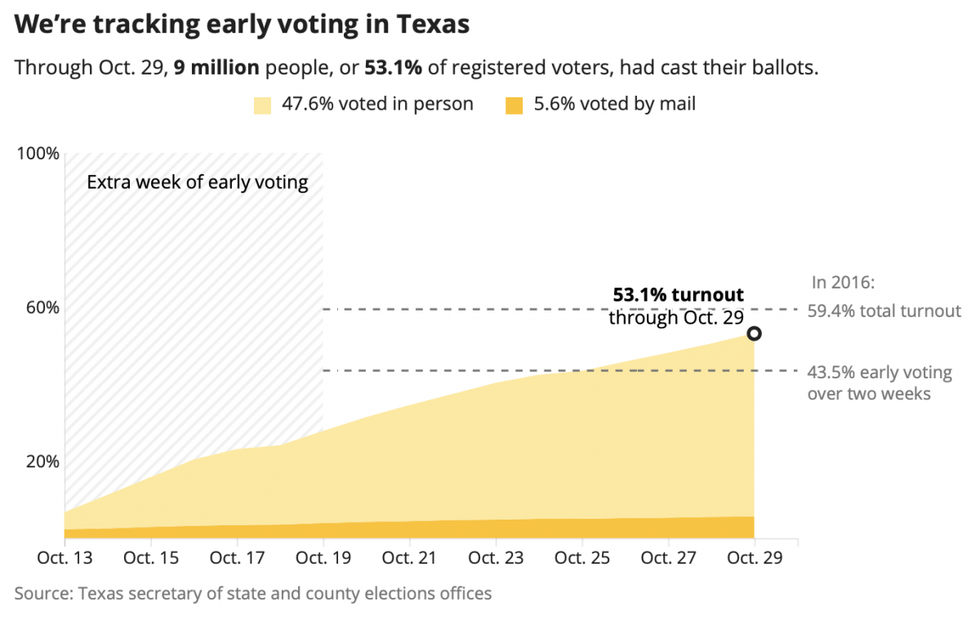
The AP put those data points into context:
Voters statewide don't register by party affiliation, so no one can yet know which side will benefit from the surge. Turnout has also been inflated by Texas' booming population. More than 16.9 million Texans are registered to vote in 2020, a roughly 1.8 million increase from 2016's about 15.1-plus million. The number of early votes so far accounts for only about 53% of statewide registered voters, while about 59% of registered voters cast early and Election Day ballots in 2016.
Earlier this month, Biden poured $6.3 million into an advertising blitz in the state, prompting local media and state Democrats to point out that he was the first party nominee in decades to make a serious push in Texas. That move came shortly after a Washington Post opinion piece by former Democratic presidential primary candidate and Texas Congressman Beto O'Rourke and Tory Gavito, president and co-founder of Way to Win and the former executive director of the Texas Future Project.
Urging Biden to invest in their state, O'Rourke--also known nationally for narrowly losing to incumbent Sen. Ted Cruz (R-Texas) in 2018--and Gavito noted that defeating President Donald Trump there could cause a Biden victory on Election Day, "because Texas' 38 electoral college votes are the most up for grabs of any swing state."
Though securing Texas' electoral votes would be no easy feat for the former vice president--Trump beat 2016 Democratic nominee Hillary Clinton by 9% in the state and most local polls this month have favored the president--there is some anticipation of a long-sought shift. On Wednesday, the nonpartisan Cook Political Report declared Texas a "Toss Up" in terms of the presidential election, with national editor Amy Walter writing "it is clear that it's more competitive than ever."
"Texas' shift from Lean Republican to Toss Up shouldn't come as a surprise," Walter added. "Recent polling in the state--both public and private--shows a 2-4 point race. That's pretty much in line with the hotly contested 2018 Senate race in the state where Sen. Ted Cruz narrowly defeated Rep. Beto O'Rourke 51% to 48%."
Biden and his supporters, including O'Rourke, are still hard at work to win over voters in Texas. His primary rival-turned-running mate, Sen. Kamala Harris (D-Calif.), campaigned in the state on Friday, starting in Fort Worth before heading to McAllen and Houston, according to the Tribune.
"So listen, today is the last day of early voting in Texas and you all have been doing your thing," Harris told a mostly Black, socially distanced, and seated crowd, during an event at the First Saint John Cathedral in Fort Worth. "Now we know this is no time to let up on the pedal though, right?"
Reporting for Politico Friday, Will Ford detailed how left-leaning Texans are now also targeting some of the reddest areas of the state. "For years, Democratic orthodoxy has maintained that flipping Texas Democratic in statewide races--this year for presidential candidate Joe Biden and Senate candidate MJ Hegar, most prominently--means increasing turnout in urban areas and swing suburbs," Ford explained. "But that strategy alone hasn't worked yet--even as favorable demographic changes, especially in urban areas, suburbs, and now even exurbs, have put the state in play."
These days, people like Hannah Horick, chair of the Ector County Democratic Party, and David Logan, a data analyst for Jon Mark Hogg, the Democratic candidate for Texas' 11th Congressional District, "are part of an effort by Democrats to broaden their strategy by targeting the most Republican areas of the state as well," he continued. "If they can boost Democratic support in places like Odessa just slightly, then, together with the unprecedented early vote surge in cities, Democrats think they might finally get enough votes to flip the state. It's not about winning in these deep-red counties and districts--it's about cutting into Republican margins, no matter how large."
O'Rourke, who campaigned all across the state during his bid to oust Cruz from the Senate, spoke with Ford about this approach:
"I think it's a false choice," O'Rourke told me, of the traditional thinking that parties have to choose between targeting rural and urban voters. "You can do both. In Texas, there were really two populations left uncontested--rural red counties written off and urban ones taken for granted." For Republicans, he added, the same was true, though in opposite directions.
But when I asked whether he received pushback against this strategy in Democratic circles, he almost laughed. "Tons. They all said, 'Your vote's in Houston and the cities.'" West Texan voters were equally surprised: O'Rourke said some voters in West Texas told him they hadn't seen a statewide Democratic candidate visit since LBJ.
On Friday, with a possible Biden win just days away, O'Rourke was back to knocking on doors--this time, urging residents of Mission, Texas to cast their votes for his former primary competitor.

Beto O'Rourke told reporters Saturday that he has no concerns about Sen. Bernie Sanders's fitness for the presidency following the Vermont senator's brief hospitalization for a heart attack last week.
"There isn't a more important voice out there on some of the most important issues that this country faces," said O'Rourke, a former Texas congressman and current 2020 Democratic presidential candidate. "There isn't a more energized, energetic candidate and campaigner keeping up a relentless schedule."
"I have no fears about Bernie Sanders, and [it] does not cause me any concern at all," O'Rourke added, referring to Sanders's hospitalization. "And really all I wish for him is a full and speedy recovery, and his ability to get back after it on the campaign trail. Grateful that he's a candidate and grateful to be in this race with him."
David Sirota, Sanders's speechwriter, applauded O'Rourke's remarks, which came as the Sanders campaign is pushing back against an emerging media narrative that the senator was not forthright about his health scare.
"A class act," tweeted Sirota.
Sanders was discharged from the hospital Friday after two and a half days. On Tuesday, the campaign said Sanders had a heart stent procedure after the senator experienced chest discomfort on the trail in Nevada.
Upon Sanders's exit from the hospital Friday, the campaign released a statement from the senator's doctors announcing he was treated for a myocardial infarction, the medical term for a heart attack.
Responding to criticism of the way the campaign handled Sanders's hospitalization and diagnosis, Mike Casca, senior communications adviser for Sanders, tweeted: "Give me a break. We consistently updated the press and supporters on the senator's condition during his stay through statements and a gaggle with Jane, and we released all the information from his doctors as he was discharged."
In a video posted on Twitter hours after leaving the hospital, Sanders expressed gratitude for the love and well-wishes he received and said he is "feeling so much better."
"See you soon on the campaign trail," Sanders said.