
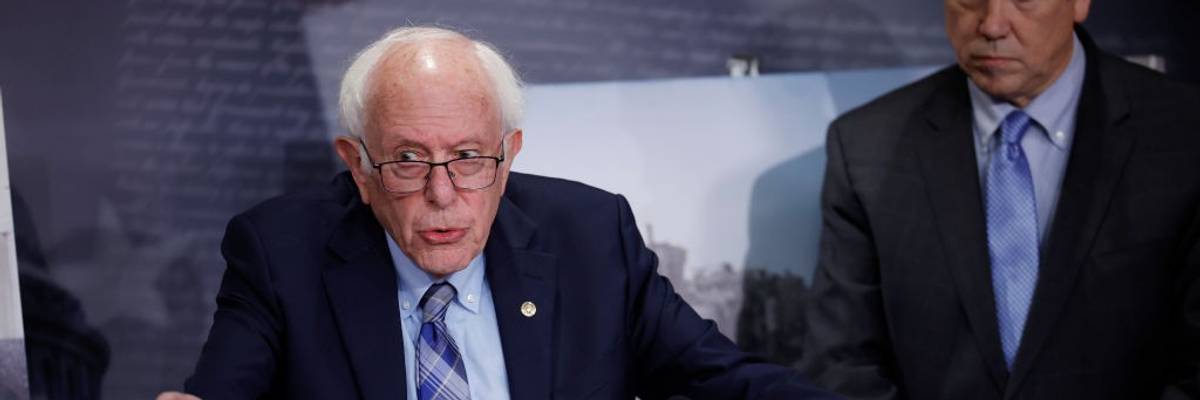
U.S. Sen. Bernie Sanders (I-Vt.) speaks at a news conference on November 19, 2024 in Washington, D.C.
Sanders Explains Why He's Voting Against the New $850 Billion Pentagon Budget
"We do not need to spend almost a trillion dollars on the military, while half a million Americans are homeless and children go hungry," Sen. Bernie Sanders writes in a new op-ed.
U.S. Sen. Bernie Sanders on Sunday announced his opposition to an annual military policy bill that would authorize a Pentagon budget of nearly $850 billion, a sum that the progressive senator from Vermont characterized as outrageous—particularly as so many Americans face economic hardship.
"We do not need to spend almost a trillion dollars on the military, while half a million Americans are homeless and children go hungry," Sanders (I-Vt.) wrote in an op-ed for The Guardian after the House and Senate released legislative text for the National Defense Authorization Act (NDAA) for Fiscal Year 2025.
Sanders continued:
In this moment in history, it would be wise for us to remember what Dwight D. Eisenhower, a former five-star general, said in his farewell address in 1961: "In the councils of government, we must guard against the acquisition of unwarranted influence, whether sought or unsought, by the military-industrial complex. The potential for the disastrous rise of misplaced power exists and will persist." What Eisenhower said was true in 1961. It is even more true today.
I will be voting against the military budget.
The senator's op-ed came hours after lawmakers from both chambers of Congress unveiled the sprawling, 1,813-page NDAA for the coming fiscal year. The legislation's topline is just over $895 billion as lawmakers from both parties push annual U.S. military spending inexorably toward $1 trillion, even as the Pentagon fails to pass an audit.
The U.S. currently spends more on its military than the next nine countries combined, and military spending accounts for more than half of the nation's yearly discretionary spending, according to the National Priorities Project.
Sanders wrote Sunday that "very few people who have researched the military-industrial complex doubt that there is massive fraud, waste and cost over-runs in the system." One analysis estimates that over 50% of the Pentagon's annual budget, the subject of aggressive industry lobbying, goes to private contractors.
"Defense contractors routinely overcharge the Pentagon by 40%—and sometimes more than 4,000%," Sanders continued. "For example, in October, RTX (formerly Raytheon) was fined $950 million for inflating bills to the DoD, lying about labor and material costs, and paying bribes to secure foreign business. In June, Lockheed Martin was fined $70 million for overcharging the navy for aircraft parts, the latest in a long line of similar abuses. The F-35, the most expensive weapon system in history, has run up hundreds of billions in cost overruns."
The NDAA could have some trouble getting through the divided Congress—but not because of the proposed size of the Pentagon budget.
House Speaker Mike Johnson (R-La.) said in a statement that the legislation includes language that would "permanently ban transgender medical treatment for minors" and other provisions that are expected to draw Democratic opposition.
Kelley Robinson, president of the Human Rights Campaign, said in a statement Saturday that "anti-equality House Republican leaders are hijacking a defense bill to play politics with the healthcare of children of servicemembers."
"This cruel and hateful bill suddenly strips away access to medical care for families that members of our armed forces are counting on, and it could force servicemembers to choose between staying in the military or providing healthcare for their children," said Robinson. "Politicians have no place inserting themselves into decisions that should be between families and their doctors. We call on members of Congress to do what's right and vote against this damaging legislation."
We are at a crossroads
This country and this world are at a monumental crossroads. In a few short weeks, US voters will have an opportunity to beat back the forces of fascism and confront the billionaires who are rigging the economy, our media system, and our democracy, making it increasingly impossible for ordinary people to get by. We’re not just talking about the election. We’re talking about what must be done once these fascist elements are vanquished from power. We need a bolder set of solutions than what either major party has so far been willing to offer and a working-class movement ready to fight like hell for it. Trump didn't emerge from nowhere. The conditions that fueled MAGA authoritarianism were created by decades of radical neoliberal economic policies and a corrupt political system dominated by corporate interests. They slashed taxes on the super-rich, promising that the benefits would trickle down. They said giveaways to the corporate titans would make life more affordable for the rest of us. It was all bullshit. And when a bitter, betrayed populace searches for someone to blame, right-wing demagogues have little trouble finding scapegoats. People know when they're being lied to, but you won't hear any of this from the corporate media. Only independent journalism—powered and funded by people who believe in building a better world—can deliver truly trustworthy daily news. Our Fall Campaign is underway, and we need your help. To power our newsroom through the rest of the year, we need to raise $125,000 by midnight on October 31. So if you share our vision, please contribute whatever you can to sustain our work. |
U.S. Sen. Bernie Sanders on Sunday announced his opposition to an annual military policy bill that would authorize a Pentagon budget of nearly $850 billion, a sum that the progressive senator from Vermont characterized as outrageous—particularly as so many Americans face economic hardship.
"We do not need to spend almost a trillion dollars on the military, while half a million Americans are homeless and children go hungry," Sanders (I-Vt.) wrote in an op-ed for The Guardian after the House and Senate released legislative text for the National Defense Authorization Act (NDAA) for Fiscal Year 2025.
Sanders continued:
In this moment in history, it would be wise for us to remember what Dwight D. Eisenhower, a former five-star general, said in his farewell address in 1961: "In the councils of government, we must guard against the acquisition of unwarranted influence, whether sought or unsought, by the military-industrial complex. The potential for the disastrous rise of misplaced power exists and will persist." What Eisenhower said was true in 1961. It is even more true today.
I will be voting against the military budget.
The senator's op-ed came hours after lawmakers from both chambers of Congress unveiled the sprawling, 1,813-page NDAA for the coming fiscal year. The legislation's topline is just over $895 billion as lawmakers from both parties push annual U.S. military spending inexorably toward $1 trillion, even as the Pentagon fails to pass an audit.
The U.S. currently spends more on its military than the next nine countries combined, and military spending accounts for more than half of the nation's yearly discretionary spending, according to the National Priorities Project.
Sanders wrote Sunday that "very few people who have researched the military-industrial complex doubt that there is massive fraud, waste and cost over-runs in the system." One analysis estimates that over 50% of the Pentagon's annual budget, the subject of aggressive industry lobbying, goes to private contractors.
"Defense contractors routinely overcharge the Pentagon by 40%—and sometimes more than 4,000%," Sanders continued. "For example, in October, RTX (formerly Raytheon) was fined $950 million for inflating bills to the DoD, lying about labor and material costs, and paying bribes to secure foreign business. In June, Lockheed Martin was fined $70 million for overcharging the navy for aircraft parts, the latest in a long line of similar abuses. The F-35, the most expensive weapon system in history, has run up hundreds of billions in cost overruns."
The NDAA could have some trouble getting through the divided Congress—but not because of the proposed size of the Pentagon budget.
House Speaker Mike Johnson (R-La.) said in a statement that the legislation includes language that would "permanently ban transgender medical treatment for minors" and other provisions that are expected to draw Democratic opposition.
Kelley Robinson, president of the Human Rights Campaign, said in a statement Saturday that "anti-equality House Republican leaders are hijacking a defense bill to play politics with the healthcare of children of servicemembers."
"This cruel and hateful bill suddenly strips away access to medical care for families that members of our armed forces are counting on, and it could force servicemembers to choose between staying in the military or providing healthcare for their children," said Robinson. "Politicians have no place inserting themselves into decisions that should be between families and their doctors. We call on members of Congress to do what's right and vote against this damaging legislation."
U.S. Sen. Bernie Sanders on Sunday announced his opposition to an annual military policy bill that would authorize a Pentagon budget of nearly $850 billion, a sum that the progressive senator from Vermont characterized as outrageous—particularly as so many Americans face economic hardship.
"We do not need to spend almost a trillion dollars on the military, while half a million Americans are homeless and children go hungry," Sanders (I-Vt.) wrote in an op-ed for The Guardian after the House and Senate released legislative text for the National Defense Authorization Act (NDAA) for Fiscal Year 2025.
Sanders continued:
In this moment in history, it would be wise for us to remember what Dwight D. Eisenhower, a former five-star general, said in his farewell address in 1961: "In the councils of government, we must guard against the acquisition of unwarranted influence, whether sought or unsought, by the military-industrial complex. The potential for the disastrous rise of misplaced power exists and will persist." What Eisenhower said was true in 1961. It is even more true today.
I will be voting against the military budget.
The senator's op-ed came hours after lawmakers from both chambers of Congress unveiled the sprawling, 1,813-page NDAA for the coming fiscal year. The legislation's topline is just over $895 billion as lawmakers from both parties push annual U.S. military spending inexorably toward $1 trillion, even as the Pentagon fails to pass an audit.
The U.S. currently spends more on its military than the next nine countries combined, and military spending accounts for more than half of the nation's yearly discretionary spending, according to the National Priorities Project.
Sanders wrote Sunday that "very few people who have researched the military-industrial complex doubt that there is massive fraud, waste and cost over-runs in the system." One analysis estimates that over 50% of the Pentagon's annual budget, the subject of aggressive industry lobbying, goes to private contractors.
"Defense contractors routinely overcharge the Pentagon by 40%—and sometimes more than 4,000%," Sanders continued. "For example, in October, RTX (formerly Raytheon) was fined $950 million for inflating bills to the DoD, lying about labor and material costs, and paying bribes to secure foreign business. In June, Lockheed Martin was fined $70 million for overcharging the navy for aircraft parts, the latest in a long line of similar abuses. The F-35, the most expensive weapon system in history, has run up hundreds of billions in cost overruns."
The NDAA could have some trouble getting through the divided Congress—but not because of the proposed size of the Pentagon budget.
House Speaker Mike Johnson (R-La.) said in a statement that the legislation includes language that would "permanently ban transgender medical treatment for minors" and other provisions that are expected to draw Democratic opposition.
Kelley Robinson, president of the Human Rights Campaign, said in a statement Saturday that "anti-equality House Republican leaders are hijacking a defense bill to play politics with the healthcare of children of servicemembers."
"This cruel and hateful bill suddenly strips away access to medical care for families that members of our armed forces are counting on, and it could force servicemembers to choose between staying in the military or providing healthcare for their children," said Robinson. "Politicians have no place inserting themselves into decisions that should be between families and their doctors. We call on members of Congress to do what's right and vote against this damaging legislation."