

SUBSCRIBE TO OUR FREE NEWSLETTER
Daily news & progressive opinion—funded by the people, not the corporations—delivered straight to your inbox.
5
#000000
#FFFFFF
To donate by check, phone, or other method, see our More Ways to Give page.
Daily news & progressive opinion—funded by the people, not the corporations—delivered straight to your inbox.
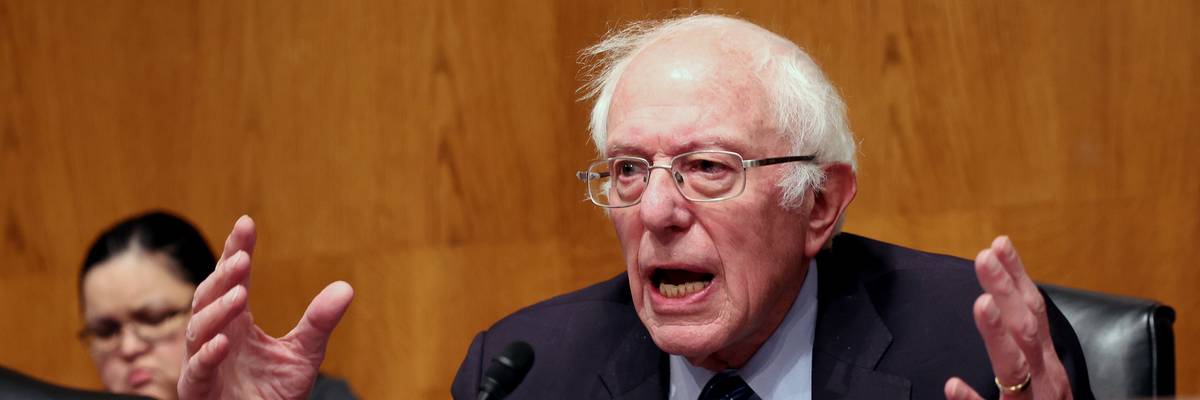
U.S. Senate Health, Education, Labor, and Pensions Committee Chair Bernie Sanders (I-Vt.) speaks during a November 14, 2023 hearing in Washington, D.C. on corporate green and unions.
"All over this country, we are seeing workers standing up and fighting back against the unprecedented corporate greed taking place in America in a way that we have not seen in decades."
Amid a nationwide wave of labor organizing and victories, U.S. Senate Health, Education, Labor, and Pensions Committee Chair Bernie Sanders on Tuesday held a hearing on the critical role unions play in raising up working families and fighting corporate greed.
"In America today, we have more income and wealth inequality than at any time since the Gilded Age," Sanders (I-Vt.) noted in his prepared remarks. "Today, three people in our country own more wealth than the bottom half of our society—over 165 million Americans."
"Today, while the very richest people in America become much richer, over 60% of our people are living paycheck-to-paycheck and many work for starvation wages and under terrible working conditions," he continued. "Today, while millions of ordinary people are struggling to pay the rent, pay for daycare, and put food on the table, CEOs are making nearly 350 times as much as their average workers."
"While there is much to be concerned about in today's economy, there is also some very good news and that is what brings us to the topic of today's hearing," Sanders asserted.
He continued:
All over this country, we are seeing workers standing up and fighting back against the unprecedented corporate greed taking place in America in a way that we have not seen in decades. This year alone, over 450,000 workers in America have gone on strike for better wages, benefits, and working conditions—up more than 900% compared to just two years ago. Last year, union membership in America increased by 273,000—to a total of 14.3 million workers. Last year, employees in nearly 2,600 worksites in America filed petitions with the National Labor Relations Board to form a union—up more than 50% from two years ago.
"In other words, in America today, more workers want to join unions; more workers are joining unions; and more workers are going out on strike to improve their working conditions than we have seen in a very long time—and many of those unions are winning strong contracts for their workers," Sanders said.
"And what we are seeing is that these historic union victories are not only improving the lives of their members, they are beginning to improve the lives of nonunion workers all over the country," he added.
Speaking at the hearing, United Auto Workers (UAW) president Shawn Fain—who has garnered national attention recently with the "Big Three" strikes—said that "the working class needs this committee, and the entire Congress to step up."
"You all have an essential role to play," he added. "Not only in supporting our fights and other fights like ours. But to finish the job for economic and social justice for the entire working class."
Association of Flight Attendants-CWA president Sara Nelson also spoke at the hearing, as did Teamsters president Sean O'Brien, who was challenged to a fistfight by Sen. Markwayne Mullin (R-Okla.) before Sanders stepped in to stop them.
The hearing came amid a string of recent labor victories, as unions representing autoworkers, medical professionals, and writers and actors are among those that have notched big wins. From Starbucks to strip clubs, workers are also forming or joining unions at rates not seen in decades. Meanwhile, public approval of unions is higher than it's been in the last half-century.
However, just 10% of U.S. workers belong to a union—the lowest rate ever recorded—while last year union membership fell for the second straight year. In contrast, nearly a third of the country's workforce was unionized in the 1950s.
In an interview with The Guardian's Michael Sainato published on Tuesday, Sanders stressed that "we have got to expand union organizing in this country if we're going to save the middle class."
"The American people are sick and tired of corporate greed, of record-breaking profits, outrageous compensation packages for CEOs while workers in many cases are earning starvation wages," he continued. "That dynamic has got to change. I think we've seen real, real progress in the last year."
"What we have got to do in Congress is pass legislation like the PRO Act which allows workers to exercise their constitutional right to form a union," added Sanders, who reintroduced the Richard L. Trumka Protecting the Right to Organize Act earlier this year.
Dear Common Dreams reader, It’s been nearly 30 years since I co-founded Common Dreams with my late wife, Lina Newhouser. We had the radical notion that journalism should serve the public good, not corporate profits. It was clear to us from the outset what it would take to build such a project. No paid advertisements. No corporate sponsors. No millionaire publisher telling us what to think or do. Many people said we wouldn't last a year, but we proved those doubters wrong. Together with a tremendous team of journalists and dedicated staff, we built an independent media outlet free from the constraints of profits and corporate control. Our mission has always been simple: To inform. To inspire. To ignite change for the common good. Building Common Dreams was not easy. Our survival was never guaranteed. When you take on the most powerful forces—Wall Street greed, fossil fuel industry destruction, Big Tech lobbyists, and uber-rich oligarchs who have spent billions upon billions rigging the economy and democracy in their favor—the only bulwark you have is supporters who believe in your work. But here’s the urgent message from me today. It's never been this bad out there. And it's never been this hard to keep us going. At the very moment Common Dreams is most needed, the threats we face are intensifying. We need your support now more than ever. We don't accept corporate advertising and never will. We don't have a paywall because we don't think people should be blocked from critical news based on their ability to pay. Everything we do is funded by the donations of readers like you. When everyone does the little they can afford, we are strong. But if that support retreats or dries up, so do we. Will you donate now to make sure Common Dreams not only survives but thrives? —Craig Brown, Co-founder |
Amid a nationwide wave of labor organizing and victories, U.S. Senate Health, Education, Labor, and Pensions Committee Chair Bernie Sanders on Tuesday held a hearing on the critical role unions play in raising up working families and fighting corporate greed.
"In America today, we have more income and wealth inequality than at any time since the Gilded Age," Sanders (I-Vt.) noted in his prepared remarks. "Today, three people in our country own more wealth than the bottom half of our society—over 165 million Americans."
"Today, while the very richest people in America become much richer, over 60% of our people are living paycheck-to-paycheck and many work for starvation wages and under terrible working conditions," he continued. "Today, while millions of ordinary people are struggling to pay the rent, pay for daycare, and put food on the table, CEOs are making nearly 350 times as much as their average workers."
"While there is much to be concerned about in today's economy, there is also some very good news and that is what brings us to the topic of today's hearing," Sanders asserted.
He continued:
All over this country, we are seeing workers standing up and fighting back against the unprecedented corporate greed taking place in America in a way that we have not seen in decades. This year alone, over 450,000 workers in America have gone on strike for better wages, benefits, and working conditions—up more than 900% compared to just two years ago. Last year, union membership in America increased by 273,000—to a total of 14.3 million workers. Last year, employees in nearly 2,600 worksites in America filed petitions with the National Labor Relations Board to form a union—up more than 50% from two years ago.
"In other words, in America today, more workers want to join unions; more workers are joining unions; and more workers are going out on strike to improve their working conditions than we have seen in a very long time—and many of those unions are winning strong contracts for their workers," Sanders said.
"And what we are seeing is that these historic union victories are not only improving the lives of their members, they are beginning to improve the lives of nonunion workers all over the country," he added.
Speaking at the hearing, United Auto Workers (UAW) president Shawn Fain—who has garnered national attention recently with the "Big Three" strikes—said that "the working class needs this committee, and the entire Congress to step up."
"You all have an essential role to play," he added. "Not only in supporting our fights and other fights like ours. But to finish the job for economic and social justice for the entire working class."
Association of Flight Attendants-CWA president Sara Nelson also spoke at the hearing, as did Teamsters president Sean O'Brien, who was challenged to a fistfight by Sen. Markwayne Mullin (R-Okla.) before Sanders stepped in to stop them.
The hearing came amid a string of recent labor victories, as unions representing autoworkers, medical professionals, and writers and actors are among those that have notched big wins. From Starbucks to strip clubs, workers are also forming or joining unions at rates not seen in decades. Meanwhile, public approval of unions is higher than it's been in the last half-century.
However, just 10% of U.S. workers belong to a union—the lowest rate ever recorded—while last year union membership fell for the second straight year. In contrast, nearly a third of the country's workforce was unionized in the 1950s.
In an interview with The Guardian's Michael Sainato published on Tuesday, Sanders stressed that "we have got to expand union organizing in this country if we're going to save the middle class."
"The American people are sick and tired of corporate greed, of record-breaking profits, outrageous compensation packages for CEOs while workers in many cases are earning starvation wages," he continued. "That dynamic has got to change. I think we've seen real, real progress in the last year."
"What we have got to do in Congress is pass legislation like the PRO Act which allows workers to exercise their constitutional right to form a union," added Sanders, who reintroduced the Richard L. Trumka Protecting the Right to Organize Act earlier this year.
Amid a nationwide wave of labor organizing and victories, U.S. Senate Health, Education, Labor, and Pensions Committee Chair Bernie Sanders on Tuesday held a hearing on the critical role unions play in raising up working families and fighting corporate greed.
"In America today, we have more income and wealth inequality than at any time since the Gilded Age," Sanders (I-Vt.) noted in his prepared remarks. "Today, three people in our country own more wealth than the bottom half of our society—over 165 million Americans."
"Today, while the very richest people in America become much richer, over 60% of our people are living paycheck-to-paycheck and many work for starvation wages and under terrible working conditions," he continued. "Today, while millions of ordinary people are struggling to pay the rent, pay for daycare, and put food on the table, CEOs are making nearly 350 times as much as their average workers."
"While there is much to be concerned about in today's economy, there is also some very good news and that is what brings us to the topic of today's hearing," Sanders asserted.
He continued:
All over this country, we are seeing workers standing up and fighting back against the unprecedented corporate greed taking place in America in a way that we have not seen in decades. This year alone, over 450,000 workers in America have gone on strike for better wages, benefits, and working conditions—up more than 900% compared to just two years ago. Last year, union membership in America increased by 273,000—to a total of 14.3 million workers. Last year, employees in nearly 2,600 worksites in America filed petitions with the National Labor Relations Board to form a union—up more than 50% from two years ago.
"In other words, in America today, more workers want to join unions; more workers are joining unions; and more workers are going out on strike to improve their working conditions than we have seen in a very long time—and many of those unions are winning strong contracts for their workers," Sanders said.
"And what we are seeing is that these historic union victories are not only improving the lives of their members, they are beginning to improve the lives of nonunion workers all over the country," he added.
Speaking at the hearing, United Auto Workers (UAW) president Shawn Fain—who has garnered national attention recently with the "Big Three" strikes—said that "the working class needs this committee, and the entire Congress to step up."
"You all have an essential role to play," he added. "Not only in supporting our fights and other fights like ours. But to finish the job for economic and social justice for the entire working class."
Association of Flight Attendants-CWA president Sara Nelson also spoke at the hearing, as did Teamsters president Sean O'Brien, who was challenged to a fistfight by Sen. Markwayne Mullin (R-Okla.) before Sanders stepped in to stop them.
The hearing came amid a string of recent labor victories, as unions representing autoworkers, medical professionals, and writers and actors are among those that have notched big wins. From Starbucks to strip clubs, workers are also forming or joining unions at rates not seen in decades. Meanwhile, public approval of unions is higher than it's been in the last half-century.
However, just 10% of U.S. workers belong to a union—the lowest rate ever recorded—while last year union membership fell for the second straight year. In contrast, nearly a third of the country's workforce was unionized in the 1950s.
In an interview with The Guardian's Michael Sainato published on Tuesday, Sanders stressed that "we have got to expand union organizing in this country if we're going to save the middle class."
"The American people are sick and tired of corporate greed, of record-breaking profits, outrageous compensation packages for CEOs while workers in many cases are earning starvation wages," he continued. "That dynamic has got to change. I think we've seen real, real progress in the last year."
"What we have got to do in Congress is pass legislation like the PRO Act which allows workers to exercise their constitutional right to form a union," added Sanders, who reintroduced the Richard L. Trumka Protecting the Right to Organize Act earlier this year.

