SUBSCRIBE TO OUR FREE NEWSLETTER
Daily news & progressive opinion—funded by the people, not the corporations—delivered straight to your inbox.
5
#000000
#FFFFFF
To donate by check, phone, or other method, see our More Ways to Give page.
Daily news & progressive opinion—funded by the people, not the corporations—delivered straight to your inbox.
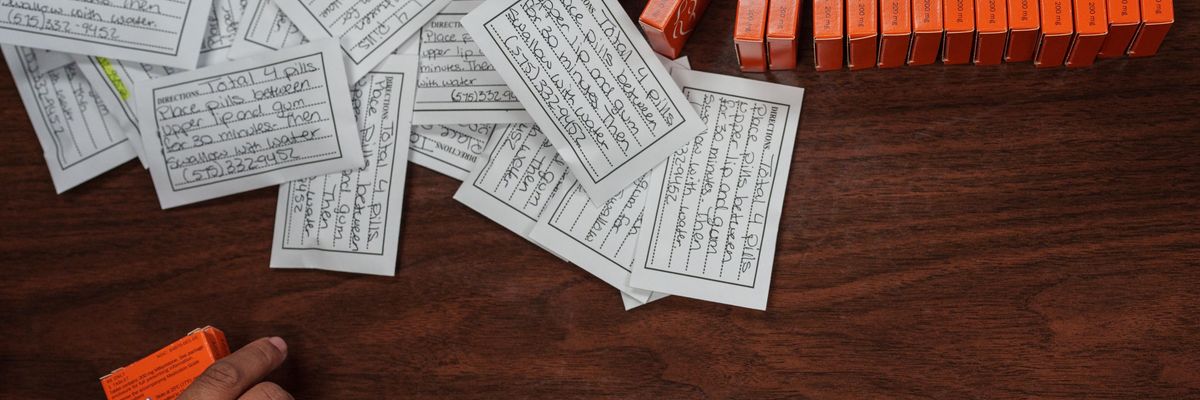
Doses of Mifepristone and Misoprostol, which are taken for medication abortions, are pictured at a health clinic in Santa Teresa, New Mexico on May 7, 2022.
"If abortion medication isn't available—if pharmacies literally don't carry it, or only have limited quantities available—we will see unprecedented suffering," said one rights advocate.
A month after the two largest pharmacy chains in the United States announced their efforts to become certified to dispense abortion pills by mail, in accordance with a new Food and Drug Administration rule, the Republican attorneys general of 20 states on Wednesday warned the companies that providing the medications by mail in their states could result in legal action against them.
In a letter co-signed by 19 attorneys general from states that have banned or attempted to ban abortion since the U.S. Supreme Court overturned Roe v. Wade last year, Attorney General Andrew Bailey of Missouri wrote to officials at Walgreens and CVS and suggested that they could face litigation if they follow new regulatory guidelines introduced by the FDA in early January.
The agency announced last month that retail drugstores can dispense mifepristone and misoprostol—drugs used for medication abortions, which accounted for 51% of abortions in 2020 according to the Centers for Disease Control and Prevention. The rule reversed strict regulations that for decades required patients to obtain mifepristone only at health clinics, which medical experts have long said were unnecessarily limited people's access to the pills and were rooted in politics rather than science.
"The prohibition and difficulty in accessing abortion pills has no medical basis, just a political one."
Both pharmacies
said soon after the rule was changed that they were beginning the process of becoming certified to send abortion pills to patients who have a prescription for them from a healthcare provider, in states where abortion care is legal.
The attorneys general who signed Bailey's letter on Wednesday claimed the companies will be in violation "not only of federal law, but also of the laws of the various states" if they follow the FDA guidance.
Two states—Indiana and Texas—have
imposed bans on medication abortions starting at a certain point in pregnancy, while 18 states require patients to be in the physical presence of a prescribing clinician to obtain mifepristone and misoprostol—restrictions that run afoul of the new federal regulations.
A manufacturer of mifepristone filed a lawsuit late last month to overturn West Virginia's abortion ban, arguing that the FDA's approval of the drug preempts the state's law.
The Biden administration also issued a legal opinion last month saying the U.S. Postal Service can mail abortion pills to states with abortion bans or severe restrictions, if the sender does not intend to break the law.
Of the 20 states whose attorneys general signed the letter sent Wednesday to CVS and Walgreens, 10—Alaska, Florida, Georgia, Indiana, Iowa, Montana, North Dakota, Ohio, South Carolina, and Utah— still permit abortion care. Several of the states have attempted to ban the procedure but the proposals have been blocked.
Despite this, the attorneys general suggested that sending abortion pills to patients in their states will violate their laws.
"These state laws reflect not only our commitment to protecting the lives and dignity of children, but also of women," wrote Bailey. "We emphasize that it is our responsibility as state attorneys general to uphold the law and protect the health, safety, and well-being of women and unborn children in our states."
The right-wing attorneys general "are in the wrong here," said women's rights group UltraViolet.
The letter comes just over a week after South Dakota's Republican governor, Kristi Noem, joined state Attorney General Marty Jackley in
threatening the state's pharmacists with felony charges if they distribute abortion pills.
If the pharmacies cave to the demands of the Republicans, said author and advocate Jessica Valenti, people in the 20 states in question "will no longer have access to one of the most common forms of miscarriage treatment."
"If abortion medication isn't available—if pharmacies literally don't carry it, or only have limited quantities available—we will see unprecedented suffering," she
said.
Dear Common Dreams reader, It’s been nearly 30 years since I co-founded Common Dreams with my late wife, Lina Newhouser. We had the radical notion that journalism should serve the public good, not corporate profits. It was clear to us from the outset what it would take to build such a project. No paid advertisements. No corporate sponsors. No millionaire publisher telling us what to think or do. Many people said we wouldn't last a year, but we proved those doubters wrong. Together with a tremendous team of journalists and dedicated staff, we built an independent media outlet free from the constraints of profits and corporate control. Our mission has always been simple: To inform. To inspire. To ignite change for the common good. Building Common Dreams was not easy. Our survival was never guaranteed. When you take on the most powerful forces—Wall Street greed, fossil fuel industry destruction, Big Tech lobbyists, and uber-rich oligarchs who have spent billions upon billions rigging the economy and democracy in their favor—the only bulwark you have is supporters who believe in your work. But here’s the urgent message from me today. It's never been this bad out there. And it's never been this hard to keep us going. At the very moment Common Dreams is most needed, the threats we face are intensifying. We need your support now more than ever. We don't accept corporate advertising and never will. We don't have a paywall because we don't think people should be blocked from critical news based on their ability to pay. Everything we do is funded by the donations of readers like you. When everyone does the little they can afford, we are strong. But if that support retreats or dries up, so do we. Will you donate now to make sure Common Dreams not only survives but thrives? —Craig Brown, Co-founder |
A month after the two largest pharmacy chains in the United States announced their efforts to become certified to dispense abortion pills by mail, in accordance with a new Food and Drug Administration rule, the Republican attorneys general of 20 states on Wednesday warned the companies that providing the medications by mail in their states could result in legal action against them.
In a letter co-signed by 19 attorneys general from states that have banned or attempted to ban abortion since the U.S. Supreme Court overturned Roe v. Wade last year, Attorney General Andrew Bailey of Missouri wrote to officials at Walgreens and CVS and suggested that they could face litigation if they follow new regulatory guidelines introduced by the FDA in early January.
The agency announced last month that retail drugstores can dispense mifepristone and misoprostol—drugs used for medication abortions, which accounted for 51% of abortions in 2020 according to the Centers for Disease Control and Prevention. The rule reversed strict regulations that for decades required patients to obtain mifepristone only at health clinics, which medical experts have long said were unnecessarily limited people's access to the pills and were rooted in politics rather than science.
"The prohibition and difficulty in accessing abortion pills has no medical basis, just a political one."
Both pharmacies
said soon after the rule was changed that they were beginning the process of becoming certified to send abortion pills to patients who have a prescription for them from a healthcare provider, in states where abortion care is legal.
The attorneys general who signed Bailey's letter on Wednesday claimed the companies will be in violation "not only of federal law, but also of the laws of the various states" if they follow the FDA guidance.
Two states—Indiana and Texas—have
imposed bans on medication abortions starting at a certain point in pregnancy, while 18 states require patients to be in the physical presence of a prescribing clinician to obtain mifepristone and misoprostol—restrictions that run afoul of the new federal regulations.
A manufacturer of mifepristone filed a lawsuit late last month to overturn West Virginia's abortion ban, arguing that the FDA's approval of the drug preempts the state's law.
The Biden administration also issued a legal opinion last month saying the U.S. Postal Service can mail abortion pills to states with abortion bans or severe restrictions, if the sender does not intend to break the law.
Of the 20 states whose attorneys general signed the letter sent Wednesday to CVS and Walgreens, 10—Alaska, Florida, Georgia, Indiana, Iowa, Montana, North Dakota, Ohio, South Carolina, and Utah— still permit abortion care. Several of the states have attempted to ban the procedure but the proposals have been blocked.
Despite this, the attorneys general suggested that sending abortion pills to patients in their states will violate their laws.
"These state laws reflect not only our commitment to protecting the lives and dignity of children, but also of women," wrote Bailey. "We emphasize that it is our responsibility as state attorneys general to uphold the law and protect the health, safety, and well-being of women and unborn children in our states."
The right-wing attorneys general "are in the wrong here," said women's rights group UltraViolet.
The letter comes just over a week after South Dakota's Republican governor, Kristi Noem, joined state Attorney General Marty Jackley in
threatening the state's pharmacists with felony charges if they distribute abortion pills.
If the pharmacies cave to the demands of the Republicans, said author and advocate Jessica Valenti, people in the 20 states in question "will no longer have access to one of the most common forms of miscarriage treatment."
"If abortion medication isn't available—if pharmacies literally don't carry it, or only have limited quantities available—we will see unprecedented suffering," she
said.
A month after the two largest pharmacy chains in the United States announced their efforts to become certified to dispense abortion pills by mail, in accordance with a new Food and Drug Administration rule, the Republican attorneys general of 20 states on Wednesday warned the companies that providing the medications by mail in their states could result in legal action against them.
In a letter co-signed by 19 attorneys general from states that have banned or attempted to ban abortion since the U.S. Supreme Court overturned Roe v. Wade last year, Attorney General Andrew Bailey of Missouri wrote to officials at Walgreens and CVS and suggested that they could face litigation if they follow new regulatory guidelines introduced by the FDA in early January.
The agency announced last month that retail drugstores can dispense mifepristone and misoprostol—drugs used for medication abortions, which accounted for 51% of abortions in 2020 according to the Centers for Disease Control and Prevention. The rule reversed strict regulations that for decades required patients to obtain mifepristone only at health clinics, which medical experts have long said were unnecessarily limited people's access to the pills and were rooted in politics rather than science.
"The prohibition and difficulty in accessing abortion pills has no medical basis, just a political one."
Both pharmacies
said soon after the rule was changed that they were beginning the process of becoming certified to send abortion pills to patients who have a prescription for them from a healthcare provider, in states where abortion care is legal.
The attorneys general who signed Bailey's letter on Wednesday claimed the companies will be in violation "not only of federal law, but also of the laws of the various states" if they follow the FDA guidance.
Two states—Indiana and Texas—have
imposed bans on medication abortions starting at a certain point in pregnancy, while 18 states require patients to be in the physical presence of a prescribing clinician to obtain mifepristone and misoprostol—restrictions that run afoul of the new federal regulations.
A manufacturer of mifepristone filed a lawsuit late last month to overturn West Virginia's abortion ban, arguing that the FDA's approval of the drug preempts the state's law.
The Biden administration also issued a legal opinion last month saying the U.S. Postal Service can mail abortion pills to states with abortion bans or severe restrictions, if the sender does not intend to break the law.
Of the 20 states whose attorneys general signed the letter sent Wednesday to CVS and Walgreens, 10—Alaska, Florida, Georgia, Indiana, Iowa, Montana, North Dakota, Ohio, South Carolina, and Utah— still permit abortion care. Several of the states have attempted to ban the procedure but the proposals have been blocked.
Despite this, the attorneys general suggested that sending abortion pills to patients in their states will violate their laws.
"These state laws reflect not only our commitment to protecting the lives and dignity of children, but also of women," wrote Bailey. "We emphasize that it is our responsibility as state attorneys general to uphold the law and protect the health, safety, and well-being of women and unborn children in our states."
The right-wing attorneys general "are in the wrong here," said women's rights group UltraViolet.
The letter comes just over a week after South Dakota's Republican governor, Kristi Noem, joined state Attorney General Marty Jackley in
threatening the state's pharmacists with felony charges if they distribute abortion pills.
If the pharmacies cave to the demands of the Republicans, said author and advocate Jessica Valenti, people in the 20 states in question "will no longer have access to one of the most common forms of miscarriage treatment."
"If abortion medication isn't available—if pharmacies literally don't carry it, or only have limited quantities available—we will see unprecedented suffering," she
said.