SUBSCRIBE TO OUR FREE NEWSLETTER
Daily news & progressive opinion—funded by the people, not the corporations—delivered straight to your inbox.
5
#000000
#FFFFFF
To donate by check, phone, or other method, see our More Ways to Give page.
Daily news & progressive opinion—funded by the people, not the corporations—delivered straight to your inbox.
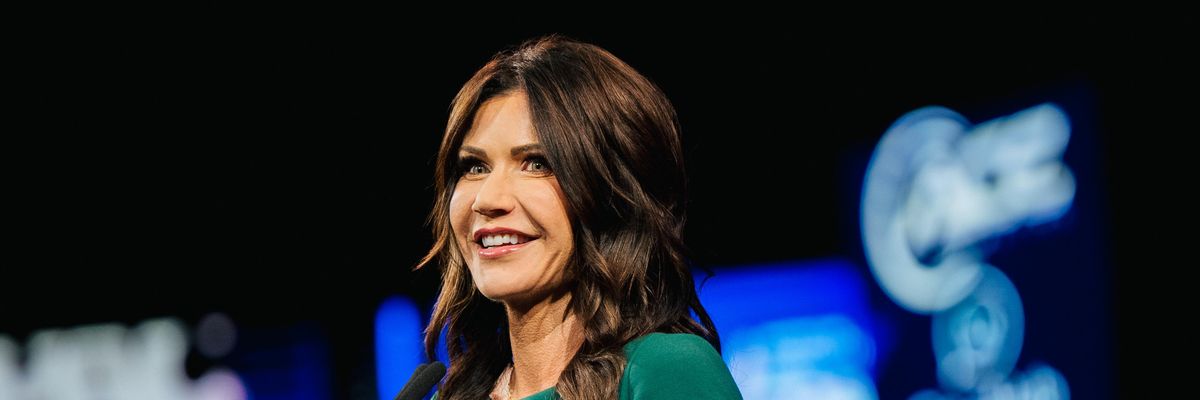
Republican South Dakota Gov. Kristi Noem speaks during the Conservative Political Action Conference (CPAC) at the Hilton Anatole on July 11, 2021 in Dallas, Texas.
One critic said Republican Gov. Kristi Noem is "stopping at nothing until every woman in South Dakota is forced to carry an unwanted pregnancy to term."
South Dakota's Republican governor and attorney general on Tuesday issued a threatening letter directed at the state's pharmacists in response to a recent move by the Biden administration to ease restrictions on dispensing abortion pills amid the GOP's nationwide assault on reproductive freedom.
Gov. Kristi Noem and AG Marty Jackley's letter begins by noting that after Dobbs v. Jackson Women's Health Organization, the U.S. Supreme Court ruling that reversed Roe v. Wade last year, abortion became illegal in South Dakota except to save the life of the pregnant person. It's one of 14 states where abortions are now largely unavailable.
The letter states that "in South Dakota, any person who administers, prescribes, or procures for any pregnant female any medicine or drug with the intent to induce an abortion is guilty of a felony."
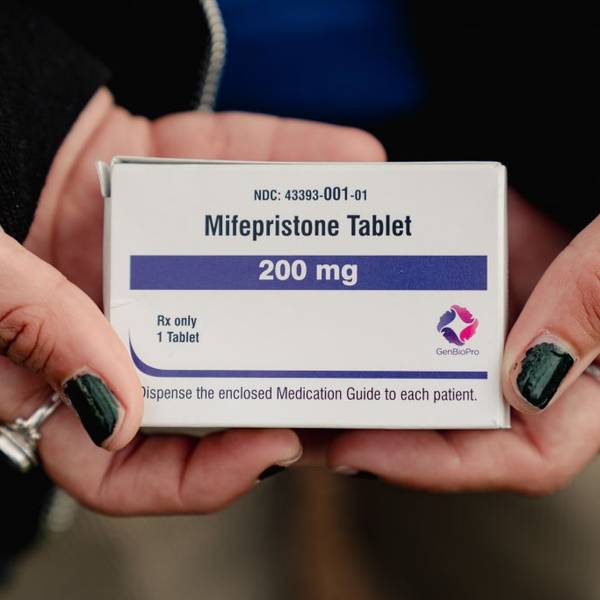
In a policy change long advocated by medical experts and rights campaigners, the Food and Drug Administration (FDA) earlier this month formalized a regulatory change to allow retail pharmacies in the U.S. to dispense mifepristone, one of two drugs often taken in tandem for a medication abortion.
Referencing that development, the letter says that "under South Dakota law, pharmacies, including chain drug stores, are prohibited from procuring and dispensing abortion-inducing drugs with the intent to induce an abortion, and are subject to felony prosecution under South Dakota law, despite the recent FDA ruling."
As The Associated Press reported Tuesday:
The [FDA's] change could expand access at online pharmacies. People can get a prescription via telehealth consultation with a health professional and then receive the pills through the mail, where permitted by law.
Still, in states like South Dakota, the rule change's impact has been blunted by laws limiting abortion broadly and the pills specifically. Legal experts foresee years of court battles over access to the pills as abortion rights proponents bring test cases to challenge state restrictions.
Amanda Bacon, the director of the South Dakota Pharmacists Association, said in an email that she was not aware of any South Dakota pharmacies with plans to participate in the federal program to dispense abortion pills.
The pro-choice Guttmacher Institute, which tracks policies across the country, labels all six states that border South Dakota as restrictive of abortion access to various degrees—and South Dakota is among the dozen "most restrictive" states in the nation.
Since the Dobbs decision, states with pro-choice policies—especially those like Illinois, which is surrounded by states with abortion restrictions—have seen an influx of "healthcare refugees."
While the FDA's recent move was widely seen as a step toward alleviating some of the strain on clinics trying to serve a growing number of patients fleeing states with forced-birth policies, an ongoing legal battle over the agency's initial approval of mifepristone in 2000 could jeopardize access to the drug nationwide.
Anti-choice physicians last month asked Judge Matthew Kacsmaryk—appointed by former President Donald Trump to the U.S. District Court for the Northern District of Texas—to throw out the FDA's 2000 decision. The judge, who was previously the deputy general counsel at a conservative Christian legal advocacy group, could issue a ruling as soon as February 10.
If the Christian alliance that launched the attack on the FDA approval "wins in federal district court, the Biden administration would appeal to the 5th Circuit in New Orleans, a conservative court with 12 of its 16 active judges appointed by Republicans," CNBC pointed out Tuesday. "From there, the case could end up at the Supreme Court."
Dear Common Dreams reader, It’s been nearly 30 years since I co-founded Common Dreams with my late wife, Lina Newhouser. We had the radical notion that journalism should serve the public good, not corporate profits. It was clear to us from the outset what it would take to build such a project. No paid advertisements. No corporate sponsors. No millionaire publisher telling us what to think or do. Many people said we wouldn't last a year, but we proved those doubters wrong. Together with a tremendous team of journalists and dedicated staff, we built an independent media outlet free from the constraints of profits and corporate control. Our mission has always been simple: To inform. To inspire. To ignite change for the common good. Building Common Dreams was not easy. Our survival was never guaranteed. When you take on the most powerful forces—Wall Street greed, fossil fuel industry destruction, Big Tech lobbyists, and uber-rich oligarchs who have spent billions upon billions rigging the economy and democracy in their favor—the only bulwark you have is supporters who believe in your work. But here’s the urgent message from me today. It's never been this bad out there. And it's never been this hard to keep us going. At the very moment Common Dreams is most needed, the threats we face are intensifying. We need your support now more than ever. We don't accept corporate advertising and never will. We don't have a paywall because we don't think people should be blocked from critical news based on their ability to pay. Everything we do is funded by the donations of readers like you. When everyone does the little they can afford, we are strong. But if that support retreats or dries up, so do we. Will you donate now to make sure Common Dreams not only survives but thrives? —Craig Brown, Co-founder |
South Dakota's Republican governor and attorney general on Tuesday issued a threatening letter directed at the state's pharmacists in response to a recent move by the Biden administration to ease restrictions on dispensing abortion pills amid the GOP's nationwide assault on reproductive freedom.
Gov. Kristi Noem and AG Marty Jackley's letter begins by noting that after Dobbs v. Jackson Women's Health Organization, the U.S. Supreme Court ruling that reversed Roe v. Wade last year, abortion became illegal in South Dakota except to save the life of the pregnant person. It's one of 14 states where abortions are now largely unavailable.
The letter states that "in South Dakota, any person who administers, prescribes, or procures for any pregnant female any medicine or drug with the intent to induce an abortion is guilty of a felony."
In a policy change long advocated by medical experts and rights campaigners, the Food and Drug Administration (FDA) earlier this month formalized a regulatory change to allow retail pharmacies in the U.S. to dispense mifepristone, one of two drugs often taken in tandem for a medication abortion.
Referencing that development, the letter says that "under South Dakota law, pharmacies, including chain drug stores, are prohibited from procuring and dispensing abortion-inducing drugs with the intent to induce an abortion, and are subject to felony prosecution under South Dakota law, despite the recent FDA ruling."
As The Associated Press reported Tuesday:
The [FDA's] change could expand access at online pharmacies. People can get a prescription via telehealth consultation with a health professional and then receive the pills through the mail, where permitted by law.
Still, in states like South Dakota, the rule change's impact has been blunted by laws limiting abortion broadly and the pills specifically. Legal experts foresee years of court battles over access to the pills as abortion rights proponents bring test cases to challenge state restrictions.
Amanda Bacon, the director of the South Dakota Pharmacists Association, said in an email that she was not aware of any South Dakota pharmacies with plans to participate in the federal program to dispense abortion pills.
The pro-choice Guttmacher Institute, which tracks policies across the country, labels all six states that border South Dakota as restrictive of abortion access to various degrees—and South Dakota is among the dozen "most restrictive" states in the nation.
Since the Dobbs decision, states with pro-choice policies—especially those like Illinois, which is surrounded by states with abortion restrictions—have seen an influx of "healthcare refugees."
While the FDA's recent move was widely seen as a step toward alleviating some of the strain on clinics trying to serve a growing number of patients fleeing states with forced-birth policies, an ongoing legal battle over the agency's initial approval of mifepristone in 2000 could jeopardize access to the drug nationwide.
Anti-choice physicians last month asked Judge Matthew Kacsmaryk—appointed by former President Donald Trump to the U.S. District Court for the Northern District of Texas—to throw out the FDA's 2000 decision. The judge, who was previously the deputy general counsel at a conservative Christian legal advocacy group, could issue a ruling as soon as February 10.
If the Christian alliance that launched the attack on the FDA approval "wins in federal district court, the Biden administration would appeal to the 5th Circuit in New Orleans, a conservative court with 12 of its 16 active judges appointed by Republicans," CNBC pointed out Tuesday. "From there, the case could end up at the Supreme Court."
South Dakota's Republican governor and attorney general on Tuesday issued a threatening letter directed at the state's pharmacists in response to a recent move by the Biden administration to ease restrictions on dispensing abortion pills amid the GOP's nationwide assault on reproductive freedom.
Gov. Kristi Noem and AG Marty Jackley's letter begins by noting that after Dobbs v. Jackson Women's Health Organization, the U.S. Supreme Court ruling that reversed Roe v. Wade last year, abortion became illegal in South Dakota except to save the life of the pregnant person. It's one of 14 states where abortions are now largely unavailable.
The letter states that "in South Dakota, any person who administers, prescribes, or procures for any pregnant female any medicine or drug with the intent to induce an abortion is guilty of a felony."
In a policy change long advocated by medical experts and rights campaigners, the Food and Drug Administration (FDA) earlier this month formalized a regulatory change to allow retail pharmacies in the U.S. to dispense mifepristone, one of two drugs often taken in tandem for a medication abortion.
Referencing that development, the letter says that "under South Dakota law, pharmacies, including chain drug stores, are prohibited from procuring and dispensing abortion-inducing drugs with the intent to induce an abortion, and are subject to felony prosecution under South Dakota law, despite the recent FDA ruling."
As The Associated Press reported Tuesday:
The [FDA's] change could expand access at online pharmacies. People can get a prescription via telehealth consultation with a health professional and then receive the pills through the mail, where permitted by law.
Still, in states like South Dakota, the rule change's impact has been blunted by laws limiting abortion broadly and the pills specifically. Legal experts foresee years of court battles over access to the pills as abortion rights proponents bring test cases to challenge state restrictions.
Amanda Bacon, the director of the South Dakota Pharmacists Association, said in an email that she was not aware of any South Dakota pharmacies with plans to participate in the federal program to dispense abortion pills.
The pro-choice Guttmacher Institute, which tracks policies across the country, labels all six states that border South Dakota as restrictive of abortion access to various degrees—and South Dakota is among the dozen "most restrictive" states in the nation.
Since the Dobbs decision, states with pro-choice policies—especially those like Illinois, which is surrounded by states with abortion restrictions—have seen an influx of "healthcare refugees."
While the FDA's recent move was widely seen as a step toward alleviating some of the strain on clinics trying to serve a growing number of patients fleeing states with forced-birth policies, an ongoing legal battle over the agency's initial approval of mifepristone in 2000 could jeopardize access to the drug nationwide.
Anti-choice physicians last month asked Judge Matthew Kacsmaryk—appointed by former President Donald Trump to the U.S. District Court for the Northern District of Texas—to throw out the FDA's 2000 decision. The judge, who was previously the deputy general counsel at a conservative Christian legal advocacy group, could issue a ruling as soon as February 10.
If the Christian alliance that launched the attack on the FDA approval "wins in federal district court, the Biden administration would appeal to the 5th Circuit in New Orleans, a conservative court with 12 of its 16 active judges appointed by Republicans," CNBC pointed out Tuesday. "From there, the case could end up at the Supreme Court."