

SUBSCRIBE TO OUR FREE NEWSLETTER
Daily news & progressive opinion—funded by the people, not the corporations—delivered straight to your inbox.
5
#000000
#FFFFFF
To donate by check, phone, or other method, see our More Ways to Give page.
Daily news & progressive opinion—funded by the people, not the corporations—delivered straight to your inbox.
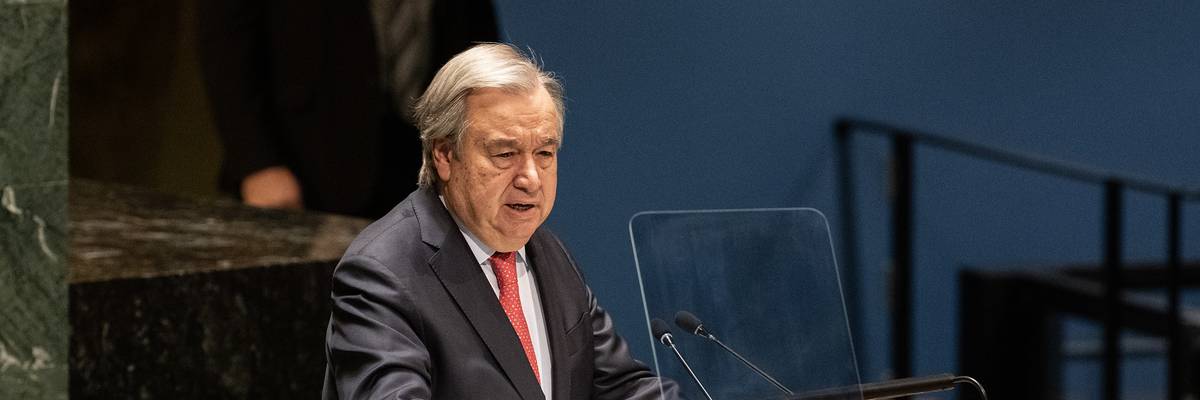
"This is climate breakdown—in real time," said United Nations Secretary-General António Guterres.
United Nations Secretary-General António Guterres said in a year-end message on Monday that "we have no time to lose" in the face of the worsening global climate crisis, which pushed temperatures to a record high this year and supercharged deadly extreme weather around the world.
"Today, I can officially report that we have just endured a decade of deadly heat," Guterres said in a video message posted to social media. "The top 10 hottest years on record have happened in the last 10 years, including 2024."
“This is climate breakdown in real time. We must exit this road to ruin," he continued. "In 2025, countries must put the world on a safer path by dramatically slashing emissions and supporting the transition to a renewable future. It is essential—and it is possible."
Even in the darkest days, I’ve seen hope power change.
There are no guarantees for what’s ahead in 2025.
But I pledge to stand with all those who are working to forge a more peaceful, equal, stable and healthy future for all people. pic.twitter.com/wD28KQBq2S
— António Guterres (@antonioguterres) December 30, 2024
Guterres' call to action came in the waning days of what scientists say is almost certain to be the hottest year on record and the first full year to breach the critical 1.5°C temperature threshold.
Celeste Saulo, secretary-general of the World Meteorological Organization (WMO), echoed Guterres' warning about the dire consequences of the status quo, saying in a statement Monday that "if we want a safer planet, we must act now."
"It's our responsibility. It's a common responsibility, a global responsibility," Saulo said. "Every fraction of a degree of warming matters, and increases climate extremes, impacts, and risks. Temperatures are only part of the picture. Climate change plays out before our eyes on an almost daily basis in the form of increased occurrence and impact of extreme weather events."
Last month, with emissions continuing to surge as the rich nations most responsible for the climate emergency refuse to ditch fossil fuels, world leaders convened for a U.N. climate summit in Azerbaijan that was swarmed by oil and gas lobbyists. The key gathering ended with a deal that climate advocates described as a step backward in the necessary push to rein in fossil fuel emissions.
Climate-denier and fossil fuel booster Donald Trump's looming return to office in the U.S.—the world's largest historical emitter—has campaigners and scientists increasingly concerned about the future of existing global climate agreements such as the Paris accord, from which the president-elect has pledged to withdraw once again.
One recent analysis projected that a second Trump administration could unleash an additional 4 billion tonnes of carbon dioxide equivalent by 2030, which would inflict $900 billion in global climate damages and deal a devastating blow to efforts to forestall runaway warming.
Throughout 2024, Guterres used his role as head of the U.N. to sound the alarm about the world's dangerous trajectory, saying in an October address that "there is a direct link between increasing emissions and increasingly frequent and intense climate disasters."
"We're playing with fire," he said, "but there can be no more playing for time."
Dear Common Dreams reader, It’s been nearly 30 years since I co-founded Common Dreams with my late wife, Lina Newhouser. We had the radical notion that journalism should serve the public good, not corporate profits. It was clear to us from the outset what it would take to build such a project. No paid advertisements. No corporate sponsors. No millionaire publisher telling us what to think or do. Many people said we wouldn't last a year, but we proved those doubters wrong. Together with a tremendous team of journalists and dedicated staff, we built an independent media outlet free from the constraints of profits and corporate control. Our mission has always been simple: To inform. To inspire. To ignite change for the common good. Building Common Dreams was not easy. Our survival was never guaranteed. When you take on the most powerful forces—Wall Street greed, fossil fuel industry destruction, Big Tech lobbyists, and uber-rich oligarchs who have spent billions upon billions rigging the economy and democracy in their favor—the only bulwark you have is supporters who believe in your work. But here’s the urgent message from me today. It's never been this bad out there. And it's never been this hard to keep us going. At the very moment Common Dreams is most needed, the threats we face are intensifying. We need your support now more than ever. We don't accept corporate advertising and never will. We don't have a paywall because we don't think people should be blocked from critical news based on their ability to pay. Everything we do is funded by the donations of readers like you. When everyone does the little they can afford, we are strong. But if that support retreats or dries up, so do we. Will you donate now to make sure Common Dreams not only survives but thrives? —Craig Brown, Co-founder |
United Nations Secretary-General António Guterres said in a year-end message on Monday that "we have no time to lose" in the face of the worsening global climate crisis, which pushed temperatures to a record high this year and supercharged deadly extreme weather around the world.
"Today, I can officially report that we have just endured a decade of deadly heat," Guterres said in a video message posted to social media. "The top 10 hottest years on record have happened in the last 10 years, including 2024."
“This is climate breakdown in real time. We must exit this road to ruin," he continued. "In 2025, countries must put the world on a safer path by dramatically slashing emissions and supporting the transition to a renewable future. It is essential—and it is possible."
Even in the darkest days, I’ve seen hope power change.
There are no guarantees for what’s ahead in 2025.
But I pledge to stand with all those who are working to forge a more peaceful, equal, stable and healthy future for all people. pic.twitter.com/wD28KQBq2S
— António Guterres (@antonioguterres) December 30, 2024
Guterres' call to action came in the waning days of what scientists say is almost certain to be the hottest year on record and the first full year to breach the critical 1.5°C temperature threshold.
Celeste Saulo, secretary-general of the World Meteorological Organization (WMO), echoed Guterres' warning about the dire consequences of the status quo, saying in a statement Monday that "if we want a safer planet, we must act now."
"It's our responsibility. It's a common responsibility, a global responsibility," Saulo said. "Every fraction of a degree of warming matters, and increases climate extremes, impacts, and risks. Temperatures are only part of the picture. Climate change plays out before our eyes on an almost daily basis in the form of increased occurrence and impact of extreme weather events."
Last month, with emissions continuing to surge as the rich nations most responsible for the climate emergency refuse to ditch fossil fuels, world leaders convened for a U.N. climate summit in Azerbaijan that was swarmed by oil and gas lobbyists. The key gathering ended with a deal that climate advocates described as a step backward in the necessary push to rein in fossil fuel emissions.
Climate-denier and fossil fuel booster Donald Trump's looming return to office in the U.S.—the world's largest historical emitter—has campaigners and scientists increasingly concerned about the future of existing global climate agreements such as the Paris accord, from which the president-elect has pledged to withdraw once again.
One recent analysis projected that a second Trump administration could unleash an additional 4 billion tonnes of carbon dioxide equivalent by 2030, which would inflict $900 billion in global climate damages and deal a devastating blow to efforts to forestall runaway warming.
Throughout 2024, Guterres used his role as head of the U.N. to sound the alarm about the world's dangerous trajectory, saying in an October address that "there is a direct link between increasing emissions and increasingly frequent and intense climate disasters."
"We're playing with fire," he said, "but there can be no more playing for time."
United Nations Secretary-General António Guterres said in a year-end message on Monday that "we have no time to lose" in the face of the worsening global climate crisis, which pushed temperatures to a record high this year and supercharged deadly extreme weather around the world.
"Today, I can officially report that we have just endured a decade of deadly heat," Guterres said in a video message posted to social media. "The top 10 hottest years on record have happened in the last 10 years, including 2024."
“This is climate breakdown in real time. We must exit this road to ruin," he continued. "In 2025, countries must put the world on a safer path by dramatically slashing emissions and supporting the transition to a renewable future. It is essential—and it is possible."
Even in the darkest days, I’ve seen hope power change.
There are no guarantees for what’s ahead in 2025.
But I pledge to stand with all those who are working to forge a more peaceful, equal, stable and healthy future for all people. pic.twitter.com/wD28KQBq2S
— António Guterres (@antonioguterres) December 30, 2024
Guterres' call to action came in the waning days of what scientists say is almost certain to be the hottest year on record and the first full year to breach the critical 1.5°C temperature threshold.
Celeste Saulo, secretary-general of the World Meteorological Organization (WMO), echoed Guterres' warning about the dire consequences of the status quo, saying in a statement Monday that "if we want a safer planet, we must act now."
"It's our responsibility. It's a common responsibility, a global responsibility," Saulo said. "Every fraction of a degree of warming matters, and increases climate extremes, impacts, and risks. Temperatures are only part of the picture. Climate change plays out before our eyes on an almost daily basis in the form of increased occurrence and impact of extreme weather events."
Last month, with emissions continuing to surge as the rich nations most responsible for the climate emergency refuse to ditch fossil fuels, world leaders convened for a U.N. climate summit in Azerbaijan that was swarmed by oil and gas lobbyists. The key gathering ended with a deal that climate advocates described as a step backward in the necessary push to rein in fossil fuel emissions.
Climate-denier and fossil fuel booster Donald Trump's looming return to office in the U.S.—the world's largest historical emitter—has campaigners and scientists increasingly concerned about the future of existing global climate agreements such as the Paris accord, from which the president-elect has pledged to withdraw once again.
One recent analysis projected that a second Trump administration could unleash an additional 4 billion tonnes of carbon dioxide equivalent by 2030, which would inflict $900 billion in global climate damages and deal a devastating blow to efforts to forestall runaway warming.
Throughout 2024, Guterres used his role as head of the U.N. to sound the alarm about the world's dangerous trajectory, saying in an October address that "there is a direct link between increasing emissions and increasingly frequent and intense climate disasters."
"We're playing with fire," he said, "but there can be no more playing for time."

