SUBSCRIBE TO OUR FREE NEWSLETTER
Daily news & progressive opinion—funded by the people, not the corporations—delivered straight to your inbox.
5
#000000
#FFFFFF
To donate by check, phone, or other method, see our More Ways to Give page.
Daily news & progressive opinion—funded by the people, not the corporations—delivered straight to your inbox.
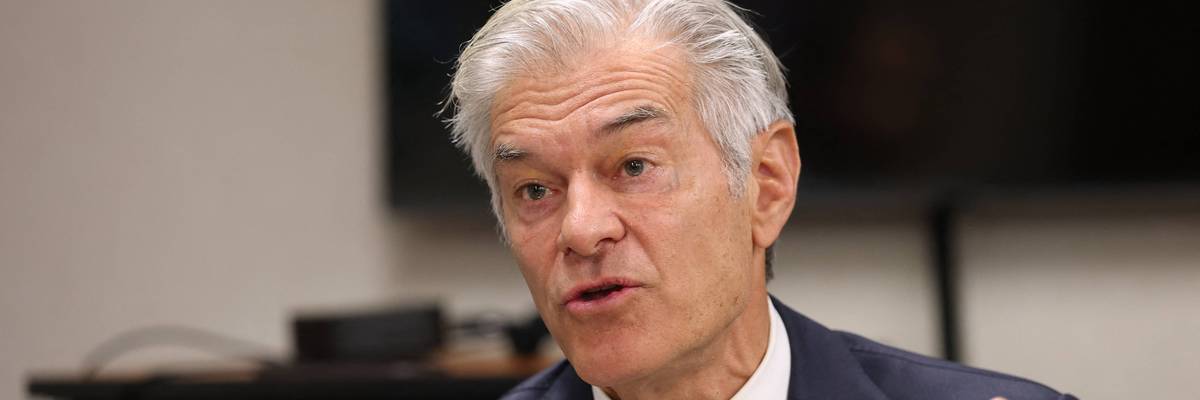
Medicare and Medicaid Administrator Mehmet Oz speaks during a news conference on January 9, 2026 in Los Angeles, California.
"It’s not safe to be an OB-GYN in red states, so they are turning to robots to care for pregnant woman. This is not an innovation success story."
Alabama is among the states that have seen a significant drop in the number of obstetrician-gynecologists working there since Roe v. Wade was overturned and cleared the way for states to ban abortion, resulting in doctors being unable to provide standard care and in a number of cases, placing patients in serious and even deadly danger.
On Friday, at a White House roundtable on healthcare in rural areas—some of the hardest-hit by the lack of OB-GYN care in states with abortion bans—one of President Donald Trump's top health officials suggested the exodus of doctors from Alabama and other crises in healthcare access have resulted in positive innovations as care is outsourced to "robots."
Dr. Mehmet Oz, administrator for the Centers for Medicare and Medicaid Services (CMS), said that since Alabama "has no OB-GYNs in many of their counties," the state is "doing something pretty cool."
"They're actually having robots do ultrasounds on these pregnant moms," said Oz.
Dr Oz: "Alabama has no OBGYNs in many of their counties, so they're doing something pretty cool. They're actually having robots do ultrasounds on these pregnant moms." pic.twitter.com/sEwd4OJss9
— Aaron Rupar (@atrupar) January 16, 2026
CMS, which oversees the new Office of Rural Health Transformation, recently highlighted in a report about rural healthcare Alabama's Maternal and Fetal Health Initiative, which it said "provides digital maternity care by using telerobotic ultrasound devices and labor and delivery carts to rural hospitals."
Oz asserted that robotic ultrasounds will help to reduce Alabama's maternal mortality rate, which is the highest in the United States, as medical centers will be able to detect health issues and abnormalities.
But observers said that praising an outcome of the dearth of maternal healthcare in the state—which has been at least partially caused by Trump's push to overturn Roe and Republicans' efforts to ban abortion—was "horrific."
"The severe lack of OB-GYNs," said the labor-focused media group More Perfect Union, "is a crisis, especially in rural America."
Melanie D'Arrigo, executive director of the Campaign for New York Health, added: "It’s not safe to be an OB-GYN in red states, so they are turning to robots to care for pregnant woman. This is not an innovation success story. It’s a dystopian horror story."
A 2024 analysis by the Association of American Medical Colleges found that in the year following the US Supreme Court's Dobbs v. Jackson Women’s Health Organization decision, applicants for OB-GYN residency programs plummeted 21.2%.
The ruling allowed Alabama's near-total abortion ban—which has only one ostensible "exception" for cases in which a pregnant person faces a serious health risk—to go into effect. Rights groups said that the law, one of the most extreme bans in the US, had been passed by the state's Republican legislature as part of an effort to force the court to reconsider Roe.
Robin Marty, executive director of WAWC Healthcare in the state, told the Alabama Reflector in 2024 that "when it comes to, especially, OB-GYN residencies, nobody wants to come out here because we can’t fulfill all of the requirements, which include being able to do abortions and manage miscarriage."
There had also been a 13.1% drop in applicants for OB-GYN programs in 2019-20 after the approval of the state's Sanctity of Life Act, which recognized “the sanctity of unborn life and the rights of unborn children, including the right to life."
“Legislative interference that imposes restrictions on full-scope reproductive healthcare, including abortion care, discourages medical students from pursuing residency training in states with restrictions, directly hurting patients by reducing the physician workforce in the communities that often need clinicians the most,” AnnaMarie Connolly, chief of education and academic affairs of the American College of Obstetricians and Gynecologists (ACOG), told the Alabama Reflector.
In addition to the state's abortion ban, the worsening lack of prenatal care in rural Alabama has also driven the state's decision to turn to robotics to provide some aspects of healthcare.
Since 2020, more than 100 rural hospitals across the nation have stopped delivering babies; at least three of them have been in Alabama, where just 30% of rural health centers have labor and delivery units. Hospitals have cited staffing shortages and low Medicaid reimbursement payments—which were worsened by the Republicans' One Big Beautiful Bill Act—as reasons for closing obstetric care units. Closures have left many families traveling an hour or more to receive prenatal care, and can worsen maternal mortality rates.
Regarding the robotic ultrasounds heralded by Oz, political analyst Drew Savicki said: "That is interesting but it represents a very small fraction of what an OB-GYN does. What is an ultrasound robot going to do for a woman who is coming in for her post-childbirth examination?"
In his comments, Oz unwittingly described the crisis the Trump administration has helped to make worse: "We have the best healthcare, if you can get to it."
One observer suggested Trump's healthcare officials "explain why no OB-GYNs want to work in Alabama, rather than bragging about robots."
Dear Common Dreams reader, It’s been nearly 30 years since I co-founded Common Dreams with my late wife, Lina Newhouser. We had the radical notion that journalism should serve the public good, not corporate profits. It was clear to us from the outset what it would take to build such a project. No paid advertisements. No corporate sponsors. No millionaire publisher telling us what to think or do. Many people said we wouldn't last a year, but we proved those doubters wrong. Together with a tremendous team of journalists and dedicated staff, we built an independent media outlet free from the constraints of profits and corporate control. Our mission has always been simple: To inform. To inspire. To ignite change for the common good. Building Common Dreams was not easy. Our survival was never guaranteed. When you take on the most powerful forces—Wall Street greed, fossil fuel industry destruction, Big Tech lobbyists, and uber-rich oligarchs who have spent billions upon billions rigging the economy and democracy in their favor—the only bulwark you have is supporters who believe in your work. But here’s the urgent message from me today. It's never been this bad out there. And it's never been this hard to keep us going. At the very moment Common Dreams is most needed, the threats we face are intensifying. We need your support now more than ever. We don't accept corporate advertising and never will. We don't have a paywall because we don't think people should be blocked from critical news based on their ability to pay. Everything we do is funded by the donations of readers like you. When everyone does the little they can afford, we are strong. But if that support retreats or dries up, so do we. Will you donate now to make sure Common Dreams not only survives but thrives? —Craig Brown, Co-founder |
Alabama is among the states that have seen a significant drop in the number of obstetrician-gynecologists working there since Roe v. Wade was overturned and cleared the way for states to ban abortion, resulting in doctors being unable to provide standard care and in a number of cases, placing patients in serious and even deadly danger.
On Friday, at a White House roundtable on healthcare in rural areas—some of the hardest-hit by the lack of OB-GYN care in states with abortion bans—one of President Donald Trump's top health officials suggested the exodus of doctors from Alabama and other crises in healthcare access have resulted in positive innovations as care is outsourced to "robots."
Dr. Mehmet Oz, administrator for the Centers for Medicare and Medicaid Services (CMS), said that since Alabama "has no OB-GYNs in many of their counties," the state is "doing something pretty cool."
"They're actually having robots do ultrasounds on these pregnant moms," said Oz.
Dr Oz: "Alabama has no OBGYNs in many of their counties, so they're doing something pretty cool. They're actually having robots do ultrasounds on these pregnant moms." pic.twitter.com/sEwd4OJss9
— Aaron Rupar (@atrupar) January 16, 2026
CMS, which oversees the new Office of Rural Health Transformation, recently highlighted in a report about rural healthcare Alabama's Maternal and Fetal Health Initiative, which it said "provides digital maternity care by using telerobotic ultrasound devices and labor and delivery carts to rural hospitals."
Oz asserted that robotic ultrasounds will help to reduce Alabama's maternal mortality rate, which is the highest in the United States, as medical centers will be able to detect health issues and abnormalities.
But observers said that praising an outcome of the dearth of maternal healthcare in the state—which has been at least partially caused by Trump's push to overturn Roe and Republicans' efforts to ban abortion—was "horrific."
"The severe lack of OB-GYNs," said the labor-focused media group More Perfect Union, "is a crisis, especially in rural America."
Melanie D'Arrigo, executive director of the Campaign for New York Health, added: "It’s not safe to be an OB-GYN in red states, so they are turning to robots to care for pregnant woman. This is not an innovation success story. It’s a dystopian horror story."
A 2024 analysis by the Association of American Medical Colleges found that in the year following the US Supreme Court's Dobbs v. Jackson Women’s Health Organization decision, applicants for OB-GYN residency programs plummeted 21.2%.
The ruling allowed Alabama's near-total abortion ban—which has only one ostensible "exception" for cases in which a pregnant person faces a serious health risk—to go into effect. Rights groups said that the law, one of the most extreme bans in the US, had been passed by the state's Republican legislature as part of an effort to force the court to reconsider Roe.
Robin Marty, executive director of WAWC Healthcare in the state, told the Alabama Reflector in 2024 that "when it comes to, especially, OB-GYN residencies, nobody wants to come out here because we can’t fulfill all of the requirements, which include being able to do abortions and manage miscarriage."
There had also been a 13.1% drop in applicants for OB-GYN programs in 2019-20 after the approval of the state's Sanctity of Life Act, which recognized “the sanctity of unborn life and the rights of unborn children, including the right to life."
“Legislative interference that imposes restrictions on full-scope reproductive healthcare, including abortion care, discourages medical students from pursuing residency training in states with restrictions, directly hurting patients by reducing the physician workforce in the communities that often need clinicians the most,” AnnaMarie Connolly, chief of education and academic affairs of the American College of Obstetricians and Gynecologists (ACOG), told the Alabama Reflector.
In addition to the state's abortion ban, the worsening lack of prenatal care in rural Alabama has also driven the state's decision to turn to robotics to provide some aspects of healthcare.
Since 2020, more than 100 rural hospitals across the nation have stopped delivering babies; at least three of them have been in Alabama, where just 30% of rural health centers have labor and delivery units. Hospitals have cited staffing shortages and low Medicaid reimbursement payments—which were worsened by the Republicans' One Big Beautiful Bill Act—as reasons for closing obstetric care units. Closures have left many families traveling an hour or more to receive prenatal care, and can worsen maternal mortality rates.
Regarding the robotic ultrasounds heralded by Oz, political analyst Drew Savicki said: "That is interesting but it represents a very small fraction of what an OB-GYN does. What is an ultrasound robot going to do for a woman who is coming in for her post-childbirth examination?"
In his comments, Oz unwittingly described the crisis the Trump administration has helped to make worse: "We have the best healthcare, if you can get to it."
One observer suggested Trump's healthcare officials "explain why no OB-GYNs want to work in Alabama, rather than bragging about robots."
Alabama is among the states that have seen a significant drop in the number of obstetrician-gynecologists working there since Roe v. Wade was overturned and cleared the way for states to ban abortion, resulting in doctors being unable to provide standard care and in a number of cases, placing patients in serious and even deadly danger.
On Friday, at a White House roundtable on healthcare in rural areas—some of the hardest-hit by the lack of OB-GYN care in states with abortion bans—one of President Donald Trump's top health officials suggested the exodus of doctors from Alabama and other crises in healthcare access have resulted in positive innovations as care is outsourced to "robots."
Dr. Mehmet Oz, administrator for the Centers for Medicare and Medicaid Services (CMS), said that since Alabama "has no OB-GYNs in many of their counties," the state is "doing something pretty cool."
"They're actually having robots do ultrasounds on these pregnant moms," said Oz.
Dr Oz: "Alabama has no OBGYNs in many of their counties, so they're doing something pretty cool. They're actually having robots do ultrasounds on these pregnant moms." pic.twitter.com/sEwd4OJss9
— Aaron Rupar (@atrupar) January 16, 2026
CMS, which oversees the new Office of Rural Health Transformation, recently highlighted in a report about rural healthcare Alabama's Maternal and Fetal Health Initiative, which it said "provides digital maternity care by using telerobotic ultrasound devices and labor and delivery carts to rural hospitals."
Oz asserted that robotic ultrasounds will help to reduce Alabama's maternal mortality rate, which is the highest in the United States, as medical centers will be able to detect health issues and abnormalities.
But observers said that praising an outcome of the dearth of maternal healthcare in the state—which has been at least partially caused by Trump's push to overturn Roe and Republicans' efforts to ban abortion—was "horrific."
"The severe lack of OB-GYNs," said the labor-focused media group More Perfect Union, "is a crisis, especially in rural America."
Melanie D'Arrigo, executive director of the Campaign for New York Health, added: "It’s not safe to be an OB-GYN in red states, so they are turning to robots to care for pregnant woman. This is not an innovation success story. It’s a dystopian horror story."
A 2024 analysis by the Association of American Medical Colleges found that in the year following the US Supreme Court's Dobbs v. Jackson Women’s Health Organization decision, applicants for OB-GYN residency programs plummeted 21.2%.
The ruling allowed Alabama's near-total abortion ban—which has only one ostensible "exception" for cases in which a pregnant person faces a serious health risk—to go into effect. Rights groups said that the law, one of the most extreme bans in the US, had been passed by the state's Republican legislature as part of an effort to force the court to reconsider Roe.
Robin Marty, executive director of WAWC Healthcare in the state, told the Alabama Reflector in 2024 that "when it comes to, especially, OB-GYN residencies, nobody wants to come out here because we can’t fulfill all of the requirements, which include being able to do abortions and manage miscarriage."
There had also been a 13.1% drop in applicants for OB-GYN programs in 2019-20 after the approval of the state's Sanctity of Life Act, which recognized “the sanctity of unborn life and the rights of unborn children, including the right to life."
“Legislative interference that imposes restrictions on full-scope reproductive healthcare, including abortion care, discourages medical students from pursuing residency training in states with restrictions, directly hurting patients by reducing the physician workforce in the communities that often need clinicians the most,” AnnaMarie Connolly, chief of education and academic affairs of the American College of Obstetricians and Gynecologists (ACOG), told the Alabama Reflector.
In addition to the state's abortion ban, the worsening lack of prenatal care in rural Alabama has also driven the state's decision to turn to robotics to provide some aspects of healthcare.
Since 2020, more than 100 rural hospitals across the nation have stopped delivering babies; at least three of them have been in Alabama, where just 30% of rural health centers have labor and delivery units. Hospitals have cited staffing shortages and low Medicaid reimbursement payments—which were worsened by the Republicans' One Big Beautiful Bill Act—as reasons for closing obstetric care units. Closures have left many families traveling an hour or more to receive prenatal care, and can worsen maternal mortality rates.
Regarding the robotic ultrasounds heralded by Oz, political analyst Drew Savicki said: "That is interesting but it represents a very small fraction of what an OB-GYN does. What is an ultrasound robot going to do for a woman who is coming in for her post-childbirth examination?"
In his comments, Oz unwittingly described the crisis the Trump administration has helped to make worse: "We have the best healthcare, if you can get to it."
One observer suggested Trump's healthcare officials "explain why no OB-GYNs want to work in Alabama, rather than bragging about robots."