

SUBSCRIBE TO OUR FREE NEWSLETTER
Daily news & progressive opinion—funded by the people, not the corporations—delivered straight to your inbox.
5
#000000
#FFFFFF
To donate by check, phone, or other method, see our More Ways to Give page.
Daily news & progressive opinion—funded by the people, not the corporations—delivered straight to your inbox.
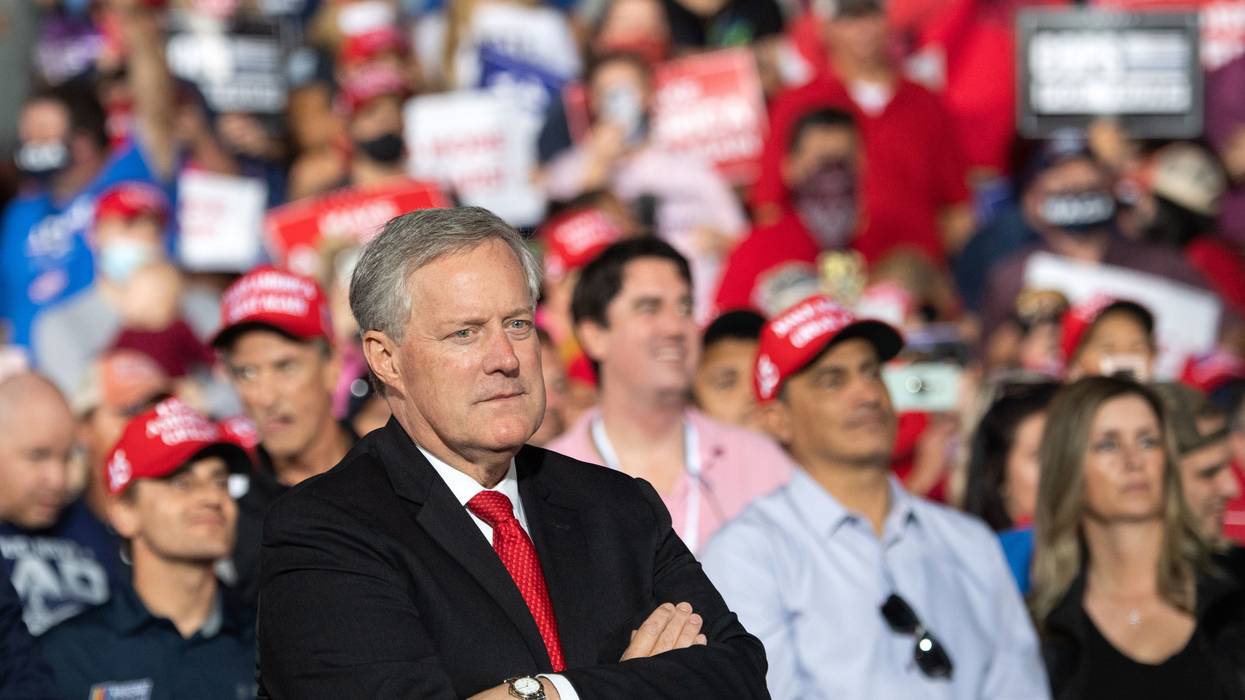
Had it succeeded, said the state's attorney general, the scheme would have "deprived Arizona's voters of their right to have their votes counted for their chosen president."
A grand jury in Arizona on Wednesday charged seven aides to Donald Trump and nearly a dozen Republican officials over a "fake electors" scheme in the state that aimed to keep the former president in power after his 2020 loss to President Joe Biden.
Trump, who is currently facing nearly 90 charges across four criminal cases as he runs for another White House term, was described as "unindicted co-conspirator 1" in the 58-page indictment, which was announced by Arizona Attorney General Kris Mayes.
"The people of Arizona elected President Biden," Mayes, a Democrat, said Wednesday. "Unwilling to accept this fact, the defendants charged by the state grand jury allegedly schemed to prevent the lawful transfer of the presidency. Whatever their reasoning was, the plot to violate the law must be answered for."
The indictment names former Arizona Republican Party Chair Kelli Ward, sitting state Republican Sens. Jake Hoffman and Anthony Kern, former U.S. Senate candidate Jim Lamon, and seven others as the "fake electors" who sought to declare Trump the rightful winner of the state's presidential contest.
The names of other individuals indicted by the state grand jury are redacted, but the document's descriptions make clear that former White House Chief of Staff Mark Meadows, former Trump attorney Rudy Giuliani, and top Trump legal strategist Boris Epshteyn are among those facing felony charges—including fraud, forgery, and conspiracy.
"In Arizona, defendants, unindicted coconspirators, and others pressured the three groups of election officials responsible for certifying election results to encourage them to change the election results," the document reads. "Discussions about using the Republican electors to change the outcome of the election began as early as November 4, 2020. Those plans evolved during November based on memos drafted by [an attorney for the Trump campaign, Kenneth Chesebro]."
Mayes said Wednesday that had the fake elector scheme succeeded, it would have "deprived Arizona's voters of their right to have their votes counted for their chosen president."
"It effectively would have made their right to vote meaningless," said Mayes.
A state grand jury, made up of everyday, regular Arizonans, has handed down felony indictments in the ongoing investigation into the fake elector scheme in Arizona. pic.twitter.com/Nu8GcD4ZqJ
— AZ Attorney General Kris Mayes (@AZAGMayes) April 24, 2024
Alex Gulotta, state director of All Voting Is Local Action Arizona, said Wednesday that "the indictment of the eleven fake electors is one of the first steps required in holding these election deniers accountable for their alleged attempts to take power away from voters by disrupting our free and fair elections."
"Arizonans deserve to trust the election officials responsible for administering our elections and preserving our democracy," said Gulotta, "and this is a positive step forward as we continue to strengthen the foundations of our democracy and restore faith in our elections."
The Arizona Republic reported Wednesday that "several of the Arizona electors have previously claimed they were merely offering Congress a backup plan, though nothing in the documents they sent to Congress and the National Archives backs up that assertion."
"The indictment includes several statements the false electors made on social media that contradict those claims," the newspaper observed.
Jenny Guzman, director of Common Cause's Arizona program, said the indictment "marks the start of a new chapter for the fake elector scheme that has plagued Arizona."
"Arizonans are still dealing with the fallout from the false electors and the Big Lie about the 2020 elections," said Guzman. "We are relieved that the investigation by Attorney General Mayes has concluded and Arizonans can now know that what comes next is accountability. These efforts by these fake electors to undermine the will of Arizona’s voters have had implications far beyond their failed attempt to overthrow the 2020 election."
"This indictment can reassure all Arizonans that if anyone, regardless of their political affiliation, attempts to undermine their vote, consequences will follow," Guzman added.
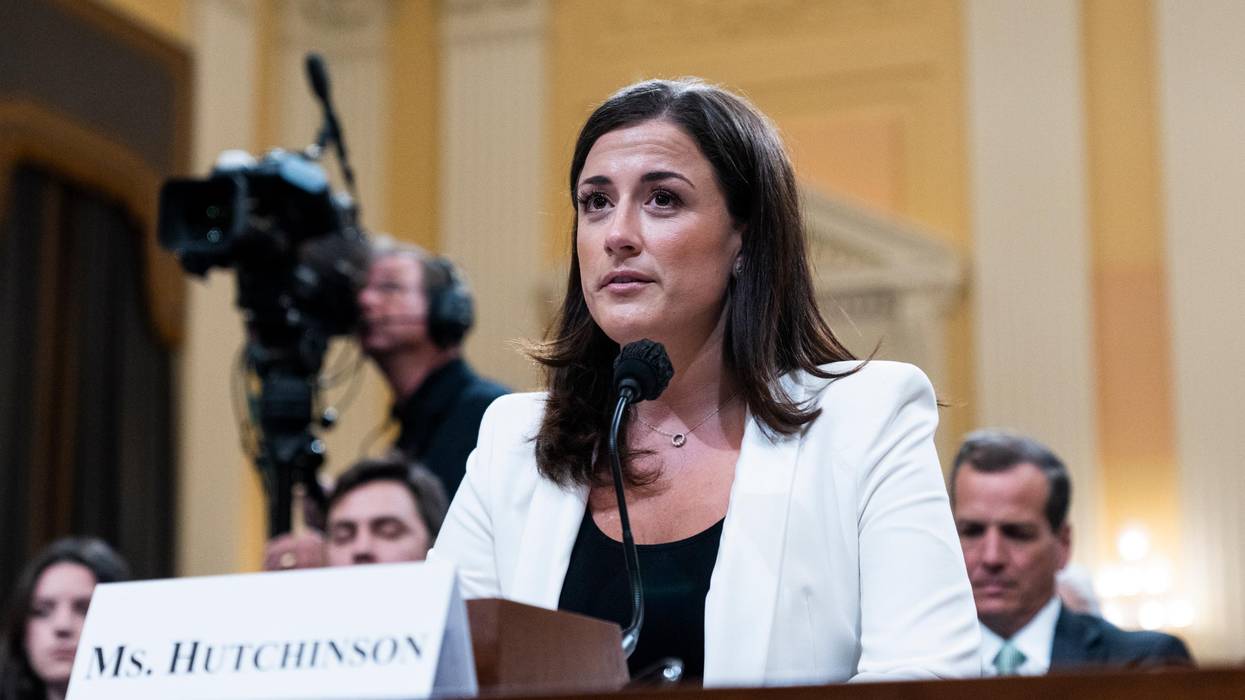
The allegations against the former Trump attorney and New York City mayor follow a $10 million sexual assault suit filed earlier this year by a former high-level employee.
Former White House aide Cassidy Hutchinson alleges that Rudy Giuliani, who was serving as an attorney for then-President Donald Trump, groped her hours before the January 6, 2021 attack on the U.S. Capitol, The Guardian reported Wednesday.
Hutchinson—a former aide to White House Chief of Staff Mark Meadows who has testified before Congress about the conduct of Trump and members of his inner circle on the day of the insurrection—accuses Giuliani in her new book, Enough. Hutchinson claims the former New York City mayor touched "under my blazer, then my skirt."
"I feel his frozen fingers trail up my thigh," she writes. "He tilts his chin up. The whites of his eyes look jaundiced. My eyes dart to [Trump adviser] John Eastman, who flashes a leering grin."
"I fight against the tension in my muscles and recoil from Rudy's grip," she continues. "Filled with rage, I storm through the tent, on yet another quest for Mark."
The alleged incident took place backstage at the speech Trump delivered near the White House, in which he exhorted his supporters to march on the Capitol as part of his efforts to overturn his 2020 election loss to President Joe Biden.
Giuliani spokesperson Ted Goodman told The Guardian that "it's fair to ask Cassidy Hutchinson why she is just now coming out with these allegations from two-and-a-half years ago, as part of the marketing campaign for her upcoming book release."
"This is a disgusting lie against Mayor Rudy Giuliani—a man whose distinguished career in public service includes taking down the mafia, cleaning up New York City, and comforting the nation following September 11," Goodman added.
This isn't the first time that Giuliani has been accused of sexual misconduct. In May, Noelle Dunphy, a former head of business development for multiple Giuliani-owned companies, filed a $10 million lawsuit alleging "unlawful abuses of power, wide-ranging sexual assault and harassment, wage theft, and other misconduct."
Dunphy's suit claims Giuliani—who she said took Viagra "in preparation"—would demand "sexual gratification" from her and make her "work naked, in a bikini, or in short-shorts with an American flag on them that he bought for her."
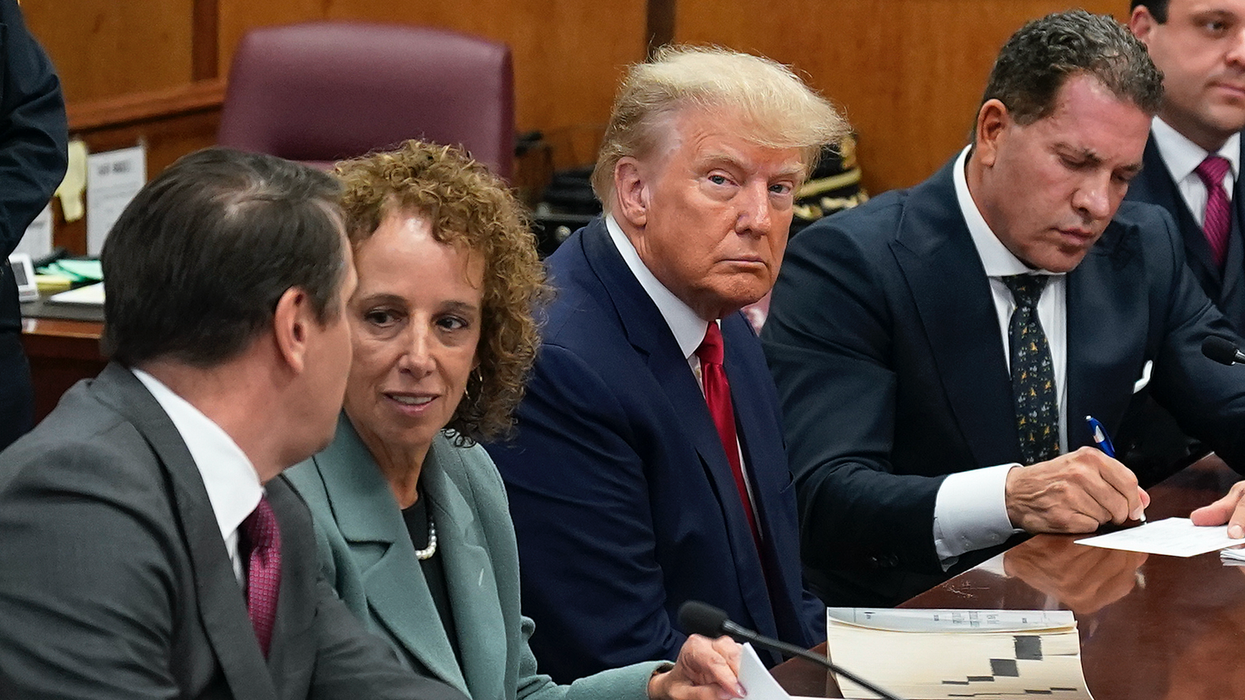
He believes he can get away with intimidating and harassing potential witnesses, jurors, prosecutors, and judges. He is confident he is above the law.
Last night, Trump and 18 others were criminally charged in Georgia in connection with efforts to overturn Joe Biden’s 2020 victory in the state.
Trump was charged with 13 counts, including violating the state’s racketeering act, soliciting a public officer to violate their oath, conspiring to impersonate a public officer, conspiring to commit forgery in the first degree, and conspiring to file false documents.
The indictment also charges some of Trump’s most prominent advisers, including Rudolph W. Giuliani, his former personal lawyer, and Mark Meadows, who served as White House chief of staff at the time of the election.
Trump’s posts continue to directly and explicitly violate the conditions of Trump’s release from jail pending trial.
This indictment follows a two-and-a-half year investigation by Fulton County District Attorney Fani Willis—after audio leaked from a January 2021 phone call during which Trump urged Georgia Secretary of State Brad Raffensperger to question the validity of thousands of ballots, especially in the heavily Democratic Atlanta area, and said he wanted to “find” the votes to erase his 2020 loss in the state.
It is another step in America’s slow but steady process of criminal justice, another illustration that no one is above the law. Fani Willis and her staff deserve the nation’s thanks, as do Jack Smith and his staff, and Alvin Bragg and his staff in Manhattan.
This is not easy work under the best of circumstances. When a rogue former president is on the loose, fanning the flames of anger and recrimination, the work is fraught and potentially dangerous.
Early yesterday morning, before the Georgia grand jury met, Trump posted the following:
I am reading reports that failed former Lt. Governor of Georgia, Jeff Duncan, will be testifying before the Fulton County Grand Jury. He shouldn’t. I barely know him but he was, right from the beginning of this Witch Hunt, a nasty disaster for those looking into the Election Fraud that took place in Georgia. He refused having a Special Session to find out what went on, became very unpopular with Republicans (I refused to endorse him!), and fought the TRUTH all the way. A loser, he went to FNCNN!
I have no idea whether Mr. Duncan was intimidated by this post when he testified yesterday, whether he altered or downplayed his testimony out of fear of retribution by a Trump supporter. But the mere possibility raises a broader question that must be answered by the judges presiding over Trump’s trials—and very soon.
Trump’s conditions of release at his arraignment earlier this month included a vow—which Trump swore to uphold—that he would not intimidate or harass witnesses and officers of the court or threaten the administration of justice.
Yet he has not ceased posting inflammatory invective against potential witnesses, against potential jurors in Washington D.C., New York, and Georgia, against judges who have been assigned to hear the cases against him, against Special Counsel Jack Smith, and against other prosecutors.
His wild statements endanger all these people—we know all too well about the violent proclivities of a subset of Trump supporters. His posts could silence potential witnesses in any and all of Trump’s pending trials. His rants could intimidate jurors, prosecutors, and judges.
Trump’s posts continue to directly and explicitly violate the conditions of Trump’s release from jail pending trial.
Last Friday, federal Judge Tanya Chutkan, who is presiding over the Justice Department’s case charging Trump with federal crimes in connection with seeking to overturn the 2020 election, repeatedly instructed Trump that he is bound by laws preventing him from influencing jurors or witnesses. She said any “inflammatory remarks” that could influence a jury would hasten a trial, and she warned that “I will take whatever measures are necessary to safeguard the integrity of the case.”
Hours later, Trump called Judge Chutkan “highly partisan” and “very biased and unfair,” adding, “She obviously wants me behind bars.”
Friends, Trump is daring Judge Chutkan and other judges involved (or soon to be involved) in these four proceedings to revoke his release pending trial. He believes he can get away with intimidating and harassing potential witnesses, jurors, prosecutors, and judges. He is confident he is above the law.
He must be shown he is not above the law. His release pending trial must be revoked.
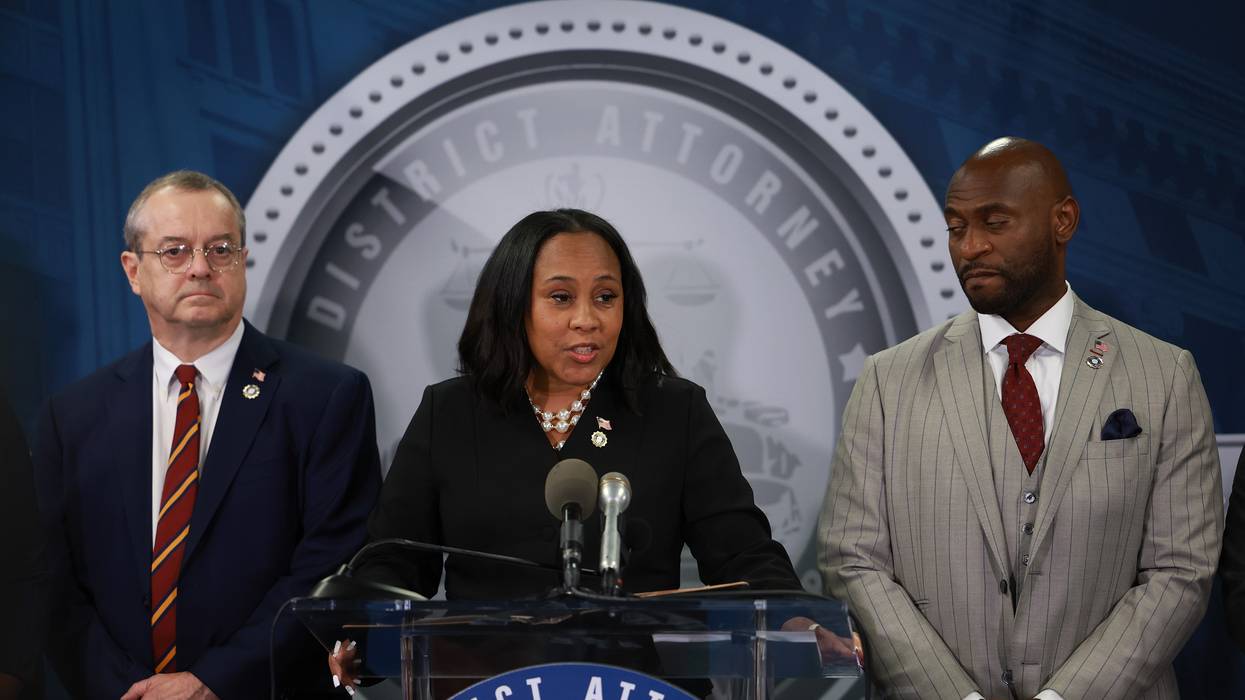
Donald Trump, Rudy Giuliani, Mark Meadows, and others "constituted a criminal organization whose members and associates engaged in various related criminal activities," the indictment states.
A grand jury in Fulton County, Georgia indicted former President Donald Trump and 18 others on Monday for taking part in a sprawling "criminal enterprise" aimed at overturning the 2020 presidential election results in the state.
The 98-page indictment, which includes a total of 41 counts, marks the fourth time Trump has been charged in a criminal investigation since April.
The indictment states that Trump and the other defendants—including former White House Chief of Staff Mark Meadows and Trump's former personal lawyer, Rudy Giuliani—"refused to accept that Trump lost, and they knowingly and willfully joined a conspiracy to unlawfully change the outcome of the election in favor of Trump."
Trump, Giuliani, Meadows, and more than a dozen others "constituted a criminal organization whose members and associates engaged in various related criminal activities including, but not limited to, false statements and writings, impersonating a public officer, forgery, filing false documents, influencing witnesses, computer theft, computer trespass, computer invasion of privacy, conspiracy to defraud the state, acts involving theft, and perjury."
The former president faces 13 charges under the Georgia indictment, including soliciting a public officer to violate their oath and breaching the state's Racketeering Influenced and Corrupt Organizations (RICO) Act.
Georgia's RICO law carries up to 20 years in prison for those convicted.
The indictment—the product of a sweeping investigation led by Fulton County District Attorney Fani Willis—cites Trump's early December phone call to Georgia Gov. Brian Kemp, during which the former president "solicited, requested, and importuned Kemp to call a special session of the Georgia General Assembly."
"This was an overt act in furtherance of the conspiracy," the indictment reads.
Willis launched the election interference investigation after an audio recording obtained by The Washington Post revealed that Trump called Georgia Secretary of State Brad Raffensperger and said he wants "to find 11,780 votes, which is one more than we have."
During a press conference, Willis said arrest warrants have been issued for those charged in the indictment, including Trump, who is running for president again in 2024.
"I am giving the defendants the opportunity to voluntarily surrender no later than noon on Friday, the 25th day of August 2023," said Willis.
Christina Harvey, executive director of the advocacy group Stand Up America, said in a statement that "the evidence of Trump's criminal conduct is overwhelming" and "holding the former president and his co-conspirators accountable is vital to protect our democracy and freedom to vote in future elections."
"At the heart of this indictment are Trump's concerted efforts to overturn the will of Georgia voters, Trump's attempts to deliberately spread disinformation, pressure Georgia officials to violate their oaths of office, and unlawfully change the outcome of the election in his favor demonstrate his deep-seated contempt for the law, the American people, and our democracy," said Harvey.
Common Cause Georgia executive director Aunna Dennis added that "we know today's indictment is just the beginning of what might be a long process in the courts, and that an indictment is not a conviction."
Nevertheless, Dennis said, "today's indictment of Trump and his co-conspirators highlights Georgia voters' steadfast insistence that anyone who attempts to steal our most sacred of rights must be held accountable."
"The people of Georgia can now take a moment to reflect on what type of government we want moving forward," said Dennis. "Do we want a democracy in the hands of a wealthy few, or in the hands of the people?"
Members of the House Select Committee to Investigate the January 6th Attack on the United States Capitol are expected to finalize decisions on criminal referrals during a virtual meeting Sunday afternoon.
CBS News' Margaret Brennan inquired about the panel's plans earlier Sunday, when Rep. Adam Schiff (D-Calif.)--a member of the subcommittee created to deal with outstanding issues, including potential referrals--to the U.S. Department of Justice (DOJ)--appeared on "Face the Nation."
Pointing to reporting that the committee is considering referrals for former President Donald Trump, ex-DOJ official Jeffrey Clark, right-wing attorney John Eastman, former Trump lawyer Rudy Giuliani, and ex-White House chief of staff Mark Meadows, she asked, "Is there a consensus on whether to send a referral for criminal prosecution to the Justice Department, and would doing that be anything more than symbolic?"
"I think we are in common agreement about what our approach should be. I'm not ready or authorized at this point to tell you what that is. We are, as a subcommittee--several of us that were charged with making the recommendation about referrals--gonna be making that recommendation to full committee today," Schiff said, adding that the decisions will be included in a panel report set to be released later this month.
Schiff continued:
What I can tell you about the process is we're looking at: What is the quantum of evidence that we have against individuals? What is the impact of making a referral? Are we gonna create some suggestion by referring some, that others, there wasn't sufficient evidence, when we don't know, for example, what evidence is in the position of the Justice Department?
So, if we do make referrals, we want to be very careful about how we do them. But I think we're all certainly in agreement that there is evidence of criminality here and we want to make sure that the Justice Department is aware of that.
In the wake of Trump's announcement last month that he is seeking the GOP's presidential nomination for 2024--despite his various legal issues and inciting last year's deadly Capitol attack with his "Big Lie" about the 2020 contest--Attorney General Merrick Garland appointed Jack Smith, a longtime federal prosecutor, as special counsel to oversee ongoing investigations involving the twice-impeached former president.
The DOJ notably does not need a referral from Congress to bring charges. Referencing the department's probes, Brennan asked Schiff, "So what does the committee sending a referral do other than look political?"
"Well, look, we have been far out ahead in most respects of the Justice Department in conducting our investigation," the congressman responded. "I think they have made use of the evidence that we have presented in open hearings. I think they'll make use of the evidence that we present in our report to further their investigations."
"And I think it makes an important statement, not a political one, but a statement about the evidence of an attack on the institutions of our democracy and the peaceful transfer of power, that Congress examining an attack on itself is willing to report criminality," he added. "So I think it's an important decision in its own right if we go forward with it and one that the department ought to give due consideration to."
Committee Chairman Rep. Bennie Thompson (D-Miss.) had confirmed to reporters on Thursday that the committee planned to make decisions about criminal referrals during Sunday's meeting.
"I think the more we looked at the body of evidence that we had collected," he said, "we just felt that while we're not in the business of investigating people for criminal activities, we just couldn't overlook some of them."
The panel's only two Republicans--Vice Chair Liz Cheney (Wyo.) and Rep. Adam Kinzinger (Ill.)--are both leaving office in a few weeks and the GOP is set to take control of the House. Rep. Kevin McCarthy (R-Calif.), who hopes to be the next speaker, has vowed to hold hearings investigating the committee.
The Hill reported Sunday that McCarthy and the other four members of Congress who ignored subpoenas from the committee--GOP Reps. Andy Biggs (Ariz.), Mo Brooks (Ala.), Jim Jordan (Ohio), and Reps. Scott Perry (Pa.)--could be referred to the House Ethics Committee rather than the DOJ.
Rep. Jamie Raskin (D-Md.), a constitutional law expert who chairs the subcommittee focusing on referrals, pointed to the relevant part of the U.S. Constitution.
"The speech or debate clause makes it clear that Congress doesn't hold members of Congress accountable in the judiciary or other places in the government," he said. "Members of Congress are only held accountable through Article 1 in their own chambers for their actions."
This post has been updated with reporting about the five House Republicans who defied subpoenas from the panel.

U.S. Supreme Court Justice Clarence Thomas faced fresh calls to step down Thursday after new reporting revealed that his wife's involvement in efforts to overturn the 2020 presidential election was broader than previously known, extending to the battleground state of Wisconsin as well as Arizona.
"Reminder that Clarence Thomas heard election cases while his wife conspired to overthrow democracy."
Emails obtained by the Washington Post and the organization Documented show that Ginni Thomas, a longtime far-right activist with close ties to the conservative dark money network, "messaged two Republican lawmakers in Wisconsin: state Sen. Kathy Bernier, then chair of the Senate elections committee, and state Rep. Gary Tauchen," the newspaper reported.
"Bernier and Tauchen received the email at 10:47 a.m. on November 9, virtually the same time the Arizona lawmakers received a verbatim copy of the message from Thomas," the Post added. "Ginni Thomas' political activism is highly unusual for the spouse of a Supreme Court justice, and for years it has raised questions about potential conflicts of interest for her husband. She has said that the two of them keep their professional lives separate."
But watchdog groups and Democratic lawmakers have questioned that claim and demanded that Thomas, at the very least, recuse himself from election-related cases--something he notably didn't do while his wife was engaged in attempts to keep former President Donald Trump in power.
"Reminder that Clarence Thomas heard election cases while his wife conspired to overthrow democracy," Rep. Bill Pascrell (D-N.J.) tweeted Thursday. "Clarence Thomas is corrupt as hell and should resign from the Supreme Court."
House Democrats have also called on the party leadership to launch impeachment proceedings against the right-wing justice, a demand backed by more than 1.2 million people across the U.S.
Christina Harvey, executive director of Stand Up America, said in a statement Thursday that "if Clarence Thomas had any shame, he would resign immediately."
"But he doesn't," Harvey continued, "so Congress must act immediately to pass a code of ethics for the Supreme Court that would require justices to recuse themselves in cases where they have an actual or apparent conflict of interest."
The latest revelations from the Post add to the newspaper's previous reporting about Ginni Thomas' messages to then-White House Chief of Staff Mark Meadows and Arizona Republicans in the wake of Trump's election loss.
"Ginni Thomas didn't just push Mark Meadows to overturn the election or urge lawmakers in Arizona to ignore the popular vote," tweeted the watchdog group Citizens for Responsibility and Ethics in Washington. "She also pushed Wisconsin lawmakers to ignore Biden's victory in the state."
"Despite all this, she's still on a federal board," the group added, referring to Thomas' spot on the Library of Congress Trust Fund Board. Trump appointed her to a five-year term on the board in May 2020.
Thomas' actions in the aftermath of the 2020 presidential contest have drawn the scrutiny of the House select committee investigating the January 6, 2021 assault on the U.S. Capitol, an attack fueled by Trump's lies about the presidential election.
The Post reported Thursday that the House panel "asked Thomas to sit for a voluntary interview in June."
"The committee also sought a broad range of documents from her, including any related to plans to overturn the election and all communications with members of Congress and their staff and Justice Department employees," the Post noted. "At the time, Thomas indicated she would comply. 'I can't wait to clear up misconceptions. I look forward to talking to them,' Thomas told the Daily Caller, her former employer."
"Less than two weeks later, on June 28, Paoletta told the committee that while Thomas remained willing to sit for an interview, he did not believe there was 'sufficient basis' for her to do so," the Post added.
The House committee is expected to kick off a new series of hearings on the January 6 attack this month.

Democracy defenders responded to Tuesday's testimony by a former Trump administration aide before the January 6 committee by demanding that the former president and his co-conspirators be held to account in the face of increasingly incriminating evidence of their culpability for the 2021 insurrection.
"Hutchinson's testimony blows any notion of plausible deniability surrounding January 6 out of the water."
Cassidy Hutchinson, who served as a special assistant to Mark Meadows, former President Donald Trump's last chief of staff, revealed what the consumer advocacy group Public Citizen described as "bombshell after bombshell" during her in-person testimony to members of the House Select Committee to Investigate the January 6th Attack on the United States Capitol.
Lisa Gilbert, executive vice president of Public Citizen and co-chair of the Not Above the Law Coalition, said in a statement that "in the reams of evidence against Trump and his allies, Hutchinson's testimony of the deeply detailed plans of January 6 and the inaction of those in the White House in response to the violence show just how close we came to a coup."
"Her testimony comes at a critical point in the hearings, showing the conspirators knew what they were doing was illegal, and knew it could result in violence, yet they proceeded anyway," she added. "And that once the violence was ongoing, the president refused to act."
Among other things, Hutchinson testified that:
"Trump and his chief of staff Mark Meadows were warned repeatedly of anticipated violence on January 6th yet did nothing," Common Cause president Karen Hobert Flynn said in response to Hutchinson's testimony. "They were informed of semi-automatic rifles and pistols--AR-15s and Glocks--being carried by members of the audience on the Ellipse, hours before his speech, yet Trump incited the crowd and called on his heavily armed audience to march on the Capitol and 'fight like hell.'"
Hobert Flynn continued:
The armed and vicious mob he sent to the Capitol on January 6th was the final desperate act in a monthslong, multi-layered criminal conspiracy by former President Trump and his henchmen to ignore the will of the American people and overturn the legitimate results of the 2020 election by any means.
His actions and inaction as the insurrection unfolded, outlined in sworn testimony to the January 6 select committee, [are] jaw-dropping, un-American, and yet another warning to us all. Just when we think accounts of the actions of the former president and his inner circle can get no worse, we learn that in fact it can.
Gilbert of Public Citizen said that "Hutchinson's testimony blows any notion of plausible deniability surrounding January 6 out of the water. She said Trump knew his rally crowd was armed, but said they weren't there to hurt him. He encouraged an armed crowd to go to the Capitol, and told them that he would be with them."
Progressives said Tuesday's testimony underscored the imperative for accountability for Trump and members of his inner circle.
Rep. Mark Pocan (D-Wis.) tweeted that Trump "knew dangerous weapons were headed to the Capitol. He knew Congress was the target. He said the VP deserved to be hung for upholding the Constitution. He attacked a member of his Secret Service. He incited an insurrection."
Common Cause's Hobert Flynn asserted that "the former president and his co-conspirators must be held accountable by the Justice Department and any other authority with jurisdiction, including by state or local officials where parts of this scheme were plotted and carried out."
Echoing Hobert Flynn, Gilbert said that Hutchinson's testimony "makes it absolutely clear that Donald Trump remains a danger to our democracy and to our nation."
She added, "There must be accountability for the criminal conspiracy to steal our votes that ultimately led to the violence on January 6 that we now know the administration anticipated, and that Trump encouraged."

Mark Meadows, former President Donald Trump's chief of staff, sought a presidential pardon related to last year's January 6 insurrection, Cassidy Hutchinson told members of Congress during sworn testimony on Tuesday.
Hutchinson, who served as Meadows' special assistant, testified during a last-minute hearing of the House Select Committee to Investigate the January 6th Attack on the United States Capitol.
Asked by Rep. Liz Cheney (R-Wyo.), the panel's vice chair, if Meadows ever indicated that he was interested in receiving a pardon related to January 6, Hutchinson responded that he "did seek that pardon, yes ma'am."
That confirmation came just after Hutchinson testified that Trump attorney Rudy Giuliani also sought a pardon.
The panel last week identified the "seditious six" House members who sought preemptive pardons from Trump after they tried to overturn the 2020 presidential election results: GOP Reps. Andy Biggs (Ariz.), Mo Brooks (Ala.), Matt Gaetz (Fla.), Louie Gohmert (Texas), Marjorie Taylor Greene (Ga.), and Scott Perry (Pa.).
Noting the full list, the advocacy group Public Citizen said Tuesday: "You know who doesn't ask for pardons? Innocent people."
That sentiment was echoed last week by Rep. Adam Kinzinger (R-Ill.)--the only Republican on the committee other than Cheney--who said that "the only reason you ask for a pardon is if you think you've committed a crime."

Cassidy Hutchinson, who served as a special assistant to former President Donald Trump's chief of staff Mark Meadows, is expected to testify Tuesday before the House committee investigating the January 6, 2021 attack on the U.S. Capitol.
Although it had not been scheduled to meet again until next month, the panel announced Monday that it will hold its sixth public hearing on Tuesday at 1:00 pm ET to "present recently obtained evidence and receive witness testimony."
It's not clear whether any other witnesses will testify during Tuesday's hearing.
Watch live:
During the more than 20 hours she spent in deposition with the House January 6 committee, Hutchinson "provided extensive information about Meadows' activities in trying to overturn the election," according to the Washington Post.
Hutchinson, poised to become a star witness as the first White House employee to publicly testify, previously told the committee that she saw Meadows burning documents after he met with Rep. Scott Perry (R-Pa.) following the election.
In recorded testimony that the panel released in April, Hutchinson identified Perry and his fellow Republican Reps. Jim Jordan (Ohio), Marjorie Taylor Greene (Ga.), and Lauren Boebert (Colo.) as members of Congress "who were raising the idea of the vice president doing anything other than just counting electoral votes on January the 6th."
Just five days ago, the panel unveiled a recorded interview in which Hutchinson named six GOP lawmakers--Perry, Greene, and Reps. Mo Brooks (Ala.), Matt Gaetz (Fla.), Andy Biggs (Ariz.), and Louie Gohmert (Texas)--who sought pardons from the White House before and after Trump's coup attempt was defeated.
Less than a week after the deadly insurrection, Brooks allegedly requested pardons for all 147 congressional Republicans who voted against certifying President Joe Biden's Electoral College victory, while Gaetz began asking for blanket immunity in early December 2020.
As Slate reported earlier this month:
[Hutchinson] also testified about a strategy meeting ahead of the election certification in which the Republicans discussed delaying the joint session of Congress or otherwise blocking the counting of electoral votes. That meeting, she said, had Jordan and Greene in attendance, as well as at least nine other Republican lawmakers. "They felt that he had the authority to--pardon me if my phrasing isn't correct on this, but--send votes back to the states or the electors back to the states," she testified.
She also told the committee in that testimony that Meadows had been warned before the insurrection about the "potential for violence." A senior Secret Service official told Meadows about intel reports of potential violence. "And Mr. Meadows said: All right. Let's talk about it," she said. She said she was "not sure" what Meadows had done with the information or if they were seen as "genuine concerns."
The Hill reported Tuesday that "her testimony has even offered details on Trump's reactions the day of the riot. It was Hutchinson who detailed Trump's indifference to chants of 'Hang Mike Pence' unfolding at the riot, suggesting the supporters 'have the right idea.'"
Hutchinson's testimony, Slate noted, "could prove crucial for a future prosecution of Trump, particularly as Meadows has refused to cooperate with the committee."
The House committee lacks prosecutorial authority. Attorney General Merrick Garland has indicated that the Justice Department, which can bring criminal charges, is closely following the panel's work while pursuing its own investigation, but top Democratic leaders have expressed concerns over the DOJ's lack of urgency.

The House committee investigating the January 6, 2021 attack on the United States Capitol revealed Thursday that half a dozen Republican lawmakers sought preemptive pardons from then-President Donald Trump after they tried to overturn the results of the 2020 presidential election.
According to the committee, Rep. Mo Brooks (R-Ala.) emailed the White House five days after the deadly insurrection requesting preemptive pardons for Rep. Matt Gaetz (R-Fla.), himself and "every congressman or senator who voted to reject the electoral college vote submissions of Arizona and Pennsylvania."
Cassidy Hutchinson, a former aide to White House Chief of Staff Mark Meadows, said in a video deposition that Gaetz asked for blanket pardons starting in early December 2020. Hutchinson said that GOP Reps. Andy Biggs (Ariz.), Louie Gohmert (Texas), and Scott Perry (Pa.) also requested pardons. She also testified that she heard Rep. Marjorie Taylor Greene (R-Ga.) asked the White House counsel's office for a pardon.
Responding to Thursday's revelations, committee member Rep. Adam Kinzinger (R-Ill.) opined that "the only reason you ask for a pardon is if you think you've committed a crime."
Last week, Rep. Pete Aguilar testified before the panel that right-wing attorney John Eastman, who espoused the baseless belief that then-Vice President Mike Pence had the authority to single-handedly reject President Joe Biden's Electoral College victory, also sought a preemptive pardon for his actions.
"'I've decided I should be on the pardon list' is one of the most incriminating, damning, guilty, and also dumb things a lawyer could ever put in writing. Literally," quipped MSNBC's Ari Melber in response to Eastman's request.
Several of the implicated Republicans denied asking for pardons.
"It is clear that deep-pocketed and vitriolic Socialist Democrats (with perhaps some liberal Republican help) are going to abuse America's judicial system by targeting numerous Republicans with sham charges deriving from our recent fight for honest and accurate elections," said Brooks.
Related Content

The January 6 hearings are now on hold until after House lawmakers return from recess on July 11. Committee member Rep. Jamie Raskin (D-Md.) explained Wednesday that the delay is due to a "deluge of new evidence."