SUBSCRIBE TO OUR FREE NEWSLETTER
Daily news & progressive opinion—funded by the people, not the corporations—delivered straight to your inbox.
5
#000000
#FFFFFF
To donate by check, phone, or other method, see our More Ways to Give page.
Daily news & progressive opinion—funded by the people, not the corporations—delivered straight to your inbox.
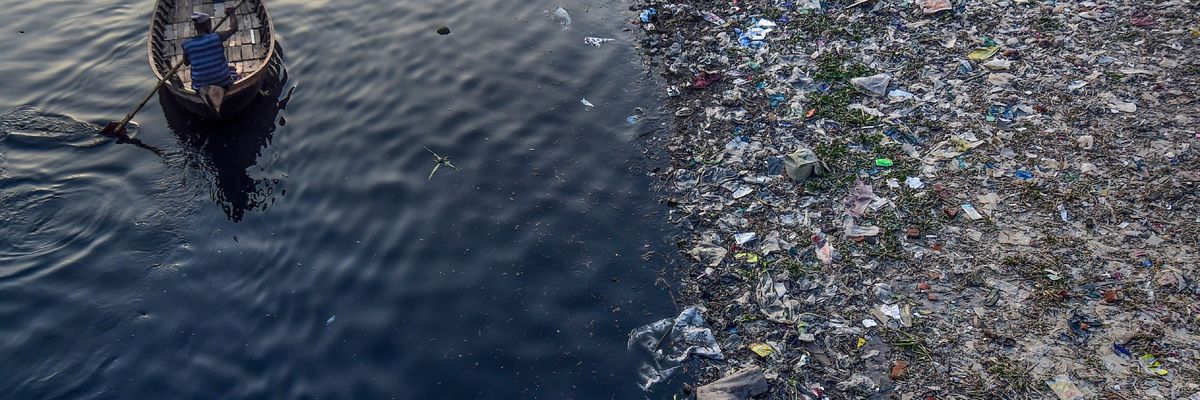
A man paddles on a boat as plastic bags float on the surface of the Buriganga River in Dhaka, Bangladesh on January 21, 2020. (Photo: Munir Uz Zaman/AFP via Getty Images)
Climate campaigners attending the first negotiations for a global plastics treaty in Punta Del Este, Uruguay this week are reporting that discussions have had a strong emphasis on protecting the rights of communities that are severely impacted by plastic pollution, but they warned that policymakers must avoid producing a "Paris agreement for plastics."
The international movement Break Free From Plastic said Wednesday night that several of the more than 150 assembled countries have expressed support for an agreement which would allow individual governments to "establish their own standards rather than global control measures."
"Plastic production remains unchecked, and companies, in league with Big Oil, continue to burden us with their disposable packaging that harms our health and the climate just so they can maximize their profits."
"We need legally binding obligations for all parties!" said the Center for International Environmental Law (CIEL), which is attending the summit.
The disagreement over whether new limits on countries' contributions to the planet's plastic pollution crisis should be standardized across the world is just one sticking point in the first round of negotiations which are set to adjourn on Friday, with talks continuing through 2024.
Campaigners are pushing for the final treaty to include language drastically limiting the production of plastic, roughly one trillion pounds of which is produced each year--a figure that is expected to double by 2045 unless action is taken.
Future discussions could target new regulations or bans regarding single-use plastic, reported Wired this week, but campaigners are emphasizing that the answer to plastic pollution won't be found in simply ramping up plastic recycling--which now stands at just 5% in the United States--or cleaning up the estimated 11 million metric tons that enters oceans each year.
The summit is the result of a mandate adopted in March at the United Nations Environmental Assembly 5.2 in Nairobi, where policymakers agreed to forge as "global, legally binding agreement that addresses the full lifecycle of plastic," wrote Marian Ledesma, zero waste campaigner at Greenpeace Philippines, at Common Dreams this week.
"We are at risk because plastic production remains unchecked, and companies, in league with Big Oil, continue to burden us with their disposable packaging that harms our health and the climate just so they can maximize their profits," wrote Ledesma. "This is why it is essential that the global plastics treaty immediately limit and reduce total plastic production and use... Ending the corporate addiction to single-use plastic is a vital step towards addressing climate change and protecting communities."
Graham Forbes, plastics global project leader for Greenpeace, told Wired this week that humans "need to reset our relationship to plastic, just full stop."
"The scale of the problem is mind-boggling," Forbes added. "Plastic is in our blood. It's in fetuses. It's really encroaching on every aspect of human existence."
According to Break Free From Plastic, there has been "much focus on technology transfer, with heavy emphasis on chemical recycling" in the talks so far.
Chemical recycling--in which high heat and chemicals are used to break used plastic products down to their chemical components--"is a dangerous, false solution to the plastics and climate crises," said CIEL.
Jane Patton, campaign manager of plastics and petrochemicals at CIEL, told Wired that her organization is pushing for "mandatory and obligatory caps on production."
"We're going to be pushing for changes in the way the plastics are produced, to eliminate toxic chemicals from the production and the supply chain," Patton said.
Some scientists at the talks are emphasizing calls to ban toxins like polymers, endocrine-disrupting chemicals, and phthalates, which have been linked to a variety of health issues and premature deaths.
"According to one study," reported Wired, "of the 10,000-plus different chemicals that have been used in various forms of plastics--like PVC or polystyrene--a quarter are substances of concern, meaning they're known toxicants, or accumulate and persist in organisms and the environment."
On Wednesday, the United Nations Office of the High Commissioner for Human Rights (OHCHR) called for a plastics treaty which advances the "realization of human rights, including the human right to a clean, healthy, and sustainable environment."
"The human rights and health of all persons, particularly persons, groups, and peoples disproportionately affected by plastic pollution, must be taken into account in all stages of the plastics cycle including extraction, production, consumption, and waste management," said the OHCHR.
Dear Common Dreams reader, It’s been nearly 30 years since I co-founded Common Dreams with my late wife, Lina Newhouser. We had the radical notion that journalism should serve the public good, not corporate profits. It was clear to us from the outset what it would take to build such a project. No paid advertisements. No corporate sponsors. No millionaire publisher telling us what to think or do. Many people said we wouldn't last a year, but we proved those doubters wrong. Together with a tremendous team of journalists and dedicated staff, we built an independent media outlet free from the constraints of profits and corporate control. Our mission has always been simple: To inform. To inspire. To ignite change for the common good. Building Common Dreams was not easy. Our survival was never guaranteed. When you take on the most powerful forces—Wall Street greed, fossil fuel industry destruction, Big Tech lobbyists, and uber-rich oligarchs who have spent billions upon billions rigging the economy and democracy in their favor—the only bulwark you have is supporters who believe in your work. But here’s the urgent message from me today. It's never been this bad out there. And it's never been this hard to keep us going. At the very moment Common Dreams is most needed, the threats we face are intensifying. We need your support now more than ever. We don't accept corporate advertising and never will. We don't have a paywall because we don't think people should be blocked from critical news based on their ability to pay. Everything we do is funded by the donations of readers like you. When everyone does the little they can afford, we are strong. But if that support retreats or dries up, so do we. Will you donate now to make sure Common Dreams not only survives but thrives? —Craig Brown, Co-founder |
Climate campaigners attending the first negotiations for a global plastics treaty in Punta Del Este, Uruguay this week are reporting that discussions have had a strong emphasis on protecting the rights of communities that are severely impacted by plastic pollution, but they warned that policymakers must avoid producing a "Paris agreement for plastics."
The international movement Break Free From Plastic said Wednesday night that several of the more than 150 assembled countries have expressed support for an agreement which would allow individual governments to "establish their own standards rather than global control measures."
"Plastic production remains unchecked, and companies, in league with Big Oil, continue to burden us with their disposable packaging that harms our health and the climate just so they can maximize their profits."
"We need legally binding obligations for all parties!" said the Center for International Environmental Law (CIEL), which is attending the summit.
The disagreement over whether new limits on countries' contributions to the planet's plastic pollution crisis should be standardized across the world is just one sticking point in the first round of negotiations which are set to adjourn on Friday, with talks continuing through 2024.
Campaigners are pushing for the final treaty to include language drastically limiting the production of plastic, roughly one trillion pounds of which is produced each year--a figure that is expected to double by 2045 unless action is taken.
Future discussions could target new regulations or bans regarding single-use plastic, reported Wired this week, but campaigners are emphasizing that the answer to plastic pollution won't be found in simply ramping up plastic recycling--which now stands at just 5% in the United States--or cleaning up the estimated 11 million metric tons that enters oceans each year.
The summit is the result of a mandate adopted in March at the United Nations Environmental Assembly 5.2 in Nairobi, where policymakers agreed to forge as "global, legally binding agreement that addresses the full lifecycle of plastic," wrote Marian Ledesma, zero waste campaigner at Greenpeace Philippines, at Common Dreams this week.
"We are at risk because plastic production remains unchecked, and companies, in league with Big Oil, continue to burden us with their disposable packaging that harms our health and the climate just so they can maximize their profits," wrote Ledesma. "This is why it is essential that the global plastics treaty immediately limit and reduce total plastic production and use... Ending the corporate addiction to single-use plastic is a vital step towards addressing climate change and protecting communities."
Graham Forbes, plastics global project leader for Greenpeace, told Wired this week that humans "need to reset our relationship to plastic, just full stop."
"The scale of the problem is mind-boggling," Forbes added. "Plastic is in our blood. It's in fetuses. It's really encroaching on every aspect of human existence."
According to Break Free From Plastic, there has been "much focus on technology transfer, with heavy emphasis on chemical recycling" in the talks so far.
Chemical recycling--in which high heat and chemicals are used to break used plastic products down to their chemical components--"is a dangerous, false solution to the plastics and climate crises," said CIEL.
Jane Patton, campaign manager of plastics and petrochemicals at CIEL, told Wired that her organization is pushing for "mandatory and obligatory caps on production."
"We're going to be pushing for changes in the way the plastics are produced, to eliminate toxic chemicals from the production and the supply chain," Patton said.
Some scientists at the talks are emphasizing calls to ban toxins like polymers, endocrine-disrupting chemicals, and phthalates, which have been linked to a variety of health issues and premature deaths.
"According to one study," reported Wired, "of the 10,000-plus different chemicals that have been used in various forms of plastics--like PVC or polystyrene--a quarter are substances of concern, meaning they're known toxicants, or accumulate and persist in organisms and the environment."
On Wednesday, the United Nations Office of the High Commissioner for Human Rights (OHCHR) called for a plastics treaty which advances the "realization of human rights, including the human right to a clean, healthy, and sustainable environment."
"The human rights and health of all persons, particularly persons, groups, and peoples disproportionately affected by plastic pollution, must be taken into account in all stages of the plastics cycle including extraction, production, consumption, and waste management," said the OHCHR.
Climate campaigners attending the first negotiations for a global plastics treaty in Punta Del Este, Uruguay this week are reporting that discussions have had a strong emphasis on protecting the rights of communities that are severely impacted by plastic pollution, but they warned that policymakers must avoid producing a "Paris agreement for plastics."
The international movement Break Free From Plastic said Wednesday night that several of the more than 150 assembled countries have expressed support for an agreement which would allow individual governments to "establish their own standards rather than global control measures."
"Plastic production remains unchecked, and companies, in league with Big Oil, continue to burden us with their disposable packaging that harms our health and the climate just so they can maximize their profits."
"We need legally binding obligations for all parties!" said the Center for International Environmental Law (CIEL), which is attending the summit.
The disagreement over whether new limits on countries' contributions to the planet's plastic pollution crisis should be standardized across the world is just one sticking point in the first round of negotiations which are set to adjourn on Friday, with talks continuing through 2024.
Campaigners are pushing for the final treaty to include language drastically limiting the production of plastic, roughly one trillion pounds of which is produced each year--a figure that is expected to double by 2045 unless action is taken.
Future discussions could target new regulations or bans regarding single-use plastic, reported Wired this week, but campaigners are emphasizing that the answer to plastic pollution won't be found in simply ramping up plastic recycling--which now stands at just 5% in the United States--or cleaning up the estimated 11 million metric tons that enters oceans each year.
The summit is the result of a mandate adopted in March at the United Nations Environmental Assembly 5.2 in Nairobi, where policymakers agreed to forge as "global, legally binding agreement that addresses the full lifecycle of plastic," wrote Marian Ledesma, zero waste campaigner at Greenpeace Philippines, at Common Dreams this week.
"We are at risk because plastic production remains unchecked, and companies, in league with Big Oil, continue to burden us with their disposable packaging that harms our health and the climate just so they can maximize their profits," wrote Ledesma. "This is why it is essential that the global plastics treaty immediately limit and reduce total plastic production and use... Ending the corporate addiction to single-use plastic is a vital step towards addressing climate change and protecting communities."
Graham Forbes, plastics global project leader for Greenpeace, told Wired this week that humans "need to reset our relationship to plastic, just full stop."
"The scale of the problem is mind-boggling," Forbes added. "Plastic is in our blood. It's in fetuses. It's really encroaching on every aspect of human existence."
According to Break Free From Plastic, there has been "much focus on technology transfer, with heavy emphasis on chemical recycling" in the talks so far.
Chemical recycling--in which high heat and chemicals are used to break used plastic products down to their chemical components--"is a dangerous, false solution to the plastics and climate crises," said CIEL.
Jane Patton, campaign manager of plastics and petrochemicals at CIEL, told Wired that her organization is pushing for "mandatory and obligatory caps on production."
"We're going to be pushing for changes in the way the plastics are produced, to eliminate toxic chemicals from the production and the supply chain," Patton said.
Some scientists at the talks are emphasizing calls to ban toxins like polymers, endocrine-disrupting chemicals, and phthalates, which have been linked to a variety of health issues and premature deaths.
"According to one study," reported Wired, "of the 10,000-plus different chemicals that have been used in various forms of plastics--like PVC or polystyrene--a quarter are substances of concern, meaning they're known toxicants, or accumulate and persist in organisms and the environment."
On Wednesday, the United Nations Office of the High Commissioner for Human Rights (OHCHR) called for a plastics treaty which advances the "realization of human rights, including the human right to a clean, healthy, and sustainable environment."
"The human rights and health of all persons, particularly persons, groups, and peoples disproportionately affected by plastic pollution, must be taken into account in all stages of the plastics cycle including extraction, production, consumption, and waste management," said the OHCHR.