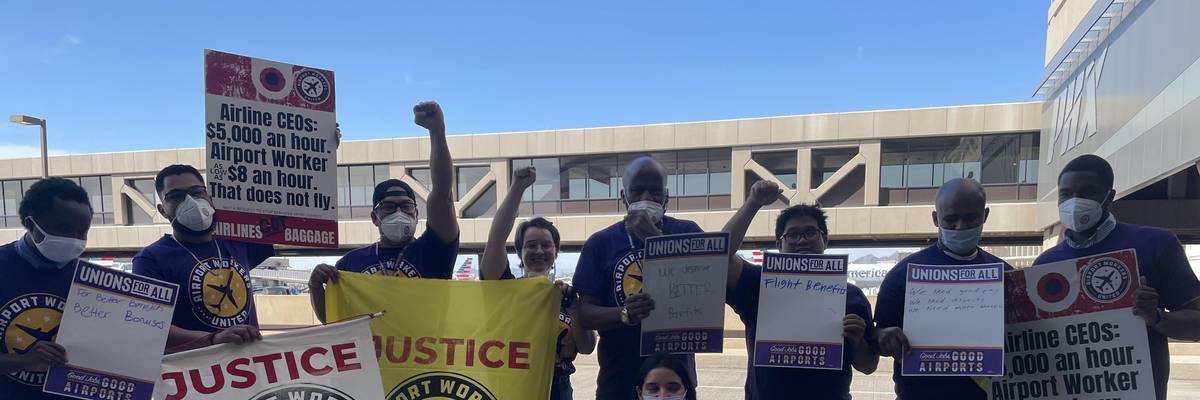
Protesters in Phoenix joined a national day of action for airport workers demanding better employment conditions. (Photo: Airport Workers United/Twitter)
Airport Workers Protest Across US Demanding 'Living Wage' and Right to Union
"We're fed up after years of working jobs where we're called essential, but treated as disposable."
Contracted airport workers--including baggage handlers, cabin cleaners, security officers, and wheelchair agents--in more than 20 U.S. cities staged coordinated demonstrations Wednesday to call for higher wages, better benefits, and the right to unionize.
"As an immigrant who spent 10 years in refugee camps, I've faced plenty of hardship in my life, but none as great as the last two years."
"Airports keep our economy and our world connected. I assist disabled, elderly, and other passengers, who need help getting through the airport to their plane," said Omer Hussein, a wheelchair attendant servicing American Airlines at Dallas-Fort Worth International Airport, in a statement.
"I'm only paid $12 an hour. I work a lot of hours and some days I work so late that I just sleep over at the airport," he explained. "I can't afford a car, rent, and to send money home to my family in Sudan. I like working with passengers, but I'm so tired all the time. That won't fly any longer."
Hussein added that "now, airport workers like me are fed up and taking action to demand that all airport jobs must be good, union jobs that pay enough to support our families."
Along with his workplace in Texas, workers planned protests at airports in or near Atlanta, Boston, Charlotte, Chicago, Denver, Fort Lauderdale, Houston, Los Angeles, Miami, Minneapolis, Newark, New York, Orlando, Philadelphia, Phoenix, Portland, Seattle, Tampa, and Washington, D.C.
"If I got hit by a car or a stray bullet, I'll tell the ambulance to take me to Dulles to work because otherwise I won't have a job when I come back," said 71-year-old Paul Blair, a terminal cleaner at Washington Dulles International Airport, in a statement.
Blair, who suffers from arthritis and heart problems, highlighted that "we sacrificed our lives working through Covid, but we still don't get benefits and must come to work sick because we can't afford to lose pay."
As part of the day of action, the workers--who are organizing with the Service Employees International Union (SEIU)--ran a full-page advertisement in USA Today with a letter addressed to the CEOs of three major airlines: American, Delta, and United.
"Airports connect people worldwide and power the global economy. And it's workers like us who make it all possible," the ad says. "But we're fed up after years of working jobs where we're called essential, but treated as disposable."
The letter calls on the chief executives to sign the "Good Airports Pledge," which would mean promising to:
- Acknowledge that airlines have the ability and responsibility to end poverty-wage jobs and inequality through the system;
- Ensure the billions of public dollars airlines receive annually serve the public good, not just shareholders and executives;
- Set a minimum wage and benefit standard guaranteeing all workers are paid living wages and provided affordable, quality healthcare and paid time off;
- Respect workers' right to join together in a union; and
- Ensure contracts with airport service providers are able to meet living wage and fair benefits standards and encourage contracts to be neutral when workers organize a union.
"Amid a national reckoning and wave of workers exercising their power, airport workers are building on years of organizing and asserting themselves as the newest force in the surging labor movement," declared SEIU international president Mary Kay Henry ahead of the protests. "They're standing up to airline CEOs, raising their voices to demand respect, protections, and pay that they can raise a family on."
"They're fed up with a system where Black and Brown workers make tens of thousands of dollars less than their white peers, and they're taking action," the labor leader added. "Airlines have long proven they can't be trusted to use the billions of public dollars they receive to serve the public good."
In statements about the demonstrations, some workers shared how the ongoing Covid-19 pandemic has affected them.
"As an immigrant who spent 10 years in refugee camps, I've faced plenty of hardship in my life, but none as great as the last two years," said Ababuti Olok, a skycap worker and wheelchair attendant at Boston Logan International Airport who lives in Chelsea with his wife and two sons.
"I was grateful to go back to work after being in lay off for many months, but I still fell over three months behind on rent and feared my family would end up homeless. Even now, I'm still behind on my bills," he added. "I need relief so my children can stay in our home."
Skycap Almaz Abera, who has worked at Ronald Reagan Washington National Airport for 18 years, said that "almost all of my coworkers got Covid, I'm very sad over the loss of my coworkers Ana and Brook, sometimes we cry when we talk about them."
"Those who lack health insurance can't afford to go to hospital, often dying as a result," Abera noted. "Those with healthcare make it because they can afford to go to the hospital. We have to fight the airlines for healthcare and sick leave because you can die and they won't care."
Some federal lawmakers, including Reps. Gerry Connolly (D-Va.) and Pramila Jayapal (D-Wash.), expressed support for the protesting workers.
"Airport workers can be paid as little as $8/hour, while CEOs are paid on average $5,000/hour," tweeted Jayapal, chair of the Congressional Progressive Caucus. "It's time to raise the wage for workers across this country."
We are at a crossroads
This country and this world are at a monumental crossroads. In a few short weeks, US voters will have an opportunity to beat back the forces of fascism and confront the billionaires who are rigging the economy, our media system, and our democracy, making it increasingly impossible for ordinary people to get by. We’re not just talking about the election. We’re talking about what must be done once these fascist elements are vanquished from power. We need a bolder set of solutions than what either major party has so far been willing to offer and a working-class movement ready to fight like hell for it. Trump didn't emerge from nowhere. The conditions that fueled MAGA authoritarianism were created by decades of radical neoliberal economic policies and a corrupt political system dominated by corporate interests. They slashed taxes on the super-rich, promising that the benefits would trickle down. They said giveaways to the corporate titans would make life more affordable for the rest of us. It was all bullshit. And when a bitter, betrayed populace searches for someone to blame, right-wing demagogues have little trouble finding scapegoats. People know when they're being lied to, but you won't hear any of this from the corporate media. Only independent journalism—powered and funded by people who believe in building a better world—can deliver truly trustworthy daily news. Our Fall Campaign is underway, and we need your help. To power our newsroom through the rest of the year, we need to raise $125,000 by midnight on October 31. So if you share our vision, please contribute whatever you can to sustain our work. |
Contracted airport workers--including baggage handlers, cabin cleaners, security officers, and wheelchair agents--in more than 20 U.S. cities staged coordinated demonstrations Wednesday to call for higher wages, better benefits, and the right to unionize.
"As an immigrant who spent 10 years in refugee camps, I've faced plenty of hardship in my life, but none as great as the last two years."
"Airports keep our economy and our world connected. I assist disabled, elderly, and other passengers, who need help getting through the airport to their plane," said Omer Hussein, a wheelchair attendant servicing American Airlines at Dallas-Fort Worth International Airport, in a statement.
"I'm only paid $12 an hour. I work a lot of hours and some days I work so late that I just sleep over at the airport," he explained. "I can't afford a car, rent, and to send money home to my family in Sudan. I like working with passengers, but I'm so tired all the time. That won't fly any longer."
Hussein added that "now, airport workers like me are fed up and taking action to demand that all airport jobs must be good, union jobs that pay enough to support our families."
Along with his workplace in Texas, workers planned protests at airports in or near Atlanta, Boston, Charlotte, Chicago, Denver, Fort Lauderdale, Houston, Los Angeles, Miami, Minneapolis, Newark, New York, Orlando, Philadelphia, Phoenix, Portland, Seattle, Tampa, and Washington, D.C.
"If I got hit by a car or a stray bullet, I'll tell the ambulance to take me to Dulles to work because otherwise I won't have a job when I come back," said 71-year-old Paul Blair, a terminal cleaner at Washington Dulles International Airport, in a statement.
Blair, who suffers from arthritis and heart problems, highlighted that "we sacrificed our lives working through Covid, but we still don't get benefits and must come to work sick because we can't afford to lose pay."
As part of the day of action, the workers--who are organizing with the Service Employees International Union (SEIU)--ran a full-page advertisement in USA Today with a letter addressed to the CEOs of three major airlines: American, Delta, and United.
"Airports connect people worldwide and power the global economy. And it's workers like us who make it all possible," the ad says. "But we're fed up after years of working jobs where we're called essential, but treated as disposable."
The letter calls on the chief executives to sign the "Good Airports Pledge," which would mean promising to:
- Acknowledge that airlines have the ability and responsibility to end poverty-wage jobs and inequality through the system;
- Ensure the billions of public dollars airlines receive annually serve the public good, not just shareholders and executives;
- Set a minimum wage and benefit standard guaranteeing all workers are paid living wages and provided affordable, quality healthcare and paid time off;
- Respect workers' right to join together in a union; and
- Ensure contracts with airport service providers are able to meet living wage and fair benefits standards and encourage contracts to be neutral when workers organize a union.
"Amid a national reckoning and wave of workers exercising their power, airport workers are building on years of organizing and asserting themselves as the newest force in the surging labor movement," declared SEIU international president Mary Kay Henry ahead of the protests. "They're standing up to airline CEOs, raising their voices to demand respect, protections, and pay that they can raise a family on."
"They're fed up with a system where Black and Brown workers make tens of thousands of dollars less than their white peers, and they're taking action," the labor leader added. "Airlines have long proven they can't be trusted to use the billions of public dollars they receive to serve the public good."
In statements about the demonstrations, some workers shared how the ongoing Covid-19 pandemic has affected them.
"As an immigrant who spent 10 years in refugee camps, I've faced plenty of hardship in my life, but none as great as the last two years," said Ababuti Olok, a skycap worker and wheelchair attendant at Boston Logan International Airport who lives in Chelsea with his wife and two sons.
"I was grateful to go back to work after being in lay off for many months, but I still fell over three months behind on rent and feared my family would end up homeless. Even now, I'm still behind on my bills," he added. "I need relief so my children can stay in our home."
Skycap Almaz Abera, who has worked at Ronald Reagan Washington National Airport for 18 years, said that "almost all of my coworkers got Covid, I'm very sad over the loss of my coworkers Ana and Brook, sometimes we cry when we talk about them."
"Those who lack health insurance can't afford to go to hospital, often dying as a result," Abera noted. "Those with healthcare make it because they can afford to go to the hospital. We have to fight the airlines for healthcare and sick leave because you can die and they won't care."
Some federal lawmakers, including Reps. Gerry Connolly (D-Va.) and Pramila Jayapal (D-Wash.), expressed support for the protesting workers.
"Airport workers can be paid as little as $8/hour, while CEOs are paid on average $5,000/hour," tweeted Jayapal, chair of the Congressional Progressive Caucus. "It's time to raise the wage for workers across this country."
Contracted airport workers--including baggage handlers, cabin cleaners, security officers, and wheelchair agents--in more than 20 U.S. cities staged coordinated demonstrations Wednesday to call for higher wages, better benefits, and the right to unionize.
"As an immigrant who spent 10 years in refugee camps, I've faced plenty of hardship in my life, but none as great as the last two years."
"Airports keep our economy and our world connected. I assist disabled, elderly, and other passengers, who need help getting through the airport to their plane," said Omer Hussein, a wheelchair attendant servicing American Airlines at Dallas-Fort Worth International Airport, in a statement.
"I'm only paid $12 an hour. I work a lot of hours and some days I work so late that I just sleep over at the airport," he explained. "I can't afford a car, rent, and to send money home to my family in Sudan. I like working with passengers, but I'm so tired all the time. That won't fly any longer."
Hussein added that "now, airport workers like me are fed up and taking action to demand that all airport jobs must be good, union jobs that pay enough to support our families."
Along with his workplace in Texas, workers planned protests at airports in or near Atlanta, Boston, Charlotte, Chicago, Denver, Fort Lauderdale, Houston, Los Angeles, Miami, Minneapolis, Newark, New York, Orlando, Philadelphia, Phoenix, Portland, Seattle, Tampa, and Washington, D.C.
"If I got hit by a car or a stray bullet, I'll tell the ambulance to take me to Dulles to work because otherwise I won't have a job when I come back," said 71-year-old Paul Blair, a terminal cleaner at Washington Dulles International Airport, in a statement.
Blair, who suffers from arthritis and heart problems, highlighted that "we sacrificed our lives working through Covid, but we still don't get benefits and must come to work sick because we can't afford to lose pay."
As part of the day of action, the workers--who are organizing with the Service Employees International Union (SEIU)--ran a full-page advertisement in USA Today with a letter addressed to the CEOs of three major airlines: American, Delta, and United.
"Airports connect people worldwide and power the global economy. And it's workers like us who make it all possible," the ad says. "But we're fed up after years of working jobs where we're called essential, but treated as disposable."
The letter calls on the chief executives to sign the "Good Airports Pledge," which would mean promising to:
- Acknowledge that airlines have the ability and responsibility to end poverty-wage jobs and inequality through the system;
- Ensure the billions of public dollars airlines receive annually serve the public good, not just shareholders and executives;
- Set a minimum wage and benefit standard guaranteeing all workers are paid living wages and provided affordable, quality healthcare and paid time off;
- Respect workers' right to join together in a union; and
- Ensure contracts with airport service providers are able to meet living wage and fair benefits standards and encourage contracts to be neutral when workers organize a union.
"Amid a national reckoning and wave of workers exercising their power, airport workers are building on years of organizing and asserting themselves as the newest force in the surging labor movement," declared SEIU international president Mary Kay Henry ahead of the protests. "They're standing up to airline CEOs, raising their voices to demand respect, protections, and pay that they can raise a family on."
"They're fed up with a system where Black and Brown workers make tens of thousands of dollars less than their white peers, and they're taking action," the labor leader added. "Airlines have long proven they can't be trusted to use the billions of public dollars they receive to serve the public good."
In statements about the demonstrations, some workers shared how the ongoing Covid-19 pandemic has affected them.
"As an immigrant who spent 10 years in refugee camps, I've faced plenty of hardship in my life, but none as great as the last two years," said Ababuti Olok, a skycap worker and wheelchair attendant at Boston Logan International Airport who lives in Chelsea with his wife and two sons.
"I was grateful to go back to work after being in lay off for many months, but I still fell over three months behind on rent and feared my family would end up homeless. Even now, I'm still behind on my bills," he added. "I need relief so my children can stay in our home."
Skycap Almaz Abera, who has worked at Ronald Reagan Washington National Airport for 18 years, said that "almost all of my coworkers got Covid, I'm very sad over the loss of my coworkers Ana and Brook, sometimes we cry when we talk about them."
"Those who lack health insurance can't afford to go to hospital, often dying as a result," Abera noted. "Those with healthcare make it because they can afford to go to the hospital. We have to fight the airlines for healthcare and sick leave because you can die and they won't care."
Some federal lawmakers, including Reps. Gerry Connolly (D-Va.) and Pramila Jayapal (D-Wash.), expressed support for the protesting workers.
"Airport workers can be paid as little as $8/hour, while CEOs are paid on average $5,000/hour," tweeted Jayapal, chair of the Congressional Progressive Caucus. "It's time to raise the wage for workers across this country."