SUBSCRIBE TO OUR FREE NEWSLETTER
Daily news & progressive opinion—funded by the people, not the corporations—delivered straight to your inbox.
5
#000000
#FFFFFF
To donate by check, phone, or other method, see our More Ways to Give page.
Daily news & progressive opinion—funded by the people, not the corporations—delivered straight to your inbox.
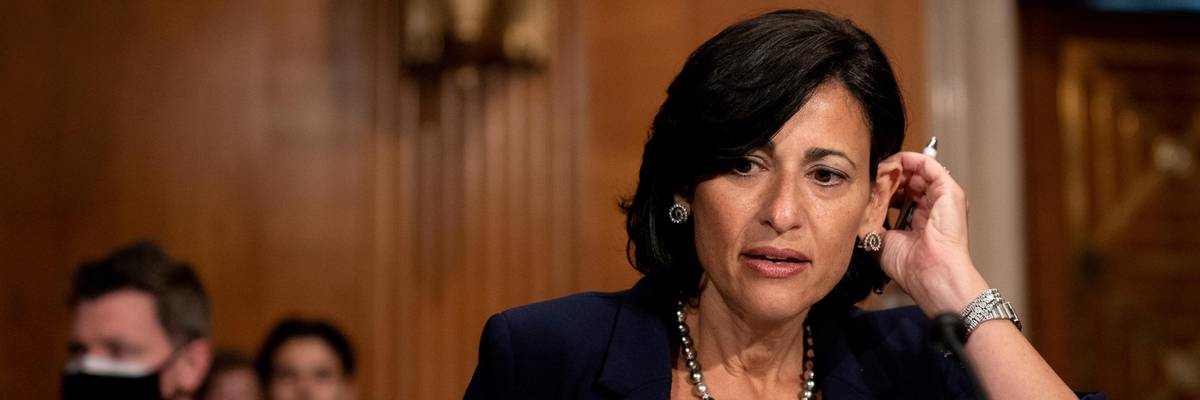
Dr. Rochelle Walensky, director of the Centers for Disease Control and Prevention (CDC), testifies on Capitol Hill on July 20, 2021 in Washington, D.C. (Photo: Stefani Reynolds-Pool/Getty Images)
Disability rights groups on Sunday were among those expressing horror at comments by Centers for Disease Control and Prevention director Dr. Rochelle Walensky regarding who is most likely to die from the Omicron variant of Covid-19.
On "Good Morning America" Friday, Walensky shared what she said was "encouraging news" about the variant which is driving case numbers to record highs in the U.S., saying, "The overwhelming number of deaths, over 75%, occurred in people who had at least four comorbidities."
"So really these are people who were unwell to begin with," she added.
Susan Henderson, executive director of the Disability Rights Education and Defense Fund (DREDF), shared on social media a letter she wrote to Walensky on Sunday in response to the remarks.
"Messages from the head of the CDC must convey that all lives are valuable, and the loss of any life from Covid-19, whether it is the life of a person with a disability, an older adult, or a 32-year-old with no known disabilities, is a tragedy," Henderson wrote.
Walensky's comments were denounced as "eugenicist" by Matthew Cortland, a lawyer and writer with a chronic illness, who also pointed out that rhetoric similar to the CDC director's has persisted since the first Covid-19 case in the U.S. was reported two years ago.
"People heard that only disabled and elderly people would die, and they said, 'Oh, psst, well we'll be fine then, right? We'll be okay,'" said writer Imani Barbarin about the early days of the pandemic on a panel about ableism hosted by Daily Kos last month. "But when you think about the fact that Indigenous and Black people have the highest rates of disability, it shifts the entire picture behind that instinct."
Walensky's remarks prompted people with disabilities to share their outrage using the hashtag #MyDisabledLifeIsWorthSaving on Twitter.
"Are our deaths less tragic? Are our lives less valuable? Are we less human?" asked disability rights and Medicare for All activist Ady Barkan. "We live in the wealthiest country in history. We can afford to give healthcare to everyone. We can afford enough masks, tests, and medical staff to keep everyone safe. But that requires seeing the full humanity of each of us."
Walensky attempted to clarify her comments Sunday, saying, "We must protect people with comorbidities from severe Covid-19," but critics including Cortland and physician Dr. Eric Reinhart said more must be done at the CDC and throughout the Biden administration to demonstrate that the White House is working to protect all Americans from the pandemic.
The administration drew condemnation from the disability rights community in recent weeks over its guidance for asymptomatic people with Covid-19, which said people to return to work and daily activities after only five days of isolation instead of 10 after testing positive.
White House Coronavirus Response Coordinator Jeffrey Zients' statement last month that unvaccinated people are "looking at a winter of severe illness and death" also angered advocates, considering that people with disabilities are more likely to have trouble obtaining vaccines, according to ABC News.
"That 75% of Covid deaths were people with multiple comorbidities, i.e. people with disabilities, is not good news, despite what the CDC director says," tweeted Maria Town on Saturday regarding Walensky's comments. "It's news that reveals our national callousness to how difficult it is for disabled people to survive."
Dear Common Dreams reader, It’s been nearly 30 years since I co-founded Common Dreams with my late wife, Lina Newhouser. We had the radical notion that journalism should serve the public good, not corporate profits. It was clear to us from the outset what it would take to build such a project. No paid advertisements. No corporate sponsors. No millionaire publisher telling us what to think or do. Many people said we wouldn't last a year, but we proved those doubters wrong. Together with a tremendous team of journalists and dedicated staff, we built an independent media outlet free from the constraints of profits and corporate control. Our mission has always been simple: To inform. To inspire. To ignite change for the common good. Building Common Dreams was not easy. Our survival was never guaranteed. When you take on the most powerful forces—Wall Street greed, fossil fuel industry destruction, Big Tech lobbyists, and uber-rich oligarchs who have spent billions upon billions rigging the economy and democracy in their favor—the only bulwark you have is supporters who believe in your work. But here’s the urgent message from me today. It's never been this bad out there. And it's never been this hard to keep us going. At the very moment Common Dreams is most needed, the threats we face are intensifying. We need your support now more than ever. We don't accept corporate advertising and never will. We don't have a paywall because we don't think people should be blocked from critical news based on their ability to pay. Everything we do is funded by the donations of readers like you. When everyone does the little they can afford, we are strong. But if that support retreats or dries up, so do we. Will you donate now to make sure Common Dreams not only survives but thrives? —Craig Brown, Co-founder |
Disability rights groups on Sunday were among those expressing horror at comments by Centers for Disease Control and Prevention director Dr. Rochelle Walensky regarding who is most likely to die from the Omicron variant of Covid-19.
On "Good Morning America" Friday, Walensky shared what she said was "encouraging news" about the variant which is driving case numbers to record highs in the U.S., saying, "The overwhelming number of deaths, over 75%, occurred in people who had at least four comorbidities."
"So really these are people who were unwell to begin with," she added.
Susan Henderson, executive director of the Disability Rights Education and Defense Fund (DREDF), shared on social media a letter she wrote to Walensky on Sunday in response to the remarks.
"Messages from the head of the CDC must convey that all lives are valuable, and the loss of any life from Covid-19, whether it is the life of a person with a disability, an older adult, or a 32-year-old with no known disabilities, is a tragedy," Henderson wrote.
Walensky's comments were denounced as "eugenicist" by Matthew Cortland, a lawyer and writer with a chronic illness, who also pointed out that rhetoric similar to the CDC director's has persisted since the first Covid-19 case in the U.S. was reported two years ago.
"People heard that only disabled and elderly people would die, and they said, 'Oh, psst, well we'll be fine then, right? We'll be okay,'" said writer Imani Barbarin about the early days of the pandemic on a panel about ableism hosted by Daily Kos last month. "But when you think about the fact that Indigenous and Black people have the highest rates of disability, it shifts the entire picture behind that instinct."
Walensky's remarks prompted people with disabilities to share their outrage using the hashtag #MyDisabledLifeIsWorthSaving on Twitter.
"Are our deaths less tragic? Are our lives less valuable? Are we less human?" asked disability rights and Medicare for All activist Ady Barkan. "We live in the wealthiest country in history. We can afford to give healthcare to everyone. We can afford enough masks, tests, and medical staff to keep everyone safe. But that requires seeing the full humanity of each of us."
Walensky attempted to clarify her comments Sunday, saying, "We must protect people with comorbidities from severe Covid-19," but critics including Cortland and physician Dr. Eric Reinhart said more must be done at the CDC and throughout the Biden administration to demonstrate that the White House is working to protect all Americans from the pandemic.
The administration drew condemnation from the disability rights community in recent weeks over its guidance for asymptomatic people with Covid-19, which said people to return to work and daily activities after only five days of isolation instead of 10 after testing positive.
White House Coronavirus Response Coordinator Jeffrey Zients' statement last month that unvaccinated people are "looking at a winter of severe illness and death" also angered advocates, considering that people with disabilities are more likely to have trouble obtaining vaccines, according to ABC News.
"That 75% of Covid deaths were people with multiple comorbidities, i.e. people with disabilities, is not good news, despite what the CDC director says," tweeted Maria Town on Saturday regarding Walensky's comments. "It's news that reveals our national callousness to how difficult it is for disabled people to survive."
Disability rights groups on Sunday were among those expressing horror at comments by Centers for Disease Control and Prevention director Dr. Rochelle Walensky regarding who is most likely to die from the Omicron variant of Covid-19.
On "Good Morning America" Friday, Walensky shared what she said was "encouraging news" about the variant which is driving case numbers to record highs in the U.S., saying, "The overwhelming number of deaths, over 75%, occurred in people who had at least four comorbidities."
"So really these are people who were unwell to begin with," she added.
Susan Henderson, executive director of the Disability Rights Education and Defense Fund (DREDF), shared on social media a letter she wrote to Walensky on Sunday in response to the remarks.
"Messages from the head of the CDC must convey that all lives are valuable, and the loss of any life from Covid-19, whether it is the life of a person with a disability, an older adult, or a 32-year-old with no known disabilities, is a tragedy," Henderson wrote.
Walensky's comments were denounced as "eugenicist" by Matthew Cortland, a lawyer and writer with a chronic illness, who also pointed out that rhetoric similar to the CDC director's has persisted since the first Covid-19 case in the U.S. was reported two years ago.
"People heard that only disabled and elderly people would die, and they said, 'Oh, psst, well we'll be fine then, right? We'll be okay,'" said writer Imani Barbarin about the early days of the pandemic on a panel about ableism hosted by Daily Kos last month. "But when you think about the fact that Indigenous and Black people have the highest rates of disability, it shifts the entire picture behind that instinct."
Walensky's remarks prompted people with disabilities to share their outrage using the hashtag #MyDisabledLifeIsWorthSaving on Twitter.
"Are our deaths less tragic? Are our lives less valuable? Are we less human?" asked disability rights and Medicare for All activist Ady Barkan. "We live in the wealthiest country in history. We can afford to give healthcare to everyone. We can afford enough masks, tests, and medical staff to keep everyone safe. But that requires seeing the full humanity of each of us."
Walensky attempted to clarify her comments Sunday, saying, "We must protect people with comorbidities from severe Covid-19," but critics including Cortland and physician Dr. Eric Reinhart said more must be done at the CDC and throughout the Biden administration to demonstrate that the White House is working to protect all Americans from the pandemic.
The administration drew condemnation from the disability rights community in recent weeks over its guidance for asymptomatic people with Covid-19, which said people to return to work and daily activities after only five days of isolation instead of 10 after testing positive.
White House Coronavirus Response Coordinator Jeffrey Zients' statement last month that unvaccinated people are "looking at a winter of severe illness and death" also angered advocates, considering that people with disabilities are more likely to have trouble obtaining vaccines, according to ABC News.
"That 75% of Covid deaths were people with multiple comorbidities, i.e. people with disabilities, is not good news, despite what the CDC director says," tweeted Maria Town on Saturday regarding Walensky's comments. "It's news that reveals our national callousness to how difficult it is for disabled people to survive."