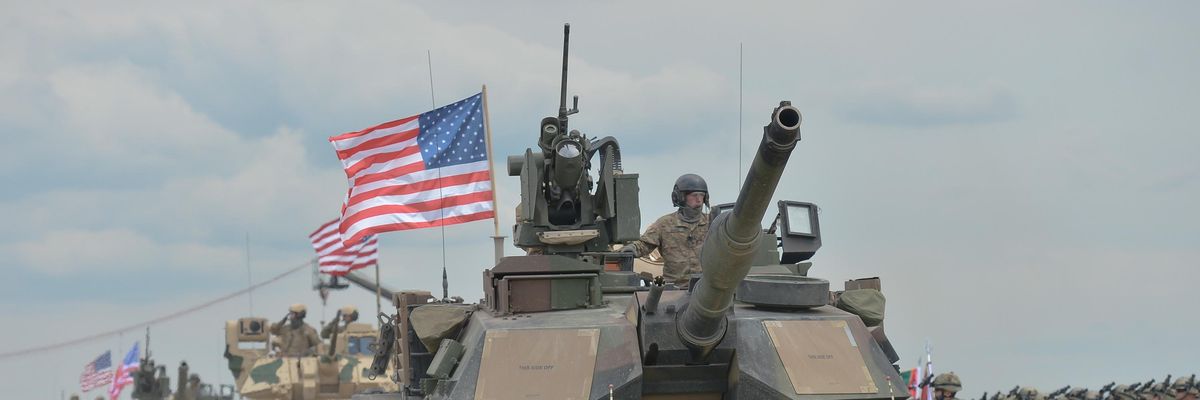
U.S. tanks appear during a military training exercise in May of 2016 in Vaziani, Georgia. (Photo: Artur Widak/NurPhoto via Getty Images)
Since 9/11, US Has Spent $21 Trillion on Militarism at Home and Abroad
"Our $21 trillion investment in militarism has cost far more than dollars."
In the 20 years since the September 11 attacks, the United States government has spent more than $21 trillion at home and overseas on militaristic policies that led to the creation of a vast surveillance apparatus, worsened mass incarceration, intensified the war on immigrant communities, and caused incalculable human suffering in Afghanistan, Iraq, Yemen, Libya, Somalia, and elsewhere.
"The end of the war in Afghanistan represents a chance to reinvest in our real needs."
--Lindsay Koshgarian, National Priorities Project
According to State of Insecurity: The Cost of Militarization Since 9/11 (pdf), a report released Wednesday by the National Priorities Project, the U.S. government's so-called "War on Terror" has "remade the U.S. into a more militarized actor both around the world and at home" by pouring vast resources into the Pentagon, federal law enforcement, and the Department of Homeland Security (DHS), an agency established in response to the September 11 attacks.
Released in the wake of the final withdrawal of U.S. troops from Afghanistan after two decades of devastating war and occupation, the new report argues that the Taliban's rapid takeover of the country "raises deep questions about our military investments to date."
"Twenty years ago, we were promised a vision of the War on Terror that did not come to pass: that Afghanistan would not become a quagmire, or that the Iraq War would be over in 'five weeks or five days or five months' and cost a mere $60 billion," the report notes. "As the country went to war and refocused domestic security spending on terrorism, few had any inkling of the far-reaching ramifications for the military, veterans, immigration, or domestic law enforcement."
The National Priorities Project (NPP), an initiative of the Institute for Policy Studies, estimates that of the $21 trillion the U.S. invested in "foreign and domestic militarization" in the aftermath of September 11, 2001, $16 trillion went to the military, $3 trillion to veterans' programs, $949 billion to DHS, and $732 billion to federal law enforcement.
In addition to fueling death and destruction overseas, the new report stresses that spending on overseas wars heightened domestic militarization, making police crackdowns on dissent at home even more violent.
"There is evidence that the War on Terror drove transfers of military equipment to police, as surges ended and the Pentagon looked to divest from surplus equipment," the analysis notes. "Transfers in 2010, when the military was still deeply engaged in the War on Terror, totaled $30 million. Over the next few years, the U.S. pulled forces out of Iraq, and military equipment transfers skyrocketed, peaking at $386 million in 2014. Today, transfers are still far higher than they were early in the War on Terror, totaling $152 million in 2020 and $101 million in just the first half of 2021."
Lindsay Koshgarian, program director of NPP and lead author of the new report, said in a statement Wednesday that "our $21 trillion investment in militarism has cost far more than dollars."
"It has cost the lives of civilians and troops lost in war, and the lives ended or torn apart by our brutal and punitive immigration, policing, and mass incarceration systems," said Koshgarian. "Meanwhile, we've neglected so much of what we really need. Militarism hasn't protected us from a pandemic that at its worst took the toll of a 9/11 every day, from poverty and instability driven by staggering inequality, or from hurricanes and wildfires made worse by climate change."
According to the new report, it would have cost far less than $21 trillion for the U.S. to make major investments in climate action and other key global and domestic priorities. As the analysis notes:
- $4.5 trillion could fully decarbonize the U.S. electric grid;
- $2.3 trillion could create five million $15-per-hour jobs with benefits and cost-of-living adjustments for 10 years;
- $1.7 trillion could erase student debt;
- $449 billion could continue the extended Child Tax Credit for another 10 years;
- $200 billion could guarantee free preschool for every 3-and-4-year old for 10 years, and raise teacher pay; and
- $25 billion could provide Covid vaccines for the population of low-income countries.
The NPP report was published on same day that Brown University's Costs of War Project released a new analysis estimating that U.S.-led post-9/11 wars in Iraq, Afghanistan, and elsewhere have killed at least 929,000 people--a figure deemed likely to be a "vast undercount"--and cost more than $8 trillion.
"The end of the war in Afghanistan represents a chance to reinvest in our real needs," Koshgarian said Wednesday. "Twenty years from now, we could live in a world made safer by investments in infrastructure, job creation, support for families, public health, and new energy systems, if we are willing to take a hard look at our priorities."

Urgent. It's never been this bad.
Dear Common Dreams reader, It’s been nearly 30 years since I co-founded Common Dreams with my late wife, Lina Newhouser. We had the radical notion that journalism should serve the public good, not corporate profits. It was clear to us from the outset what it would take to build such a project. No paid advertisements. No corporate sponsors. No millionaire publisher telling us what to think or do. Many people said we wouldn't last a year, but we proved those doubters wrong. Together with a tremendous team of journalists and dedicated staff, we built an independent media outlet free from the constraints of profits and corporate control. Our mission from the outset was simple. To inform. To inspire. To ignite change for the common good. Building Common Dreams was not easy. Our survival was never guaranteed. When you take on the most powerful forces—Wall Street greed, fossil fuel industry destruction, Big Tech lobbyists, and uber-rich oligarchs who have spent billions upon billions rigging the economy and democracy in their favor—the only bulwark you have is supporters who believe in your work. But here’s the urgent message from me today. It’s never been this bad out there. And it’s never been this hard to keep us going. At the very moment Common Dreams is most needed and doing some of its best and most important work, the threats we face are intensifying. Right now, with just hours left in our Spring Campaign, we're still falling short of our make-or-break goal. When everyone does the little they can afford, we are strong. But if that support retreats or dries up, so do we. Can you make a gift right now to make sure Common Dreams not only survives but thrives? There is no backup plan or rainy day fund. There is only you. —Craig Brown, Co-founder |
In the 20 years since the September 11 attacks, the United States government has spent more than $21 trillion at home and overseas on militaristic policies that led to the creation of a vast surveillance apparatus, worsened mass incarceration, intensified the war on immigrant communities, and caused incalculable human suffering in Afghanistan, Iraq, Yemen, Libya, Somalia, and elsewhere.
"The end of the war in Afghanistan represents a chance to reinvest in our real needs."
--Lindsay Koshgarian, National Priorities Project
According to State of Insecurity: The Cost of Militarization Since 9/11 (pdf), a report released Wednesday by the National Priorities Project, the U.S. government's so-called "War on Terror" has "remade the U.S. into a more militarized actor both around the world and at home" by pouring vast resources into the Pentagon, federal law enforcement, and the Department of Homeland Security (DHS), an agency established in response to the September 11 attacks.
Released in the wake of the final withdrawal of U.S. troops from Afghanistan after two decades of devastating war and occupation, the new report argues that the Taliban's rapid takeover of the country "raises deep questions about our military investments to date."
"Twenty years ago, we were promised a vision of the War on Terror that did not come to pass: that Afghanistan would not become a quagmire, or that the Iraq War would be over in 'five weeks or five days or five months' and cost a mere $60 billion," the report notes. "As the country went to war and refocused domestic security spending on terrorism, few had any inkling of the far-reaching ramifications for the military, veterans, immigration, or domestic law enforcement."
The National Priorities Project (NPP), an initiative of the Institute for Policy Studies, estimates that of the $21 trillion the U.S. invested in "foreign and domestic militarization" in the aftermath of September 11, 2001, $16 trillion went to the military, $3 trillion to veterans' programs, $949 billion to DHS, and $732 billion to federal law enforcement.
In addition to fueling death and destruction overseas, the new report stresses that spending on overseas wars heightened domestic militarization, making police crackdowns on dissent at home even more violent.
"There is evidence that the War on Terror drove transfers of military equipment to police, as surges ended and the Pentagon looked to divest from surplus equipment," the analysis notes. "Transfers in 2010, when the military was still deeply engaged in the War on Terror, totaled $30 million. Over the next few years, the U.S. pulled forces out of Iraq, and military equipment transfers skyrocketed, peaking at $386 million in 2014. Today, transfers are still far higher than they were early in the War on Terror, totaling $152 million in 2020 and $101 million in just the first half of 2021."
Lindsay Koshgarian, program director of NPP and lead author of the new report, said in a statement Wednesday that "our $21 trillion investment in militarism has cost far more than dollars."
"It has cost the lives of civilians and troops lost in war, and the lives ended or torn apart by our brutal and punitive immigration, policing, and mass incarceration systems," said Koshgarian. "Meanwhile, we've neglected so much of what we really need. Militarism hasn't protected us from a pandemic that at its worst took the toll of a 9/11 every day, from poverty and instability driven by staggering inequality, or from hurricanes and wildfires made worse by climate change."
According to the new report, it would have cost far less than $21 trillion for the U.S. to make major investments in climate action and other key global and domestic priorities. As the analysis notes:
- $4.5 trillion could fully decarbonize the U.S. electric grid;
- $2.3 trillion could create five million $15-per-hour jobs with benefits and cost-of-living adjustments for 10 years;
- $1.7 trillion could erase student debt;
- $449 billion could continue the extended Child Tax Credit for another 10 years;
- $200 billion could guarantee free preschool for every 3-and-4-year old for 10 years, and raise teacher pay; and
- $25 billion could provide Covid vaccines for the population of low-income countries.
The NPP report was published on same day that Brown University's Costs of War Project released a new analysis estimating that U.S.-led post-9/11 wars in Iraq, Afghanistan, and elsewhere have killed at least 929,000 people--a figure deemed likely to be a "vast undercount"--and cost more than $8 trillion.
"The end of the war in Afghanistan represents a chance to reinvest in our real needs," Koshgarian said Wednesday. "Twenty years from now, we could live in a world made safer by investments in infrastructure, job creation, support for families, public health, and new energy systems, if we are willing to take a hard look at our priorities."
- Iraq War Costs Could Hit Nearly $3 Trillion by 2050: Report ›
- Average US Taxpayer Spent $1,087 on Pentagon Contractors in 2022 ›
- US Spends More on Military Operations in Somalia Than Nation's Annual Revenue ›
- Opinion | How the War on Terror Helped Cause Us to Turn on Each Other | Common Dreams ›
- Opinion | US Spending on Weapons and War Remains Higher Than 144 Other Nations Combined | Common Dreams ›
- Pentagon Projected to Hand $407 Billion to Private Military Contractors This Fiscal Year ›
- Sanders Says Deficit Concerns 'Seem to Melt Away' When It's Time to Fill Pentagon Coffers ›
- As Corporate Dems Belly-Ache Over Social Investments, Senate Panel Approves Extra $29 Billion for Pentagon ›
- Opinion | How Trump's Department of Homeland Security Brings the War on Terror Home | Common Dreams ›
In the 20 years since the September 11 attacks, the United States government has spent more than $21 trillion at home and overseas on militaristic policies that led to the creation of a vast surveillance apparatus, worsened mass incarceration, intensified the war on immigrant communities, and caused incalculable human suffering in Afghanistan, Iraq, Yemen, Libya, Somalia, and elsewhere.
"The end of the war in Afghanistan represents a chance to reinvest in our real needs."
--Lindsay Koshgarian, National Priorities Project
According to State of Insecurity: The Cost of Militarization Since 9/11 (pdf), a report released Wednesday by the National Priorities Project, the U.S. government's so-called "War on Terror" has "remade the U.S. into a more militarized actor both around the world and at home" by pouring vast resources into the Pentagon, federal law enforcement, and the Department of Homeland Security (DHS), an agency established in response to the September 11 attacks.
Released in the wake of the final withdrawal of U.S. troops from Afghanistan after two decades of devastating war and occupation, the new report argues that the Taliban's rapid takeover of the country "raises deep questions about our military investments to date."
"Twenty years ago, we were promised a vision of the War on Terror that did not come to pass: that Afghanistan would not become a quagmire, or that the Iraq War would be over in 'five weeks or five days or five months' and cost a mere $60 billion," the report notes. "As the country went to war and refocused domestic security spending on terrorism, few had any inkling of the far-reaching ramifications for the military, veterans, immigration, or domestic law enforcement."
The National Priorities Project (NPP), an initiative of the Institute for Policy Studies, estimates that of the $21 trillion the U.S. invested in "foreign and domestic militarization" in the aftermath of September 11, 2001, $16 trillion went to the military, $3 trillion to veterans' programs, $949 billion to DHS, and $732 billion to federal law enforcement.
In addition to fueling death and destruction overseas, the new report stresses that spending on overseas wars heightened domestic militarization, making police crackdowns on dissent at home even more violent.
"There is evidence that the War on Terror drove transfers of military equipment to police, as surges ended and the Pentagon looked to divest from surplus equipment," the analysis notes. "Transfers in 2010, when the military was still deeply engaged in the War on Terror, totaled $30 million. Over the next few years, the U.S. pulled forces out of Iraq, and military equipment transfers skyrocketed, peaking at $386 million in 2014. Today, transfers are still far higher than they were early in the War on Terror, totaling $152 million in 2020 and $101 million in just the first half of 2021."
Lindsay Koshgarian, program director of NPP and lead author of the new report, said in a statement Wednesday that "our $21 trillion investment in militarism has cost far more than dollars."
"It has cost the lives of civilians and troops lost in war, and the lives ended or torn apart by our brutal and punitive immigration, policing, and mass incarceration systems," said Koshgarian. "Meanwhile, we've neglected so much of what we really need. Militarism hasn't protected us from a pandemic that at its worst took the toll of a 9/11 every day, from poverty and instability driven by staggering inequality, or from hurricanes and wildfires made worse by climate change."
According to the new report, it would have cost far less than $21 trillion for the U.S. to make major investments in climate action and other key global and domestic priorities. As the analysis notes:
- $4.5 trillion could fully decarbonize the U.S. electric grid;
- $2.3 trillion could create five million $15-per-hour jobs with benefits and cost-of-living adjustments for 10 years;
- $1.7 trillion could erase student debt;
- $449 billion could continue the extended Child Tax Credit for another 10 years;
- $200 billion could guarantee free preschool for every 3-and-4-year old for 10 years, and raise teacher pay; and
- $25 billion could provide Covid vaccines for the population of low-income countries.
The NPP report was published on same day that Brown University's Costs of War Project released a new analysis estimating that U.S.-led post-9/11 wars in Iraq, Afghanistan, and elsewhere have killed at least 929,000 people--a figure deemed likely to be a "vast undercount"--and cost more than $8 trillion.
"The end of the war in Afghanistan represents a chance to reinvest in our real needs," Koshgarian said Wednesday. "Twenty years from now, we could live in a world made safer by investments in infrastructure, job creation, support for families, public health, and new energy systems, if we are willing to take a hard look at our priorities."
- Iraq War Costs Could Hit Nearly $3 Trillion by 2050: Report ›
- Average US Taxpayer Spent $1,087 on Pentagon Contractors in 2022 ›
- US Spends More on Military Operations in Somalia Than Nation's Annual Revenue ›
- Opinion | How the War on Terror Helped Cause Us to Turn on Each Other | Common Dreams ›
- Opinion | US Spending on Weapons and War Remains Higher Than 144 Other Nations Combined | Common Dreams ›
- Pentagon Projected to Hand $407 Billion to Private Military Contractors This Fiscal Year ›
- Sanders Says Deficit Concerns 'Seem to Melt Away' When It's Time to Fill Pentagon Coffers ›
- As Corporate Dems Belly-Ache Over Social Investments, Senate Panel Approves Extra $29 Billion for Pentagon ›
- Opinion | How Trump's Department of Homeland Security Brings the War on Terror Home | Common Dreams ›