SUBSCRIBE TO OUR FREE NEWSLETTER
Daily news & progressive opinion—funded by the people, not the corporations—delivered straight to your inbox.
5
#000000
#FFFFFF
To donate by check, phone, or other method, see our More Ways to Give page.
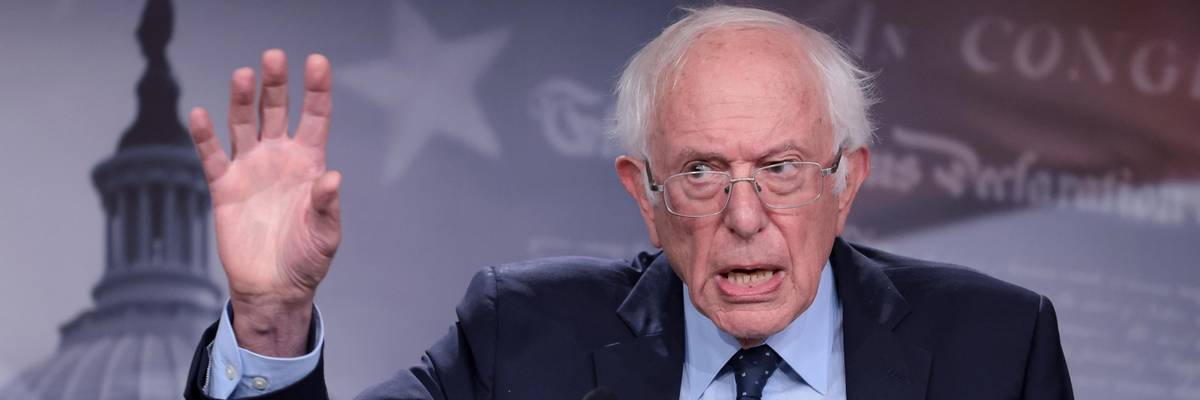
Sen. Bernie Sanders of Vermont noted in a floor speech Wednesday that concerns about the deficit curiously disappear on Capitol Hill when it's time to authorize the annual U.S. military budget, which lawmakers are preparing to boost to $778 billion for fiscal year 2022.
"All of this money is going to an agency, the Department of Defense, that continues to have massive cost overruns."
Sanders, who intends to vote against the 2022 National Defense Authorization Act (NDAA), lamented that "somehow when it comes to the defense budget and the needs of the military-industrial complex, we just cannot give them enough money."
"Day after day, here on the floor of the Senate and back in their states, many of my colleagues talk to the American people about how deeply concerned they are about the deficit and the national debt," the Vermont senator said Wednesday. "They tell us that we just don't have enough money to expand Medicare... We just don't have enough money to do what every other major country on Earth does, and that is guarantee paid family and medical leave."
"At a time when the scientists are telling us that we face an existential threat in terms of climate change, we are told that just don't have enough money to transform our energy system away from fossil fuel and create a planet that will be healthy and habitable for our kids and future generations. Just don't have enough money," he continued. "Yet today, the U.S. Senate will begin consideration of an annual defense budget that costs $778 billion--$778 billion for one year."
Sanders' remarks on the NDAA--which cleared a key procedural hurdle late Wednesday--came as Democrats in Congress also worked to finalize the Build Back Better Act, a reconciliation package whose social spending and climate provisions have been gutted to satisfy right-wing members of the majority party such as Sen. Joe Manchin (D-W.Va.).
Manchin, a key swing vote in the Senate, has repeatedly cited the national debt as a reason to pare back the reconciliation bill, which now has a top-line price tag of around $1.75 trillion over ten years--roughly half of the original $3.5 trillion framework.
But while the West Virginia Democrat says he's alarmed by the prospect of spending to expand Medicare and combat the climate crisis, he appears unconcerned that, over the past decade, Congress has poured over $9 trillion into the only federal agency that has yet to pass a full independent audit. Manchin has approved every NDAA since 2011, and he voted Wednesday to advance the 2022 Pentagon budget.
Lindsay Koshgarian of the National Priorities Project observed last month that "over the past ten years, the U.S. has handed over $3.4 trillion (or $3.7 trillion in inflation-adjusted terms) to Pentagon contractors without headline-making congressional negotiations."
"For that money, the U.S. has gotten many copies of a supposedly cutting-edge military plane that has spontaneously caught fire at least three times, has heavily subsidized average CEO pay of $17.7 million at the top military contractors, and allowed corporations to rake in profits even while they failed wildly in the effort to reconstruct Afghanistan," Koshgarian wrote in a blog post. "So, what was that again about us not being able to afford paid leave, medical care for seniors, and free community college?"
Related Content

Sanders was one of just four members of the Senate Democratic caucus to vote against advancing the latest NDAA, which is on track to pass the upper chamber this week. Joining Sanders in voting no were Sens. Elizabeth Warren (D-Mass.), Ed Markey (D-Mass.), and Cory Booker (D-N.J.).
The House approved its version of the NDAA in September. None of the corporate-backed House Democrats currently holding up the reconciliation bill over purported concerns about its costs voted against the proposed Pentagon budget increase, which progressive lawmakers have tried unsuccessfully to block.
In his floor speech Wednesday, Sanders pointed out that the Senate's 2022 military policy bill proposes spending "$37 billion more than President Trump's last defense budget and $25 billion more than what President Biden requested."
"And by the way, all of this money is going to an agency, the Department of Defense, that continues to have massive cost overruns, year after year, wasting enormous amounts of money," he added. "Concerns about the deficit seem to melt away under the influence of the military-industrial complex."
Sen. Bernie Sanders of Vermont noted in a floor speech Wednesday that concerns about the deficit curiously disappear on Capitol Hill when it's time to authorize the annual U.S. military budget, which lawmakers are preparing to boost to $778 billion for fiscal year 2022.
"All of this money is going to an agency, the Department of Defense, that continues to have massive cost overruns."
Sanders, who intends to vote against the 2022 National Defense Authorization Act (NDAA), lamented that "somehow when it comes to the defense budget and the needs of the military-industrial complex, we just cannot give them enough money."
"Day after day, here on the floor of the Senate and back in their states, many of my colleagues talk to the American people about how deeply concerned they are about the deficit and the national debt," the Vermont senator said Wednesday. "They tell us that we just don't have enough money to expand Medicare... We just don't have enough money to do what every other major country on Earth does, and that is guarantee paid family and medical leave."
"At a time when the scientists are telling us that we face an existential threat in terms of climate change, we are told that just don't have enough money to transform our energy system away from fossil fuel and create a planet that will be healthy and habitable for our kids and future generations. Just don't have enough money," he continued. "Yet today, the U.S. Senate will begin consideration of an annual defense budget that costs $778 billion--$778 billion for one year."
Sanders' remarks on the NDAA--which cleared a key procedural hurdle late Wednesday--came as Democrats in Congress also worked to finalize the Build Back Better Act, a reconciliation package whose social spending and climate provisions have been gutted to satisfy right-wing members of the majority party such as Sen. Joe Manchin (D-W.Va.).
Manchin, a key swing vote in the Senate, has repeatedly cited the national debt as a reason to pare back the reconciliation bill, which now has a top-line price tag of around $1.75 trillion over ten years--roughly half of the original $3.5 trillion framework.
But while the West Virginia Democrat says he's alarmed by the prospect of spending to expand Medicare and combat the climate crisis, he appears unconcerned that, over the past decade, Congress has poured over $9 trillion into the only federal agency that has yet to pass a full independent audit. Manchin has approved every NDAA since 2011, and he voted Wednesday to advance the 2022 Pentagon budget.
Lindsay Koshgarian of the National Priorities Project observed last month that "over the past ten years, the U.S. has handed over $3.4 trillion (or $3.7 trillion in inflation-adjusted terms) to Pentagon contractors without headline-making congressional negotiations."
"For that money, the U.S. has gotten many copies of a supposedly cutting-edge military plane that has spontaneously caught fire at least three times, has heavily subsidized average CEO pay of $17.7 million at the top military contractors, and allowed corporations to rake in profits even while they failed wildly in the effort to reconstruct Afghanistan," Koshgarian wrote in a blog post. "So, what was that again about us not being able to afford paid leave, medical care for seniors, and free community college?"
Related Content
Sanders was one of just four members of the Senate Democratic caucus to vote against advancing the latest NDAA, which is on track to pass the upper chamber this week. Joining Sanders in voting no were Sens. Elizabeth Warren (D-Mass.), Ed Markey (D-Mass.), and Cory Booker (D-N.J.).
The House approved its version of the NDAA in September. None of the corporate-backed House Democrats currently holding up the reconciliation bill over purported concerns about its costs voted against the proposed Pentagon budget increase, which progressive lawmakers have tried unsuccessfully to block.
In his floor speech Wednesday, Sanders pointed out that the Senate's 2022 military policy bill proposes spending "$37 billion more than President Trump's last defense budget and $25 billion more than what President Biden requested."
"And by the way, all of this money is going to an agency, the Department of Defense, that continues to have massive cost overruns, year after year, wasting enormous amounts of money," he added. "Concerns about the deficit seem to melt away under the influence of the military-industrial complex."
Sen. Bernie Sanders of Vermont noted in a floor speech Wednesday that concerns about the deficit curiously disappear on Capitol Hill when it's time to authorize the annual U.S. military budget, which lawmakers are preparing to boost to $778 billion for fiscal year 2022.
"All of this money is going to an agency, the Department of Defense, that continues to have massive cost overruns."
Sanders, who intends to vote against the 2022 National Defense Authorization Act (NDAA), lamented that "somehow when it comes to the defense budget and the needs of the military-industrial complex, we just cannot give them enough money."
"Day after day, here on the floor of the Senate and back in their states, many of my colleagues talk to the American people about how deeply concerned they are about the deficit and the national debt," the Vermont senator said Wednesday. "They tell us that we just don't have enough money to expand Medicare... We just don't have enough money to do what every other major country on Earth does, and that is guarantee paid family and medical leave."
"At a time when the scientists are telling us that we face an existential threat in terms of climate change, we are told that just don't have enough money to transform our energy system away from fossil fuel and create a planet that will be healthy and habitable for our kids and future generations. Just don't have enough money," he continued. "Yet today, the U.S. Senate will begin consideration of an annual defense budget that costs $778 billion--$778 billion for one year."
Sanders' remarks on the NDAA--which cleared a key procedural hurdle late Wednesday--came as Democrats in Congress also worked to finalize the Build Back Better Act, a reconciliation package whose social spending and climate provisions have been gutted to satisfy right-wing members of the majority party such as Sen. Joe Manchin (D-W.Va.).
Manchin, a key swing vote in the Senate, has repeatedly cited the national debt as a reason to pare back the reconciliation bill, which now has a top-line price tag of around $1.75 trillion over ten years--roughly half of the original $3.5 trillion framework.
But while the West Virginia Democrat says he's alarmed by the prospect of spending to expand Medicare and combat the climate crisis, he appears unconcerned that, over the past decade, Congress has poured over $9 trillion into the only federal agency that has yet to pass a full independent audit. Manchin has approved every NDAA since 2011, and he voted Wednesday to advance the 2022 Pentagon budget.
Lindsay Koshgarian of the National Priorities Project observed last month that "over the past ten years, the U.S. has handed over $3.4 trillion (or $3.7 trillion in inflation-adjusted terms) to Pentagon contractors without headline-making congressional negotiations."
"For that money, the U.S. has gotten many copies of a supposedly cutting-edge military plane that has spontaneously caught fire at least three times, has heavily subsidized average CEO pay of $17.7 million at the top military contractors, and allowed corporations to rake in profits even while they failed wildly in the effort to reconstruct Afghanistan," Koshgarian wrote in a blog post. "So, what was that again about us not being able to afford paid leave, medical care for seniors, and free community college?"
Related Content
Sanders was one of just four members of the Senate Democratic caucus to vote against advancing the latest NDAA, which is on track to pass the upper chamber this week. Joining Sanders in voting no were Sens. Elizabeth Warren (D-Mass.), Ed Markey (D-Mass.), and Cory Booker (D-N.J.).
The House approved its version of the NDAA in September. None of the corporate-backed House Democrats currently holding up the reconciliation bill over purported concerns about its costs voted against the proposed Pentagon budget increase, which progressive lawmakers have tried unsuccessfully to block.
In his floor speech Wednesday, Sanders pointed out that the Senate's 2022 military policy bill proposes spending "$37 billion more than President Trump's last defense budget and $25 billion more than what President Biden requested."
"And by the way, all of this money is going to an agency, the Department of Defense, that continues to have massive cost overruns, year after year, wasting enormous amounts of money," he added. "Concerns about the deficit seem to melt away under the influence of the military-industrial complex."