

SUBSCRIBE TO OUR FREE NEWSLETTER
Daily news & progressive opinion—funded by the people, not the corporations—delivered straight to your inbox.
5
#000000
#FFFFFF
To donate by check, phone, or other method, see our More Ways to Give page.
Daily news & progressive opinion—funded by the people, not the corporations—delivered straight to your inbox.
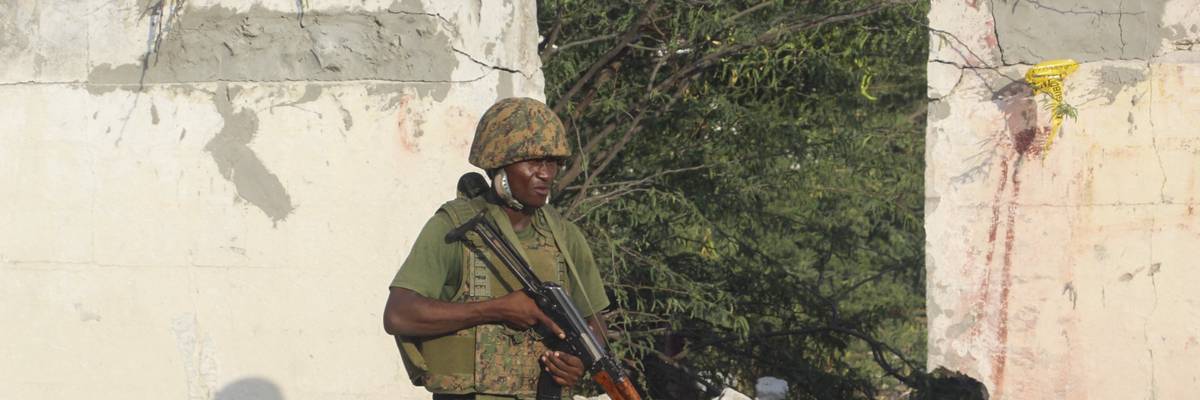
An African Union Mission to Somalia (AMISOM) soldier stands at the scene of a suicide bombing that targeted an AMISOM convoy in Mogadishu, Somalia, on November 11, 2021.
"What the United States government is doing in Somalia is not peacekeeping, but warfighting," says author of new report.
The United States' counterterrorism efforts in Somalia, which were ramped up after the emergence of the armed group al-Shabab in 2006, are worsening the East African country's instability, according to a new analysis released Thursday as progressives in Congress voted for a withdrawal of all U.S. troops from the nation.
As the Costs of War project at the Watson Institute for International and Public Affairs at Brown University said in the new report, the U.S. has spent at least $2.5 billion on counterterrorism operations in Somalia since 2007, including funding for the African Union Mission in Somalia (AMISOM) and the Somali National Army. This figure does not include the undisclosed amount of money the government has poured into intelligence and military operations there.
U.S. spending in Somalia, ostensibly to eliminate al-Shabab and a new armed group that emerged in 2016, amounts to more than the country's annual tax revenue, and according to the Costs of War report, has gone towards ineffective top-down conflict resolution tactics which only serve to perpetuate conflict.
As Oxford University lecturer Eniọlá Ànúolúwapọ́ Ṣóyẹmí explains:
The U.S. government’s top-down approach to counterterrorism has now come to be incorporated into the political motivations and objectives of high-level political operatives in Somalia, who have the greatest access both to the U.S.' financial resources and to control of U.S.-trained forces. The U.S. military's centralized approach reinforces the tendency among elites in the Somali federal government to, themselves, centralize power in opposition to more inclusive, bottom-up politics that aim genuinely to stabilize security in Somalia for the benefit of the wider population.
"Somali forces trained by the United States have been co-opted and misused by the Somali political elite for non-counterterrorism purposes like bodyguard duty, roadblock policing, or attacking political opponents," Ṣóyẹmí added. "These forces are also exacerbating conflict, leading many to fear the outbreak of full civil war."
The Pentagon recorded a 23% rise in violent activity involving al-Shabab between 2021 and 2022, and the group is "still on the rise," the report says, despite more than a decade of counterterrorism efforts by the United States.
There are currently about 500 U.S. troops in Somalia conducting counterterrorism operations, and the U.S. has completed more than 275 air strikes and raids in the country in the past 16 years.
The Biden administration, like its predecessors, has claimed U.S. military involvement in Somalia is permitted under the 2001 Authorization for Use of Military Force, but members of the Congressional Progressive Caucus (CPC) including Reps. Ilhan Omar (D-Minn.) and Pramila Jayapal (D-Wash.) joined 100 other House members in supporting a War Powers Resolution put forward by on Thursday calling for the withdrawal of U.S. troops.
"House progressives remain principled in their commitment to upholding the constitutional authority of Congress's sole powers over war and peace, a check designed by the framers to limit needless conflicts led by the executive," a representative for the CPC told The Intercept ahead of the vote.
In voting for the resolution, progressives sought to end U.S. policies which Ṣóyẹmí says are "ensuring that the conflict continues in perpetuity."
"What the United States government is doing in Somalia is not peacekeeping, but warfighting," said Ṣóyẹmí.
Dear Common Dreams reader, It’s been nearly 30 years since I co-founded Common Dreams with my late wife, Lina Newhouser. We had the radical notion that journalism should serve the public good, not corporate profits. It was clear to us from the outset what it would take to build such a project. No paid advertisements. No corporate sponsors. No millionaire publisher telling us what to think or do. Many people said we wouldn't last a year, but we proved those doubters wrong. Together with a tremendous team of journalists and dedicated staff, we built an independent media outlet free from the constraints of profits and corporate control. Our mission has always been simple: To inform. To inspire. To ignite change for the common good. Building Common Dreams was not easy. Our survival was never guaranteed. When you take on the most powerful forces—Wall Street greed, fossil fuel industry destruction, Big Tech lobbyists, and uber-rich oligarchs who have spent billions upon billions rigging the economy and democracy in their favor—the only bulwark you have is supporters who believe in your work. But here’s the urgent message from me today. It's never been this bad out there. And it's never been this hard to keep us going. At the very moment Common Dreams is most needed, the threats we face are intensifying. We need your support now more than ever. We don't accept corporate advertising and never will. We don't have a paywall because we don't think people should be blocked from critical news based on their ability to pay. Everything we do is funded by the donations of readers like you. When everyone does the little they can afford, we are strong. But if that support retreats or dries up, so do we. Will you donate now to make sure Common Dreams not only survives but thrives? —Craig Brown, Co-founder |
The United States' counterterrorism efforts in Somalia, which were ramped up after the emergence of the armed group al-Shabab in 2006, are worsening the East African country's instability, according to a new analysis released Thursday as progressives in Congress voted for a withdrawal of all U.S. troops from the nation.
As the Costs of War project at the Watson Institute for International and Public Affairs at Brown University said in the new report, the U.S. has spent at least $2.5 billion on counterterrorism operations in Somalia since 2007, including funding for the African Union Mission in Somalia (AMISOM) and the Somali National Army. This figure does not include the undisclosed amount of money the government has poured into intelligence and military operations there.
U.S. spending in Somalia, ostensibly to eliminate al-Shabab and a new armed group that emerged in 2016, amounts to more than the country's annual tax revenue, and according to the Costs of War report, has gone towards ineffective top-down conflict resolution tactics which only serve to perpetuate conflict.
As Oxford University lecturer Eniọlá Ànúolúwapọ́ Ṣóyẹmí explains:
The U.S. government’s top-down approach to counterterrorism has now come to be incorporated into the political motivations and objectives of high-level political operatives in Somalia, who have the greatest access both to the U.S.' financial resources and to control of U.S.-trained forces. The U.S. military's centralized approach reinforces the tendency among elites in the Somali federal government to, themselves, centralize power in opposition to more inclusive, bottom-up politics that aim genuinely to stabilize security in Somalia for the benefit of the wider population.
"Somali forces trained by the United States have been co-opted and misused by the Somali political elite for non-counterterrorism purposes like bodyguard duty, roadblock policing, or attacking political opponents," Ṣóyẹmí added. "These forces are also exacerbating conflict, leading many to fear the outbreak of full civil war."
The Pentagon recorded a 23% rise in violent activity involving al-Shabab between 2021 and 2022, and the group is "still on the rise," the report says, despite more than a decade of counterterrorism efforts by the United States.
There are currently about 500 U.S. troops in Somalia conducting counterterrorism operations, and the U.S. has completed more than 275 air strikes and raids in the country in the past 16 years.
The Biden administration, like its predecessors, has claimed U.S. military involvement in Somalia is permitted under the 2001 Authorization for Use of Military Force, but members of the Congressional Progressive Caucus (CPC) including Reps. Ilhan Omar (D-Minn.) and Pramila Jayapal (D-Wash.) joined 100 other House members in supporting a War Powers Resolution put forward by on Thursday calling for the withdrawal of U.S. troops.
"House progressives remain principled in their commitment to upholding the constitutional authority of Congress's sole powers over war and peace, a check designed by the framers to limit needless conflicts led by the executive," a representative for the CPC told The Intercept ahead of the vote.
In voting for the resolution, progressives sought to end U.S. policies which Ṣóyẹmí says are "ensuring that the conflict continues in perpetuity."
"What the United States government is doing in Somalia is not peacekeeping, but warfighting," said Ṣóyẹmí.
The United States' counterterrorism efforts in Somalia, which were ramped up after the emergence of the armed group al-Shabab in 2006, are worsening the East African country's instability, according to a new analysis released Thursday as progressives in Congress voted for a withdrawal of all U.S. troops from the nation.
As the Costs of War project at the Watson Institute for International and Public Affairs at Brown University said in the new report, the U.S. has spent at least $2.5 billion on counterterrorism operations in Somalia since 2007, including funding for the African Union Mission in Somalia (AMISOM) and the Somali National Army. This figure does not include the undisclosed amount of money the government has poured into intelligence and military operations there.
U.S. spending in Somalia, ostensibly to eliminate al-Shabab and a new armed group that emerged in 2016, amounts to more than the country's annual tax revenue, and according to the Costs of War report, has gone towards ineffective top-down conflict resolution tactics which only serve to perpetuate conflict.
As Oxford University lecturer Eniọlá Ànúolúwapọ́ Ṣóyẹmí explains:
The U.S. government’s top-down approach to counterterrorism has now come to be incorporated into the political motivations and objectives of high-level political operatives in Somalia, who have the greatest access both to the U.S.' financial resources and to control of U.S.-trained forces. The U.S. military's centralized approach reinforces the tendency among elites in the Somali federal government to, themselves, centralize power in opposition to more inclusive, bottom-up politics that aim genuinely to stabilize security in Somalia for the benefit of the wider population.
"Somali forces trained by the United States have been co-opted and misused by the Somali political elite for non-counterterrorism purposes like bodyguard duty, roadblock policing, or attacking political opponents," Ṣóyẹmí added. "These forces are also exacerbating conflict, leading many to fear the outbreak of full civil war."
The Pentagon recorded a 23% rise in violent activity involving al-Shabab between 2021 and 2022, and the group is "still on the rise," the report says, despite more than a decade of counterterrorism efforts by the United States.
There are currently about 500 U.S. troops in Somalia conducting counterterrorism operations, and the U.S. has completed more than 275 air strikes and raids in the country in the past 16 years.
The Biden administration, like its predecessors, has claimed U.S. military involvement in Somalia is permitted under the 2001 Authorization for Use of Military Force, but members of the Congressional Progressive Caucus (CPC) including Reps. Ilhan Omar (D-Minn.) and Pramila Jayapal (D-Wash.) joined 100 other House members in supporting a War Powers Resolution put forward by on Thursday calling for the withdrawal of U.S. troops.
"House progressives remain principled in their commitment to upholding the constitutional authority of Congress's sole powers over war and peace, a check designed by the framers to limit needless conflicts led by the executive," a representative for the CPC told The Intercept ahead of the vote.
In voting for the resolution, progressives sought to end U.S. policies which Ṣóyẹmí says are "ensuring that the conflict continues in perpetuity."
"What the United States government is doing in Somalia is not peacekeeping, but warfighting," said Ṣóyẹmí.

