

SUBSCRIBE TO OUR FREE NEWSLETTER
Daily news & progressive opinion—funded by the people, not the corporations—delivered straight to your inbox.
5
#000000
#FFFFFF
To donate by check, phone, or other method, see our More Ways to Give page.
Daily news & progressive opinion—funded by the people, not the corporations—delivered straight to your inbox.
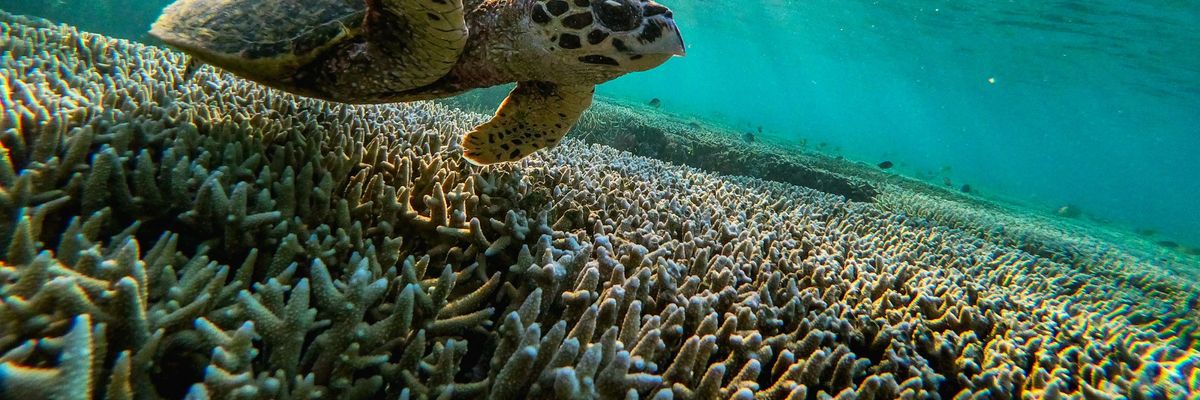
A green sea turtle is flourishing among the corals of the Great Barrier Reef in Queensland, Australia on October 10, 2019. (Photo: Jonas Gratzer/LightRocket via Getty Images)
An intense lobbying campaign by the pro-fossil fuel Australian government succeeded Friday in keeping the Great Barrier Reef off a list of World Heritage Sites considered "in danger," despite experts' warnings that the biodiverse ecosystem is increasingly imperiled by the global climate emergency.
"The Great Barrier Reef is in danger, and trying to hide the facts won't change a thing."
--Lesley Hughes, Climate Council
The 21-nation World Heritage Committee--organized by the United Nations Educational, Scientific, and Cultural Organization (UNESCO)--voted down a push to categorize the Great Barrier Reef as endangered, an effort that the right-wing Australian government fervently opposed with the backing of Saudi Arabia and other oil-friendly countries.
Instead of designating the Reef as "in danger," the World Heritage Committee on Friday instructed the government of Australia to produce a progress report on the structure's condition by February 2022.
David Ritter, CEO of Greenpeace Australia, said in a statement that Friday's vote "is a victory for one of the most cynical lobbying efforts in recent history."
"Under the UNESCO treaty, the Australian government promised the world it would do its utmost to protect the Reef--instead it has done its utmost to hide the truth," said Ritter. "This is not an achievement--it is a day of shame for the Australian government."
Lesley Hughes, a spokesperson for Climate Council, an Australia-based advocacy organization, slammed the government lobbying blitz and said lawmakers "must stop censoring science."
"The science is clear: climate change is accelerating and is the single, greatest threat to the Great Barrier Reef. In the past five years it has been repeatedly and severely damaged by three marine heatwaves," said Hughes, a professor of biology at Macquarie University in Sydney. "Until we see credible climate action, and the phasing out of fossil fuels like coal, oil, and gas, this situation will worsen, not improve. The Great Barrier Reef is in danger, and trying to hide the facts won't change a thing."
Home to hundreds of types of coral and more than 1,000 species of fish, the Great Barrier Reef has been badly damaged in recent years by mass coral bleaching fueled by warming ocean temperatures--which is why scientists have been pushing Australia and the international community to formally recognize the system as endangered.
"Everyone knows the climate crisis is threatening the Reef. Delay is denial, and a sop to fossil fuels."
--Sarah Hanson-Young, Australian Greens
The World Heritage Committee's vote Friday came a month after UNESCO issued a report (pdf) warning that the Great Barrier Reef's condition has "further deteriorated from poor to very poor" due to human-caused climate change. The U.N. body advised that the reef be listed among the world's "in danger" sites--a call endorsed by scientists around the world.
UNESCO's recommendation sparked furious backlash from the Australian government, which launched an aggressive lobbying push to prevent the listing.
As The Guardian reported, "More than a dozen ambassadors flew from Canberra to Cairns, Queensland, for a snorkeling trip on the reef," and "Australia's environment minister, Sussan Ley, was dispatched to Europe on an RAAF diplomatic jet to visit Budapest, Madrid, Sarajevo, Paris, Oman, and the Maldives."
"Australia--a major producer and exporter of coal and gas--initially won support from oil-rich Saudi Arabia and Bahrain, both members of the committee, to delay any decision on the danger listing until at least 2023," the outlet noted. "But after an interjection from Norway, the committee decided instead the reef's health would be considered again at next year's meeting."
Sarah Hanson-Young, an Australian senator with the Greens Party, warned following Friday's vote that "the decision to delay the 'in danger' listing for the Great Barrier Reef is ridiculous and will cost Australia in the long run."
"Everyone knows the climate crisis is threatening the Reef," she added. "Delay is denial, and a sop to fossil fuels."
Dear Common Dreams reader, It’s been nearly 30 years since I co-founded Common Dreams with my late wife, Lina Newhouser. We had the radical notion that journalism should serve the public good, not corporate profits. It was clear to us from the outset what it would take to build such a project. No paid advertisements. No corporate sponsors. No millionaire publisher telling us what to think or do. Many people said we wouldn't last a year, but we proved those doubters wrong. Together with a tremendous team of journalists and dedicated staff, we built an independent media outlet free from the constraints of profits and corporate control. Our mission has always been simple: To inform. To inspire. To ignite change for the common good. Building Common Dreams was not easy. Our survival was never guaranteed. When you take on the most powerful forces—Wall Street greed, fossil fuel industry destruction, Big Tech lobbyists, and uber-rich oligarchs who have spent billions upon billions rigging the economy and democracy in their favor—the only bulwark you have is supporters who believe in your work. But here’s the urgent message from me today. It's never been this bad out there. And it's never been this hard to keep us going. At the very moment Common Dreams is most needed, the threats we face are intensifying. We need your support now more than ever. We don't accept corporate advertising and never will. We don't have a paywall because we don't think people should be blocked from critical news based on their ability to pay. Everything we do is funded by the donations of readers like you. When everyone does the little they can afford, we are strong. But if that support retreats or dries up, so do we. Will you donate now to make sure Common Dreams not only survives but thrives? —Craig Brown, Co-founder |
An intense lobbying campaign by the pro-fossil fuel Australian government succeeded Friday in keeping the Great Barrier Reef off a list of World Heritage Sites considered "in danger," despite experts' warnings that the biodiverse ecosystem is increasingly imperiled by the global climate emergency.
"The Great Barrier Reef is in danger, and trying to hide the facts won't change a thing."
--Lesley Hughes, Climate Council
The 21-nation World Heritage Committee--organized by the United Nations Educational, Scientific, and Cultural Organization (UNESCO)--voted down a push to categorize the Great Barrier Reef as endangered, an effort that the right-wing Australian government fervently opposed with the backing of Saudi Arabia and other oil-friendly countries.
Instead of designating the Reef as "in danger," the World Heritage Committee on Friday instructed the government of Australia to produce a progress report on the structure's condition by February 2022.
David Ritter, CEO of Greenpeace Australia, said in a statement that Friday's vote "is a victory for one of the most cynical lobbying efforts in recent history."
"Under the UNESCO treaty, the Australian government promised the world it would do its utmost to protect the Reef--instead it has done its utmost to hide the truth," said Ritter. "This is not an achievement--it is a day of shame for the Australian government."
Lesley Hughes, a spokesperson for Climate Council, an Australia-based advocacy organization, slammed the government lobbying blitz and said lawmakers "must stop censoring science."
"The science is clear: climate change is accelerating and is the single, greatest threat to the Great Barrier Reef. In the past five years it has been repeatedly and severely damaged by three marine heatwaves," said Hughes, a professor of biology at Macquarie University in Sydney. "Until we see credible climate action, and the phasing out of fossil fuels like coal, oil, and gas, this situation will worsen, not improve. The Great Barrier Reef is in danger, and trying to hide the facts won't change a thing."
Home to hundreds of types of coral and more than 1,000 species of fish, the Great Barrier Reef has been badly damaged in recent years by mass coral bleaching fueled by warming ocean temperatures--which is why scientists have been pushing Australia and the international community to formally recognize the system as endangered.
"Everyone knows the climate crisis is threatening the Reef. Delay is denial, and a sop to fossil fuels."
--Sarah Hanson-Young, Australian Greens
The World Heritage Committee's vote Friday came a month after UNESCO issued a report (pdf) warning that the Great Barrier Reef's condition has "further deteriorated from poor to very poor" due to human-caused climate change. The U.N. body advised that the reef be listed among the world's "in danger" sites--a call endorsed by scientists around the world.
UNESCO's recommendation sparked furious backlash from the Australian government, which launched an aggressive lobbying push to prevent the listing.
As The Guardian reported, "More than a dozen ambassadors flew from Canberra to Cairns, Queensland, for a snorkeling trip on the reef," and "Australia's environment minister, Sussan Ley, was dispatched to Europe on an RAAF diplomatic jet to visit Budapest, Madrid, Sarajevo, Paris, Oman, and the Maldives."
"Australia--a major producer and exporter of coal and gas--initially won support from oil-rich Saudi Arabia and Bahrain, both members of the committee, to delay any decision on the danger listing until at least 2023," the outlet noted. "But after an interjection from Norway, the committee decided instead the reef's health would be considered again at next year's meeting."
Sarah Hanson-Young, an Australian senator with the Greens Party, warned following Friday's vote that "the decision to delay the 'in danger' listing for the Great Barrier Reef is ridiculous and will cost Australia in the long run."
"Everyone knows the climate crisis is threatening the Reef," she added. "Delay is denial, and a sop to fossil fuels."
An intense lobbying campaign by the pro-fossil fuel Australian government succeeded Friday in keeping the Great Barrier Reef off a list of World Heritage Sites considered "in danger," despite experts' warnings that the biodiverse ecosystem is increasingly imperiled by the global climate emergency.
"The Great Barrier Reef is in danger, and trying to hide the facts won't change a thing."
--Lesley Hughes, Climate Council
The 21-nation World Heritage Committee--organized by the United Nations Educational, Scientific, and Cultural Organization (UNESCO)--voted down a push to categorize the Great Barrier Reef as endangered, an effort that the right-wing Australian government fervently opposed with the backing of Saudi Arabia and other oil-friendly countries.
Instead of designating the Reef as "in danger," the World Heritage Committee on Friday instructed the government of Australia to produce a progress report on the structure's condition by February 2022.
David Ritter, CEO of Greenpeace Australia, said in a statement that Friday's vote "is a victory for one of the most cynical lobbying efforts in recent history."
"Under the UNESCO treaty, the Australian government promised the world it would do its utmost to protect the Reef--instead it has done its utmost to hide the truth," said Ritter. "This is not an achievement--it is a day of shame for the Australian government."
Lesley Hughes, a spokesperson for Climate Council, an Australia-based advocacy organization, slammed the government lobbying blitz and said lawmakers "must stop censoring science."
"The science is clear: climate change is accelerating and is the single, greatest threat to the Great Barrier Reef. In the past five years it has been repeatedly and severely damaged by three marine heatwaves," said Hughes, a professor of biology at Macquarie University in Sydney. "Until we see credible climate action, and the phasing out of fossil fuels like coal, oil, and gas, this situation will worsen, not improve. The Great Barrier Reef is in danger, and trying to hide the facts won't change a thing."
Home to hundreds of types of coral and more than 1,000 species of fish, the Great Barrier Reef has been badly damaged in recent years by mass coral bleaching fueled by warming ocean temperatures--which is why scientists have been pushing Australia and the international community to formally recognize the system as endangered.
"Everyone knows the climate crisis is threatening the Reef. Delay is denial, and a sop to fossil fuels."
--Sarah Hanson-Young, Australian Greens
The World Heritage Committee's vote Friday came a month after UNESCO issued a report (pdf) warning that the Great Barrier Reef's condition has "further deteriorated from poor to very poor" due to human-caused climate change. The U.N. body advised that the reef be listed among the world's "in danger" sites--a call endorsed by scientists around the world.
UNESCO's recommendation sparked furious backlash from the Australian government, which launched an aggressive lobbying push to prevent the listing.
As The Guardian reported, "More than a dozen ambassadors flew from Canberra to Cairns, Queensland, for a snorkeling trip on the reef," and "Australia's environment minister, Sussan Ley, was dispatched to Europe on an RAAF diplomatic jet to visit Budapest, Madrid, Sarajevo, Paris, Oman, and the Maldives."
"Australia--a major producer and exporter of coal and gas--initially won support from oil-rich Saudi Arabia and Bahrain, both members of the committee, to delay any decision on the danger listing until at least 2023," the outlet noted. "But after an interjection from Norway, the committee decided instead the reef's health would be considered again at next year's meeting."
Sarah Hanson-Young, an Australian senator with the Greens Party, warned following Friday's vote that "the decision to delay the 'in danger' listing for the Great Barrier Reef is ridiculous and will cost Australia in the long run."
"Everyone knows the climate crisis is threatening the Reef," she added. "Delay is denial, and a sop to fossil fuels."

