SUBSCRIBE TO OUR FREE NEWSLETTER
Daily news & progressive opinion—funded by the people, not the corporations—delivered straight to your inbox.
5
#000000
#FFFFFF
To donate by check, phone, or other method, see our More Ways to Give page.
Daily news & progressive opinion—funded by the people, not the corporations—delivered straight to your inbox.
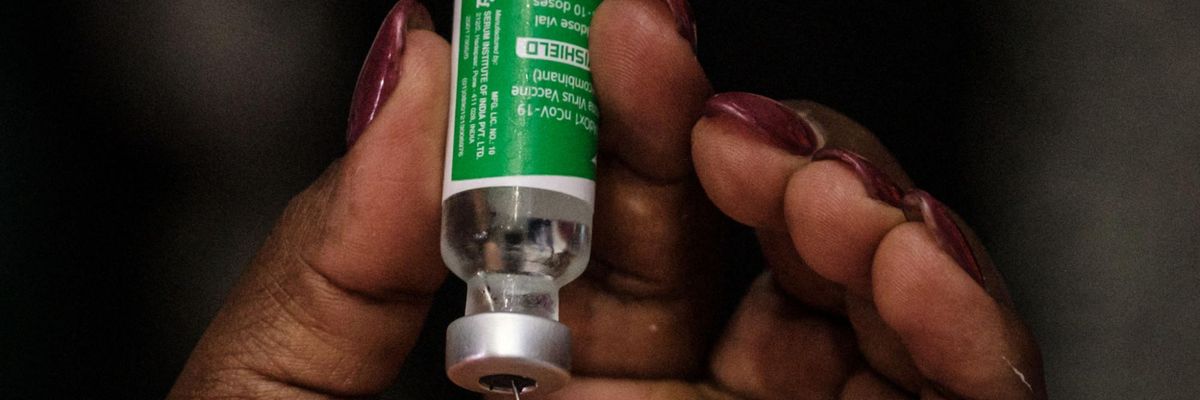
A nurse prepares an injection of a dose of the Oxford/AstraZeneca Covid-19 vaccine during the launch of the vaccination campaign for 5000 frontline workers in the tourism and hospitality sector in Nairobi county at the Kenyatta International Convention Centre (KICC) in Nairobi, Kenya, on April 21, 2021. (Photo: Yasuyoshi Chiba/AFP via Getty Images)
As campaigners worldwide continue their efforts to unleash live-saving vaccine patents and technology from the profitable control of major pharmaceutical corporations this week, new reporting by The Intercept details the "army of lobbyists" Big Pharma has aimed at U.S. lawmakers in order to kneecap the global push to lift intellectual property through a waiver at the World Trade Organization.
"We have multiple safe and effective vaccines, what we lack now is the political will to increase their supply and facilitate the distribution of these vaccines everywhere."
--Abby Maxman, Oxfam AmericaIn a story published Friday, journalist Lee Fang cites "newly filed disclosure forms from the first quarter of 2021" to reveal that "over 100 lobbyists have been mobilized to contact lawmakers and members of the Biden administration, urging them to oppose a proposed temporary waiver" of patent protections at the WTO--a push led by India and South Africa and backed by the World Health Organization, over a hundred nations, and public health experts and justice advocates worldwide.
According to Fang's reporting:
Pharmaceutical lobbyists working against the proposal include Mike McKay, a key fundraiser for House Democrats, now working on retainer for Pfizer, as well as several former staff members to the U.S. Office of Trade Representative, which oversees negotiations with the WTO.
Several trade groups funded by pharmaceutical firms have also focused closely on defeating the generic proposal, new disclosures show. The U.S. Chamber of Commerce, the Business Roundtable, and the International Intellectual Property Alliance, which all receive drug company money, have dispatched dozens of lobbyists to oppose the initiative.
In response to the revelations, Heidi Chow, senior policy and campaign manager for the U.K.-based Global Justice Now, called the corporate lobbying blitz fighting against increased vaccine production "utterly disgusting and immoral" amid a global pandemic that has already claimed north of 3 million lives worldwide.
"Millions continue to die because pharma monopolies have created vaccine scarcity in the global south," tweeted Chow. "We need a #PeoplesVaccine."
Shailly Gupta, communications adviser to the Access Campaign with Doctors Without Borders, which advocates for a global system in which vaccine technology is made universally available to the world's poorest nations, also shared Fang's story as she bemoaned the "pandemic profiteering" it represents.
On Friday, as Common Dreams reported, Sen. Bernie Sanders led other U.S. lawmakers in Congress in a demand to the Biden administration to back the WTO waiver as they presented a petition signed by over 2 million people.
"We have the tools to save human lives, and those tools should be readily available to all people," said Sanders during an online event Friday. "Poor people in Africa, Asia, Latin America, and throughout the world have as much a right to be protected from the virus, to live, as people in wealthier nations. To me, this is not a huge debate, this is common human morality."
Abby Maxman, president and CEO of Oxfam America and who also participated in the event, said, "We have multiple safe and effective vaccines, what we lack now is the political will to increase their supply and facilitate the distribution of these vaccines everywhere." President Biden, she urged, "must seize this historic opportunity to mobilize vaccine access to all by supporting the WTO proposal by South Africa, India, and others to temporarily waive intellectual property rights related to COVID-19 vaccines and treatments to encourage generic manufacturing in their own markets."
But even as the international movement for the WTO waiver has gained steam, including in the U.S., Fang reports how the effort "has encountered fierce opposition from leading drug companies, who stand to lose profit and who fear that allowing a waiver would lead to less stringent IP enforcement in the future."
In a column for The Guardian on Saturday, science and environmental writer Stephen Buranyi argues the intransigence of the wealthy nations "seems mind-bogglingly shortsighted." According to Buranyi:
The world desperately needs coronavirus vaccines. About 430m doses have been produced so far this year, enough for about 215 million people. And of the doses already given, about half have gone to the richest 16% of the world's population. Covax, the World Health Organization initiative to transfer vaccines to nations in need, has delivered just 38m doses. According to analysis by the Center for Global Development and the Economist, nations in the global south may not reach widespread vaccination until 2023.
The situation is dire, and we need more vaccines. At the moment, there is no worldwide joined-up effort to expand production. As incredible as it sounds, after all the public money that went into vaccine development, making and distributing them has been left entirely up to the market. Each company has its own--totally secret--recipes and supply chains, and they insist no other approach is possible.
But public policy experts like Dean Baker, co-founder of the Center for Economic and Policy Research (CEPR), have endlessly explained that alternative approaches are both available and possible, but that Big Pharma interests continue to block the political pathway to achieving them.
"With the pandemic costing millions of lives around the world and costing our economies trillions in lost output," Baker wrote earlier this month, "we really should be asking whether the current system serves us well in producing vaccines, tests, and treatments. Incredibly, public debate is so dominated by the pharmaceutical industry and its allies that we are primarily seeing celebration of the system's dubious claims to success, rather than discussions of the ways in which system was and is failing us in addressing the pandemic."
As political activist Lauren Steiner tweeted in response to Fang's reporting, pharmaceutical giants who are blocking patent waivers that could save millions of lives and help bring a much faster and comprehensive end to the Covid-19 pandemic "should change their name from the health care industry to the death industry."
Dear Common Dreams reader, It’s been nearly 30 years since I co-founded Common Dreams with my late wife, Lina Newhouser. We had the radical notion that journalism should serve the public good, not corporate profits. It was clear to us from the outset what it would take to build such a project. No paid advertisements. No corporate sponsors. No millionaire publisher telling us what to think or do. Many people said we wouldn't last a year, but we proved those doubters wrong. Together with a tremendous team of journalists and dedicated staff, we built an independent media outlet free from the constraints of profits and corporate control. Our mission has always been simple: To inform. To inspire. To ignite change for the common good. Building Common Dreams was not easy. Our survival was never guaranteed. When you take on the most powerful forces—Wall Street greed, fossil fuel industry destruction, Big Tech lobbyists, and uber-rich oligarchs who have spent billions upon billions rigging the economy and democracy in their favor—the only bulwark you have is supporters who believe in your work. But here’s the urgent message from me today. It's never been this bad out there. And it's never been this hard to keep us going. At the very moment Common Dreams is most needed, the threats we face are intensifying. We need your support now more than ever. We don't accept corporate advertising and never will. We don't have a paywall because we don't think people should be blocked from critical news based on their ability to pay. Everything we do is funded by the donations of readers like you. When everyone does the little they can afford, we are strong. But if that support retreats or dries up, so do we. Will you donate now to make sure Common Dreams not only survives but thrives? —Craig Brown, Co-founder |
As campaigners worldwide continue their efforts to unleash live-saving vaccine patents and technology from the profitable control of major pharmaceutical corporations this week, new reporting by The Intercept details the "army of lobbyists" Big Pharma has aimed at U.S. lawmakers in order to kneecap the global push to lift intellectual property through a waiver at the World Trade Organization.
"We have multiple safe and effective vaccines, what we lack now is the political will to increase their supply and facilitate the distribution of these vaccines everywhere."
--Abby Maxman, Oxfam AmericaIn a story published Friday, journalist Lee Fang cites "newly filed disclosure forms from the first quarter of 2021" to reveal that "over 100 lobbyists have been mobilized to contact lawmakers and members of the Biden administration, urging them to oppose a proposed temporary waiver" of patent protections at the WTO--a push led by India and South Africa and backed by the World Health Organization, over a hundred nations, and public health experts and justice advocates worldwide.
According to Fang's reporting:
Pharmaceutical lobbyists working against the proposal include Mike McKay, a key fundraiser for House Democrats, now working on retainer for Pfizer, as well as several former staff members to the U.S. Office of Trade Representative, which oversees negotiations with the WTO.
Several trade groups funded by pharmaceutical firms have also focused closely on defeating the generic proposal, new disclosures show. The U.S. Chamber of Commerce, the Business Roundtable, and the International Intellectual Property Alliance, which all receive drug company money, have dispatched dozens of lobbyists to oppose the initiative.
In response to the revelations, Heidi Chow, senior policy and campaign manager for the U.K.-based Global Justice Now, called the corporate lobbying blitz fighting against increased vaccine production "utterly disgusting and immoral" amid a global pandemic that has already claimed north of 3 million lives worldwide.
"Millions continue to die because pharma monopolies have created vaccine scarcity in the global south," tweeted Chow. "We need a #PeoplesVaccine."
Shailly Gupta, communications adviser to the Access Campaign with Doctors Without Borders, which advocates for a global system in which vaccine technology is made universally available to the world's poorest nations, also shared Fang's story as she bemoaned the "pandemic profiteering" it represents.
On Friday, as Common Dreams reported, Sen. Bernie Sanders led other U.S. lawmakers in Congress in a demand to the Biden administration to back the WTO waiver as they presented a petition signed by over 2 million people.
"We have the tools to save human lives, and those tools should be readily available to all people," said Sanders during an online event Friday. "Poor people in Africa, Asia, Latin America, and throughout the world have as much a right to be protected from the virus, to live, as people in wealthier nations. To me, this is not a huge debate, this is common human morality."
Abby Maxman, president and CEO of Oxfam America and who also participated in the event, said, "We have multiple safe and effective vaccines, what we lack now is the political will to increase their supply and facilitate the distribution of these vaccines everywhere." President Biden, she urged, "must seize this historic opportunity to mobilize vaccine access to all by supporting the WTO proposal by South Africa, India, and others to temporarily waive intellectual property rights related to COVID-19 vaccines and treatments to encourage generic manufacturing in their own markets."
But even as the international movement for the WTO waiver has gained steam, including in the U.S., Fang reports how the effort "has encountered fierce opposition from leading drug companies, who stand to lose profit and who fear that allowing a waiver would lead to less stringent IP enforcement in the future."
In a column for The Guardian on Saturday, science and environmental writer Stephen Buranyi argues the intransigence of the wealthy nations "seems mind-bogglingly shortsighted." According to Buranyi:
The world desperately needs coronavirus vaccines. About 430m doses have been produced so far this year, enough for about 215 million people. And of the doses already given, about half have gone to the richest 16% of the world's population. Covax, the World Health Organization initiative to transfer vaccines to nations in need, has delivered just 38m doses. According to analysis by the Center for Global Development and the Economist, nations in the global south may not reach widespread vaccination until 2023.
The situation is dire, and we need more vaccines. At the moment, there is no worldwide joined-up effort to expand production. As incredible as it sounds, after all the public money that went into vaccine development, making and distributing them has been left entirely up to the market. Each company has its own--totally secret--recipes and supply chains, and they insist no other approach is possible.
But public policy experts like Dean Baker, co-founder of the Center for Economic and Policy Research (CEPR), have endlessly explained that alternative approaches are both available and possible, but that Big Pharma interests continue to block the political pathway to achieving them.
"With the pandemic costing millions of lives around the world and costing our economies trillions in lost output," Baker wrote earlier this month, "we really should be asking whether the current system serves us well in producing vaccines, tests, and treatments. Incredibly, public debate is so dominated by the pharmaceutical industry and its allies that we are primarily seeing celebration of the system's dubious claims to success, rather than discussions of the ways in which system was and is failing us in addressing the pandemic."
As political activist Lauren Steiner tweeted in response to Fang's reporting, pharmaceutical giants who are blocking patent waivers that could save millions of lives and help bring a much faster and comprehensive end to the Covid-19 pandemic "should change their name from the health care industry to the death industry."
As campaigners worldwide continue their efforts to unleash live-saving vaccine patents and technology from the profitable control of major pharmaceutical corporations this week, new reporting by The Intercept details the "army of lobbyists" Big Pharma has aimed at U.S. lawmakers in order to kneecap the global push to lift intellectual property through a waiver at the World Trade Organization.
"We have multiple safe and effective vaccines, what we lack now is the political will to increase their supply and facilitate the distribution of these vaccines everywhere."
--Abby Maxman, Oxfam AmericaIn a story published Friday, journalist Lee Fang cites "newly filed disclosure forms from the first quarter of 2021" to reveal that "over 100 lobbyists have been mobilized to contact lawmakers and members of the Biden administration, urging them to oppose a proposed temporary waiver" of patent protections at the WTO--a push led by India and South Africa and backed by the World Health Organization, over a hundred nations, and public health experts and justice advocates worldwide.
According to Fang's reporting:
Pharmaceutical lobbyists working against the proposal include Mike McKay, a key fundraiser for House Democrats, now working on retainer for Pfizer, as well as several former staff members to the U.S. Office of Trade Representative, which oversees negotiations with the WTO.
Several trade groups funded by pharmaceutical firms have also focused closely on defeating the generic proposal, new disclosures show. The U.S. Chamber of Commerce, the Business Roundtable, and the International Intellectual Property Alliance, which all receive drug company money, have dispatched dozens of lobbyists to oppose the initiative.
In response to the revelations, Heidi Chow, senior policy and campaign manager for the U.K.-based Global Justice Now, called the corporate lobbying blitz fighting against increased vaccine production "utterly disgusting and immoral" amid a global pandemic that has already claimed north of 3 million lives worldwide.
"Millions continue to die because pharma monopolies have created vaccine scarcity in the global south," tweeted Chow. "We need a #PeoplesVaccine."
Shailly Gupta, communications adviser to the Access Campaign with Doctors Without Borders, which advocates for a global system in which vaccine technology is made universally available to the world's poorest nations, also shared Fang's story as she bemoaned the "pandemic profiteering" it represents.
On Friday, as Common Dreams reported, Sen. Bernie Sanders led other U.S. lawmakers in Congress in a demand to the Biden administration to back the WTO waiver as they presented a petition signed by over 2 million people.
"We have the tools to save human lives, and those tools should be readily available to all people," said Sanders during an online event Friday. "Poor people in Africa, Asia, Latin America, and throughout the world have as much a right to be protected from the virus, to live, as people in wealthier nations. To me, this is not a huge debate, this is common human morality."
Abby Maxman, president and CEO of Oxfam America and who also participated in the event, said, "We have multiple safe and effective vaccines, what we lack now is the political will to increase their supply and facilitate the distribution of these vaccines everywhere." President Biden, she urged, "must seize this historic opportunity to mobilize vaccine access to all by supporting the WTO proposal by South Africa, India, and others to temporarily waive intellectual property rights related to COVID-19 vaccines and treatments to encourage generic manufacturing in their own markets."
But even as the international movement for the WTO waiver has gained steam, including in the U.S., Fang reports how the effort "has encountered fierce opposition from leading drug companies, who stand to lose profit and who fear that allowing a waiver would lead to less stringent IP enforcement in the future."
In a column for The Guardian on Saturday, science and environmental writer Stephen Buranyi argues the intransigence of the wealthy nations "seems mind-bogglingly shortsighted." According to Buranyi:
The world desperately needs coronavirus vaccines. About 430m doses have been produced so far this year, enough for about 215 million people. And of the doses already given, about half have gone to the richest 16% of the world's population. Covax, the World Health Organization initiative to transfer vaccines to nations in need, has delivered just 38m doses. According to analysis by the Center for Global Development and the Economist, nations in the global south may not reach widespread vaccination until 2023.
The situation is dire, and we need more vaccines. At the moment, there is no worldwide joined-up effort to expand production. As incredible as it sounds, after all the public money that went into vaccine development, making and distributing them has been left entirely up to the market. Each company has its own--totally secret--recipes and supply chains, and they insist no other approach is possible.
But public policy experts like Dean Baker, co-founder of the Center for Economic and Policy Research (CEPR), have endlessly explained that alternative approaches are both available and possible, but that Big Pharma interests continue to block the political pathway to achieving them.
"With the pandemic costing millions of lives around the world and costing our economies trillions in lost output," Baker wrote earlier this month, "we really should be asking whether the current system serves us well in producing vaccines, tests, and treatments. Incredibly, public debate is so dominated by the pharmaceutical industry and its allies that we are primarily seeing celebration of the system's dubious claims to success, rather than discussions of the ways in which system was and is failing us in addressing the pandemic."
As political activist Lauren Steiner tweeted in response to Fang's reporting, pharmaceutical giants who are blocking patent waivers that could save millions of lives and help bring a much faster and comprehensive end to the Covid-19 pandemic "should change their name from the health care industry to the death industry."