SUBSCRIBE TO OUR FREE NEWSLETTER
Daily news & progressive opinion—funded by the people, not the corporations—delivered straight to your inbox.
5
#000000
#FFFFFF
To donate by check, phone, or other method, see our More Ways to Give page.
Daily news & progressive opinion—funded by the people, not the corporations—delivered straight to your inbox.
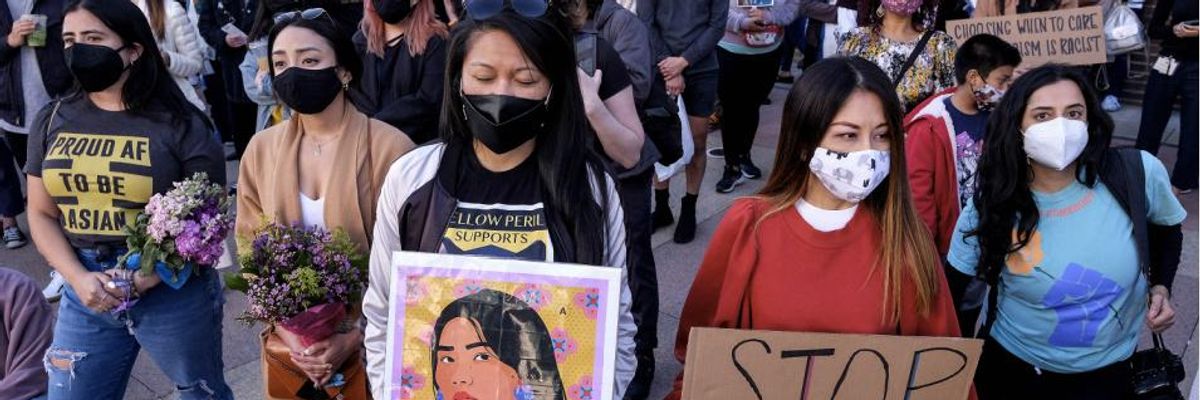
Demonstrators wearing face masks and holding signs take part in a "Love Our Communities: Build Collective Power" rally to raise awareness of anti-Asian violence at the Japanese American National Museum in Little Tokyo in Los Angeles on March 13, 2021. (Photo: Ringo Chiu/AFP via Getty Images)
Human rights defenders took to the streets of New York, Washington, D.C., and other cities Wednesday to demand an end to violence and hatred against Asian Americans in the wake of Tuesday's mass shooting in Georgia and other attacks against people who often feel ignored and excluded from wider conversations about racism in the United States.
Candlelit vigils and other demonstrations were held Wednesday in cities from Philadelphia to Phoenix to commemorate the eight people killed in Georgia--six of whom were women of Asian descent. According to The Hill:
In Washington, D.C., approximately 200 people gathered in the city's Chinatown neighborhood. Demonstrators held a vigil and marched and chanted through the city, carrying signs that said "Asian Lives Matter" and more.
"I am angry. I'm furious," Janet Namkung, who attended the vigil, told NBC4 in Washington. "I know people who have been called all kinds of slurs, fearing their lives on the streets every day."
In New York City, hundreds of people gathered in the Jackson Heights neighborhood, an area home to a large Asian American population, to hold a vigil and demonstrate against a spike in violence against Asian Americans, the New York Times reported.
Wednesday's events followed recent nationwide #StopAsianHate protests in response to the wave of attacks and racism that, while occurring in the United States for as long as Asian people have been in the country, have surged during the coronavirus pandemic, with former President Donald Trump's racist rhetoric fanning the flames of hate.
Minjon Tholen, chief inclusion and strategic innovation officer for Amnesty International USA, said in a Wednesday statement that the killings in Atlanta shine a light on the kind of misogyny as well as racist and sexual violence that has plagued the U.S. for generations, but that has also been heightened against the Asian American community specifically in the era of the Covid-19 pandemic.
"According to data from Stop AAPI Hate, 3,800 incidents of hate directed at Asian Americans were reported over the course of roughly a year during the pandemic--significantly higher than the prior year," said Tholen. "Women were 2.3 times more likely than men to report hate incidents. Nationally, a 2019 study by Mother Jones found that in at least 22 mass shootings since 2011, the perpetrators specifically targeted women, had stalked or harassed women, or had a history of domestic violence."
"We demand that elected officials forcefully denounce violence against women and hate crimes against AAPI people," she added, "and that the perpetrator of the shootings will be held accountable."
Similarly, Connie Huynh of the advocacy group People's Action denounced the violence and argued the massacre must be seen as an "issue of male domination and white supremacy" pervasive in American society.
"Georgia officials are legitimizing mass murder as an expression of 'sex addiction' to hide the fact that the obsession with Asian, Pacific Islander, and immigrant women is a political issue that can be fatal," said Huynh. "Likely low-waged working class immigrant women were sacrificed to protect the power of the ruling class."
The theme of denying or downplaying the role of racism--exemplified by a Georgia sheriff's captain suggesting that the Atlanta gunman acted because he was having "a really bad day"--has resonated with many Asian Americans and other people of color in the wake of Tuesday's mass shooting and other recent attacks.
"We know hate when we see it," said Sen. Raphael Warnock (D-Ga.) in the wake of the murders that rocked his home state. "Only hate drives you to take eight precious lives."
Max Leung, a community organizer in San Francisco--where there have been multiple attacks on Asian elders since the Atlanta murders--lamented that he is "tired of having to prove that we face discrimination."
"I'm tired of having to prove that we belong," Leung told The Guardian. "I'm tired of having to prove that we're allies. I'm tired of having to apologize for speaking up. I'm tired of being gaslighted. I'm tired of the victim-blaming."
"I'm tired of thinking of others while nobody else is thinking about us," he added. "I'm tired of having to have to internalize the pain. I'm just so tired."
Dear Common Dreams reader, It’s been nearly 30 years since I co-founded Common Dreams with my late wife, Lina Newhouser. We had the radical notion that journalism should serve the public good, not corporate profits. It was clear to us from the outset what it would take to build such a project. No paid advertisements. No corporate sponsors. No millionaire publisher telling us what to think or do. Many people said we wouldn't last a year, but we proved those doubters wrong. Together with a tremendous team of journalists and dedicated staff, we built an independent media outlet free from the constraints of profits and corporate control. Our mission has always been simple: To inform. To inspire. To ignite change for the common good. Building Common Dreams was not easy. Our survival was never guaranteed. When you take on the most powerful forces—Wall Street greed, fossil fuel industry destruction, Big Tech lobbyists, and uber-rich oligarchs who have spent billions upon billions rigging the economy and democracy in their favor—the only bulwark you have is supporters who believe in your work. But here’s the urgent message from me today. It's never been this bad out there. And it's never been this hard to keep us going. At the very moment Common Dreams is most needed, the threats we face are intensifying. We need your support now more than ever. We don't accept corporate advertising and never will. We don't have a paywall because we don't think people should be blocked from critical news based on their ability to pay. Everything we do is funded by the donations of readers like you. When everyone does the little they can afford, we are strong. But if that support retreats or dries up, so do we. Will you donate now to make sure Common Dreams not only survives but thrives? —Craig Brown, Co-founder |
Human rights defenders took to the streets of New York, Washington, D.C., and other cities Wednesday to demand an end to violence and hatred against Asian Americans in the wake of Tuesday's mass shooting in Georgia and other attacks against people who often feel ignored and excluded from wider conversations about racism in the United States.
Candlelit vigils and other demonstrations were held Wednesday in cities from Philadelphia to Phoenix to commemorate the eight people killed in Georgia--six of whom were women of Asian descent. According to The Hill:
In Washington, D.C., approximately 200 people gathered in the city's Chinatown neighborhood. Demonstrators held a vigil and marched and chanted through the city, carrying signs that said "Asian Lives Matter" and more.
"I am angry. I'm furious," Janet Namkung, who attended the vigil, told NBC4 in Washington. "I know people who have been called all kinds of slurs, fearing their lives on the streets every day."
In New York City, hundreds of people gathered in the Jackson Heights neighborhood, an area home to a large Asian American population, to hold a vigil and demonstrate against a spike in violence against Asian Americans, the New York Times reported.
Wednesday's events followed recent nationwide #StopAsianHate protests in response to the wave of attacks and racism that, while occurring in the United States for as long as Asian people have been in the country, have surged during the coronavirus pandemic, with former President Donald Trump's racist rhetoric fanning the flames of hate.
Minjon Tholen, chief inclusion and strategic innovation officer for Amnesty International USA, said in a Wednesday statement that the killings in Atlanta shine a light on the kind of misogyny as well as racist and sexual violence that has plagued the U.S. for generations, but that has also been heightened against the Asian American community specifically in the era of the Covid-19 pandemic.
"According to data from Stop AAPI Hate, 3,800 incidents of hate directed at Asian Americans were reported over the course of roughly a year during the pandemic--significantly higher than the prior year," said Tholen. "Women were 2.3 times more likely than men to report hate incidents. Nationally, a 2019 study by Mother Jones found that in at least 22 mass shootings since 2011, the perpetrators specifically targeted women, had stalked or harassed women, or had a history of domestic violence."
"We demand that elected officials forcefully denounce violence against women and hate crimes against AAPI people," she added, "and that the perpetrator of the shootings will be held accountable."
Similarly, Connie Huynh of the advocacy group People's Action denounced the violence and argued the massacre must be seen as an "issue of male domination and white supremacy" pervasive in American society.
"Georgia officials are legitimizing mass murder as an expression of 'sex addiction' to hide the fact that the obsession with Asian, Pacific Islander, and immigrant women is a political issue that can be fatal," said Huynh. "Likely low-waged working class immigrant women were sacrificed to protect the power of the ruling class."
The theme of denying or downplaying the role of racism--exemplified by a Georgia sheriff's captain suggesting that the Atlanta gunman acted because he was having "a really bad day"--has resonated with many Asian Americans and other people of color in the wake of Tuesday's mass shooting and other recent attacks.
"We know hate when we see it," said Sen. Raphael Warnock (D-Ga.) in the wake of the murders that rocked his home state. "Only hate drives you to take eight precious lives."
Max Leung, a community organizer in San Francisco--where there have been multiple attacks on Asian elders since the Atlanta murders--lamented that he is "tired of having to prove that we face discrimination."
"I'm tired of having to prove that we belong," Leung told The Guardian. "I'm tired of having to prove that we're allies. I'm tired of having to apologize for speaking up. I'm tired of being gaslighted. I'm tired of the victim-blaming."
"I'm tired of thinking of others while nobody else is thinking about us," he added. "I'm tired of having to have to internalize the pain. I'm just so tired."
Human rights defenders took to the streets of New York, Washington, D.C., and other cities Wednesday to demand an end to violence and hatred against Asian Americans in the wake of Tuesday's mass shooting in Georgia and other attacks against people who often feel ignored and excluded from wider conversations about racism in the United States.
Candlelit vigils and other demonstrations were held Wednesday in cities from Philadelphia to Phoenix to commemorate the eight people killed in Georgia--six of whom were women of Asian descent. According to The Hill:
In Washington, D.C., approximately 200 people gathered in the city's Chinatown neighborhood. Demonstrators held a vigil and marched and chanted through the city, carrying signs that said "Asian Lives Matter" and more.
"I am angry. I'm furious," Janet Namkung, who attended the vigil, told NBC4 in Washington. "I know people who have been called all kinds of slurs, fearing their lives on the streets every day."
In New York City, hundreds of people gathered in the Jackson Heights neighborhood, an area home to a large Asian American population, to hold a vigil and demonstrate against a spike in violence against Asian Americans, the New York Times reported.
Wednesday's events followed recent nationwide #StopAsianHate protests in response to the wave of attacks and racism that, while occurring in the United States for as long as Asian people have been in the country, have surged during the coronavirus pandemic, with former President Donald Trump's racist rhetoric fanning the flames of hate.
Minjon Tholen, chief inclusion and strategic innovation officer for Amnesty International USA, said in a Wednesday statement that the killings in Atlanta shine a light on the kind of misogyny as well as racist and sexual violence that has plagued the U.S. for generations, but that has also been heightened against the Asian American community specifically in the era of the Covid-19 pandemic.
"According to data from Stop AAPI Hate, 3,800 incidents of hate directed at Asian Americans were reported over the course of roughly a year during the pandemic--significantly higher than the prior year," said Tholen. "Women were 2.3 times more likely than men to report hate incidents. Nationally, a 2019 study by Mother Jones found that in at least 22 mass shootings since 2011, the perpetrators specifically targeted women, had stalked or harassed women, or had a history of domestic violence."
"We demand that elected officials forcefully denounce violence against women and hate crimes against AAPI people," she added, "and that the perpetrator of the shootings will be held accountable."
Similarly, Connie Huynh of the advocacy group People's Action denounced the violence and argued the massacre must be seen as an "issue of male domination and white supremacy" pervasive in American society.
"Georgia officials are legitimizing mass murder as an expression of 'sex addiction' to hide the fact that the obsession with Asian, Pacific Islander, and immigrant women is a political issue that can be fatal," said Huynh. "Likely low-waged working class immigrant women were sacrificed to protect the power of the ruling class."
The theme of denying or downplaying the role of racism--exemplified by a Georgia sheriff's captain suggesting that the Atlanta gunman acted because he was having "a really bad day"--has resonated with many Asian Americans and other people of color in the wake of Tuesday's mass shooting and other recent attacks.
"We know hate when we see it," said Sen. Raphael Warnock (D-Ga.) in the wake of the murders that rocked his home state. "Only hate drives you to take eight precious lives."
Max Leung, a community organizer in San Francisco--where there have been multiple attacks on Asian elders since the Atlanta murders--lamented that he is "tired of having to prove that we face discrimination."
"I'm tired of having to prove that we belong," Leung told The Guardian. "I'm tired of having to prove that we're allies. I'm tired of having to apologize for speaking up. I'm tired of being gaslighted. I'm tired of the victim-blaming."
"I'm tired of thinking of others while nobody else is thinking about us," he added. "I'm tired of having to have to internalize the pain. I'm just so tired."