
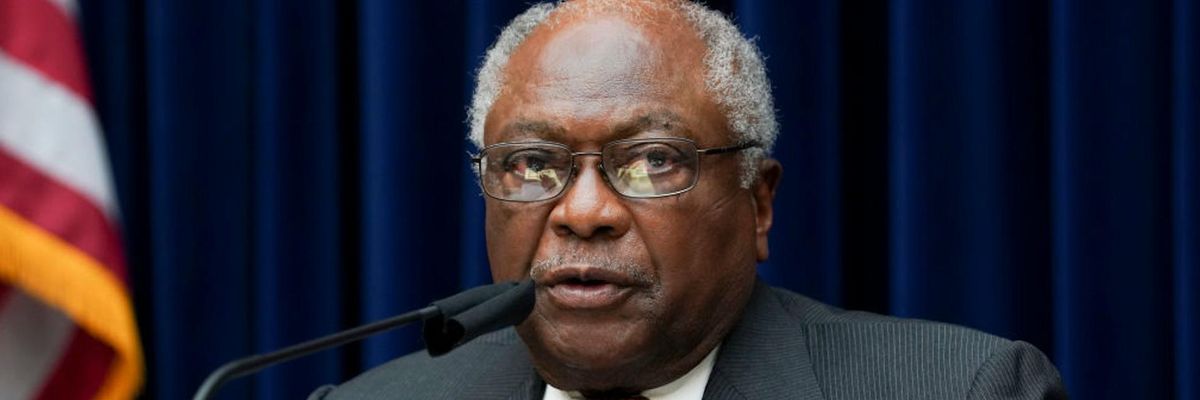
Rep. James Clyburn (D-S.C.) and Sen. Amy Klobuchar introduced the Accessible, Affordable Internet for All Act, a $94 billion bill aimed at closing the digital divide, on March 11, 2021. (Photo: Stefani Reynolds/Pool/Getty Images)
Democrats Introduce Bill to 'Help Bridge the Digital Divide Once and for All'
"In 2021, we should be able to bring high-speed internet to every family in America—regardless of their zip code," said Sen. Amy Klobuchar.
Taking aim at the growing digital divide, which has been further exacerbated by the coronavirus pandemic, Rep. James Clyburn and Sen. Amy Klobuchar on Thursday reintroduced a bill that would invest $94 billion in expanding and improving the nation's broadband infrastructure and making internet access more affordable.
"Access to broadband today will have the same dramatic impact on rural communities as the rural electrification efforts in the last century."
--Rep. James Clyburn
The Accessible, Affordable Internet for All Act (AAIA) (pdf), would use the funds to connect communities that lack any or adequate access to affordable high-speed internet service.
The ongoing pandemic--during which broadband is critical for remote work and study--has "put a big magnifying glass" on the issue of digital disparities, Klobuchar (D-Minn.) told USA Today.
Clyburn (D-S.C.), who in 2019 launched the Rural Broadband Task Force, first introduced the AAIA last year during the tenure of former President Donald Trump, who never followed through with his promise of a $2 trillion infrastructrue plan. A companion bill was introduced in the Senate; neither measure was ever brought to a vote. Clyburn is now pinning his hopes on President Joe Biden, who has also vowed to rebuild the nation's crumbling infrastructure and to bridge the digital divide.
The vast bulk of the AAIA--around $80 billion--will go toward installing and expanding high-speed broadband nationwide. The bill also authorizes $6 billion for the Emergency Broadband Benefit Program, through which the Federal Communications Commission (FCC) offers discount internet service for qualified applicants--who are disproportionately Black, Latinx, and people with low incomes.
An additional $2 billion to $7 billion would fund the E-Rate program, which helps schools and libraries obtain affordable internet access and is part of the $1.9 trillion American Rescue Plan pandemic recovery and relief measure signed by Biden on Thursday.
"Access to broadband today will have the same dramatic impact on rural communities as the rural electrification efforts in the last century," Clyburn said in a statement. "When I formed the Rural Broadband Task Force, our mission was to address the digital divide. The disparate effects of that divide have been amplified during the Covid-19 pandemic and exposed the urgency of ensuring universal access to high-speed internet."
Klobuchar said in a statement that "when we invest in broadband infrastructure, we invest in opportunity for all Americans."
"In 2021, we should be able to bring high-speed internet to every family in America--regardless of their zip code," she added. "This legislation will help bridge the digital divide once and for all."
According to the FCC, around 30 million Americans lack access to broadband service. However a 2020 report from BroadbandNow estimates that the actual figure is about 42 million.
The AAIA is supported by a broad range of digital, labor, consumer, and education advocacy groups. Matt Wood, general counsel and vice president of policy at Free Press, called the legislation "as necessary as ever."
"These kinds of smart public investments in broadband affordability and choice will ensure that the initial down payment on closing the digital divide in recent [Covid-19] relief bills is supported by enough funding and forward thinking to finish the job," Wood said in a statement.
An Urgent Message From Our Co-Founder
Dear Common Dreams reader, It’s been nearly 30 years since I co-founded Common Dreams with my late wife, Lina Newhouser. We had the radical notion that journalism should serve the public good, not corporate profits. It was clear to us from the outset what it would take to build such a project. No paid advertisements. No corporate sponsors. No millionaire publisher telling us what to think or do. Many people said we wouldn't last a year, but we proved those doubters wrong. Together with a tremendous team of journalists and dedicated staff, we built an independent media outlet free from the constraints of profits and corporate control. Our mission has always been simple: To inform. To inspire. To ignite change for the common good. Building Common Dreams was not easy. Our survival was never guaranteed. When you take on the most powerful forces—Wall Street greed, fossil fuel industry destruction, Big Tech lobbyists, and uber-rich oligarchs who have spent billions upon billions rigging the economy and democracy in their favor—the only bulwark you have is supporters who believe in your work. But here’s the urgent message from me today. It's never been this bad out there. And it's never been this hard to keep us going. At the very moment Common Dreams is most needed, the threats we face are intensifying. We need your support now more than ever. We don't accept corporate advertising and never will. We don't have a paywall because we don't think people should be blocked from critical news based on their ability to pay. Everything we do is funded by the donations of readers like you. When everyone does the little they can afford, we are strong. But if that support retreats or dries up, so do we. Will you donate now to make sure Common Dreams not only survives but thrives? —Craig Brown, Co-founder |
Taking aim at the growing digital divide, which has been further exacerbated by the coronavirus pandemic, Rep. James Clyburn and Sen. Amy Klobuchar on Thursday reintroduced a bill that would invest $94 billion in expanding and improving the nation's broadband infrastructure and making internet access more affordable.
"Access to broadband today will have the same dramatic impact on rural communities as the rural electrification efforts in the last century."
--Rep. James Clyburn
The Accessible, Affordable Internet for All Act (AAIA) (pdf), would use the funds to connect communities that lack any or adequate access to affordable high-speed internet service.
The ongoing pandemic--during which broadband is critical for remote work and study--has "put a big magnifying glass" on the issue of digital disparities, Klobuchar (D-Minn.) told USA Today.
Clyburn (D-S.C.), who in 2019 launched the Rural Broadband Task Force, first introduced the AAIA last year during the tenure of former President Donald Trump, who never followed through with his promise of a $2 trillion infrastructrue plan. A companion bill was introduced in the Senate; neither measure was ever brought to a vote. Clyburn is now pinning his hopes on President Joe Biden, who has also vowed to rebuild the nation's crumbling infrastructure and to bridge the digital divide.
The vast bulk of the AAIA--around $80 billion--will go toward installing and expanding high-speed broadband nationwide. The bill also authorizes $6 billion for the Emergency Broadband Benefit Program, through which the Federal Communications Commission (FCC) offers discount internet service for qualified applicants--who are disproportionately Black, Latinx, and people with low incomes.
An additional $2 billion to $7 billion would fund the E-Rate program, which helps schools and libraries obtain affordable internet access and is part of the $1.9 trillion American Rescue Plan pandemic recovery and relief measure signed by Biden on Thursday.
"Access to broadband today will have the same dramatic impact on rural communities as the rural electrification efforts in the last century," Clyburn said in a statement. "When I formed the Rural Broadband Task Force, our mission was to address the digital divide. The disparate effects of that divide have been amplified during the Covid-19 pandemic and exposed the urgency of ensuring universal access to high-speed internet."
Klobuchar said in a statement that "when we invest in broadband infrastructure, we invest in opportunity for all Americans."
"In 2021, we should be able to bring high-speed internet to every family in America--regardless of their zip code," she added. "This legislation will help bridge the digital divide once and for all."
According to the FCC, around 30 million Americans lack access to broadband service. However a 2020 report from BroadbandNow estimates that the actual figure is about 42 million.
The AAIA is supported by a broad range of digital, labor, consumer, and education advocacy groups. Matt Wood, general counsel and vice president of policy at Free Press, called the legislation "as necessary as ever."
"These kinds of smart public investments in broadband affordability and choice will ensure that the initial down payment on closing the digital divide in recent [Covid-19] relief bills is supported by enough funding and forward thinking to finish the job," Wood said in a statement.
Taking aim at the growing digital divide, which has been further exacerbated by the coronavirus pandemic, Rep. James Clyburn and Sen. Amy Klobuchar on Thursday reintroduced a bill that would invest $94 billion in expanding and improving the nation's broadband infrastructure and making internet access more affordable.
"Access to broadband today will have the same dramatic impact on rural communities as the rural electrification efforts in the last century."
--Rep. James Clyburn
The Accessible, Affordable Internet for All Act (AAIA) (pdf), would use the funds to connect communities that lack any or adequate access to affordable high-speed internet service.
The ongoing pandemic--during which broadband is critical for remote work and study--has "put a big magnifying glass" on the issue of digital disparities, Klobuchar (D-Minn.) told USA Today.
Clyburn (D-S.C.), who in 2019 launched the Rural Broadband Task Force, first introduced the AAIA last year during the tenure of former President Donald Trump, who never followed through with his promise of a $2 trillion infrastructrue plan. A companion bill was introduced in the Senate; neither measure was ever brought to a vote. Clyburn is now pinning his hopes on President Joe Biden, who has also vowed to rebuild the nation's crumbling infrastructure and to bridge the digital divide.
The vast bulk of the AAIA--around $80 billion--will go toward installing and expanding high-speed broadband nationwide. The bill also authorizes $6 billion for the Emergency Broadband Benefit Program, through which the Federal Communications Commission (FCC) offers discount internet service for qualified applicants--who are disproportionately Black, Latinx, and people with low incomes.
An additional $2 billion to $7 billion would fund the E-Rate program, which helps schools and libraries obtain affordable internet access and is part of the $1.9 trillion American Rescue Plan pandemic recovery and relief measure signed by Biden on Thursday.
"Access to broadband today will have the same dramatic impact on rural communities as the rural electrification efforts in the last century," Clyburn said in a statement. "When I formed the Rural Broadband Task Force, our mission was to address the digital divide. The disparate effects of that divide have been amplified during the Covid-19 pandemic and exposed the urgency of ensuring universal access to high-speed internet."
Klobuchar said in a statement that "when we invest in broadband infrastructure, we invest in opportunity for all Americans."
"In 2021, we should be able to bring high-speed internet to every family in America--regardless of their zip code," she added. "This legislation will help bridge the digital divide once and for all."
According to the FCC, around 30 million Americans lack access to broadband service. However a 2020 report from BroadbandNow estimates that the actual figure is about 42 million.
The AAIA is supported by a broad range of digital, labor, consumer, and education advocacy groups. Matt Wood, general counsel and vice president of policy at Free Press, called the legislation "as necessary as ever."
"These kinds of smart public investments in broadband affordability and choice will ensure that the initial down payment on closing the digital divide in recent [Covid-19] relief bills is supported by enough funding and forward thinking to finish the job," Wood said in a statement.