SUBSCRIBE TO OUR FREE NEWSLETTER
Daily news & progressive opinion—funded by the people, not the corporations—delivered straight to your inbox.
5
#000000
#FFFFFF
To donate by check, phone, or other method, see our More Ways to Give page.
Daily news & progressive opinion—funded by the people, not the corporations—delivered straight to your inbox.
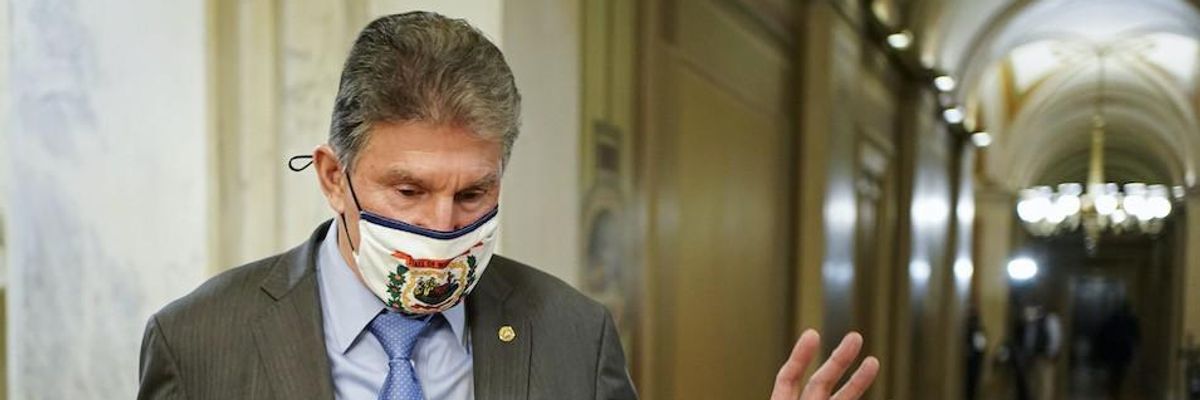
Sen. Joe Manchin (D-W.Va.) departs after the day's proceedings in the impeachment trial of former President Donald Trump at the U.S. Capitol on February 10, 2021 in Washington, D.C. (Photo: Joshua Roberts-Pool/Getty Images)
With the fate of major voting rights, minimum wage, immigration, and climate legislation likely hanging on the Senate Democratic majority's willingness to eliminate the legislative filibuster, Sen. Joe Manchin of West Virginia on Monday yelled at reporters that he will "never" agree to scrapping the 60-vote threshold standing in the way of his own party's agenda.
"Jesus Christ! What don't you understand about never?" said Manchin (D-W.Va.), an outburst that came as top progressive Sens. Bernie Sanders (I-Vt.) and Elizabeth Warren (D-Mass.) both stressed the necessity of eliminating the filibuster in the wake of the Senate parliamentarian's advisory ruling against the inclusion of a minimum wage increase in the emerging coronavirus relief package.
"Americans didn't send us to Washington to be some kind of debating society. They sent us here to get things done, and that's what we should do. And that means no veto for Mitch McConnell."
--Sen. Elizabeth Warren
The parliamentarian's widely disputed opinion that the proposed $15 minimum wage provision would violate the Senate Byrd Rule--and Vice President Kamala Harris' refusal to override the unelected official's advice--lays bare the severe limitations inherent in using the filibuster-proof budget reconciliation process to leapfrog obstructionist Republicans.
Asked whether there's any "practical vehicle" left for Senate Democrats to raise the federal minimum wage, Warren said in an appearance on MSNBC late Monday that "of course it can happen, if we just get rid of the filibuster."
"[Republican Senate Minority Leader] Mitch McConnell, right now, has a veto over our being able to do anything, unless we can twist ourselves into pretzels and make it fit through reconciliation," Warren said. "Understand, it's not just minimum wage. It's voter protection. It's environmental crisis issues. It's immigration. It's universal childcare. It's college. It's gun safety. It's the things we need to pass to make this country work."
"And I want to be clear: It's the things the majority of Americans strongly support," the Massachusetts Democrat continued. "Americans didn't send us to Washington to be some kind of debating society. They sent us here to get things done, and that's what we should do. And that means no veto for Mitch McConnell."
Sanders echoed his progressive colleague in a statement Monday night, declaring that "obviously, as soon as we can, we must end the filibuster that currently exists in the U.S. Senate."
"Given the enormous crises facing working families today," the Vermont senator said, "we cannot allow a minority of the Senate to obstruct what the vast majority of the American people want and need."
"Given the enormous crises facing working families today, we cannot allow a minority of the Senate to obstruct what the vast majority of the American people want and need."
--Sen. Bernie Sanders
Scrapping the filibuster would require 50 votes in the Senate plus a tie-breaking vote from Harris, a level of support that cannot be achieved without the assent of Manchin--who supported reforming the filibuster a decade ago--and Sen. Kyrsten Sinema (D-Ariz.), another outspoken defender of the current 60-vote threshold required to end debate on legislation.
This past weekend, Arizonans flooded Sinema's voicemail box with demands that she get on board with eliminating the legislative filibuster:
While Manchin and Sinema have both claimed the legislative filibuster is necessary to promote bipartisanship, The Week's Ryan Cooper wrote in a column Tuesday that "back when 51 Senate votes were enough to pass a law, there was a lot more compromise and collaboration, because members of Congress often figured that if something was going through anyway, they might as well see what they could get with their vote."
Manchin's own effort to pass a bipartisan gun control amendment with Sen. Pat Toomey (R-Pa.) in 2013 received 54 votes but collapsed due to the filibuster--an experience that appears to have had no impact on the West Virginia Democrat's view of the 60-vote rule.
Cooper argued that "whether or not Democrats can overcome the Senate filibuster and their own timidity to pass H.R. 1"--sweeping democracy reform legislation backed by the White House and two-thirds of U.S. voters--"is now the most important single factor in whether they can hang on to their congressional majorities, and hence stop Republicans from cheating them permanently out of national power."
"More than 250 vote suppression bills have... been introduced at the state level. I would not be at all surprised to see some state Republican Party attempt to pass a law straight-up banning Democrats from voting at some point," Cooper wrote. "Moderate Democrats in the Senate have a choice to make: They can either defend democracy and the Constitution by passing H.R. 1 or they can save the McConnell filibuster. They can't do both."
This country and this world are at a monumental crossroads. US voters have an opportunity to beat back the forces of fascism and confront the billionaires who are rigging the economy, our media system, and our democracy, making it increasingly impossible for ordinary people to get by. We’re not just talking about the election. We’re talking about what must be done once these fascist elements are vanquished from power. We need a bolder set of solutions than what either major party has so far been willing to offer and a working-class movement ready to fight like hell for it. Trump didn't emerge from nowhere. The conditions that fueled MAGA authoritarianism were created by decades of radical neoliberal economic policies and a corrupt political system dominated by corporate interests. They slashed taxes on the super-rich, promising that the benefits would trickle down. They said giveaways to the corporate titans would make life more affordable for the rest of us. It was all bullshit. And when a bitter, betrayed populace searches for someone to blame, right-wing demagogues have little trouble finding scapegoats. People know when they're being lied to, but you won't hear any of this from the corporate media. Only independent journalism—powered and funded by people who believe in building a better world—can deliver truly trustworthy daily news. If you share our vision, please contribute whatever you can to sustain our work. |
With the fate of major voting rights, minimum wage, immigration, and climate legislation likely hanging on the Senate Democratic majority's willingness to eliminate the legislative filibuster, Sen. Joe Manchin of West Virginia on Monday yelled at reporters that he will "never" agree to scrapping the 60-vote threshold standing in the way of his own party's agenda.
"Jesus Christ! What don't you understand about never?" said Manchin (D-W.Va.), an outburst that came as top progressive Sens. Bernie Sanders (I-Vt.) and Elizabeth Warren (D-Mass.) both stressed the necessity of eliminating the filibuster in the wake of the Senate parliamentarian's advisory ruling against the inclusion of a minimum wage increase in the emerging coronavirus relief package.
"Americans didn't send us to Washington to be some kind of debating society. They sent us here to get things done, and that's what we should do. And that means no veto for Mitch McConnell."
--Sen. Elizabeth Warren
The parliamentarian's widely disputed opinion that the proposed $15 minimum wage provision would violate the Senate Byrd Rule--and Vice President Kamala Harris' refusal to override the unelected official's advice--lays bare the severe limitations inherent in using the filibuster-proof budget reconciliation process to leapfrog obstructionist Republicans.
Asked whether there's any "practical vehicle" left for Senate Democrats to raise the federal minimum wage, Warren said in an appearance on MSNBC late Monday that "of course it can happen, if we just get rid of the filibuster."
"[Republican Senate Minority Leader] Mitch McConnell, right now, has a veto over our being able to do anything, unless we can twist ourselves into pretzels and make it fit through reconciliation," Warren said. "Understand, it's not just minimum wage. It's voter protection. It's environmental crisis issues. It's immigration. It's universal childcare. It's college. It's gun safety. It's the things we need to pass to make this country work."
"And I want to be clear: It's the things the majority of Americans strongly support," the Massachusetts Democrat continued. "Americans didn't send us to Washington to be some kind of debating society. They sent us here to get things done, and that's what we should do. And that means no veto for Mitch McConnell."
Sanders echoed his progressive colleague in a statement Monday night, declaring that "obviously, as soon as we can, we must end the filibuster that currently exists in the U.S. Senate."
"Given the enormous crises facing working families today," the Vermont senator said, "we cannot allow a minority of the Senate to obstruct what the vast majority of the American people want and need."
"Given the enormous crises facing working families today, we cannot allow a minority of the Senate to obstruct what the vast majority of the American people want and need."
--Sen. Bernie Sanders
Scrapping the filibuster would require 50 votes in the Senate plus a tie-breaking vote from Harris, a level of support that cannot be achieved without the assent of Manchin--who supported reforming the filibuster a decade ago--and Sen. Kyrsten Sinema (D-Ariz.), another outspoken defender of the current 60-vote threshold required to end debate on legislation.
This past weekend, Arizonans flooded Sinema's voicemail box with demands that she get on board with eliminating the legislative filibuster:
While Manchin and Sinema have both claimed the legislative filibuster is necessary to promote bipartisanship, The Week's Ryan Cooper wrote in a column Tuesday that "back when 51 Senate votes were enough to pass a law, there was a lot more compromise and collaboration, because members of Congress often figured that if something was going through anyway, they might as well see what they could get with their vote."
Manchin's own effort to pass a bipartisan gun control amendment with Sen. Pat Toomey (R-Pa.) in 2013 received 54 votes but collapsed due to the filibuster--an experience that appears to have had no impact on the West Virginia Democrat's view of the 60-vote rule.
Cooper argued that "whether or not Democrats can overcome the Senate filibuster and their own timidity to pass H.R. 1"--sweeping democracy reform legislation backed by the White House and two-thirds of U.S. voters--"is now the most important single factor in whether they can hang on to their congressional majorities, and hence stop Republicans from cheating them permanently out of national power."
"More than 250 vote suppression bills have... been introduced at the state level. I would not be at all surprised to see some state Republican Party attempt to pass a law straight-up banning Democrats from voting at some point," Cooper wrote. "Moderate Democrats in the Senate have a choice to make: They can either defend democracy and the Constitution by passing H.R. 1 or they can save the McConnell filibuster. They can't do both."