SUBSCRIBE TO OUR FREE NEWSLETTER
Daily news & progressive opinion—funded by the people, not the corporations—delivered straight to your inbox.
5
#000000
#FFFFFF
To donate by check, phone, or other method, see our More Ways to Give page.
Daily news & progressive opinion—funded by the people, not the corporations—delivered straight to your inbox.
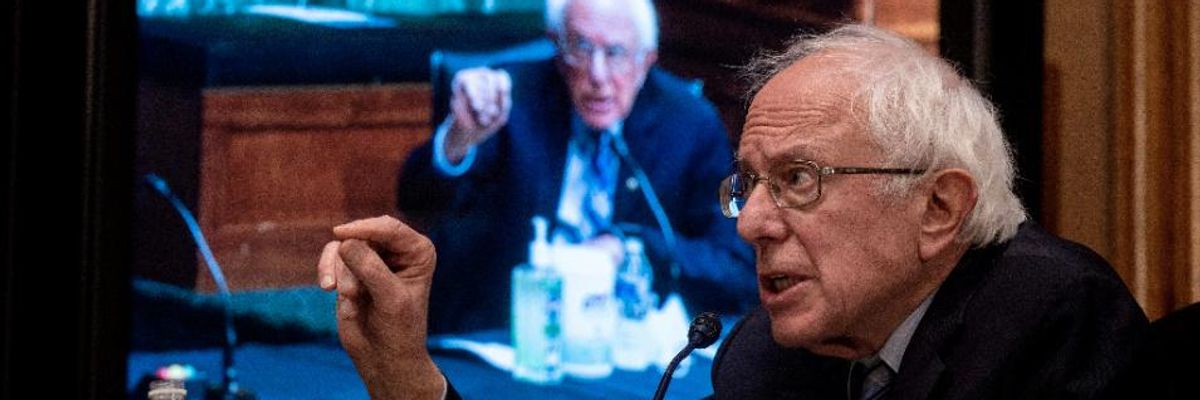
Sen. Bernie Sanders (I-Vt.) questions former Michigan Governor Jennifer Granholm during the Senate Energy and Natural Resources Committee hearing to examine her nomination to be secretary of Energy on Capitol Hill in Washington, D.C. on January 27, 2021. (Photo: Jim Watson/Pool/AFP via Getty Images)
Sen. Bernie Sanders took to Twitter Saturday night to call out Democrats in Congress who are considering a proposal to exclude millions of Americans from receiving $1,400 Covid-19 relief checks with narrower eligibility restrictions than the previous coronavirus pandemic packages passed under former President Donald Trump.
As the new chair of the Senate Budget Committee, Sanders (I-Vt.) is playing a key role in congressional Democrats' efforts to enact President Joe Biden's $1.9 trillion American Rescue Plan. Amid reporting this week about lawmakers potentially further restricting direct relief, Sanders has repeatedly and forcefully spoken out against that.
"Unbelievable," Sanders tweeted Saturday. "There are some Dems who want to lower the income eligibility for direct payments from $75,000 to $50,000 for individuals, and $150,000 to $100,000 for couples. In other words, working-class people who got checks from Trump would not get them from Biden. Brilliant!"
Sanders followed up with a post reiterating his position: "I strongly oppose lowering income eligibility for direct payments from $75,000 to $50,000 for individuals and $150,000 to $100,000 for couples. In these difficult times, ALL working-class people deserve the full $1,400. Last I heard, someone making $55,000 a year is not 'rich.'"
Rep. Alexandria Ocasio-Cortez (D-N.Y.) concurred, declaring that "it would be outrageous if we ran on giving more relief and ended up doing the opposite."
"In conclusion," Ocasio-Cortez added, "$50k is wack and we shouldn't do wack things."
Other lawmakers have also slammed lowering the income eligibility this week.
Sen. Ron Wyden (D-Ore.), the new chair of the Senate Finance Committee, told the Washington Post's Jeff Stein, "I understand the desire to ensure those most in need receive checks, but families who received the first two checks will be counting on a third check to pay the bills."
Stein had reported Tuesday that "the White House is open to narrowing eligibility for the next round of stimulus payments but not lowering those payments below $1,400 per person."
In a preview of an interview with CBS's Norah O'Donnell set to air Sunday night, Biden said that he is set on $1,400 checks but "prepared to negotiate" on who receives them.
"But here's the deal: middle-class folks need help," the president added. "It's somewhere between an individual making up to $75,000 and phasing out, and a couple making up to $150,000 and then phasing out, but again, I'm wide open on what that is."
CBS News reported Sunday on how economic conditions are fueling demands for relief:
Many Democrats are arguing for a large stimulus package, pointing to renewed economic distress in recent months as the pandemic worsens. The January jobs report indicated subdued hiring, with employers adding a modest 49,000 jobs. White-collar services [led] the gains as lower-paid service jobs continued to suffer.
"It may look good, but it ain't," wrote Oxford Economics economist Lydia Boussour in a February 5 research note. "The labor market recovery remained stuck in a rut in January as the pandemic's winter surge weighed on hiring."
The labor market isn't likely to return to pre-pandemic levels until 2024, according to a February 1 report from the Congressional Budget Office. The U.S. economy shrank 3.5% last year, its largest annual decline in 74 years, government data shows.
Dear Common Dreams reader, It’s been nearly 30 years since I co-founded Common Dreams with my late wife, Lina Newhouser. We had the radical notion that journalism should serve the public good, not corporate profits. It was clear to us from the outset what it would take to build such a project. No paid advertisements. No corporate sponsors. No millionaire publisher telling us what to think or do. Many people said we wouldn't last a year, but we proved those doubters wrong. Together with a tremendous team of journalists and dedicated staff, we built an independent media outlet free from the constraints of profits and corporate control. Our mission has always been simple: To inform. To inspire. To ignite change for the common good. Building Common Dreams was not easy. Our survival was never guaranteed. When you take on the most powerful forces—Wall Street greed, fossil fuel industry destruction, Big Tech lobbyists, and uber-rich oligarchs who have spent billions upon billions rigging the economy and democracy in their favor—the only bulwark you have is supporters who believe in your work. But here’s the urgent message from me today. It's never been this bad out there. And it's never been this hard to keep us going. At the very moment Common Dreams is most needed, the threats we face are intensifying. We need your support now more than ever. We don't accept corporate advertising and never will. We don't have a paywall because we don't think people should be blocked from critical news based on their ability to pay. Everything we do is funded by the donations of readers like you. When everyone does the little they can afford, we are strong. But if that support retreats or dries up, so do we. Will you donate now to make sure Common Dreams not only survives but thrives? —Craig Brown, Co-founder |
Sen. Bernie Sanders took to Twitter Saturday night to call out Democrats in Congress who are considering a proposal to exclude millions of Americans from receiving $1,400 Covid-19 relief checks with narrower eligibility restrictions than the previous coronavirus pandemic packages passed under former President Donald Trump.
As the new chair of the Senate Budget Committee, Sanders (I-Vt.) is playing a key role in congressional Democrats' efforts to enact President Joe Biden's $1.9 trillion American Rescue Plan. Amid reporting this week about lawmakers potentially further restricting direct relief, Sanders has repeatedly and forcefully spoken out against that.
"Unbelievable," Sanders tweeted Saturday. "There are some Dems who want to lower the income eligibility for direct payments from $75,000 to $50,000 for individuals, and $150,000 to $100,000 for couples. In other words, working-class people who got checks from Trump would not get them from Biden. Brilliant!"
Sanders followed up with a post reiterating his position: "I strongly oppose lowering income eligibility for direct payments from $75,000 to $50,000 for individuals and $150,000 to $100,000 for couples. In these difficult times, ALL working-class people deserve the full $1,400. Last I heard, someone making $55,000 a year is not 'rich.'"
Rep. Alexandria Ocasio-Cortez (D-N.Y.) concurred, declaring that "it would be outrageous if we ran on giving more relief and ended up doing the opposite."
"In conclusion," Ocasio-Cortez added, "$50k is wack and we shouldn't do wack things."
Other lawmakers have also slammed lowering the income eligibility this week.
Sen. Ron Wyden (D-Ore.), the new chair of the Senate Finance Committee, told the Washington Post's Jeff Stein, "I understand the desire to ensure those most in need receive checks, but families who received the first two checks will be counting on a third check to pay the bills."
Stein had reported Tuesday that "the White House is open to narrowing eligibility for the next round of stimulus payments but not lowering those payments below $1,400 per person."
In a preview of an interview with CBS's Norah O'Donnell set to air Sunday night, Biden said that he is set on $1,400 checks but "prepared to negotiate" on who receives them.
"But here's the deal: middle-class folks need help," the president added. "It's somewhere between an individual making up to $75,000 and phasing out, and a couple making up to $150,000 and then phasing out, but again, I'm wide open on what that is."
CBS News reported Sunday on how economic conditions are fueling demands for relief:
Many Democrats are arguing for a large stimulus package, pointing to renewed economic distress in recent months as the pandemic worsens. The January jobs report indicated subdued hiring, with employers adding a modest 49,000 jobs. White-collar services [led] the gains as lower-paid service jobs continued to suffer.
"It may look good, but it ain't," wrote Oxford Economics economist Lydia Boussour in a February 5 research note. "The labor market recovery remained stuck in a rut in January as the pandemic's winter surge weighed on hiring."
The labor market isn't likely to return to pre-pandemic levels until 2024, according to a February 1 report from the Congressional Budget Office. The U.S. economy shrank 3.5% last year, its largest annual decline in 74 years, government data shows.
Sen. Bernie Sanders took to Twitter Saturday night to call out Democrats in Congress who are considering a proposal to exclude millions of Americans from receiving $1,400 Covid-19 relief checks with narrower eligibility restrictions than the previous coronavirus pandemic packages passed under former President Donald Trump.
As the new chair of the Senate Budget Committee, Sanders (I-Vt.) is playing a key role in congressional Democrats' efforts to enact President Joe Biden's $1.9 trillion American Rescue Plan. Amid reporting this week about lawmakers potentially further restricting direct relief, Sanders has repeatedly and forcefully spoken out against that.
"Unbelievable," Sanders tweeted Saturday. "There are some Dems who want to lower the income eligibility for direct payments from $75,000 to $50,000 for individuals, and $150,000 to $100,000 for couples. In other words, working-class people who got checks from Trump would not get them from Biden. Brilliant!"
Sanders followed up with a post reiterating his position: "I strongly oppose lowering income eligibility for direct payments from $75,000 to $50,000 for individuals and $150,000 to $100,000 for couples. In these difficult times, ALL working-class people deserve the full $1,400. Last I heard, someone making $55,000 a year is not 'rich.'"
Rep. Alexandria Ocasio-Cortez (D-N.Y.) concurred, declaring that "it would be outrageous if we ran on giving more relief and ended up doing the opposite."
"In conclusion," Ocasio-Cortez added, "$50k is wack and we shouldn't do wack things."
Other lawmakers have also slammed lowering the income eligibility this week.
Sen. Ron Wyden (D-Ore.), the new chair of the Senate Finance Committee, told the Washington Post's Jeff Stein, "I understand the desire to ensure those most in need receive checks, but families who received the first two checks will be counting on a third check to pay the bills."
Stein had reported Tuesday that "the White House is open to narrowing eligibility for the next round of stimulus payments but not lowering those payments below $1,400 per person."
In a preview of an interview with CBS's Norah O'Donnell set to air Sunday night, Biden said that he is set on $1,400 checks but "prepared to negotiate" on who receives them.
"But here's the deal: middle-class folks need help," the president added. "It's somewhere between an individual making up to $75,000 and phasing out, and a couple making up to $150,000 and then phasing out, but again, I'm wide open on what that is."
CBS News reported Sunday on how economic conditions are fueling demands for relief:
Many Democrats are arguing for a large stimulus package, pointing to renewed economic distress in recent months as the pandemic worsens. The January jobs report indicated subdued hiring, with employers adding a modest 49,000 jobs. White-collar services [led] the gains as lower-paid service jobs continued to suffer.
"It may look good, but it ain't," wrote Oxford Economics economist Lydia Boussour in a February 5 research note. "The labor market recovery remained stuck in a rut in January as the pandemic's winter surge weighed on hiring."
The labor market isn't likely to return to pre-pandemic levels until 2024, according to a February 1 report from the Congressional Budget Office. The U.S. economy shrank 3.5% last year, its largest annual decline in 74 years, government data shows.