

SUBSCRIBE TO OUR FREE NEWSLETTER
Daily news & progressive opinion—funded by the people, not the corporations—delivered straight to your inbox.
5
#000000
#FFFFFF
To donate by check, phone, or other method, see our More Ways to Give page.
Daily news & progressive opinion—funded by the people, not the corporations—delivered straight to your inbox.
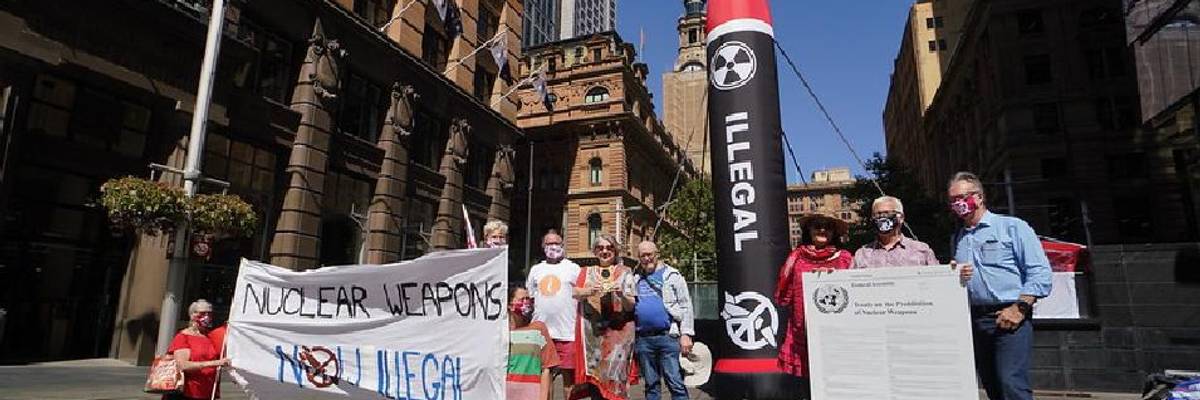
Members of the International Campaign to Abolish Nuclear Weapons protest in Sydney, Australia on January 22, 2021. (Photo: Michelle Haywood/ICAN)
In a victory for disarmament and peace campaigners--and all of humanity--a treaty banning nuclear weapons entered into force on Friday, a development that experts and activists hailed as "groundbreaking" even though the pact lacks support from the world's nine nuclear powers.
"Ever since the atomic bombings of Hiroshima and Nagasaki, citizens the world over have petitioned and protested for a permanent ban on nuclear weapons."
--Beatrice Fihn, ICAN
"Today we reach a major milestone on the road to a more peaceful and secure world, free from the ultimate menace of nuclear war," said Beatrice Fihn, executive director of the International Campaign to Abolish Nuclear Weapons (ICAN), at a United Nations ceremony on Friday marking the momentous occasion.
ICAN was awarded the 2017 Nobel Peace Prize for its efforts "to draw attention to the catastrophic humanitarian consequences of any use of nuclear weapons" and advance the ban.
"Ever since the atomic bombings of Hiroshima and Nagasaki, citizens the world over have petitioned and protested for a permanent ban on nuclear weapons. That ban--long imagined, long sought--is now, finally, in force," Fihn noted Friday, calling the historic treaty a "monumental accomplishment."
During the event, Cambodia became the 52nd state party to the Treaty on the Prohibition of Nuclear Weapons (TPNW), which was adopted in July 2017 and opened for signature that September. It took over three years for the treaty to gain the requisite 50 ratifications to enter into force.
Despite opposition from nuclear states, particularly the U.S. under the Trump administration, Honduras became the 50th state to ratify the TPNW in October. States party to the agreement cannot develop, test, produce, acquire, possess, stockpile, use, or threaten to use nuclear weapons.
"Nuclear weapons pose growing dangers and the world needs urgent action to ensure their elimination and prevent the catastrophic human and environmental consequences any use would cause."
--U.N. Secretary-General Antonio Guterres
"Some will seek to downplay the historical significance of this moment--those intent on preserving the status quo, who feel strong wielding these instruments of mass murder; or those who profit from their production," Fihn said Friday. "But their voices are soft whimpers amid the loud chorus of support for this crucial new piece of international law."
Fihn called on states that haven't yet ratified the TPNW to do so and those that support their allies' nuclear weapons to "stop now." She also appealed directly to nuclear-armed states (China, France, India, Israel, North Korea, Pakistan, Russia, the United Kingdom, and the United States), saying: "Your weapons are now banned. Permanently. You are on the wrong side of international law, the wrong side of history, and the wrong side of humanity. It's time to consign your awful bombs to the dustbin of history."
U.N. Secretary-General Antonio Guterres welcomed the ban with a video message in which he declared, "Nuclear weapons pose growing dangers and the world needs urgent action to ensure their elimination and prevent the catastrophic human and environmental consequences any use would cause."
Guterres commended states that have ratified the TPNW and recognized the contributions of survivors of nuclear explosions and nuclear tests who "offered tragic testimonies and were a moral force behind the treaty," adding that "entry into force is a tribute to their enduring advocacy."
The U.N. chief also said that he looks forward to "carrying out the functions assigned by the treaty, including in preparation for the first Meeting of States Parties," and reiterated that "the elimination of nuclear weapons remains the highest disarmament priority of the United Nations."
Other peace advocates and experts also added their voices to the celebration.
"This treaty--the result of more than 75 years of work--sends a clear signal that nuclear weapons are unacceptable from a moral, humanitarian, and now a legal point of view," said Peter Maurer, president of the International Committee of the Red Cross. "It sets in motion even higher legal barriers and an even greater stigmatization of nuclear warheads than already exists. It allows us to imagine a world free from these inhumane weapons as an achievable goal."
Pope Francis, in a tweet welcomed by ICAN, encouraged all states and people "to work decisively toward promoting conditions necessary for a world without nuclear weapons, contributing to the advancement of #peace and multilateral cooperation which humanity greatly needs today."
In a statement anticipating the treaty's entry into force, Daryl G. Kimball, executive director of the U.S.-based Arms Control Association, said that "the TPNW is a powerful reminder that for the majority of the world's states, nuclear weapons--and policies that threaten their use for any reason--are immoral, dangerous, and unsustainable."
Tom Countryman, former U.S. assistant secretary of state for international security and nonproliferation, now serves as chair of the board of the Arms Control Association. He urged U.S. President Joe Biden, who took office on Wednesday, to pursue a different path from his predecessor--whose administration tried to argue that the TPNW "is dangerous" to the 1968 Nuclear Nonproliferation Treaty (NPT).
"Rather than adopt the Trump administration's misguided criticism of the TPNW as a threat to the NPT and repeat its clumsy attempt to get states [to] un-sign the treaty," Countryman said, "the incoming Biden administration should make it clear that the United States views the TPNW a good faith effort by the majority of the world's nations to fulfill their own NPT-related disarmament obligations and help build the legal framework for the eventual elimination of nuclear weapons."
William J. Perry served as undersecretary of defense for research and engineering in the Carter administration and secretary of defense in the Clinton administration. Now the chair of the Bulletin of the Atomic Scientists' Board of Sponsors, Perry offered Biden similar advice:
Nearly a year ago, the Bulletin set its Doomsday Clock at 100 seconds to midnight, "closer than ever before to apocalypse." The decades-old symbol of the threat posed by nuclear weaponry and, more recently, the human-caused climate crisis is set to be updated again next week.
Dear Common Dreams reader, It’s been nearly 30 years since I co-founded Common Dreams with my late wife, Lina Newhouser. We had the radical notion that journalism should serve the public good, not corporate profits. It was clear to us from the outset what it would take to build such a project. No paid advertisements. No corporate sponsors. No millionaire publisher telling us what to think or do. Many people said we wouldn't last a year, but we proved those doubters wrong. Together with a tremendous team of journalists and dedicated staff, we built an independent media outlet free from the constraints of profits and corporate control. Our mission has always been simple: To inform. To inspire. To ignite change for the common good. Building Common Dreams was not easy. Our survival was never guaranteed. When you take on the most powerful forces—Wall Street greed, fossil fuel industry destruction, Big Tech lobbyists, and uber-rich oligarchs who have spent billions upon billions rigging the economy and democracy in their favor—the only bulwark you have is supporters who believe in your work. But here’s the urgent message from me today. It's never been this bad out there. And it's never been this hard to keep us going. At the very moment Common Dreams is most needed, the threats we face are intensifying. We need your support now more than ever. We don't accept corporate advertising and never will. We don't have a paywall because we don't think people should be blocked from critical news based on their ability to pay. Everything we do is funded by the donations of readers like you. When everyone does the little they can afford, we are strong. But if that support retreats or dries up, so do we. Will you donate now to make sure Common Dreams not only survives but thrives? —Craig Brown, Co-founder |
In a victory for disarmament and peace campaigners--and all of humanity--a treaty banning nuclear weapons entered into force on Friday, a development that experts and activists hailed as "groundbreaking" even though the pact lacks support from the world's nine nuclear powers.
"Ever since the atomic bombings of Hiroshima and Nagasaki, citizens the world over have petitioned and protested for a permanent ban on nuclear weapons."
--Beatrice Fihn, ICAN
"Today we reach a major milestone on the road to a more peaceful and secure world, free from the ultimate menace of nuclear war," said Beatrice Fihn, executive director of the International Campaign to Abolish Nuclear Weapons (ICAN), at a United Nations ceremony on Friday marking the momentous occasion.
ICAN was awarded the 2017 Nobel Peace Prize for its efforts "to draw attention to the catastrophic humanitarian consequences of any use of nuclear weapons" and advance the ban.
"Ever since the atomic bombings of Hiroshima and Nagasaki, citizens the world over have petitioned and protested for a permanent ban on nuclear weapons. That ban--long imagined, long sought--is now, finally, in force," Fihn noted Friday, calling the historic treaty a "monumental accomplishment."
During the event, Cambodia became the 52nd state party to the Treaty on the Prohibition of Nuclear Weapons (TPNW), which was adopted in July 2017 and opened for signature that September. It took over three years for the treaty to gain the requisite 50 ratifications to enter into force.
Despite opposition from nuclear states, particularly the U.S. under the Trump administration, Honduras became the 50th state to ratify the TPNW in October. States party to the agreement cannot develop, test, produce, acquire, possess, stockpile, use, or threaten to use nuclear weapons.
"Nuclear weapons pose growing dangers and the world needs urgent action to ensure their elimination and prevent the catastrophic human and environmental consequences any use would cause."
--U.N. Secretary-General Antonio Guterres
"Some will seek to downplay the historical significance of this moment--those intent on preserving the status quo, who feel strong wielding these instruments of mass murder; or those who profit from their production," Fihn said Friday. "But their voices are soft whimpers amid the loud chorus of support for this crucial new piece of international law."
Fihn called on states that haven't yet ratified the TPNW to do so and those that support their allies' nuclear weapons to "stop now." She also appealed directly to nuclear-armed states (China, France, India, Israel, North Korea, Pakistan, Russia, the United Kingdom, and the United States), saying: "Your weapons are now banned. Permanently. You are on the wrong side of international law, the wrong side of history, and the wrong side of humanity. It's time to consign your awful bombs to the dustbin of history."
U.N. Secretary-General Antonio Guterres welcomed the ban with a video message in which he declared, "Nuclear weapons pose growing dangers and the world needs urgent action to ensure their elimination and prevent the catastrophic human and environmental consequences any use would cause."
Guterres commended states that have ratified the TPNW and recognized the contributions of survivors of nuclear explosions and nuclear tests who "offered tragic testimonies and were a moral force behind the treaty," adding that "entry into force is a tribute to their enduring advocacy."
The U.N. chief also said that he looks forward to "carrying out the functions assigned by the treaty, including in preparation for the first Meeting of States Parties," and reiterated that "the elimination of nuclear weapons remains the highest disarmament priority of the United Nations."
Other peace advocates and experts also added their voices to the celebration.
"This treaty--the result of more than 75 years of work--sends a clear signal that nuclear weapons are unacceptable from a moral, humanitarian, and now a legal point of view," said Peter Maurer, president of the International Committee of the Red Cross. "It sets in motion even higher legal barriers and an even greater stigmatization of nuclear warheads than already exists. It allows us to imagine a world free from these inhumane weapons as an achievable goal."
Pope Francis, in a tweet welcomed by ICAN, encouraged all states and people "to work decisively toward promoting conditions necessary for a world without nuclear weapons, contributing to the advancement of #peace and multilateral cooperation which humanity greatly needs today."
In a statement anticipating the treaty's entry into force, Daryl G. Kimball, executive director of the U.S.-based Arms Control Association, said that "the TPNW is a powerful reminder that for the majority of the world's states, nuclear weapons--and policies that threaten their use for any reason--are immoral, dangerous, and unsustainable."
Tom Countryman, former U.S. assistant secretary of state for international security and nonproliferation, now serves as chair of the board of the Arms Control Association. He urged U.S. President Joe Biden, who took office on Wednesday, to pursue a different path from his predecessor--whose administration tried to argue that the TPNW "is dangerous" to the 1968 Nuclear Nonproliferation Treaty (NPT).
"Rather than adopt the Trump administration's misguided criticism of the TPNW as a threat to the NPT and repeat its clumsy attempt to get states [to] un-sign the treaty," Countryman said, "the incoming Biden administration should make it clear that the United States views the TPNW a good faith effort by the majority of the world's nations to fulfill their own NPT-related disarmament obligations and help build the legal framework for the eventual elimination of nuclear weapons."
William J. Perry served as undersecretary of defense for research and engineering in the Carter administration and secretary of defense in the Clinton administration. Now the chair of the Bulletin of the Atomic Scientists' Board of Sponsors, Perry offered Biden similar advice:
Nearly a year ago, the Bulletin set its Doomsday Clock at 100 seconds to midnight, "closer than ever before to apocalypse." The decades-old symbol of the threat posed by nuclear weaponry and, more recently, the human-caused climate crisis is set to be updated again next week.
In a victory for disarmament and peace campaigners--and all of humanity--a treaty banning nuclear weapons entered into force on Friday, a development that experts and activists hailed as "groundbreaking" even though the pact lacks support from the world's nine nuclear powers.
"Ever since the atomic bombings of Hiroshima and Nagasaki, citizens the world over have petitioned and protested for a permanent ban on nuclear weapons."
--Beatrice Fihn, ICAN
"Today we reach a major milestone on the road to a more peaceful and secure world, free from the ultimate menace of nuclear war," said Beatrice Fihn, executive director of the International Campaign to Abolish Nuclear Weapons (ICAN), at a United Nations ceremony on Friday marking the momentous occasion.
ICAN was awarded the 2017 Nobel Peace Prize for its efforts "to draw attention to the catastrophic humanitarian consequences of any use of nuclear weapons" and advance the ban.
"Ever since the atomic bombings of Hiroshima and Nagasaki, citizens the world over have petitioned and protested for a permanent ban on nuclear weapons. That ban--long imagined, long sought--is now, finally, in force," Fihn noted Friday, calling the historic treaty a "monumental accomplishment."
During the event, Cambodia became the 52nd state party to the Treaty on the Prohibition of Nuclear Weapons (TPNW), which was adopted in July 2017 and opened for signature that September. It took over three years for the treaty to gain the requisite 50 ratifications to enter into force.
Despite opposition from nuclear states, particularly the U.S. under the Trump administration, Honduras became the 50th state to ratify the TPNW in October. States party to the agreement cannot develop, test, produce, acquire, possess, stockpile, use, or threaten to use nuclear weapons.
"Nuclear weapons pose growing dangers and the world needs urgent action to ensure their elimination and prevent the catastrophic human and environmental consequences any use would cause."
--U.N. Secretary-General Antonio Guterres
"Some will seek to downplay the historical significance of this moment--those intent on preserving the status quo, who feel strong wielding these instruments of mass murder; or those who profit from their production," Fihn said Friday. "But their voices are soft whimpers amid the loud chorus of support for this crucial new piece of international law."
Fihn called on states that haven't yet ratified the TPNW to do so and those that support their allies' nuclear weapons to "stop now." She also appealed directly to nuclear-armed states (China, France, India, Israel, North Korea, Pakistan, Russia, the United Kingdom, and the United States), saying: "Your weapons are now banned. Permanently. You are on the wrong side of international law, the wrong side of history, and the wrong side of humanity. It's time to consign your awful bombs to the dustbin of history."
U.N. Secretary-General Antonio Guterres welcomed the ban with a video message in which he declared, "Nuclear weapons pose growing dangers and the world needs urgent action to ensure their elimination and prevent the catastrophic human and environmental consequences any use would cause."
Guterres commended states that have ratified the TPNW and recognized the contributions of survivors of nuclear explosions and nuclear tests who "offered tragic testimonies and were a moral force behind the treaty," adding that "entry into force is a tribute to their enduring advocacy."
The U.N. chief also said that he looks forward to "carrying out the functions assigned by the treaty, including in preparation for the first Meeting of States Parties," and reiterated that "the elimination of nuclear weapons remains the highest disarmament priority of the United Nations."
Other peace advocates and experts also added their voices to the celebration.
"This treaty--the result of more than 75 years of work--sends a clear signal that nuclear weapons are unacceptable from a moral, humanitarian, and now a legal point of view," said Peter Maurer, president of the International Committee of the Red Cross. "It sets in motion even higher legal barriers and an even greater stigmatization of nuclear warheads than already exists. It allows us to imagine a world free from these inhumane weapons as an achievable goal."
Pope Francis, in a tweet welcomed by ICAN, encouraged all states and people "to work decisively toward promoting conditions necessary for a world without nuclear weapons, contributing to the advancement of #peace and multilateral cooperation which humanity greatly needs today."
In a statement anticipating the treaty's entry into force, Daryl G. Kimball, executive director of the U.S.-based Arms Control Association, said that "the TPNW is a powerful reminder that for the majority of the world's states, nuclear weapons--and policies that threaten their use for any reason--are immoral, dangerous, and unsustainable."
Tom Countryman, former U.S. assistant secretary of state for international security and nonproliferation, now serves as chair of the board of the Arms Control Association. He urged U.S. President Joe Biden, who took office on Wednesday, to pursue a different path from his predecessor--whose administration tried to argue that the TPNW "is dangerous" to the 1968 Nuclear Nonproliferation Treaty (NPT).
"Rather than adopt the Trump administration's misguided criticism of the TPNW as a threat to the NPT and repeat its clumsy attempt to get states [to] un-sign the treaty," Countryman said, "the incoming Biden administration should make it clear that the United States views the TPNW a good faith effort by the majority of the world's nations to fulfill their own NPT-related disarmament obligations and help build the legal framework for the eventual elimination of nuclear weapons."
William J. Perry served as undersecretary of defense for research and engineering in the Carter administration and secretary of defense in the Clinton administration. Now the chair of the Bulletin of the Atomic Scientists' Board of Sponsors, Perry offered Biden similar advice:
Nearly a year ago, the Bulletin set its Doomsday Clock at 100 seconds to midnight, "closer than ever before to apocalypse." The decades-old symbol of the threat posed by nuclear weaponry and, more recently, the human-caused climate crisis is set to be updated again next week.

