SUBSCRIBE TO OUR FREE NEWSLETTER
Daily news & progressive opinion—funded by the people, not the corporations—delivered straight to your inbox.
5
#000000
#FFFFFF
To donate by check, phone, or other method, see our More Ways to Give page.
Daily news & progressive opinion—funded by the people, not the corporations—delivered straight to your inbox.
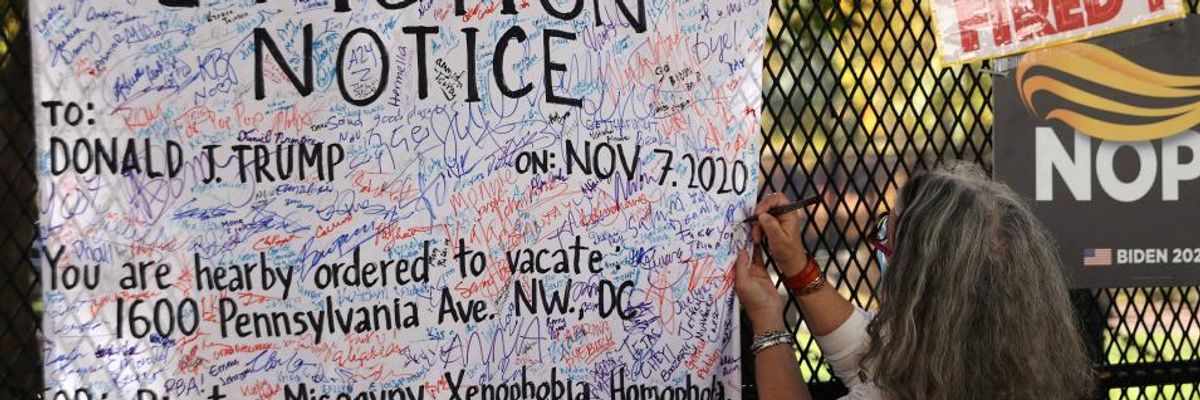
A woman signs an 'eviction notice' for President Donald Trump hanging on the security fence that surrounds the White House November 8, 2020 in Washington, D.C. (Photo: Chip Somodevilla/Getty Images)
A federal judge on Monday delivered yet another defeat to President Donald Trump and his supporters in their ongoing efforts to overturn President-elect Joe Biden's November electoral victory, which is expected to be certified by Congress in a joint session scheduled for Wednesday.
"Courts are not instruments through which parties engage in such gamesmanship or symbolic political gestures."
--Judge James E. Boasberg
The lawsuit (pdf) was filed last month in U.S. District Court for the District of Columbia by the right-wing Wisconsin Voters Alliance. Other plaintiffs included GOP Wisconsin lawmakers as well as groups and voters from Arizona, Georgia, Michigan, Pennsylvania, and Wisconsin--all of which Biden won.
The suit against Vice President Mike Pence in his official capacity as president of the Senate, both houses of Congress, the Electoral College, and leaders from the five states sought a "constitutionally compliant process for state-by-state post-election certification of presidential votes and presidential electors."
The Trump allies argued that Pence and Congress shouldn't be allowed to consider states' electoral votes "unless their respective state legislatures have voted affirmatively in a post-election vote to certify presidential votes and their presidential electors for the current and future presidential elections."
District Court Judge James E. Boasberg wrote in his seven-page opinion (pdf) Monday that the suit was filed on behalf of plaintiffs without standing and, at least regarding some defendants, in the wrong court. He added, "It would be risible were its target not so grave: the undermining of a democratic election for president of the United States."
"Even if the the court had subject-matter and personal jurisdiction, it still could not rule in plaintiffs' favor because their central contention is flat-out wrong," explained judge, tearing apart the Trump allies' claims about Article II of the Constitution.
"Plaintiffs somehow interpret this straightforward passage to mean that state legislatures alone must certify presidential votes and presidential electors after each election, and that governors or other entities have no constitutionally permitted role," the judge wrote, adding that this "is not at all what Article II says."
Noting that each of the five battleground states in question has passed constitutionally sound statutes "directing how votes are to be certified and electors selected," Boasberg concluded that "plaintiffs' theory that all of these laws are unconstitutional and that the court should instead require state legislatures themselves to certify every presidential election lies somewhere between a willful misreading of the Constitution and fantasy."
"It is not a stretch to find a serious lack of good faith here," wrote the judge. "Yet even that may be letting plaintiffs off the hook too lightly. Their failure to make any effort to serve or formally notify any defendant--even after reminder by the court in its minute order--renders it difficult to believe that the suit is meant seriously."
"Courts are not instruments through which parties engage in such gamesmanship or symbolic political gestures," added Boasberg, threatening a possible referral to a committee that could sanction the Trump allies' counsel.
The judge was appointed to the district court in D.C. by former President Barack Obama. He was previously appointed by former President George W. Bush to serve as an associate judge of the Superior Court of the District of Columbia.
Boasberg's decision comes after a federal appeals court on Saturday dismissed a suit by Rep. Louie Gohmert (R-Texas) and other Republicans that sought to empower Pence to interfere in the Electoral College vote count and overturn Biden's win.
Sen. Ted Cruz (R-Texas) led another group of Republicans who announced Saturday that they will join Sen. Josh Hawley (R-Mo.)--and more than 100 GOP House members--in contesting the presidential election results during the Wednesday session, which provoked accusations of "sedition."
Trump, meanwhile, pressured Georgia's GOP Secretary of State Brad Raffensperger on Saturday to "find" enough votes to overturn Biden's win. Leaked audio of the hourlong call drew demands for a criminal probe of the president and others.
Continued outrage over Trump's attempted election interference in Georgia comes just a day before a pair of runoff races in the state will determine which party controls the Senate. With a Democratic majority in the House, the outcomes of those elections are expected to dramatically impact Biden's ability to implement his agenda.
Dear Common Dreams reader, It’s been nearly 30 years since I co-founded Common Dreams with my late wife, Lina Newhouser. We had the radical notion that journalism should serve the public good, not corporate profits. It was clear to us from the outset what it would take to build such a project. No paid advertisements. No corporate sponsors. No millionaire publisher telling us what to think or do. Many people said we wouldn't last a year, but we proved those doubters wrong. Together with a tremendous team of journalists and dedicated staff, we built an independent media outlet free from the constraints of profits and corporate control. Our mission has always been simple: To inform. To inspire. To ignite change for the common good. Building Common Dreams was not easy. Our survival was never guaranteed. When you take on the most powerful forces—Wall Street greed, fossil fuel industry destruction, Big Tech lobbyists, and uber-rich oligarchs who have spent billions upon billions rigging the economy and democracy in their favor—the only bulwark you have is supporters who believe in your work. But here’s the urgent message from me today. It's never been this bad out there. And it's never been this hard to keep us going. At the very moment Common Dreams is most needed, the threats we face are intensifying. We need your support now more than ever. We don't accept corporate advertising and never will. We don't have a paywall because we don't think people should be blocked from critical news based on their ability to pay. Everything we do is funded by the donations of readers like you. When everyone does the little they can afford, we are strong. But if that support retreats or dries up, so do we. Will you donate now to make sure Common Dreams not only survives but thrives? —Craig Brown, Co-founder |
A federal judge on Monday delivered yet another defeat to President Donald Trump and his supporters in their ongoing efforts to overturn President-elect Joe Biden's November electoral victory, which is expected to be certified by Congress in a joint session scheduled for Wednesday.
"Courts are not instruments through which parties engage in such gamesmanship or symbolic political gestures."
--Judge James E. Boasberg
The lawsuit (pdf) was filed last month in U.S. District Court for the District of Columbia by the right-wing Wisconsin Voters Alliance. Other plaintiffs included GOP Wisconsin lawmakers as well as groups and voters from Arizona, Georgia, Michigan, Pennsylvania, and Wisconsin--all of which Biden won.
The suit against Vice President Mike Pence in his official capacity as president of the Senate, both houses of Congress, the Electoral College, and leaders from the five states sought a "constitutionally compliant process for state-by-state post-election certification of presidential votes and presidential electors."
The Trump allies argued that Pence and Congress shouldn't be allowed to consider states' electoral votes "unless their respective state legislatures have voted affirmatively in a post-election vote to certify presidential votes and their presidential electors for the current and future presidential elections."
District Court Judge James E. Boasberg wrote in his seven-page opinion (pdf) Monday that the suit was filed on behalf of plaintiffs without standing and, at least regarding some defendants, in the wrong court. He added, "It would be risible were its target not so grave: the undermining of a democratic election for president of the United States."
"Even if the the court had subject-matter and personal jurisdiction, it still could not rule in plaintiffs' favor because their central contention is flat-out wrong," explained judge, tearing apart the Trump allies' claims about Article II of the Constitution.
"Plaintiffs somehow interpret this straightforward passage to mean that state legislatures alone must certify presidential votes and presidential electors after each election, and that governors or other entities have no constitutionally permitted role," the judge wrote, adding that this "is not at all what Article II says."
Noting that each of the five battleground states in question has passed constitutionally sound statutes "directing how votes are to be certified and electors selected," Boasberg concluded that "plaintiffs' theory that all of these laws are unconstitutional and that the court should instead require state legislatures themselves to certify every presidential election lies somewhere between a willful misreading of the Constitution and fantasy."
"It is not a stretch to find a serious lack of good faith here," wrote the judge. "Yet even that may be letting plaintiffs off the hook too lightly. Their failure to make any effort to serve or formally notify any defendant--even after reminder by the court in its minute order--renders it difficult to believe that the suit is meant seriously."
"Courts are not instruments through which parties engage in such gamesmanship or symbolic political gestures," added Boasberg, threatening a possible referral to a committee that could sanction the Trump allies' counsel.
The judge was appointed to the district court in D.C. by former President Barack Obama. He was previously appointed by former President George W. Bush to serve as an associate judge of the Superior Court of the District of Columbia.
Boasberg's decision comes after a federal appeals court on Saturday dismissed a suit by Rep. Louie Gohmert (R-Texas) and other Republicans that sought to empower Pence to interfere in the Electoral College vote count and overturn Biden's win.
Sen. Ted Cruz (R-Texas) led another group of Republicans who announced Saturday that they will join Sen. Josh Hawley (R-Mo.)--and more than 100 GOP House members--in contesting the presidential election results during the Wednesday session, which provoked accusations of "sedition."
Trump, meanwhile, pressured Georgia's GOP Secretary of State Brad Raffensperger on Saturday to "find" enough votes to overturn Biden's win. Leaked audio of the hourlong call drew demands for a criminal probe of the president and others.
Continued outrage over Trump's attempted election interference in Georgia comes just a day before a pair of runoff races in the state will determine which party controls the Senate. With a Democratic majority in the House, the outcomes of those elections are expected to dramatically impact Biden's ability to implement his agenda.
A federal judge on Monday delivered yet another defeat to President Donald Trump and his supporters in their ongoing efforts to overturn President-elect Joe Biden's November electoral victory, which is expected to be certified by Congress in a joint session scheduled for Wednesday.
"Courts are not instruments through which parties engage in such gamesmanship or symbolic political gestures."
--Judge James E. Boasberg
The lawsuit (pdf) was filed last month in U.S. District Court for the District of Columbia by the right-wing Wisconsin Voters Alliance. Other plaintiffs included GOP Wisconsin lawmakers as well as groups and voters from Arizona, Georgia, Michigan, Pennsylvania, and Wisconsin--all of which Biden won.
The suit against Vice President Mike Pence in his official capacity as president of the Senate, both houses of Congress, the Electoral College, and leaders from the five states sought a "constitutionally compliant process for state-by-state post-election certification of presidential votes and presidential electors."
The Trump allies argued that Pence and Congress shouldn't be allowed to consider states' electoral votes "unless their respective state legislatures have voted affirmatively in a post-election vote to certify presidential votes and their presidential electors for the current and future presidential elections."
District Court Judge James E. Boasberg wrote in his seven-page opinion (pdf) Monday that the suit was filed on behalf of plaintiffs without standing and, at least regarding some defendants, in the wrong court. He added, "It would be risible were its target not so grave: the undermining of a democratic election for president of the United States."
"Even if the the court had subject-matter and personal jurisdiction, it still could not rule in plaintiffs' favor because their central contention is flat-out wrong," explained judge, tearing apart the Trump allies' claims about Article II of the Constitution.
"Plaintiffs somehow interpret this straightforward passage to mean that state legislatures alone must certify presidential votes and presidential electors after each election, and that governors or other entities have no constitutionally permitted role," the judge wrote, adding that this "is not at all what Article II says."
Noting that each of the five battleground states in question has passed constitutionally sound statutes "directing how votes are to be certified and electors selected," Boasberg concluded that "plaintiffs' theory that all of these laws are unconstitutional and that the court should instead require state legislatures themselves to certify every presidential election lies somewhere between a willful misreading of the Constitution and fantasy."
"It is not a stretch to find a serious lack of good faith here," wrote the judge. "Yet even that may be letting plaintiffs off the hook too lightly. Their failure to make any effort to serve or formally notify any defendant--even after reminder by the court in its minute order--renders it difficult to believe that the suit is meant seriously."
"Courts are not instruments through which parties engage in such gamesmanship or symbolic political gestures," added Boasberg, threatening a possible referral to a committee that could sanction the Trump allies' counsel.
The judge was appointed to the district court in D.C. by former President Barack Obama. He was previously appointed by former President George W. Bush to serve as an associate judge of the Superior Court of the District of Columbia.
Boasberg's decision comes after a federal appeals court on Saturday dismissed a suit by Rep. Louie Gohmert (R-Texas) and other Republicans that sought to empower Pence to interfere in the Electoral College vote count and overturn Biden's win.
Sen. Ted Cruz (R-Texas) led another group of Republicans who announced Saturday that they will join Sen. Josh Hawley (R-Mo.)--and more than 100 GOP House members--in contesting the presidential election results during the Wednesday session, which provoked accusations of "sedition."
Trump, meanwhile, pressured Georgia's GOP Secretary of State Brad Raffensperger on Saturday to "find" enough votes to overturn Biden's win. Leaked audio of the hourlong call drew demands for a criminal probe of the president and others.
Continued outrage over Trump's attempted election interference in Georgia comes just a day before a pair of runoff races in the state will determine which party controls the Senate. With a Democratic majority in the House, the outcomes of those elections are expected to dramatically impact Biden's ability to implement his agenda.