

SUBSCRIBE TO OUR FREE NEWSLETTER
Daily news & progressive opinion—funded by the people, not the corporations—delivered straight to your inbox.
5
#000000
#FFFFFF
To donate by check, phone, or other method, see our More Ways to Give page.
Daily news & progressive opinion—funded by the people, not the corporations—delivered straight to your inbox.
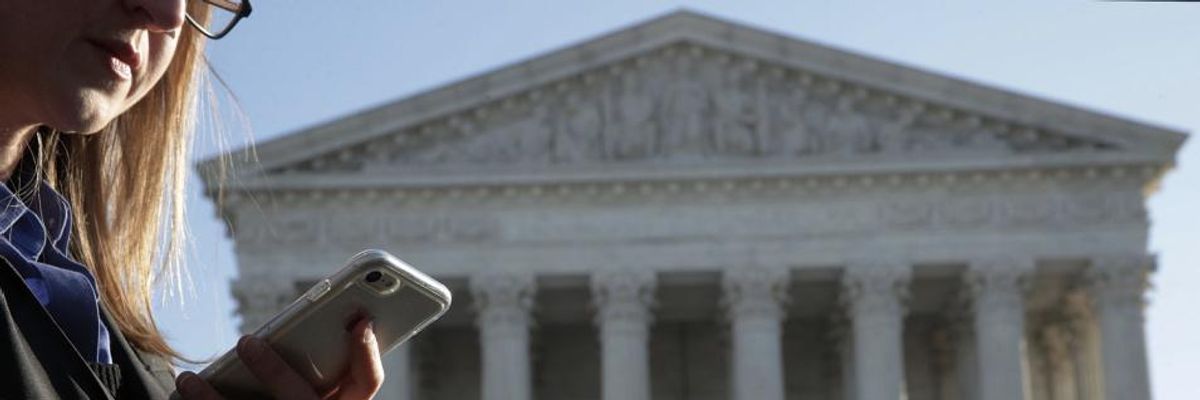
A woman checks her cell phone as she waits in line to enter the U.S. Supreme Court in Washington, D.C on November 29, 2017 for a hearing on Carpenter v. United States. (Photo: Alex Wong/Getty Images)
After a series of news reports that have alarmed civil liberties advocates and progressive lawmakers, the ACLU sued on Wednesday to find out how and why federal agencies are buying access to bulk databases of Americans' cell phone location information and effectively bypassing the Fourth Amendment's warrant requirement.
"We're suing to bring some much-needed transparency to these disturbing practices," Nathan Freed Wessler, a staff attorney with the ACLU's Speech, Privacy, and Technology Project, explains in a blog post about the new lawsuit. "Transparency is the first step to accountability."
As the complaint details, the legal group filed suit in the U.S. District Court for the Southern District of New York to force the U.S. Department of Homeland Security (DHS) and two agencies it oversees, Immigration and Customs Enforcement (ICE) and Customs and Border Protection (CBP), "to release records about their purchases of cell phone location data for immigration enforcement and other purposes."
Freed Wessler notes that "more than nine months after we submitted a request for information under the Freedom of Information Act, DHS, CBP, and ICE have yet to provide us with a single responsive record. DHS has even refused to provide its legal memorandum about these practices to U.S. senators who have requested it."
Earlier this year, Sens. Sherrod Brown (D-Ohio), Ed Markey (D-Mass.), Brian Schatz (D-Hawaii), Elizabeth Warren (D-Mass.), and Ron Wyden (D-Ore.) requested an inspector general investigation into CBP's warrantless use of commercial databases containing Americans' cell phone location information--including by paying nearly half a million dollars to the government contractor Venntel.
In a statement Wednesday, those same senators announced that DHS will launch the requested probe, with Wyden declaring that "the public deserves answers and accountability," and vowing that he "won't accept anything less than a thorough and swift inspector general investigation."
"Americans are increasingly concerned that they cannot travel, move, or go about their daily lives without being tracked. Information about where we are and where we have been is highly sensitive, and it's time for answers about exactly how the Department of Homeland Security is accessing this type of data," noted Markey. "The right to privacy must not become a thing of the past."
Warren emphasized that "CBP is not above the law," that the agency refused to answer their questions about its activities, and that lawmakers "must protect the public's Fourth Amendment rights to be free from warrantless searches."
Both the lawmakers and Freed Wessler cited Carpenter v. United States, a 2018 U.S. Supreme Court case argued by the ACLU. As the attorney points out in the blog post:
[The]Supreme Court ruled that law enforcement agencies cannot request personal location information from a cellphone company without first obtaining a search warrant from a judge. As Chief Justice Roberts wrote, these records deserve protection because mapping a cellphone's location "provides an intimate window into a person's life, revealing not only his particular movements, but through them his 'familial, political, professional, religious, and sexual associations.'"
If law enforcement agencies can buy their way around the Fourth Amendment's warrant requirement, the landmark protection announced by the Supreme Court in Carpenter will be in peril. Despite federal agencies spending hundreds of thousands of dollars on access to cell phone location databases, those agencies have not publicly explained their legal justifications or internal limitations on access to this invasive information.
The ACLU's initial public records request to DHS came in Februrary, after the Wall Street Journal reported that according to documents the newspaper obtained and unnamed sources, DHS "has bought access to a commercial database that maps the movements of millions of cellphones in America and is using it for immigration and border enforcement."
"The location data is drawn from ordinary cellphone apps, including those for games, weather, and e-commerce, for which the user has granted permission to log the phone's location," the Journal detailed. "The Department of Homeland Security has used the information to detect undocumented immigrants and others who may be entering the U.S. unlawfully."
An ICE spokesperson told the Journal that "we do not discuss specific law-enforcement tactics or techniques, or discuss the existence or absence of specific law-enforcement-sensitive capabilities," but added that the agency "generally" doesn't use location data for deportation operations.
A CBP spokesperson said at the time that while the agency "is being provided access to location information, it is important to note that such information doesn't include cellular phone tower data, is not ingested in bulk, and doesn't include the individual user's identity."
The Journal article is just one piece of a growing body of reporting that has shed light on the smartphone tracking industry. Just last month, Motherboard revealed that "the U.S. military is buying the granular movement data of people around the world, harvested from innocuous-seeming apps," including a Muslim prayer and Quran app that has been downloaded over 98 million times worldwide.
In response to Motherboard's revelation, Rep. Ilhan Omar (D-Minn.)--one of the first two Muslim women elected to Congress--tweeted that "the military industrial complex and the surveillance state have always had a cozy relationship with tech. Buying bulk data in order to profile Muslims is par for the course for them--and is absolutely sickening. It should be illegal!"
Dear Common Dreams reader, It’s been nearly 30 years since I co-founded Common Dreams with my late wife, Lina Newhouser. We had the radical notion that journalism should serve the public good, not corporate profits. It was clear to us from the outset what it would take to build such a project. No paid advertisements. No corporate sponsors. No millionaire publisher telling us what to think or do. Many people said we wouldn't last a year, but we proved those doubters wrong. Together with a tremendous team of journalists and dedicated staff, we built an independent media outlet free from the constraints of profits and corporate control. Our mission has always been simple: To inform. To inspire. To ignite change for the common good. Building Common Dreams was not easy. Our survival was never guaranteed. When you take on the most powerful forces—Wall Street greed, fossil fuel industry destruction, Big Tech lobbyists, and uber-rich oligarchs who have spent billions upon billions rigging the economy and democracy in their favor—the only bulwark you have is supporters who believe in your work. But here’s the urgent message from me today. It's never been this bad out there. And it's never been this hard to keep us going. At the very moment Common Dreams is most needed, the threats we face are intensifying. We need your support now more than ever. We don't accept corporate advertising and never will. We don't have a paywall because we don't think people should be blocked from critical news based on their ability to pay. Everything we do is funded by the donations of readers like you. When everyone does the little they can afford, we are strong. But if that support retreats or dries up, so do we. Will you donate now to make sure Common Dreams not only survives but thrives? —Craig Brown, Co-founder |
After a series of news reports that have alarmed civil liberties advocates and progressive lawmakers, the ACLU sued on Wednesday to find out how and why federal agencies are buying access to bulk databases of Americans' cell phone location information and effectively bypassing the Fourth Amendment's warrant requirement.
"We're suing to bring some much-needed transparency to these disturbing practices," Nathan Freed Wessler, a staff attorney with the ACLU's Speech, Privacy, and Technology Project, explains in a blog post about the new lawsuit. "Transparency is the first step to accountability."
As the complaint details, the legal group filed suit in the U.S. District Court for the Southern District of New York to force the U.S. Department of Homeland Security (DHS) and two agencies it oversees, Immigration and Customs Enforcement (ICE) and Customs and Border Protection (CBP), "to release records about their purchases of cell phone location data for immigration enforcement and other purposes."
Freed Wessler notes that "more than nine months after we submitted a request for information under the Freedom of Information Act, DHS, CBP, and ICE have yet to provide us with a single responsive record. DHS has even refused to provide its legal memorandum about these practices to U.S. senators who have requested it."
Earlier this year, Sens. Sherrod Brown (D-Ohio), Ed Markey (D-Mass.), Brian Schatz (D-Hawaii), Elizabeth Warren (D-Mass.), and Ron Wyden (D-Ore.) requested an inspector general investigation into CBP's warrantless use of commercial databases containing Americans' cell phone location information--including by paying nearly half a million dollars to the government contractor Venntel.
In a statement Wednesday, those same senators announced that DHS will launch the requested probe, with Wyden declaring that "the public deserves answers and accountability," and vowing that he "won't accept anything less than a thorough and swift inspector general investigation."
"Americans are increasingly concerned that they cannot travel, move, or go about their daily lives without being tracked. Information about where we are and where we have been is highly sensitive, and it's time for answers about exactly how the Department of Homeland Security is accessing this type of data," noted Markey. "The right to privacy must not become a thing of the past."
Warren emphasized that "CBP is not above the law," that the agency refused to answer their questions about its activities, and that lawmakers "must protect the public's Fourth Amendment rights to be free from warrantless searches."
Both the lawmakers and Freed Wessler cited Carpenter v. United States, a 2018 U.S. Supreme Court case argued by the ACLU. As the attorney points out in the blog post:
[The]Supreme Court ruled that law enforcement agencies cannot request personal location information from a cellphone company without first obtaining a search warrant from a judge. As Chief Justice Roberts wrote, these records deserve protection because mapping a cellphone's location "provides an intimate window into a person's life, revealing not only his particular movements, but through them his 'familial, political, professional, religious, and sexual associations.'"
If law enforcement agencies can buy their way around the Fourth Amendment's warrant requirement, the landmark protection announced by the Supreme Court in Carpenter will be in peril. Despite federal agencies spending hundreds of thousands of dollars on access to cell phone location databases, those agencies have not publicly explained their legal justifications or internal limitations on access to this invasive information.
The ACLU's initial public records request to DHS came in Februrary, after the Wall Street Journal reported that according to documents the newspaper obtained and unnamed sources, DHS "has bought access to a commercial database that maps the movements of millions of cellphones in America and is using it for immigration and border enforcement."
"The location data is drawn from ordinary cellphone apps, including those for games, weather, and e-commerce, for which the user has granted permission to log the phone's location," the Journal detailed. "The Department of Homeland Security has used the information to detect undocumented immigrants and others who may be entering the U.S. unlawfully."
An ICE spokesperson told the Journal that "we do not discuss specific law-enforcement tactics or techniques, or discuss the existence or absence of specific law-enforcement-sensitive capabilities," but added that the agency "generally" doesn't use location data for deportation operations.
A CBP spokesperson said at the time that while the agency "is being provided access to location information, it is important to note that such information doesn't include cellular phone tower data, is not ingested in bulk, and doesn't include the individual user's identity."
The Journal article is just one piece of a growing body of reporting that has shed light on the smartphone tracking industry. Just last month, Motherboard revealed that "the U.S. military is buying the granular movement data of people around the world, harvested from innocuous-seeming apps," including a Muslim prayer and Quran app that has been downloaded over 98 million times worldwide.
In response to Motherboard's revelation, Rep. Ilhan Omar (D-Minn.)--one of the first two Muslim women elected to Congress--tweeted that "the military industrial complex and the surveillance state have always had a cozy relationship with tech. Buying bulk data in order to profile Muslims is par for the course for them--and is absolutely sickening. It should be illegal!"
After a series of news reports that have alarmed civil liberties advocates and progressive lawmakers, the ACLU sued on Wednesday to find out how and why federal agencies are buying access to bulk databases of Americans' cell phone location information and effectively bypassing the Fourth Amendment's warrant requirement.
"We're suing to bring some much-needed transparency to these disturbing practices," Nathan Freed Wessler, a staff attorney with the ACLU's Speech, Privacy, and Technology Project, explains in a blog post about the new lawsuit. "Transparency is the first step to accountability."
As the complaint details, the legal group filed suit in the U.S. District Court for the Southern District of New York to force the U.S. Department of Homeland Security (DHS) and two agencies it oversees, Immigration and Customs Enforcement (ICE) and Customs and Border Protection (CBP), "to release records about their purchases of cell phone location data for immigration enforcement and other purposes."
Freed Wessler notes that "more than nine months after we submitted a request for information under the Freedom of Information Act, DHS, CBP, and ICE have yet to provide us with a single responsive record. DHS has even refused to provide its legal memorandum about these practices to U.S. senators who have requested it."
Earlier this year, Sens. Sherrod Brown (D-Ohio), Ed Markey (D-Mass.), Brian Schatz (D-Hawaii), Elizabeth Warren (D-Mass.), and Ron Wyden (D-Ore.) requested an inspector general investigation into CBP's warrantless use of commercial databases containing Americans' cell phone location information--including by paying nearly half a million dollars to the government contractor Venntel.
In a statement Wednesday, those same senators announced that DHS will launch the requested probe, with Wyden declaring that "the public deserves answers and accountability," and vowing that he "won't accept anything less than a thorough and swift inspector general investigation."
"Americans are increasingly concerned that they cannot travel, move, or go about their daily lives without being tracked. Information about where we are and where we have been is highly sensitive, and it's time for answers about exactly how the Department of Homeland Security is accessing this type of data," noted Markey. "The right to privacy must not become a thing of the past."
Warren emphasized that "CBP is not above the law," that the agency refused to answer their questions about its activities, and that lawmakers "must protect the public's Fourth Amendment rights to be free from warrantless searches."
Both the lawmakers and Freed Wessler cited Carpenter v. United States, a 2018 U.S. Supreme Court case argued by the ACLU. As the attorney points out in the blog post:
[The]Supreme Court ruled that law enforcement agencies cannot request personal location information from a cellphone company without first obtaining a search warrant from a judge. As Chief Justice Roberts wrote, these records deserve protection because mapping a cellphone's location "provides an intimate window into a person's life, revealing not only his particular movements, but through them his 'familial, political, professional, religious, and sexual associations.'"
If law enforcement agencies can buy their way around the Fourth Amendment's warrant requirement, the landmark protection announced by the Supreme Court in Carpenter will be in peril. Despite federal agencies spending hundreds of thousands of dollars on access to cell phone location databases, those agencies have not publicly explained their legal justifications or internal limitations on access to this invasive information.
The ACLU's initial public records request to DHS came in Februrary, after the Wall Street Journal reported that according to documents the newspaper obtained and unnamed sources, DHS "has bought access to a commercial database that maps the movements of millions of cellphones in America and is using it for immigration and border enforcement."
"The location data is drawn from ordinary cellphone apps, including those for games, weather, and e-commerce, for which the user has granted permission to log the phone's location," the Journal detailed. "The Department of Homeland Security has used the information to detect undocumented immigrants and others who may be entering the U.S. unlawfully."
An ICE spokesperson told the Journal that "we do not discuss specific law-enforcement tactics or techniques, or discuss the existence or absence of specific law-enforcement-sensitive capabilities," but added that the agency "generally" doesn't use location data for deportation operations.
A CBP spokesperson said at the time that while the agency "is being provided access to location information, it is important to note that such information doesn't include cellular phone tower data, is not ingested in bulk, and doesn't include the individual user's identity."
The Journal article is just one piece of a growing body of reporting that has shed light on the smartphone tracking industry. Just last month, Motherboard revealed that "the U.S. military is buying the granular movement data of people around the world, harvested from innocuous-seeming apps," including a Muslim prayer and Quran app that has been downloaded over 98 million times worldwide.
In response to Motherboard's revelation, Rep. Ilhan Omar (D-Minn.)--one of the first two Muslim women elected to Congress--tweeted that "the military industrial complex and the surveillance state have always had a cozy relationship with tech. Buying bulk data in order to profile Muslims is par for the course for them--and is absolutely sickening. It should be illegal!"

