SUBSCRIBE TO OUR FREE NEWSLETTER
Daily news & progressive opinion—funded by the people, not the corporations—delivered straight to your inbox.
5
#000000
#FFFFFF
To donate by check, phone, or other method, see our More Ways to Give page.
Daily news & progressive opinion—funded by the people, not the corporations—delivered straight to your inbox.
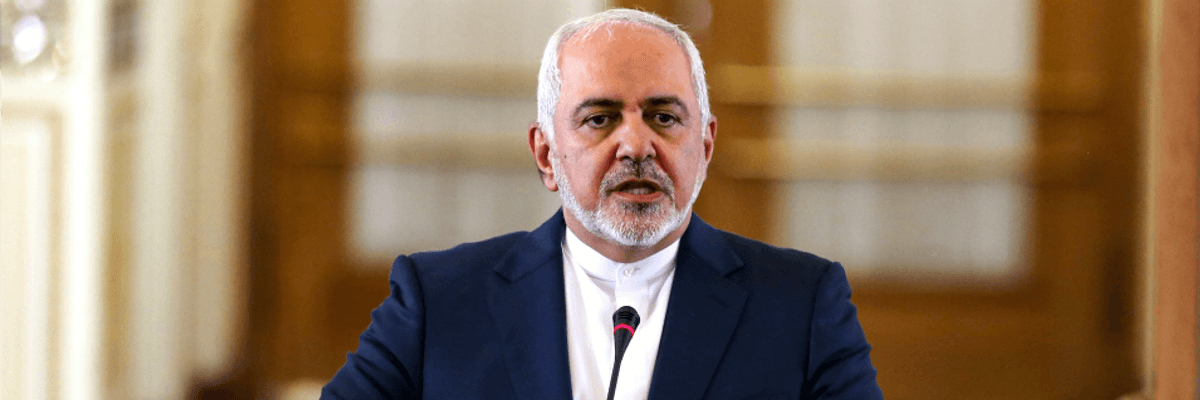
Iran's Foreign Minister Mohammad Javad Zarif speaks during a press conference in Tehran on June 10, 2019. (Photo: Atta Kenare/AFP/Getty Images)
Iran's Foreign Minister Javad Zarif on Monday took aim at the United States' ongoing "war on terror," which he blamed for "countless broken societies."
The Iranian official's comments came in a video address to a high level meeting of the General Assembly marking the U.N's 75th anniversary.
"The eight violent wars that the United States initiated or joined since 2001, under the rubric of war on terror, have resulted in the loss of hundreds of thousands of innocent lives, countless broken societies and families... and unprecedented extremism," Zarif, a frequent critic of U.S. foreign policy, said in his remarks, according to Agence France-Presse.
"It's time to change that," he said, "saving American blood and treasure, and sparing the world from further misery."
The U.N., added Zarif, must "recommit itself to stand up united against unilateralism and war."
Zarif's comments came as Iran faces the Trump administration, which is stacked with Iran hardliners including Secretary of State Mike Pompeo, and punishing new sanctions imposed by the U.S. in the midst of the coronavirus pandemic.
President Donald Trump has just this year threatened to bomb Iranian cultural sites and allegedly had Iranian General Qasem Soleimani assassinated. And just this month Trump told s right-wing radio personality Rush Limbaugh that "if you do something bad to us, we are going to do things to you that have never been done before," referring to Iran.
Zarif's far from alone in his assessment of the so-called war on terror. U.S.-based researchers have put the death toll of post-9/11 wars at 800,000 or even as high as one million. The war on terror--which has cost some $6.4 trillion--has also been roundly blamed for effects including helping to militarize U.S. police forces and fomenting extremism.
U.N. Secretary-General Antonio Guterres, for his part, marked the body's 75th anniversary by renewing his demand for a global ceasefire and pointed to the coronavirus as humanity's "one common enemy."
"Now is the time for a stepped-up push for peace to achieve a global ceasefire," said Guterres. "The clock is ticking."
Dear Common Dreams reader, It’s been nearly 30 years since I co-founded Common Dreams with my late wife, Lina Newhouser. We had the radical notion that journalism should serve the public good, not corporate profits. It was clear to us from the outset what it would take to build such a project. No paid advertisements. No corporate sponsors. No millionaire publisher telling us what to think or do. Many people said we wouldn't last a year, but we proved those doubters wrong. Together with a tremendous team of journalists and dedicated staff, we built an independent media outlet free from the constraints of profits and corporate control. Our mission has always been simple: To inform. To inspire. To ignite change for the common good. Building Common Dreams was not easy. Our survival was never guaranteed. When you take on the most powerful forces—Wall Street greed, fossil fuel industry destruction, Big Tech lobbyists, and uber-rich oligarchs who have spent billions upon billions rigging the economy and democracy in their favor—the only bulwark you have is supporters who believe in your work. But here’s the urgent message from me today. It's never been this bad out there. And it's never been this hard to keep us going. At the very moment Common Dreams is most needed, the threats we face are intensifying. We need your support now more than ever. We don't accept corporate advertising and never will. We don't have a paywall because we don't think people should be blocked from critical news based on their ability to pay. Everything we do is funded by the donations of readers like you. When everyone does the little they can afford, we are strong. But if that support retreats or dries up, so do we. Will you donate now to make sure Common Dreams not only survives but thrives? —Craig Brown, Co-founder |
Iran's Foreign Minister Javad Zarif on Monday took aim at the United States' ongoing "war on terror," which he blamed for "countless broken societies."
The Iranian official's comments came in a video address to a high level meeting of the General Assembly marking the U.N's 75th anniversary.
"The eight violent wars that the United States initiated or joined since 2001, under the rubric of war on terror, have resulted in the loss of hundreds of thousands of innocent lives, countless broken societies and families... and unprecedented extremism," Zarif, a frequent critic of U.S. foreign policy, said in his remarks, according to Agence France-Presse.
"It's time to change that," he said, "saving American blood and treasure, and sparing the world from further misery."
The U.N., added Zarif, must "recommit itself to stand up united against unilateralism and war."
Zarif's comments came as Iran faces the Trump administration, which is stacked with Iran hardliners including Secretary of State Mike Pompeo, and punishing new sanctions imposed by the U.S. in the midst of the coronavirus pandemic.
President Donald Trump has just this year threatened to bomb Iranian cultural sites and allegedly had Iranian General Qasem Soleimani assassinated. And just this month Trump told s right-wing radio personality Rush Limbaugh that "if you do something bad to us, we are going to do things to you that have never been done before," referring to Iran.
Zarif's far from alone in his assessment of the so-called war on terror. U.S.-based researchers have put the death toll of post-9/11 wars at 800,000 or even as high as one million. The war on terror--which has cost some $6.4 trillion--has also been roundly blamed for effects including helping to militarize U.S. police forces and fomenting extremism.
U.N. Secretary-General Antonio Guterres, for his part, marked the body's 75th anniversary by renewing his demand for a global ceasefire and pointed to the coronavirus as humanity's "one common enemy."
"Now is the time for a stepped-up push for peace to achieve a global ceasefire," said Guterres. "The clock is ticking."
Iran's Foreign Minister Javad Zarif on Monday took aim at the United States' ongoing "war on terror," which he blamed for "countless broken societies."
The Iranian official's comments came in a video address to a high level meeting of the General Assembly marking the U.N's 75th anniversary.
"The eight violent wars that the United States initiated or joined since 2001, under the rubric of war on terror, have resulted in the loss of hundreds of thousands of innocent lives, countless broken societies and families... and unprecedented extremism," Zarif, a frequent critic of U.S. foreign policy, said in his remarks, according to Agence France-Presse.
"It's time to change that," he said, "saving American blood and treasure, and sparing the world from further misery."
The U.N., added Zarif, must "recommit itself to stand up united against unilateralism and war."
Zarif's comments came as Iran faces the Trump administration, which is stacked with Iran hardliners including Secretary of State Mike Pompeo, and punishing new sanctions imposed by the U.S. in the midst of the coronavirus pandemic.
President Donald Trump has just this year threatened to bomb Iranian cultural sites and allegedly had Iranian General Qasem Soleimani assassinated. And just this month Trump told s right-wing radio personality Rush Limbaugh that "if you do something bad to us, we are going to do things to you that have never been done before," referring to Iran.
Zarif's far from alone in his assessment of the so-called war on terror. U.S.-based researchers have put the death toll of post-9/11 wars at 800,000 or even as high as one million. The war on terror--which has cost some $6.4 trillion--has also been roundly blamed for effects including helping to militarize U.S. police forces and fomenting extremism.
U.N. Secretary-General Antonio Guterres, for his part, marked the body's 75th anniversary by renewing his demand for a global ceasefire and pointed to the coronavirus as humanity's "one common enemy."
"Now is the time for a stepped-up push for peace to achieve a global ceasefire," said Guterres. "The clock is ticking."