SUBSCRIBE TO OUR FREE NEWSLETTER
Daily news & progressive opinion—funded by the people, not the corporations—delivered straight to your inbox.
5
#000000
#FFFFFF
To donate by check, phone, or other method, see our More Ways to Give page.
Daily news & progressive opinion—funded by the people, not the corporations—delivered straight to your inbox.
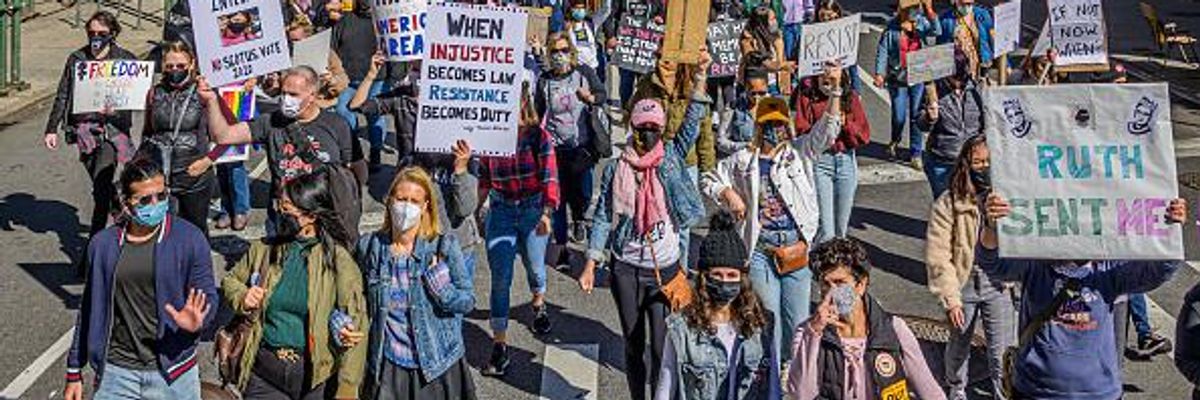
Participants in the latest Women's March took to the streets of New York City on Saturday, October 17, 2020 to denounce President Donald Trump, Judge Amy Coney Barrett, and the Republican Party's conservative agenda.
Thousands of people--mostly young women, some in costumes, many donning signs, and all wearing masks--marched and rallied Saturday in Washington, D.C. and in cities around the U.S. to voice opposition to President Donald Trump as well as his latest Supreme Court nominee Amy Coney Barrett, and to urge voters to soundly defeat the Republican Party's congressional candidates at the ballot box.
This weekend's nationwide protest was the latest in a series of women's marches that began the day after Trump's inauguration in 2017.
Rachel O'Leary Carmona, executive director of the Women's March, told the crowd in the nation's capitol: "His presidency began with women marching and now it's going to end with women voting. Period."
"From Denver to Durham to D.C., women sent an unmistakable message," the Women's March Twitter account noted on Saturday night. "We've had enough. We reject Trump's agenda that doesn't include all of us, and we will unite across our differences to vote him out."
In a video shared by the New York Times, women described their motives for attending the protest. Natalie Gates told reporters that she wanted to use her voice to oppose the appointment of Barrett to the high court, since Trump's nominee "will affect my children and the future."
Chants of "Vote him out!" and "Donald Trump has got to go!" can be heard throughout.
Another recording shared by the Washington Post shows evidence of clashes between women's rights advocates and a small group of right-wing counterprotesters.
There were far more opponents of the reactionary agenda of Trump, Barrett, and the GOP than supporters. "I will NOT go quietly back to the 1950s!" read one protester's sign.
A young woman from West Virginia named Taylor told a reporter that "I am marching because access to reproductive healthcare is a human right."
"Women showed up in force on day one of Trump's presidency for the first Women's March," Carmona said at the D.C. rally, "and now we're mobilizing to finish what we started."
"People need to get out and vote," Tamika Palmer, the mother of Breonna Taylor, told attendees. "Protesting is good but if we don't take it to the polls we're really not going to make the change we want and need."
Dear Common Dreams reader, It’s been nearly 30 years since I co-founded Common Dreams with my late wife, Lina Newhouser. We had the radical notion that journalism should serve the public good, not corporate profits. It was clear to us from the outset what it would take to build such a project. No paid advertisements. No corporate sponsors. No millionaire publisher telling us what to think or do. Many people said we wouldn't last a year, but we proved those doubters wrong. Together with a tremendous team of journalists and dedicated staff, we built an independent media outlet free from the constraints of profits and corporate control. Our mission has always been simple: To inform. To inspire. To ignite change for the common good. Building Common Dreams was not easy. Our survival was never guaranteed. When you take on the most powerful forces—Wall Street greed, fossil fuel industry destruction, Big Tech lobbyists, and uber-rich oligarchs who have spent billions upon billions rigging the economy and democracy in their favor—the only bulwark you have is supporters who believe in your work. But here’s the urgent message from me today. It's never been this bad out there. And it's never been this hard to keep us going. At the very moment Common Dreams is most needed, the threats we face are intensifying. We need your support now more than ever. We don't accept corporate advertising and never will. We don't have a paywall because we don't think people should be blocked from critical news based on their ability to pay. Everything we do is funded by the donations of readers like you. When everyone does the little they can afford, we are strong. But if that support retreats or dries up, so do we. Will you donate now to make sure Common Dreams not only survives but thrives? —Craig Brown, Co-founder |
Thousands of people--mostly young women, some in costumes, many donning signs, and all wearing masks--marched and rallied Saturday in Washington, D.C. and in cities around the U.S. to voice opposition to President Donald Trump as well as his latest Supreme Court nominee Amy Coney Barrett, and to urge voters to soundly defeat the Republican Party's congressional candidates at the ballot box.
This weekend's nationwide protest was the latest in a series of women's marches that began the day after Trump's inauguration in 2017.
Rachel O'Leary Carmona, executive director of the Women's March, told the crowd in the nation's capitol: "His presidency began with women marching and now it's going to end with women voting. Period."
"From Denver to Durham to D.C., women sent an unmistakable message," the Women's March Twitter account noted on Saturday night. "We've had enough. We reject Trump's agenda that doesn't include all of us, and we will unite across our differences to vote him out."
In a video shared by the New York Times, women described their motives for attending the protest. Natalie Gates told reporters that she wanted to use her voice to oppose the appointment of Barrett to the high court, since Trump's nominee "will affect my children and the future."
Chants of "Vote him out!" and "Donald Trump has got to go!" can be heard throughout.
Another recording shared by the Washington Post shows evidence of clashes between women's rights advocates and a small group of right-wing counterprotesters.
There were far more opponents of the reactionary agenda of Trump, Barrett, and the GOP than supporters. "I will NOT go quietly back to the 1950s!" read one protester's sign.
A young woman from West Virginia named Taylor told a reporter that "I am marching because access to reproductive healthcare is a human right."
"Women showed up in force on day one of Trump's presidency for the first Women's March," Carmona said at the D.C. rally, "and now we're mobilizing to finish what we started."
"People need to get out and vote," Tamika Palmer, the mother of Breonna Taylor, told attendees. "Protesting is good but if we don't take it to the polls we're really not going to make the change we want and need."
Thousands of people--mostly young women, some in costumes, many donning signs, and all wearing masks--marched and rallied Saturday in Washington, D.C. and in cities around the U.S. to voice opposition to President Donald Trump as well as his latest Supreme Court nominee Amy Coney Barrett, and to urge voters to soundly defeat the Republican Party's congressional candidates at the ballot box.
This weekend's nationwide protest was the latest in a series of women's marches that began the day after Trump's inauguration in 2017.
Rachel O'Leary Carmona, executive director of the Women's March, told the crowd in the nation's capitol: "His presidency began with women marching and now it's going to end with women voting. Period."
"From Denver to Durham to D.C., women sent an unmistakable message," the Women's March Twitter account noted on Saturday night. "We've had enough. We reject Trump's agenda that doesn't include all of us, and we will unite across our differences to vote him out."
In a video shared by the New York Times, women described their motives for attending the protest. Natalie Gates told reporters that she wanted to use her voice to oppose the appointment of Barrett to the high court, since Trump's nominee "will affect my children and the future."
Chants of "Vote him out!" and "Donald Trump has got to go!" can be heard throughout.
Another recording shared by the Washington Post shows evidence of clashes between women's rights advocates and a small group of right-wing counterprotesters.
There were far more opponents of the reactionary agenda of Trump, Barrett, and the GOP than supporters. "I will NOT go quietly back to the 1950s!" read one protester's sign.
A young woman from West Virginia named Taylor told a reporter that "I am marching because access to reproductive healthcare is a human right."
"Women showed up in force on day one of Trump's presidency for the first Women's March," Carmona said at the D.C. rally, "and now we're mobilizing to finish what we started."
"People need to get out and vote," Tamika Palmer, the mother of Breonna Taylor, told attendees. "Protesting is good but if we don't take it to the polls we're really not going to make the change we want and need."