SUBSCRIBE TO OUR FREE NEWSLETTER
Daily news & progressive opinion—funded by the people, not the corporations—delivered straight to your inbox.
5
#000000
#FFFFFF
To donate by check, phone, or other method, see our More Ways to Give page.
Daily news & progressive opinion—funded by the people, not the corporations—delivered straight to your inbox.
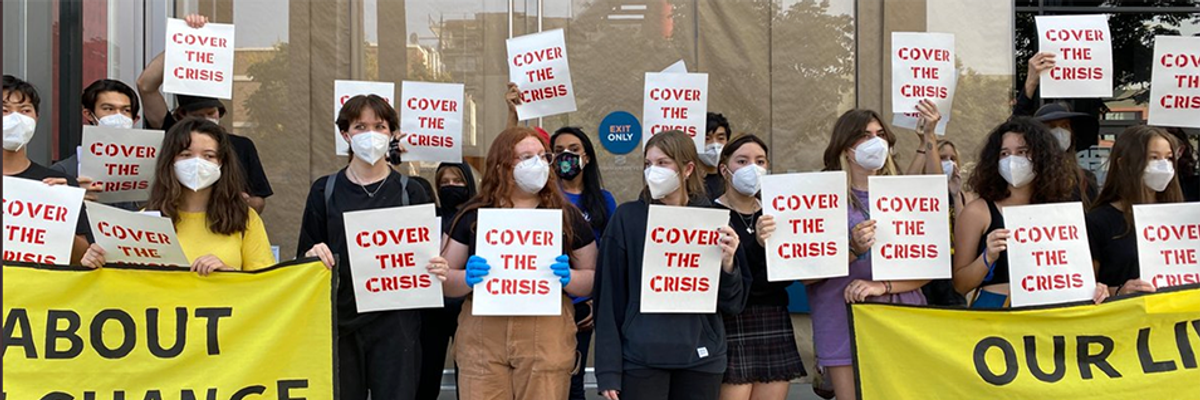
Sunrise L.A. Youth, a hub of the national Sunrise Movement, marched and protested outside CNN's Los Angeles offices Thursday to demand the outlet "Cover the Crisis" of climate change more thoroughly. (Photo: Sunrise L.A. Youth/Twitter)
As wildfires continue to rage across the western United States and hurricanes barrel towards the East Coast, a new report out Thursday says voters want the media to do a better job at covering the climate crisis and connecting the dots between extreme weather events and climate change.
"The media has a responsibility to inform viewers of the connections between climate change and the increasingly unstable world around them," wrote Dr. Genevieve Gunther, Danielle Deiseroth, and Marcela Mulholland in a summary of the research conducted by Data for Progress and End Climate Silence. "It's not just climate activists and policy wonks that want to see this kind of coverage; our polling shows that a broad-base of voters do too."
While plenty of coverage of extreme weather events such as hurricanes exists, what does not is the connection to the climate crisis in the same reporting, the authors wrote. For example, ABC, CBS, and NBC aired a combined 50 segments on Hurricane Laura, yet not one connected the storm to climate change.
"Media coverage is critical in determining how the public perceives climate change," they continued. "To give voters the information they need to make political decisions in an increasingly chaotic world, the media must cover the climate crisis with the accuracy and urgency it deserves."
According to the report, a Data for Progress poll found that more than seven in 10 Americans (72%) say that if there is a connection between an extreme weather event and climate change, they want to hear about it in the news. This includes 85% of Democrats, 59% of independents, and 62% of Republicans surveyed. Additionally, poll results showed 75% of Americans think it's important for news coverage of extreme weather to explain its connections to climate change.
"The science and reality couldn't be clearer--climate-fueled planetary emergency is the context in which all issues now exist," the report's authors wrote. "Journalists would be wise to frame their reporting with this in mind. They can feel confident that it is not only the right thing to do, but also what voters want."
The poll results came as climate activists from the Sunrise Movement protested outside CNN's Los Angeles offices to demand they "Cover the Crisis" of climate change.
"We're here to hold the journalists at CNN to a higher standard and demand that they address the climate crisis with the urgency that is necessary to ensure a livable future for young people," Claire Donahue, a 17-year-old activist, said according to a statement from Sunrise L.A. Youth. "We've seen the course of history changed when journalists have the courage to call out injustice which is why we are demanding that CNN take bold, transformative action to address the climate crisis."
Sunrise Movement tweeted about the Data for Progress study on Thursday and called for moderators of presidential debates to press candidates on the issue.
During a CNN town hall Thursday night, Anderson Cooper pressed Democratic presidential nominee Joe Biden on fracking--a practice linked to methane spikes in the earth's atmosphere which the former vice president has said he will not ban.
"You said you won't ban fracking but that you wanted to gradually move away from it, ultimately," Cooper said to Biden. "It sounds like, to some, you are trying to have it both ways. Politically, it's understandable why you might say that, but if fracking contributes to climate change and climate change is an existential threat, why should it, fracking, continue at all?"
Biden responded that fracking "has to continue because we need a transition."
"We're going to get to net-zero emissions by 2050, and we'll get to net-zero power emissions by 2035," the candidate said. "But there is no rationale to eliminate, right now, fracking."
On Monday, during a speech about the wildfires on the West Coast, Biden called climate-change denier President Donald Trump a "climate arsonist."
In an op-ed last week in The Boston Globe, End Climate Silence director Gunther wrote that because Republican lawmakers have attacked existing climate science, broadcast news outlets may fear retribution if they cover extreme weather in the context of the crisis.
"The first job of a free press is not to be intimidated by governmental threats meant to suppress the truths discovered by science--or any other truths, for that matter," she wrote. "And it's not to be manipulated into silence by special interests when news consumers want to understand the links between the disasters they fear and the climate change that's fueling them."
Dear Common Dreams reader, It’s been nearly 30 years since I co-founded Common Dreams with my late wife, Lina Newhouser. We had the radical notion that journalism should serve the public good, not corporate profits. It was clear to us from the outset what it would take to build such a project. No paid advertisements. No corporate sponsors. No millionaire publisher telling us what to think or do. Many people said we wouldn't last a year, but we proved those doubters wrong. Together with a tremendous team of journalists and dedicated staff, we built an independent media outlet free from the constraints of profits and corporate control. Our mission has always been simple: To inform. To inspire. To ignite change for the common good. Building Common Dreams was not easy. Our survival was never guaranteed. When you take on the most powerful forces—Wall Street greed, fossil fuel industry destruction, Big Tech lobbyists, and uber-rich oligarchs who have spent billions upon billions rigging the economy and democracy in their favor—the only bulwark you have is supporters who believe in your work. But here’s the urgent message from me today. It's never been this bad out there. And it's never been this hard to keep us going. At the very moment Common Dreams is most needed, the threats we face are intensifying. We need your support now more than ever. We don't accept corporate advertising and never will. We don't have a paywall because we don't think people should be blocked from critical news based on their ability to pay. Everything we do is funded by the donations of readers like you. When everyone does the little they can afford, we are strong. But if that support retreats or dries up, so do we. Will you donate now to make sure Common Dreams not only survives but thrives? —Craig Brown, Co-founder |
As wildfires continue to rage across the western United States and hurricanes barrel towards the East Coast, a new report out Thursday says voters want the media to do a better job at covering the climate crisis and connecting the dots between extreme weather events and climate change.
"The media has a responsibility to inform viewers of the connections between climate change and the increasingly unstable world around them," wrote Dr. Genevieve Gunther, Danielle Deiseroth, and Marcela Mulholland in a summary of the research conducted by Data for Progress and End Climate Silence. "It's not just climate activists and policy wonks that want to see this kind of coverage; our polling shows that a broad-base of voters do too."
While plenty of coverage of extreme weather events such as hurricanes exists, what does not is the connection to the climate crisis in the same reporting, the authors wrote. For example, ABC, CBS, and NBC aired a combined 50 segments on Hurricane Laura, yet not one connected the storm to climate change.
"Media coverage is critical in determining how the public perceives climate change," they continued. "To give voters the information they need to make political decisions in an increasingly chaotic world, the media must cover the climate crisis with the accuracy and urgency it deserves."
According to the report, a Data for Progress poll found that more than seven in 10 Americans (72%) say that if there is a connection between an extreme weather event and climate change, they want to hear about it in the news. This includes 85% of Democrats, 59% of independents, and 62% of Republicans surveyed. Additionally, poll results showed 75% of Americans think it's important for news coverage of extreme weather to explain its connections to climate change.
"The science and reality couldn't be clearer--climate-fueled planetary emergency is the context in which all issues now exist," the report's authors wrote. "Journalists would be wise to frame their reporting with this in mind. They can feel confident that it is not only the right thing to do, but also what voters want."
The poll results came as climate activists from the Sunrise Movement protested outside CNN's Los Angeles offices to demand they "Cover the Crisis" of climate change.
"We're here to hold the journalists at CNN to a higher standard and demand that they address the climate crisis with the urgency that is necessary to ensure a livable future for young people," Claire Donahue, a 17-year-old activist, said according to a statement from Sunrise L.A. Youth. "We've seen the course of history changed when journalists have the courage to call out injustice which is why we are demanding that CNN take bold, transformative action to address the climate crisis."
Sunrise Movement tweeted about the Data for Progress study on Thursday and called for moderators of presidential debates to press candidates on the issue.
During a CNN town hall Thursday night, Anderson Cooper pressed Democratic presidential nominee Joe Biden on fracking--a practice linked to methane spikes in the earth's atmosphere which the former vice president has said he will not ban.
"You said you won't ban fracking but that you wanted to gradually move away from it, ultimately," Cooper said to Biden. "It sounds like, to some, you are trying to have it both ways. Politically, it's understandable why you might say that, but if fracking contributes to climate change and climate change is an existential threat, why should it, fracking, continue at all?"
Biden responded that fracking "has to continue because we need a transition."
"We're going to get to net-zero emissions by 2050, and we'll get to net-zero power emissions by 2035," the candidate said. "But there is no rationale to eliminate, right now, fracking."
On Monday, during a speech about the wildfires on the West Coast, Biden called climate-change denier President Donald Trump a "climate arsonist."
In an op-ed last week in The Boston Globe, End Climate Silence director Gunther wrote that because Republican lawmakers have attacked existing climate science, broadcast news outlets may fear retribution if they cover extreme weather in the context of the crisis.
"The first job of a free press is not to be intimidated by governmental threats meant to suppress the truths discovered by science--or any other truths, for that matter," she wrote. "And it's not to be manipulated into silence by special interests when news consumers want to understand the links between the disasters they fear and the climate change that's fueling them."
As wildfires continue to rage across the western United States and hurricanes barrel towards the East Coast, a new report out Thursday says voters want the media to do a better job at covering the climate crisis and connecting the dots between extreme weather events and climate change.
"The media has a responsibility to inform viewers of the connections between climate change and the increasingly unstable world around them," wrote Dr. Genevieve Gunther, Danielle Deiseroth, and Marcela Mulholland in a summary of the research conducted by Data for Progress and End Climate Silence. "It's not just climate activists and policy wonks that want to see this kind of coverage; our polling shows that a broad-base of voters do too."
While plenty of coverage of extreme weather events such as hurricanes exists, what does not is the connection to the climate crisis in the same reporting, the authors wrote. For example, ABC, CBS, and NBC aired a combined 50 segments on Hurricane Laura, yet not one connected the storm to climate change.
"Media coverage is critical in determining how the public perceives climate change," they continued. "To give voters the information they need to make political decisions in an increasingly chaotic world, the media must cover the climate crisis with the accuracy and urgency it deserves."
According to the report, a Data for Progress poll found that more than seven in 10 Americans (72%) say that if there is a connection between an extreme weather event and climate change, they want to hear about it in the news. This includes 85% of Democrats, 59% of independents, and 62% of Republicans surveyed. Additionally, poll results showed 75% of Americans think it's important for news coverage of extreme weather to explain its connections to climate change.
"The science and reality couldn't be clearer--climate-fueled planetary emergency is the context in which all issues now exist," the report's authors wrote. "Journalists would be wise to frame their reporting with this in mind. They can feel confident that it is not only the right thing to do, but also what voters want."
The poll results came as climate activists from the Sunrise Movement protested outside CNN's Los Angeles offices to demand they "Cover the Crisis" of climate change.
"We're here to hold the journalists at CNN to a higher standard and demand that they address the climate crisis with the urgency that is necessary to ensure a livable future for young people," Claire Donahue, a 17-year-old activist, said according to a statement from Sunrise L.A. Youth. "We've seen the course of history changed when journalists have the courage to call out injustice which is why we are demanding that CNN take bold, transformative action to address the climate crisis."
Sunrise Movement tweeted about the Data for Progress study on Thursday and called for moderators of presidential debates to press candidates on the issue.
During a CNN town hall Thursday night, Anderson Cooper pressed Democratic presidential nominee Joe Biden on fracking--a practice linked to methane spikes in the earth's atmosphere which the former vice president has said he will not ban.
"You said you won't ban fracking but that you wanted to gradually move away from it, ultimately," Cooper said to Biden. "It sounds like, to some, you are trying to have it both ways. Politically, it's understandable why you might say that, but if fracking contributes to climate change and climate change is an existential threat, why should it, fracking, continue at all?"
Biden responded that fracking "has to continue because we need a transition."
"We're going to get to net-zero emissions by 2050, and we'll get to net-zero power emissions by 2035," the candidate said. "But there is no rationale to eliminate, right now, fracking."
On Monday, during a speech about the wildfires on the West Coast, Biden called climate-change denier President Donald Trump a "climate arsonist."
In an op-ed last week in The Boston Globe, End Climate Silence director Gunther wrote that because Republican lawmakers have attacked existing climate science, broadcast news outlets may fear retribution if they cover extreme weather in the context of the crisis.
"The first job of a free press is not to be intimidated by governmental threats meant to suppress the truths discovered by science--or any other truths, for that matter," she wrote. "And it's not to be manipulated into silence by special interests when news consumers want to understand the links between the disasters they fear and the climate change that's fueling them."