SUBSCRIBE TO OUR FREE NEWSLETTER
Daily news & progressive opinion—funded by the people, not the corporations—delivered straight to your inbox.
5
#000000
#FFFFFF
To donate by check, phone, or other method, see our More Ways to Give page.
Daily news & progressive opinion—funded by the people, not the corporations—delivered straight to your inbox.
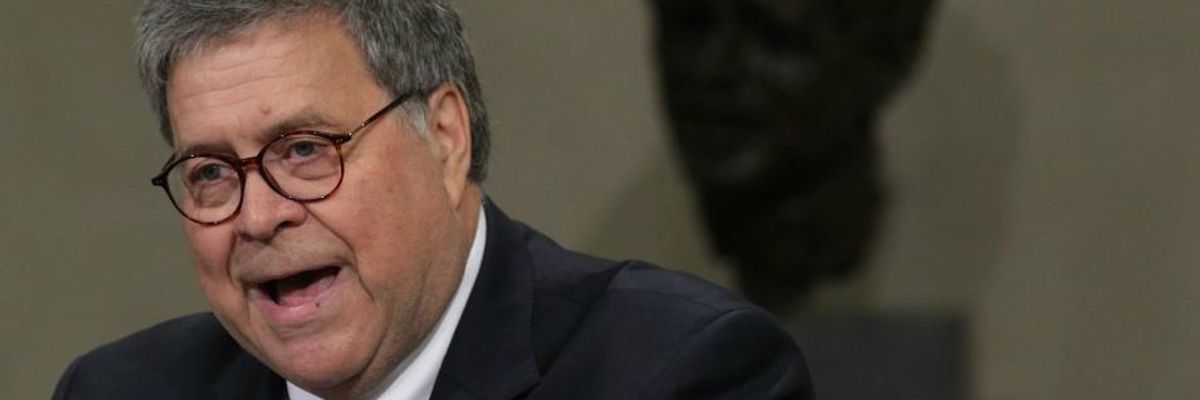
Attorney General William Barr wants federal prosecutors to more aggressively charge protesters, including with sedition in certain cases. (Photo: Alex Wong/Getty Images)
Attorney General William Barr drew stinging rebuke from legal experts and civil liberties advocates including the ACLU Wednesday after he told federal prosecutors to more aggressively charge some protesters with crimes--including sedition, under certain circumstances.
The Wall Street Journal reports Barr's directive came during a conference call last week in which the attorney general warned that protests--which have been overwhelmingly peaceful and focused on racial justice--could increase as Election Day approaches.
Two people familiar with the call told the Journal that Barr urged prosecutors to seek federal charges wherever possible--including a rarely-used sedition law meant to punish people who conspire to overthrow the U.S. government.
However, legal experts noted that in order to successfully charge someone with sedition, prosecutors must prove that they were part of a conspiracy to overthrow the government or attack government officials, or that they posed an imminent threat to the nation.
"Treating protest as a form of sedition won't stand up in court, but that is clearly not the point here," Somil Trivedi, a senior staff attorney with the ACLU's Criminal Law Reform Project, said in an email to Common Dreams. "This is a tyrannical and un-American attempt to suppress demands for racial justice and an end to police violence. Independent and ethical prosecutors should reject this administration's authoritarian impulses."
Some observers warned that aggressively prosecuting protesters could have a chilling effect on constitutionally-protected free speech, assembly, and expression.
Others wondered whether sedition charges would apply to violent right-wing protesters who support Trump.
Both Barr and President Donald Trump have (often falsely) blamed left-wing and anarchist protesters, including members of the Black Lives Matter movement and people who loosely identify under the Antifa umbrella, for most of the violence during the ongoing protests that began earlier this year after police and white supremacist killings of Black and Latinx people including George Floyd, Breonna Taylor, and Ahmaud Arbery.
However, a study by the Armed Conflict Location & Event Data Project (ACLED), which analyzed more than 7,750 Black Lives Matter demonstrations in all 50 states and Washington D.C. that occurred between May 26 and August 22, found that fully 93% of the protests were peaceful.
Nevertheless, the president has called the Black Lives Matter movement--the latest iteration of the centuries-old Black struggle for equality and justice--"a symbol of hate."
Trump has made "law and order"--replete with thinly-veiled racist appeals to white voters--a pillar of his re-election bid. He has habitually downplayed right-wing violence, even as his own Department of Homeland Security warned earlier this month that white supremacist pose the greatest domestic terrorist threat, and even as white supremacists keep attacking and killing people.
In 2017 the president infamously called neo-Nazis and other white nationalists who attended the Charlottesville, Virginia protest where anti-racist protester Heather Heyer was murdered "very fine people."
Despite the growing white supremacist threat, Trump revoked funding for the federal program tasked with countering violent extremism, while focusing his ire on the overwhelmingly peaceful Black Lives Matter movement. The president and some of his prominent supporters have repeatedly conflated the movement for Black lives with what the FBI for a while called "Black identity extremists."
Dear Common Dreams reader, It’s been nearly 30 years since I co-founded Common Dreams with my late wife, Lina Newhouser. We had the radical notion that journalism should serve the public good, not corporate profits. It was clear to us from the outset what it would take to build such a project. No paid advertisements. No corporate sponsors. No millionaire publisher telling us what to think or do. Many people said we wouldn't last a year, but we proved those doubters wrong. Together with a tremendous team of journalists and dedicated staff, we built an independent media outlet free from the constraints of profits and corporate control. Our mission has always been simple: To inform. To inspire. To ignite change for the common good. Building Common Dreams was not easy. Our survival was never guaranteed. When you take on the most powerful forces—Wall Street greed, fossil fuel industry destruction, Big Tech lobbyists, and uber-rich oligarchs who have spent billions upon billions rigging the economy and democracy in their favor—the only bulwark you have is supporters who believe in your work. But here’s the urgent message from me today. It's never been this bad out there. And it's never been this hard to keep us going. At the very moment Common Dreams is most needed, the threats we face are intensifying. We need your support now more than ever. We don't accept corporate advertising and never will. We don't have a paywall because we don't think people should be blocked from critical news based on their ability to pay. Everything we do is funded by the donations of readers like you. When everyone does the little they can afford, we are strong. But if that support retreats or dries up, so do we. Will you donate now to make sure Common Dreams not only survives but thrives? —Craig Brown, Co-founder |
Attorney General William Barr drew stinging rebuke from legal experts and civil liberties advocates including the ACLU Wednesday after he told federal prosecutors to more aggressively charge some protesters with crimes--including sedition, under certain circumstances.
The Wall Street Journal reports Barr's directive came during a conference call last week in which the attorney general warned that protests--which have been overwhelmingly peaceful and focused on racial justice--could increase as Election Day approaches.
Two people familiar with the call told the Journal that Barr urged prosecutors to seek federal charges wherever possible--including a rarely-used sedition law meant to punish people who conspire to overthrow the U.S. government.
However, legal experts noted that in order to successfully charge someone with sedition, prosecutors must prove that they were part of a conspiracy to overthrow the government or attack government officials, or that they posed an imminent threat to the nation.
"Treating protest as a form of sedition won't stand up in court, but that is clearly not the point here," Somil Trivedi, a senior staff attorney with the ACLU's Criminal Law Reform Project, said in an email to Common Dreams. "This is a tyrannical and un-American attempt to suppress demands for racial justice and an end to police violence. Independent and ethical prosecutors should reject this administration's authoritarian impulses."
Some observers warned that aggressively prosecuting protesters could have a chilling effect on constitutionally-protected free speech, assembly, and expression.
Others wondered whether sedition charges would apply to violent right-wing protesters who support Trump.
Both Barr and President Donald Trump have (often falsely) blamed left-wing and anarchist protesters, including members of the Black Lives Matter movement and people who loosely identify under the Antifa umbrella, for most of the violence during the ongoing protests that began earlier this year after police and white supremacist killings of Black and Latinx people including George Floyd, Breonna Taylor, and Ahmaud Arbery.
However, a study by the Armed Conflict Location & Event Data Project (ACLED), which analyzed more than 7,750 Black Lives Matter demonstrations in all 50 states and Washington D.C. that occurred between May 26 and August 22, found that fully 93% of the protests were peaceful.
Nevertheless, the president has called the Black Lives Matter movement--the latest iteration of the centuries-old Black struggle for equality and justice--"a symbol of hate."
Trump has made "law and order"--replete with thinly-veiled racist appeals to white voters--a pillar of his re-election bid. He has habitually downplayed right-wing violence, even as his own Department of Homeland Security warned earlier this month that white supremacist pose the greatest domestic terrorist threat, and even as white supremacists keep attacking and killing people.
In 2017 the president infamously called neo-Nazis and other white nationalists who attended the Charlottesville, Virginia protest where anti-racist protester Heather Heyer was murdered "very fine people."
Despite the growing white supremacist threat, Trump revoked funding for the federal program tasked with countering violent extremism, while focusing his ire on the overwhelmingly peaceful Black Lives Matter movement. The president and some of his prominent supporters have repeatedly conflated the movement for Black lives with what the FBI for a while called "Black identity extremists."
Attorney General William Barr drew stinging rebuke from legal experts and civil liberties advocates including the ACLU Wednesday after he told federal prosecutors to more aggressively charge some protesters with crimes--including sedition, under certain circumstances.
The Wall Street Journal reports Barr's directive came during a conference call last week in which the attorney general warned that protests--which have been overwhelmingly peaceful and focused on racial justice--could increase as Election Day approaches.
Two people familiar with the call told the Journal that Barr urged prosecutors to seek federal charges wherever possible--including a rarely-used sedition law meant to punish people who conspire to overthrow the U.S. government.
However, legal experts noted that in order to successfully charge someone with sedition, prosecutors must prove that they were part of a conspiracy to overthrow the government or attack government officials, or that they posed an imminent threat to the nation.
"Treating protest as a form of sedition won't stand up in court, but that is clearly not the point here," Somil Trivedi, a senior staff attorney with the ACLU's Criminal Law Reform Project, said in an email to Common Dreams. "This is a tyrannical and un-American attempt to suppress demands for racial justice and an end to police violence. Independent and ethical prosecutors should reject this administration's authoritarian impulses."
Some observers warned that aggressively prosecuting protesters could have a chilling effect on constitutionally-protected free speech, assembly, and expression.
Others wondered whether sedition charges would apply to violent right-wing protesters who support Trump.
Both Barr and President Donald Trump have (often falsely) blamed left-wing and anarchist protesters, including members of the Black Lives Matter movement and people who loosely identify under the Antifa umbrella, for most of the violence during the ongoing protests that began earlier this year after police and white supremacist killings of Black and Latinx people including George Floyd, Breonna Taylor, and Ahmaud Arbery.
However, a study by the Armed Conflict Location & Event Data Project (ACLED), which analyzed more than 7,750 Black Lives Matter demonstrations in all 50 states and Washington D.C. that occurred between May 26 and August 22, found that fully 93% of the protests were peaceful.
Nevertheless, the president has called the Black Lives Matter movement--the latest iteration of the centuries-old Black struggle for equality and justice--"a symbol of hate."
Trump has made "law and order"--replete with thinly-veiled racist appeals to white voters--a pillar of his re-election bid. He has habitually downplayed right-wing violence, even as his own Department of Homeland Security warned earlier this month that white supremacist pose the greatest domestic terrorist threat, and even as white supremacists keep attacking and killing people.
In 2017 the president infamously called neo-Nazis and other white nationalists who attended the Charlottesville, Virginia protest where anti-racist protester Heather Heyer was murdered "very fine people."
Despite the growing white supremacist threat, Trump revoked funding for the federal program tasked with countering violent extremism, while focusing his ire on the overwhelmingly peaceful Black Lives Matter movement. The president and some of his prominent supporters have repeatedly conflated the movement for Black lives with what the FBI for a while called "Black identity extremists."