SUBSCRIBE TO OUR FREE NEWSLETTER
Daily news & progressive opinion—funded by the people, not the corporations—delivered straight to your inbox.
5
#000000
#FFFFFF
To donate by check, phone, or other method, see our More Ways to Give page.
Daily news & progressive opinion—funded by the people, not the corporations—delivered straight to your inbox.
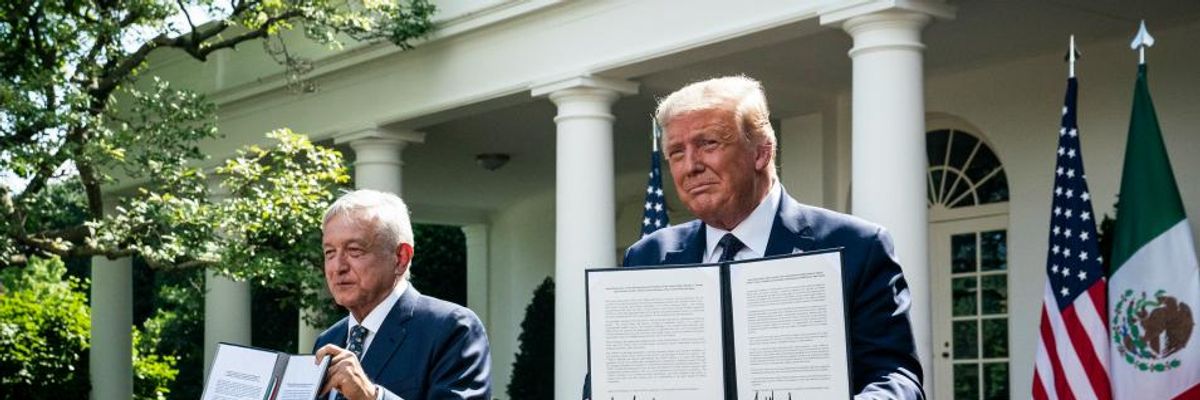
U.S. President Donald Trump and Mexican President Andres Manuel Lopez Obrador sign a joint declaration on the new USMCA agreement in the Rose Garden at the White House on Wednesday, July 8, 2020 in Washington, D.C. (Photo: Jabin Botsford/The Washington Post via Getty Images)
Donald Trump promised on the campaign trail in 2016 that, if elected president, he would bring about a rapid and unprecedented decline in the U.S. trade deficit.
But new figures released by the Commerce Department on Thursday--nearly four years after Trump's victory in the 2016 presidential election--show that the trade deficit soared to a 12-year high in July due in large part to a surge in imports, bringing the total negative trade balance in the first seven months of 2020 to $340 billion.
"The unexpectedly large growth in the trade deficit is especially notable given that trade flows have declined overall because of the global Covid-19 crisis."
--Lori Wallach, Public Citizen
"Trump pledged to eliminate the trade deficit and end job outsourcing, but the overall 2020 deficit is on track to be larger than when he took office, and his Labor Department has certified more than 300,000 American jobs were lost to outsourcing and imports during his presidency," Lori Wallach, director of Public Citizen's Global Trade Watch, said in a statement.
Wallach noted that the 300,000 job-loss number is likely an underestimate given that it only "reflects the number of workers whose trade-related job losses were approved for Trade Adjustment Assistance (TAA) retraining and other benefits."
"The July 2020 deficit is the largest monthly deficit since July 2008, during the global financial crisis and related recession," said Wallach. "The unexpectedly large growth in the trade deficit is especially notable given that trade flows have declined overall because of the global Covid-19 crisis."
Democratic presidential nominee Joe Biden--who Trump has hit over his support for the job-killing North American Free Trade Agreement in the 1990s and now-dead Trans-Pacific Partnership under the Obama administration--highlighted the surging trade deficit on Twitter, writing that "American workers can't afford another four years of his failed leadership."
"In 2016, President Trump promised to reduce the trade deficit and said: 'You will see a drop like you've never seen before,'" Biden tweeted. "The reality? It's the highest it's been in 12 years."
Seth Hanlon, a senior fellow at the Center for American Progress, echoed Biden, writing that the new deficit numbers reveal the worthlessness of Trump's lofty campaign-trail promises.
"Trump is a fraud, exhibit one billion," tweeted Hanlon.
As the Associated Press reported Thursday, the new Commerce Department statistics show that "despite a number of high-profile trade battles and a renegotiation of the North American Free Trade Agreement with Canada and Mexico, America's trade deficits have remained stubbornly high" throughout Trump's presidency.
"For July, the deficit with China in goods totaled $31.6 billion, an 11.5% increase from the June imbalance," AP noted. "The goods deficit with Mexico hit a record high of $10.6 in July... The United States ran a deficit in goods trade of $80.1 billion in July, the highest on record."
The July trade deficit numbers come less than a month after a report by the Economic Policy Institute (EPI) found that despite Trump's repeated vows to "bring back" U.S. manufacturing jobs, the president's first-term trade agenda and disastrous handling of the coronavirus pandemic have "wiped out much of the last decade's job gains in U.S. manufacturing."
"The Trump administration has taken credit for 'reshoring' manufacturing jobs, but the data show that isn't true," said Robert Scott, senior economist and director of trade and manufacturing research at EPI. "Nearly 1,800 factories have disappeared under Trump between 2016 and 2018."
"Additionally, the U.S. trade deficit in manufactured goods rose significantly between 2016 and 2019," Scott added. "In fact, the real U.S. trade deficit has increased in every year since 2016, reducing GDP growth by roughly 0.25% annually over the past three years. Compounded with the devastation left by the coronavirus pandemic, the blue collar manufacturing workers need serious help from policymakers."
Dear Common Dreams reader, It’s been nearly 30 years since I co-founded Common Dreams with my late wife, Lina Newhouser. We had the radical notion that journalism should serve the public good, not corporate profits. It was clear to us from the outset what it would take to build such a project. No paid advertisements. No corporate sponsors. No millionaire publisher telling us what to think or do. Many people said we wouldn't last a year, but we proved those doubters wrong. Together with a tremendous team of journalists and dedicated staff, we built an independent media outlet free from the constraints of profits and corporate control. Our mission has always been simple: To inform. To inspire. To ignite change for the common good. Building Common Dreams was not easy. Our survival was never guaranteed. When you take on the most powerful forces—Wall Street greed, fossil fuel industry destruction, Big Tech lobbyists, and uber-rich oligarchs who have spent billions upon billions rigging the economy and democracy in their favor—the only bulwark you have is supporters who believe in your work. But here’s the urgent message from me today. It's never been this bad out there. And it's never been this hard to keep us going. At the very moment Common Dreams is most needed, the threats we face are intensifying. We need your support now more than ever. We don't accept corporate advertising and never will. We don't have a paywall because we don't think people should be blocked from critical news based on their ability to pay. Everything we do is funded by the donations of readers like you. When everyone does the little they can afford, we are strong. But if that support retreats or dries up, so do we. Will you donate now to make sure Common Dreams not only survives but thrives? —Craig Brown, Co-founder |
Donald Trump promised on the campaign trail in 2016 that, if elected president, he would bring about a rapid and unprecedented decline in the U.S. trade deficit.
But new figures released by the Commerce Department on Thursday--nearly four years after Trump's victory in the 2016 presidential election--show that the trade deficit soared to a 12-year high in July due in large part to a surge in imports, bringing the total negative trade balance in the first seven months of 2020 to $340 billion.
"The unexpectedly large growth in the trade deficit is especially notable given that trade flows have declined overall because of the global Covid-19 crisis."
--Lori Wallach, Public Citizen
"Trump pledged to eliminate the trade deficit and end job outsourcing, but the overall 2020 deficit is on track to be larger than when he took office, and his Labor Department has certified more than 300,000 American jobs were lost to outsourcing and imports during his presidency," Lori Wallach, director of Public Citizen's Global Trade Watch, said in a statement.
Wallach noted that the 300,000 job-loss number is likely an underestimate given that it only "reflects the number of workers whose trade-related job losses were approved for Trade Adjustment Assistance (TAA) retraining and other benefits."
"The July 2020 deficit is the largest monthly deficit since July 2008, during the global financial crisis and related recession," said Wallach. "The unexpectedly large growth in the trade deficit is especially notable given that trade flows have declined overall because of the global Covid-19 crisis."
Democratic presidential nominee Joe Biden--who Trump has hit over his support for the job-killing North American Free Trade Agreement in the 1990s and now-dead Trans-Pacific Partnership under the Obama administration--highlighted the surging trade deficit on Twitter, writing that "American workers can't afford another four years of his failed leadership."
"In 2016, President Trump promised to reduce the trade deficit and said: 'You will see a drop like you've never seen before,'" Biden tweeted. "The reality? It's the highest it's been in 12 years."
Seth Hanlon, a senior fellow at the Center for American Progress, echoed Biden, writing that the new deficit numbers reveal the worthlessness of Trump's lofty campaign-trail promises.
"Trump is a fraud, exhibit one billion," tweeted Hanlon.
As the Associated Press reported Thursday, the new Commerce Department statistics show that "despite a number of high-profile trade battles and a renegotiation of the North American Free Trade Agreement with Canada and Mexico, America's trade deficits have remained stubbornly high" throughout Trump's presidency.
"For July, the deficit with China in goods totaled $31.6 billion, an 11.5% increase from the June imbalance," AP noted. "The goods deficit with Mexico hit a record high of $10.6 in July... The United States ran a deficit in goods trade of $80.1 billion in July, the highest on record."
The July trade deficit numbers come less than a month after a report by the Economic Policy Institute (EPI) found that despite Trump's repeated vows to "bring back" U.S. manufacturing jobs, the president's first-term trade agenda and disastrous handling of the coronavirus pandemic have "wiped out much of the last decade's job gains in U.S. manufacturing."
"The Trump administration has taken credit for 'reshoring' manufacturing jobs, but the data show that isn't true," said Robert Scott, senior economist and director of trade and manufacturing research at EPI. "Nearly 1,800 factories have disappeared under Trump between 2016 and 2018."
"Additionally, the U.S. trade deficit in manufactured goods rose significantly between 2016 and 2019," Scott added. "In fact, the real U.S. trade deficit has increased in every year since 2016, reducing GDP growth by roughly 0.25% annually over the past three years. Compounded with the devastation left by the coronavirus pandemic, the blue collar manufacturing workers need serious help from policymakers."
Donald Trump promised on the campaign trail in 2016 that, if elected president, he would bring about a rapid and unprecedented decline in the U.S. trade deficit.
But new figures released by the Commerce Department on Thursday--nearly four years after Trump's victory in the 2016 presidential election--show that the trade deficit soared to a 12-year high in July due in large part to a surge in imports, bringing the total negative trade balance in the first seven months of 2020 to $340 billion.
"The unexpectedly large growth in the trade deficit is especially notable given that trade flows have declined overall because of the global Covid-19 crisis."
--Lori Wallach, Public Citizen
"Trump pledged to eliminate the trade deficit and end job outsourcing, but the overall 2020 deficit is on track to be larger than when he took office, and his Labor Department has certified more than 300,000 American jobs were lost to outsourcing and imports during his presidency," Lori Wallach, director of Public Citizen's Global Trade Watch, said in a statement.
Wallach noted that the 300,000 job-loss number is likely an underestimate given that it only "reflects the number of workers whose trade-related job losses were approved for Trade Adjustment Assistance (TAA) retraining and other benefits."
"The July 2020 deficit is the largest monthly deficit since July 2008, during the global financial crisis and related recession," said Wallach. "The unexpectedly large growth in the trade deficit is especially notable given that trade flows have declined overall because of the global Covid-19 crisis."
Democratic presidential nominee Joe Biden--who Trump has hit over his support for the job-killing North American Free Trade Agreement in the 1990s and now-dead Trans-Pacific Partnership under the Obama administration--highlighted the surging trade deficit on Twitter, writing that "American workers can't afford another four years of his failed leadership."
"In 2016, President Trump promised to reduce the trade deficit and said: 'You will see a drop like you've never seen before,'" Biden tweeted. "The reality? It's the highest it's been in 12 years."
Seth Hanlon, a senior fellow at the Center for American Progress, echoed Biden, writing that the new deficit numbers reveal the worthlessness of Trump's lofty campaign-trail promises.
"Trump is a fraud, exhibit one billion," tweeted Hanlon.
As the Associated Press reported Thursday, the new Commerce Department statistics show that "despite a number of high-profile trade battles and a renegotiation of the North American Free Trade Agreement with Canada and Mexico, America's trade deficits have remained stubbornly high" throughout Trump's presidency.
"For July, the deficit with China in goods totaled $31.6 billion, an 11.5% increase from the June imbalance," AP noted. "The goods deficit with Mexico hit a record high of $10.6 in July... The United States ran a deficit in goods trade of $80.1 billion in July, the highest on record."
The July trade deficit numbers come less than a month after a report by the Economic Policy Institute (EPI) found that despite Trump's repeated vows to "bring back" U.S. manufacturing jobs, the president's first-term trade agenda and disastrous handling of the coronavirus pandemic have "wiped out much of the last decade's job gains in U.S. manufacturing."
"The Trump administration has taken credit for 'reshoring' manufacturing jobs, but the data show that isn't true," said Robert Scott, senior economist and director of trade and manufacturing research at EPI. "Nearly 1,800 factories have disappeared under Trump between 2016 and 2018."
"Additionally, the U.S. trade deficit in manufactured goods rose significantly between 2016 and 2019," Scott added. "In fact, the real U.S. trade deficit has increased in every year since 2016, reducing GDP growth by roughly 0.25% annually over the past three years. Compounded with the devastation left by the coronavirus pandemic, the blue collar manufacturing workers need serious help from policymakers."