SUBSCRIBE TO OUR FREE NEWSLETTER
Daily news & progressive opinion—funded by the people, not the corporations—delivered straight to your inbox.
5
#000000
#FFFFFF
To donate by check, phone, or other method, see our More Ways to Give page.
Daily news & progressive opinion—funded by the people, not the corporations—delivered straight to your inbox.
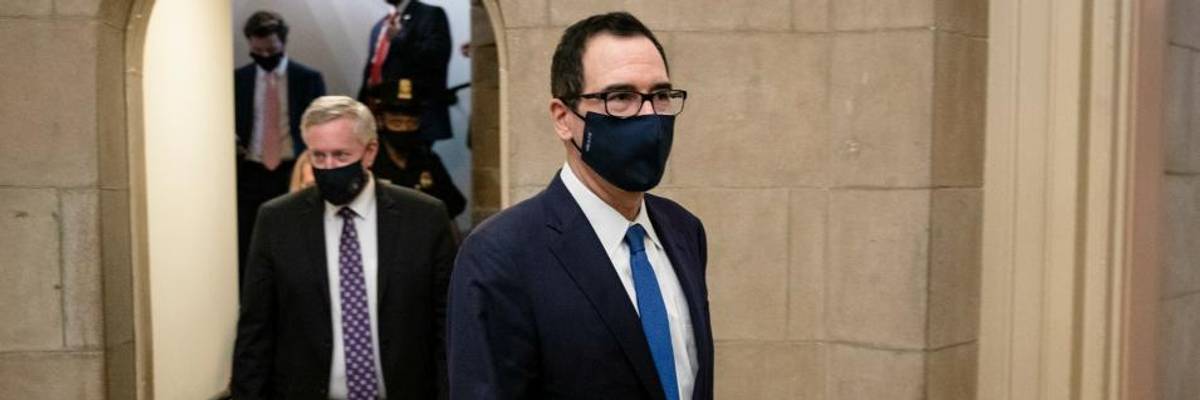
Treasury Secretary Steven Mnuchin and White House Chief of Staff Mark Meadows leave the U.S. Capitol after speaking to reporters on July 30, 2020 in Washington, D.C. (Photo: Samuel Corum/Getty Images)
Treasury Secretary Steve Mnuchin on Sunday recycled a debunked right-wing talking point to justify the GOP's proposal to cut by more than half the $600-per-week federal boost in unemployment benefits that expired at the end of last week, depriving around 30 million Americans of a key economic lifeline as joblessness remains at historic levels.
In an appearance on ABC's "This Week," Mnuchin claimed "there's no question" that the $600 weekly boost in unemployment insurance (UI) created a disincentive to work.
"The Trump administration loves socialism for the rich, unfettered capitalism for everyone else."
--Sen. Bernie Sanders
When host Martha Raddatz pointed to a recent Yale study that found "no evidence that more generous benefits disincentivized work," Mnuchin responded, "I went to Yale, I agree on certain things, I don't always agree."
As a counterpoint, the Treasury Secretary cited a "Chicago study"--apparently referring to May research from the University of Chicago showing that under the $600-per-week boost, 68% of unemployed workers who were eligible for UI could have received benefits that exceeded their previous work income. That study, however, did not examine whether the benefits created a disincentive for the unemployed to seek work.
"There are cases where people are overpaid," said Mnuchin, a former Goldman Sachs banker whose net worth is estimated to be around $400 million.
The $600 weekly payment amounts to around what a worker would earn working 40 hours per week at a $15-an-hour wage. The fact that some workers earned more under the enhanced unemployment benefits than they did from their jobs makes the case for raising wages, not cutting benefits, progressives have argued.
Senate Republicans have proposed cutting the $600 weekly boost to $200--a $1,600 monthly benefit cut for tens of millions of people.
In response to Mnuchin's remarks, Rep. Don Beyer (D-Va.) tweeted that "inflicting suffering on tens of millions of Americans by cutting unemployment benefits because of an anecdotal 'some cases' argument that has been refuted again and again by studies of actual data is a stupid way to make policy."
Sen. Bernie Sanders (I-Vt.) slammed Mnuchin for wanting to to "slash $600 a week in unemployment benefits for 30 million workers who lost jobs" while supporting "the continuation of a $500 billion slush fund for corporations."
"The Trump administration loves socialism for the rich, unfettered capitalism for everyone else," said Sanders.
The $600-per-week increase in unemployment benefits expired on Friday as Republican and Democratic negotiators failed to reach an agreement to extend the payments--even amid dire warnings that a lapse could lead to a surge in evictions, increased hunger, and massive job loss.
Mnuchin on Sunday touted the White House's offer of a one-week extension of the $600 payments, but Democratic congressional leaders and other critics dismissed the proposal as a "sham" given that it would likely take weeks for states to distribute the payments.
"They proposed it after it was too late to prevent a benefits lapse," tweeted HuffPost's Arthur Delaney. "The last checks had already gone out. State workforce agencies have thoroughly demonstrated they don't do policy changes on a dime. Republicans opposed the $600 from before anyone received their first check and they made sure the benefits stopped."
Democratic leaders met with Mnuchin and White House Chief of Staff Mark Meadows on Saturday for a rare weekend discussion as the two sides remain far apart on key priorities for the next Covid-19 stimulus package, from unemployment benefits to additional aid for state and local governments.
In a Dear Colleague letter on Saturday, House Speaker Nancy Pelosi (D-Calif.) described the weekend meeting as "more productive than our previous discussions" but added that no agreement was reached.
"This is a very different kind of negotiation, because of what is at stake," Pelosi wrote. "Millions of children are food insecure, millions of families are at risk of eviction, and for the nineteenth straight week, over one million Americans applied for unemployment insurance... All parties must understand the gravity of the situation in order to reach an agreement that protects Americans' lives, livelihoods, and the life of our democracy."
Dear Common Dreams reader, It’s been nearly 30 years since I co-founded Common Dreams with my late wife, Lina Newhouser. We had the radical notion that journalism should serve the public good, not corporate profits. It was clear to us from the outset what it would take to build such a project. No paid advertisements. No corporate sponsors. No millionaire publisher telling us what to think or do. Many people said we wouldn't last a year, but we proved those doubters wrong. Together with a tremendous team of journalists and dedicated staff, we built an independent media outlet free from the constraints of profits and corporate control. Our mission has always been simple: To inform. To inspire. To ignite change for the common good. Building Common Dreams was not easy. Our survival was never guaranteed. When you take on the most powerful forces—Wall Street greed, fossil fuel industry destruction, Big Tech lobbyists, and uber-rich oligarchs who have spent billions upon billions rigging the economy and democracy in their favor—the only bulwark you have is supporters who believe in your work. But here’s the urgent message from me today. It's never been this bad out there. And it's never been this hard to keep us going. At the very moment Common Dreams is most needed, the threats we face are intensifying. We need your support now more than ever. We don't accept corporate advertising and never will. We don't have a paywall because we don't think people should be blocked from critical news based on their ability to pay. Everything we do is funded by the donations of readers like you. When everyone does the little they can afford, we are strong. But if that support retreats or dries up, so do we. Will you donate now to make sure Common Dreams not only survives but thrives? —Craig Brown, Co-founder |
Treasury Secretary Steve Mnuchin on Sunday recycled a debunked right-wing talking point to justify the GOP's proposal to cut by more than half the $600-per-week federal boost in unemployment benefits that expired at the end of last week, depriving around 30 million Americans of a key economic lifeline as joblessness remains at historic levels.
In an appearance on ABC's "This Week," Mnuchin claimed "there's no question" that the $600 weekly boost in unemployment insurance (UI) created a disincentive to work.
"The Trump administration loves socialism for the rich, unfettered capitalism for everyone else."
--Sen. Bernie Sanders
When host Martha Raddatz pointed to a recent Yale study that found "no evidence that more generous benefits disincentivized work," Mnuchin responded, "I went to Yale, I agree on certain things, I don't always agree."
As a counterpoint, the Treasury Secretary cited a "Chicago study"--apparently referring to May research from the University of Chicago showing that under the $600-per-week boost, 68% of unemployed workers who were eligible for UI could have received benefits that exceeded their previous work income. That study, however, did not examine whether the benefits created a disincentive for the unemployed to seek work.
"There are cases where people are overpaid," said Mnuchin, a former Goldman Sachs banker whose net worth is estimated to be around $400 million.
The $600 weekly payment amounts to around what a worker would earn working 40 hours per week at a $15-an-hour wage. The fact that some workers earned more under the enhanced unemployment benefits than they did from their jobs makes the case for raising wages, not cutting benefits, progressives have argued.
Senate Republicans have proposed cutting the $600 weekly boost to $200--a $1,600 monthly benefit cut for tens of millions of people.
In response to Mnuchin's remarks, Rep. Don Beyer (D-Va.) tweeted that "inflicting suffering on tens of millions of Americans by cutting unemployment benefits because of an anecdotal 'some cases' argument that has been refuted again and again by studies of actual data is a stupid way to make policy."
Sen. Bernie Sanders (I-Vt.) slammed Mnuchin for wanting to to "slash $600 a week in unemployment benefits for 30 million workers who lost jobs" while supporting "the continuation of a $500 billion slush fund for corporations."
"The Trump administration loves socialism for the rich, unfettered capitalism for everyone else," said Sanders.
The $600-per-week increase in unemployment benefits expired on Friday as Republican and Democratic negotiators failed to reach an agreement to extend the payments--even amid dire warnings that a lapse could lead to a surge in evictions, increased hunger, and massive job loss.
Mnuchin on Sunday touted the White House's offer of a one-week extension of the $600 payments, but Democratic congressional leaders and other critics dismissed the proposal as a "sham" given that it would likely take weeks for states to distribute the payments.
"They proposed it after it was too late to prevent a benefits lapse," tweeted HuffPost's Arthur Delaney. "The last checks had already gone out. State workforce agencies have thoroughly demonstrated they don't do policy changes on a dime. Republicans opposed the $600 from before anyone received their first check and they made sure the benefits stopped."
Democratic leaders met with Mnuchin and White House Chief of Staff Mark Meadows on Saturday for a rare weekend discussion as the two sides remain far apart on key priorities for the next Covid-19 stimulus package, from unemployment benefits to additional aid for state and local governments.
In a Dear Colleague letter on Saturday, House Speaker Nancy Pelosi (D-Calif.) described the weekend meeting as "more productive than our previous discussions" but added that no agreement was reached.
"This is a very different kind of negotiation, because of what is at stake," Pelosi wrote. "Millions of children are food insecure, millions of families are at risk of eviction, and for the nineteenth straight week, over one million Americans applied for unemployment insurance... All parties must understand the gravity of the situation in order to reach an agreement that protects Americans' lives, livelihoods, and the life of our democracy."
Treasury Secretary Steve Mnuchin on Sunday recycled a debunked right-wing talking point to justify the GOP's proposal to cut by more than half the $600-per-week federal boost in unemployment benefits that expired at the end of last week, depriving around 30 million Americans of a key economic lifeline as joblessness remains at historic levels.
In an appearance on ABC's "This Week," Mnuchin claimed "there's no question" that the $600 weekly boost in unemployment insurance (UI) created a disincentive to work.
"The Trump administration loves socialism for the rich, unfettered capitalism for everyone else."
--Sen. Bernie Sanders
When host Martha Raddatz pointed to a recent Yale study that found "no evidence that more generous benefits disincentivized work," Mnuchin responded, "I went to Yale, I agree on certain things, I don't always agree."
As a counterpoint, the Treasury Secretary cited a "Chicago study"--apparently referring to May research from the University of Chicago showing that under the $600-per-week boost, 68% of unemployed workers who were eligible for UI could have received benefits that exceeded their previous work income. That study, however, did not examine whether the benefits created a disincentive for the unemployed to seek work.
"There are cases where people are overpaid," said Mnuchin, a former Goldman Sachs banker whose net worth is estimated to be around $400 million.
The $600 weekly payment amounts to around what a worker would earn working 40 hours per week at a $15-an-hour wage. The fact that some workers earned more under the enhanced unemployment benefits than they did from their jobs makes the case for raising wages, not cutting benefits, progressives have argued.
Senate Republicans have proposed cutting the $600 weekly boost to $200--a $1,600 monthly benefit cut for tens of millions of people.
In response to Mnuchin's remarks, Rep. Don Beyer (D-Va.) tweeted that "inflicting suffering on tens of millions of Americans by cutting unemployment benefits because of an anecdotal 'some cases' argument that has been refuted again and again by studies of actual data is a stupid way to make policy."
Sen. Bernie Sanders (I-Vt.) slammed Mnuchin for wanting to to "slash $600 a week in unemployment benefits for 30 million workers who lost jobs" while supporting "the continuation of a $500 billion slush fund for corporations."
"The Trump administration loves socialism for the rich, unfettered capitalism for everyone else," said Sanders.
The $600-per-week increase in unemployment benefits expired on Friday as Republican and Democratic negotiators failed to reach an agreement to extend the payments--even amid dire warnings that a lapse could lead to a surge in evictions, increased hunger, and massive job loss.
Mnuchin on Sunday touted the White House's offer of a one-week extension of the $600 payments, but Democratic congressional leaders and other critics dismissed the proposal as a "sham" given that it would likely take weeks for states to distribute the payments.
"They proposed it after it was too late to prevent a benefits lapse," tweeted HuffPost's Arthur Delaney. "The last checks had already gone out. State workforce agencies have thoroughly demonstrated they don't do policy changes on a dime. Republicans opposed the $600 from before anyone received their first check and they made sure the benefits stopped."
Democratic leaders met with Mnuchin and White House Chief of Staff Mark Meadows on Saturday for a rare weekend discussion as the two sides remain far apart on key priorities for the next Covid-19 stimulus package, from unemployment benefits to additional aid for state and local governments.
In a Dear Colleague letter on Saturday, House Speaker Nancy Pelosi (D-Calif.) described the weekend meeting as "more productive than our previous discussions" but added that no agreement was reached.
"This is a very different kind of negotiation, because of what is at stake," Pelosi wrote. "Millions of children are food insecure, millions of families are at risk of eviction, and for the nineteenth straight week, over one million Americans applied for unemployment insurance... All parties must understand the gravity of the situation in order to reach an agreement that protects Americans' lives, livelihoods, and the life of our democracy."