

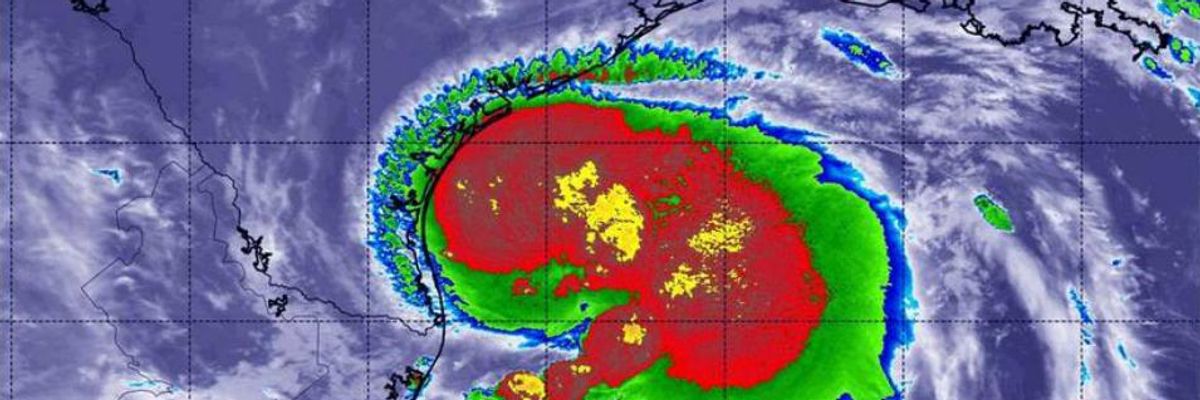
On July 25 at 3:50 am EDT, the MODIS instrument that flies aboard NASA's Aqua satellite revealed very powerful thunderstorms (yellow) around Hanna's center. (Image: NASA/NRL)
Climatologist Michael Mann on 2020 Atlantic Hurricane Season: "Hate to Say, 'We Told You So'"
Citing his pre-season forecast predicting as many as 20 named storms, the expert now warns that "if anything, that might be too low..."
"Hate to say, 'We told you so.'"
That comment came in a Monday tweet from climatologist Michael E. Mann, responding to a pair of meteorologists who noted the warm waters along the East Coast of the United States, which "means trouble for any tropical cyclones coming up the coast" for the next several weeks of the Atlantic hurricane season.
Mann, an atmospheric science professor at Penn State who directs the university's Earth System Science Center (ESSC), and other experts have warned that human-driven global heating that's warming the world's oceans is already causing and will continue to cause more intense and devastating tropical storms and hurricanes.
In April, Mann, ESSC scientist Daniel J. Brouillette, and alumnus Michael Kozar released their pre-season forecast for the 2020 North Atlantic hurricane season, which runs from the beginning of June to the end of November. They predicted a range of 15 to 24 named storms, with a "best estimate" of 20, for this year's season.
On Monday, Mann pointed out this was the first season in a decade for which they forecast up to 20 storms, then warned that "if anything, that might be too low..."
The fresh concerns from Mann and meteorologists Dan Satterfield and Eric Fisher came after the Category 1 Hurricane Hanna--the first hurricane and eighth named storm of this season--made landfall twice Saturday evening in southeast Texas, a region "already battered by the coronavirus pandemic," as the New York Times noted.
According to a weekend report from the Times:
The cities and counties in the path of Hanna are some of the same communities that have seen a sudden spike in Covid-19 cases and hospitalizations as Texas has become one of the largest hot spots in the country. In a state that is no stranger to bad weather, the typical hurricane-prep ritual was altered by social distancing and face coverings, with fever checks required to enter officials' news briefings, and sandbag distribution provided by workers who covered their faces in masks and bandannas.
The Texas Tribune reported Monday that thousands in the state remained without power as a result of Hanna. The National Hurricane Center (NHC) downgraded Hanna to a tropical storm early Sunday but also warned that "heavy rainfall, strong winds, storm surge, dangerous surf, and isolated tornadoes remain a threat from this system."
Late Tuesday morning, the NHC issued a potential tropical cyclone advisory for what could soon become the season's ninth named storm. Meteorologist Philip Klotzbach pointed out that the storm would be named Isaias and could set the record for the earliest ninth tropical cyclone in the Atlantic.
Meteorologist and science writer Eric Holthaus also responded to the news in a series of tweets. "Heads up Puerto Rico and the Virgin Islands," he wrote of the ninth storm before noting that thousands of families in Puerto Rico, a U.S. territory, are still dealing with inadequate living conditions nearly three years after Hurricane Maria.
"Tens of thousands of homes in Puerto Rico remain uninhabitable by modern standards, with damage ranging from total destruction to missing roofs," according to the Associated Press report from last week that Holthaus highlighted. "In the central mountain town of Villalba alone, 43 families still live under blue tarps as roofs."
NHC warned Tuesday that Isaias could hit Puerto Rico and various eastern Caribbean islands as early as Wednesday, bringing dangerous heavy rains, flash flooding, and mudslides. Although uncertainty remains over the storm's path, forecasters say it could reach the Bahamas on Saturday and Florida by Sunday.
We are at a crossroads
This country and this world are at a monumental crossroads. In a few short weeks, US voters will have an opportunity to beat back the forces of fascism and confront the billionaires who are rigging the economy, our media system, and our democracy, making it increasingly impossible for ordinary people to get by. We’re not just talking about the election. We’re talking about what must be done once these fascist elements are vanquished from power. We need a bolder set of solutions than what either major party has so far been willing to offer and a working-class movement ready to fight like hell for it. Trump didn't emerge from nowhere. The conditions that fueled MAGA authoritarianism were created by decades of radical neoliberal economic policies and a corrupt political system dominated by corporate interests. They slashed taxes on the super-rich, promising that the benefits would trickle down. They said giveaways to the corporate titans would make life more affordable for the rest of us. It was all bullshit. And when a bitter, betrayed populace searches for someone to blame, right-wing demagogues have little trouble finding scapegoats. People know when they're being lied to, but you won't hear any of this from the corporate media. Only independent journalism—powered and funded by people who believe in building a better world—can deliver truly trustworthy daily news. Our Fall Campaign is underway, and we need your help. To power our newsroom through the rest of the year, we need to raise $125,000 by midnight on October 31. So if you share our vision, please contribute whatever you can to sustain our work. |
"Hate to say, 'We told you so.'"
That comment came in a Monday tweet from climatologist Michael E. Mann, responding to a pair of meteorologists who noted the warm waters along the East Coast of the United States, which "means trouble for any tropical cyclones coming up the coast" for the next several weeks of the Atlantic hurricane season.
Mann, an atmospheric science professor at Penn State who directs the university's Earth System Science Center (ESSC), and other experts have warned that human-driven global heating that's warming the world's oceans is already causing and will continue to cause more intense and devastating tropical storms and hurricanes.
In April, Mann, ESSC scientist Daniel J. Brouillette, and alumnus Michael Kozar released their pre-season forecast for the 2020 North Atlantic hurricane season, which runs from the beginning of June to the end of November. They predicted a range of 15 to 24 named storms, with a "best estimate" of 20, for this year's season.
On Monday, Mann pointed out this was the first season in a decade for which they forecast up to 20 storms, then warned that "if anything, that might be too low..."
The fresh concerns from Mann and meteorologists Dan Satterfield and Eric Fisher came after the Category 1 Hurricane Hanna--the first hurricane and eighth named storm of this season--made landfall twice Saturday evening in southeast Texas, a region "already battered by the coronavirus pandemic," as the New York Times noted.
According to a weekend report from the Times:
The cities and counties in the path of Hanna are some of the same communities that have seen a sudden spike in Covid-19 cases and hospitalizations as Texas has become one of the largest hot spots in the country. In a state that is no stranger to bad weather, the typical hurricane-prep ritual was altered by social distancing and face coverings, with fever checks required to enter officials' news briefings, and sandbag distribution provided by workers who covered their faces in masks and bandannas.
The Texas Tribune reported Monday that thousands in the state remained without power as a result of Hanna. The National Hurricane Center (NHC) downgraded Hanna to a tropical storm early Sunday but also warned that "heavy rainfall, strong winds, storm surge, dangerous surf, and isolated tornadoes remain a threat from this system."
Late Tuesday morning, the NHC issued a potential tropical cyclone advisory for what could soon become the season's ninth named storm. Meteorologist Philip Klotzbach pointed out that the storm would be named Isaias and could set the record for the earliest ninth tropical cyclone in the Atlantic.
Meteorologist and science writer Eric Holthaus also responded to the news in a series of tweets. "Heads up Puerto Rico and the Virgin Islands," he wrote of the ninth storm before noting that thousands of families in Puerto Rico, a U.S. territory, are still dealing with inadequate living conditions nearly three years after Hurricane Maria.
"Tens of thousands of homes in Puerto Rico remain uninhabitable by modern standards, with damage ranging from total destruction to missing roofs," according to the Associated Press report from last week that Holthaus highlighted. "In the central mountain town of Villalba alone, 43 families still live under blue tarps as roofs."
NHC warned Tuesday that Isaias could hit Puerto Rico and various eastern Caribbean islands as early as Wednesday, bringing dangerous heavy rains, flash flooding, and mudslides. Although uncertainty remains over the storm's path, forecasters say it could reach the Bahamas on Saturday and Florida by Sunday.
"Hate to say, 'We told you so.'"
That comment came in a Monday tweet from climatologist Michael E. Mann, responding to a pair of meteorologists who noted the warm waters along the East Coast of the United States, which "means trouble for any tropical cyclones coming up the coast" for the next several weeks of the Atlantic hurricane season.
Mann, an atmospheric science professor at Penn State who directs the university's Earth System Science Center (ESSC), and other experts have warned that human-driven global heating that's warming the world's oceans is already causing and will continue to cause more intense and devastating tropical storms and hurricanes.
In April, Mann, ESSC scientist Daniel J. Brouillette, and alumnus Michael Kozar released their pre-season forecast for the 2020 North Atlantic hurricane season, which runs from the beginning of June to the end of November. They predicted a range of 15 to 24 named storms, with a "best estimate" of 20, for this year's season.
On Monday, Mann pointed out this was the first season in a decade for which they forecast up to 20 storms, then warned that "if anything, that might be too low..."
The fresh concerns from Mann and meteorologists Dan Satterfield and Eric Fisher came after the Category 1 Hurricane Hanna--the first hurricane and eighth named storm of this season--made landfall twice Saturday evening in southeast Texas, a region "already battered by the coronavirus pandemic," as the New York Times noted.
According to a weekend report from the Times:
The cities and counties in the path of Hanna are some of the same communities that have seen a sudden spike in Covid-19 cases and hospitalizations as Texas has become one of the largest hot spots in the country. In a state that is no stranger to bad weather, the typical hurricane-prep ritual was altered by social distancing and face coverings, with fever checks required to enter officials' news briefings, and sandbag distribution provided by workers who covered their faces in masks and bandannas.
The Texas Tribune reported Monday that thousands in the state remained without power as a result of Hanna. The National Hurricane Center (NHC) downgraded Hanna to a tropical storm early Sunday but also warned that "heavy rainfall, strong winds, storm surge, dangerous surf, and isolated tornadoes remain a threat from this system."
Late Tuesday morning, the NHC issued a potential tropical cyclone advisory for what could soon become the season's ninth named storm. Meteorologist Philip Klotzbach pointed out that the storm would be named Isaias and could set the record for the earliest ninth tropical cyclone in the Atlantic.
Meteorologist and science writer Eric Holthaus also responded to the news in a series of tweets. "Heads up Puerto Rico and the Virgin Islands," he wrote of the ninth storm before noting that thousands of families in Puerto Rico, a U.S. territory, are still dealing with inadequate living conditions nearly three years after Hurricane Maria.
"Tens of thousands of homes in Puerto Rico remain uninhabitable by modern standards, with damage ranging from total destruction to missing roofs," according to the Associated Press report from last week that Holthaus highlighted. "In the central mountain town of Villalba alone, 43 families still live under blue tarps as roofs."
NHC warned Tuesday that Isaias could hit Puerto Rico and various eastern Caribbean islands as early as Wednesday, bringing dangerous heavy rains, flash flooding, and mudslides. Although uncertainty remains over the storm's path, forecasters say it could reach the Bahamas on Saturday and Florida by Sunday.