SUBSCRIBE TO OUR FREE NEWSLETTER
Daily news & progressive opinion—funded by the people, not the corporations—delivered straight to your inbox.
5
#000000
#FFFFFF
To donate by check, phone, or other method, see our More Ways to Give page.
Daily news & progressive opinion—funded by the people, not the corporations—delivered straight to your inbox.
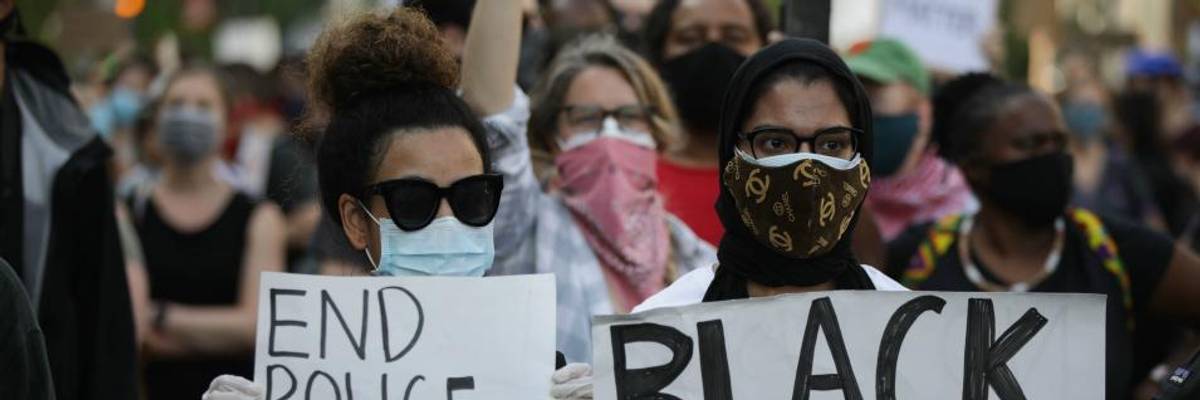
People hold banners during a protest over the death killing of George Floyd on June 2, 2020 in Washington, D.C. (Photo: Yasin Ozturk/Anadolu Agency via Getty Images)
As the nationwide uprising catalyzed by the police killing of George Floyd continues to bring hundreds of thousands of Americans into city streets around the U.S., Sen. Bernie Sanders is urging the Democratic leadership to embrace a slate of specific policy proposals aimed at mitigating the intertwined crises of systemic racism and unaccountable brutality by law enforcement.
"I am calling for sweeping policy reforms to protect people--particularly communities of color--who have suffered violence for far too long," the Vermont senator wrote in a letter (pdf) to Senate Minority Leader Chuck Schumer (D-N.Y.) on Wednesday.
Sanders' letter outlines eight policy proposals that the senator says would, if implemented, "contribute greatly to the eradication of police violence in this country."
"We have got to act boldly to eradicate systemic racism and police violence," Sanders tweeted.
Sanders' proposals come as House and Senate Democrats are beginning to lay the groundwork for a legislative response to Floyd's killing, which sparked mass demonstrations against police brutality and racism across the U.S. and around the world.
"House Speaker Nancy Pelosi (D-Calif.) has asked the Congressional Black Caucus to lead the process of drafting a legislative response to the protests that have swept the country following the death of George Floyd," NPR reported Tuesday. "House Democrats are sorting through dozens of proposals to address policing issues, including excessive use of force and racial profiling."
While some critics took issue with elements of Sanders' proposed solutions--particularly the call to raise the pay of police officers--other policies in the platform have been embraced by national civil rights groups.
In a letter to congressional leaders of both parties on Monday, more than 400 civil rights organizations expressed support for a ban on the transfer of excess U.S. military equipment to local police departments and abolition of a longstanding legal doctrine giving police sweeping immunity from lawsuits, both of which Sanders embraced.
"Federal statutory reforms are urgently needed on a range of policing issues, including use of force, police accountability, racial profiling, militarization, data collection, and training," the groups wrote. "These recent police killings of residents across the country are part of a longer history of fatal police killings against black people in America and require congressional action immediately."
Dear Common Dreams reader, It’s been nearly 30 years since I co-founded Common Dreams with my late wife, Lina Newhouser. We had the radical notion that journalism should serve the public good, not corporate profits. It was clear to us from the outset what it would take to build such a project. No paid advertisements. No corporate sponsors. No millionaire publisher telling us what to think or do. Many people said we wouldn't last a year, but we proved those doubters wrong. Together with a tremendous team of journalists and dedicated staff, we built an independent media outlet free from the constraints of profits and corporate control. Our mission has always been simple: To inform. To inspire. To ignite change for the common good. Building Common Dreams was not easy. Our survival was never guaranteed. When you take on the most powerful forces—Wall Street greed, fossil fuel industry destruction, Big Tech lobbyists, and uber-rich oligarchs who have spent billions upon billions rigging the economy and democracy in their favor—the only bulwark you have is supporters who believe in your work. But here’s the urgent message from me today. It's never been this bad out there. And it's never been this hard to keep us going. At the very moment Common Dreams is most needed, the threats we face are intensifying. We need your support now more than ever. We don't accept corporate advertising and never will. We don't have a paywall because we don't think people should be blocked from critical news based on their ability to pay. Everything we do is funded by the donations of readers like you. When everyone does the little they can afford, we are strong. But if that support retreats or dries up, so do we. Will you donate now to make sure Common Dreams not only survives but thrives? —Craig Brown, Co-founder |
As the nationwide uprising catalyzed by the police killing of George Floyd continues to bring hundreds of thousands of Americans into city streets around the U.S., Sen. Bernie Sanders is urging the Democratic leadership to embrace a slate of specific policy proposals aimed at mitigating the intertwined crises of systemic racism and unaccountable brutality by law enforcement.
"I am calling for sweeping policy reforms to protect people--particularly communities of color--who have suffered violence for far too long," the Vermont senator wrote in a letter (pdf) to Senate Minority Leader Chuck Schumer (D-N.Y.) on Wednesday.
Sanders' letter outlines eight policy proposals that the senator says would, if implemented, "contribute greatly to the eradication of police violence in this country."
"We have got to act boldly to eradicate systemic racism and police violence," Sanders tweeted.
Sanders' proposals come as House and Senate Democrats are beginning to lay the groundwork for a legislative response to Floyd's killing, which sparked mass demonstrations against police brutality and racism across the U.S. and around the world.
"House Speaker Nancy Pelosi (D-Calif.) has asked the Congressional Black Caucus to lead the process of drafting a legislative response to the protests that have swept the country following the death of George Floyd," NPR reported Tuesday. "House Democrats are sorting through dozens of proposals to address policing issues, including excessive use of force and racial profiling."
While some critics took issue with elements of Sanders' proposed solutions--particularly the call to raise the pay of police officers--other policies in the platform have been embraced by national civil rights groups.
In a letter to congressional leaders of both parties on Monday, more than 400 civil rights organizations expressed support for a ban on the transfer of excess U.S. military equipment to local police departments and abolition of a longstanding legal doctrine giving police sweeping immunity from lawsuits, both of which Sanders embraced.
"Federal statutory reforms are urgently needed on a range of policing issues, including use of force, police accountability, racial profiling, militarization, data collection, and training," the groups wrote. "These recent police killings of residents across the country are part of a longer history of fatal police killings against black people in America and require congressional action immediately."
As the nationwide uprising catalyzed by the police killing of George Floyd continues to bring hundreds of thousands of Americans into city streets around the U.S., Sen. Bernie Sanders is urging the Democratic leadership to embrace a slate of specific policy proposals aimed at mitigating the intertwined crises of systemic racism and unaccountable brutality by law enforcement.
"I am calling for sweeping policy reforms to protect people--particularly communities of color--who have suffered violence for far too long," the Vermont senator wrote in a letter (pdf) to Senate Minority Leader Chuck Schumer (D-N.Y.) on Wednesday.
Sanders' letter outlines eight policy proposals that the senator says would, if implemented, "contribute greatly to the eradication of police violence in this country."
"We have got to act boldly to eradicate systemic racism and police violence," Sanders tweeted.
Sanders' proposals come as House and Senate Democrats are beginning to lay the groundwork for a legislative response to Floyd's killing, which sparked mass demonstrations against police brutality and racism across the U.S. and around the world.
"House Speaker Nancy Pelosi (D-Calif.) has asked the Congressional Black Caucus to lead the process of drafting a legislative response to the protests that have swept the country following the death of George Floyd," NPR reported Tuesday. "House Democrats are sorting through dozens of proposals to address policing issues, including excessive use of force and racial profiling."
While some critics took issue with elements of Sanders' proposed solutions--particularly the call to raise the pay of police officers--other policies in the platform have been embraced by national civil rights groups.
In a letter to congressional leaders of both parties on Monday, more than 400 civil rights organizations expressed support for a ban on the transfer of excess U.S. military equipment to local police departments and abolition of a longstanding legal doctrine giving police sweeping immunity from lawsuits, both of which Sanders embraced.
"Federal statutory reforms are urgently needed on a range of policing issues, including use of force, police accountability, racial profiling, militarization, data collection, and training," the groups wrote. "These recent police killings of residents across the country are part of a longer history of fatal police killings against black people in America and require congressional action immediately."