

SUBSCRIBE TO OUR FREE NEWSLETTER
Daily news & progressive opinion—funded by the people, not the corporations—delivered straight to your inbox.
5
#000000
#FFFFFF
To donate by check, phone, or other method, see our More Ways to Give page.
Daily news & progressive opinion—funded by the people, not the corporations—delivered straight to your inbox.
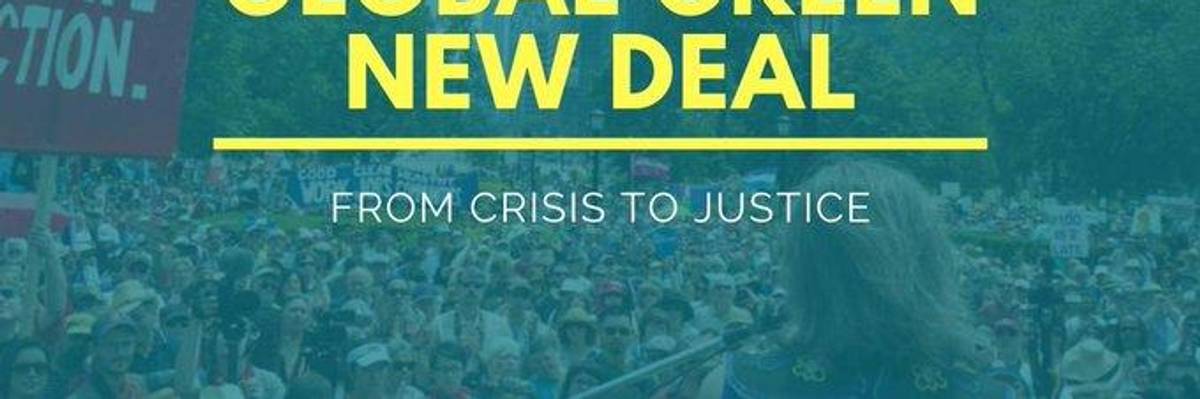
The coronavirus crisis has brought "the machine of capitalism... to a halt," said Arundhati Roy. (Image: Global Green New Deal)
Authors Arundhati Roy and Naomi Klein took part in a virtual conversation on Tuesday to help launch a Global Green New Deal project to foster internationalism and visualize possibilities for a new and better world for people and the planet.
The online event, entitled "Into the Portal, No One Left Behind," was co-sponsored by The Leap, War on Want, and Haymarket Books. Asad Rehman, executive director of War on Want, moderated the discussion.
"We knew our system was broken. But the Covid-19 pandemic has reinforced the cruelty of the global economy, and deepened the visceral injustices of our societies," organizers said in the conversation's event description. "The time to build the future we deserve is now, and international solidarity is the tool we need to begin its construction."
Klein said that driving the cruelty is "the violence of a capitalist system" rooted in "an extractivist logic that treats... the Earth itself, individual places, and entire groups of people as disposable," a "logic of endless extraction and disposal that really cherishes nothing and no one."
The coronavirus crisis means that we are now hearing the "roar of workers who are on the frontlines who are talking about being simultaneously essential and disposable or simultaneously essential and sacrificial," said Klein, adding that this duality has parallels with slavery and land theft.
A more justice vision for life on the other side of the "portal" post-pandemic should be "bounded in treating no one as if they are sacrificeable--and nowhere," she said.
Watch the full conversation:
Roy said the pandemic meant "the machine of capitalism has come to a halt," and suggested a global movement toward justice could heed lessons from the "ferocious, beautiful, and militant movements" in India.
What those movements have done, said Roy, is to ask "the world to redefine the meaning of progress, to redefine he meaning of civilization, to redefine the meaning of happiness. Do you really need to treat the Earth like a resource in order to call yourself civilized?"
"If people think coronavirus is a problem, it's a stuffed toy compared to the climate crisis that's coming," she added.
"The main thing is to change our imagination," said Roy. "Once you understand that you just can't extract everything, that things are finite," a new, more just vision can emerge.
Roy said that it was important to acknowledge that "change doesn't mean that you're going to necessarily suffer."
"Life," she continued, "could be so much more beautiful." People could be in a situation in which they respect the Earth and "have a more equal relationship with people."
Getting from this moment of global crisis to justice will take a far-reaching effort.
"The answer to the question 'How do we change the world?' isn't in any of us individually," said Reyman. "It's in all of us collectively."
The Global Green New Deal website says that a call to action is will be released in the coming weeks. "Together," says the new site, "we will create a people's plan to build a resilient global economy, based on the principles of a just transition and recovery, which guarantees the right to a dignified life for all."
Dear Common Dreams reader, It’s been nearly 30 years since I co-founded Common Dreams with my late wife, Lina Newhouser. We had the radical notion that journalism should serve the public good, not corporate profits. It was clear to us from the outset what it would take to build such a project. No paid advertisements. No corporate sponsors. No millionaire publisher telling us what to think or do. Many people said we wouldn't last a year, but we proved those doubters wrong. Together with a tremendous team of journalists and dedicated staff, we built an independent media outlet free from the constraints of profits and corporate control. Our mission has always been simple: To inform. To inspire. To ignite change for the common good. Building Common Dreams was not easy. Our survival was never guaranteed. When you take on the most powerful forces—Wall Street greed, fossil fuel industry destruction, Big Tech lobbyists, and uber-rich oligarchs who have spent billions upon billions rigging the economy and democracy in their favor—the only bulwark you have is supporters who believe in your work. But here’s the urgent message from me today. It's never been this bad out there. And it's never been this hard to keep us going. At the very moment Common Dreams is most needed, the threats we face are intensifying. We need your support now more than ever. We don't accept corporate advertising and never will. We don't have a paywall because we don't think people should be blocked from critical news based on their ability to pay. Everything we do is funded by the donations of readers like you. When everyone does the little they can afford, we are strong. But if that support retreats or dries up, so do we. Will you donate now to make sure Common Dreams not only survives but thrives? —Craig Brown, Co-founder |
Authors Arundhati Roy and Naomi Klein took part in a virtual conversation on Tuesday to help launch a Global Green New Deal project to foster internationalism and visualize possibilities for a new and better world for people and the planet.
The online event, entitled "Into the Portal, No One Left Behind," was co-sponsored by The Leap, War on Want, and Haymarket Books. Asad Rehman, executive director of War on Want, moderated the discussion.
"We knew our system was broken. But the Covid-19 pandemic has reinforced the cruelty of the global economy, and deepened the visceral injustices of our societies," organizers said in the conversation's event description. "The time to build the future we deserve is now, and international solidarity is the tool we need to begin its construction."
Klein said that driving the cruelty is "the violence of a capitalist system" rooted in "an extractivist logic that treats... the Earth itself, individual places, and entire groups of people as disposable," a "logic of endless extraction and disposal that really cherishes nothing and no one."
The coronavirus crisis means that we are now hearing the "roar of workers who are on the frontlines who are talking about being simultaneously essential and disposable or simultaneously essential and sacrificial," said Klein, adding that this duality has parallels with slavery and land theft.
A more justice vision for life on the other side of the "portal" post-pandemic should be "bounded in treating no one as if they are sacrificeable--and nowhere," she said.
Watch the full conversation:
Roy said the pandemic meant "the machine of capitalism has come to a halt," and suggested a global movement toward justice could heed lessons from the "ferocious, beautiful, and militant movements" in India.
What those movements have done, said Roy, is to ask "the world to redefine the meaning of progress, to redefine he meaning of civilization, to redefine the meaning of happiness. Do you really need to treat the Earth like a resource in order to call yourself civilized?"
"If people think coronavirus is a problem, it's a stuffed toy compared to the climate crisis that's coming," she added.
"The main thing is to change our imagination," said Roy. "Once you understand that you just can't extract everything, that things are finite," a new, more just vision can emerge.
Roy said that it was important to acknowledge that "change doesn't mean that you're going to necessarily suffer."
"Life," she continued, "could be so much more beautiful." People could be in a situation in which they respect the Earth and "have a more equal relationship with people."
Getting from this moment of global crisis to justice will take a far-reaching effort.
"The answer to the question 'How do we change the world?' isn't in any of us individually," said Reyman. "It's in all of us collectively."
The Global Green New Deal website says that a call to action is will be released in the coming weeks. "Together," says the new site, "we will create a people's plan to build a resilient global economy, based on the principles of a just transition and recovery, which guarantees the right to a dignified life for all."
Authors Arundhati Roy and Naomi Klein took part in a virtual conversation on Tuesday to help launch a Global Green New Deal project to foster internationalism and visualize possibilities for a new and better world for people and the planet.
The online event, entitled "Into the Portal, No One Left Behind," was co-sponsored by The Leap, War on Want, and Haymarket Books. Asad Rehman, executive director of War on Want, moderated the discussion.
"We knew our system was broken. But the Covid-19 pandemic has reinforced the cruelty of the global economy, and deepened the visceral injustices of our societies," organizers said in the conversation's event description. "The time to build the future we deserve is now, and international solidarity is the tool we need to begin its construction."
Klein said that driving the cruelty is "the violence of a capitalist system" rooted in "an extractivist logic that treats... the Earth itself, individual places, and entire groups of people as disposable," a "logic of endless extraction and disposal that really cherishes nothing and no one."
The coronavirus crisis means that we are now hearing the "roar of workers who are on the frontlines who are talking about being simultaneously essential and disposable or simultaneously essential and sacrificial," said Klein, adding that this duality has parallels with slavery and land theft.
A more justice vision for life on the other side of the "portal" post-pandemic should be "bounded in treating no one as if they are sacrificeable--and nowhere," she said.
Watch the full conversation:
Roy said the pandemic meant "the machine of capitalism has come to a halt," and suggested a global movement toward justice could heed lessons from the "ferocious, beautiful, and militant movements" in India.
What those movements have done, said Roy, is to ask "the world to redefine the meaning of progress, to redefine he meaning of civilization, to redefine the meaning of happiness. Do you really need to treat the Earth like a resource in order to call yourself civilized?"
"If people think coronavirus is a problem, it's a stuffed toy compared to the climate crisis that's coming," she added.
"The main thing is to change our imagination," said Roy. "Once you understand that you just can't extract everything, that things are finite," a new, more just vision can emerge.
Roy said that it was important to acknowledge that "change doesn't mean that you're going to necessarily suffer."
"Life," she continued, "could be so much more beautiful." People could be in a situation in which they respect the Earth and "have a more equal relationship with people."
Getting from this moment of global crisis to justice will take a far-reaching effort.
"The answer to the question 'How do we change the world?' isn't in any of us individually," said Reyman. "It's in all of us collectively."
The Global Green New Deal website says that a call to action is will be released in the coming weeks. "Together," says the new site, "we will create a people's plan to build a resilient global economy, based on the principles of a just transition and recovery, which guarantees the right to a dignified life for all."

