SUBSCRIBE TO OUR FREE NEWSLETTER
Daily news & progressive opinion—funded by the people, not the corporations—delivered straight to your inbox.
5
#000000
#FFFFFF
To donate by check, phone, or other method, see our More Ways to Give page.
Daily news & progressive opinion—funded by the people, not the corporations—delivered straight to your inbox.
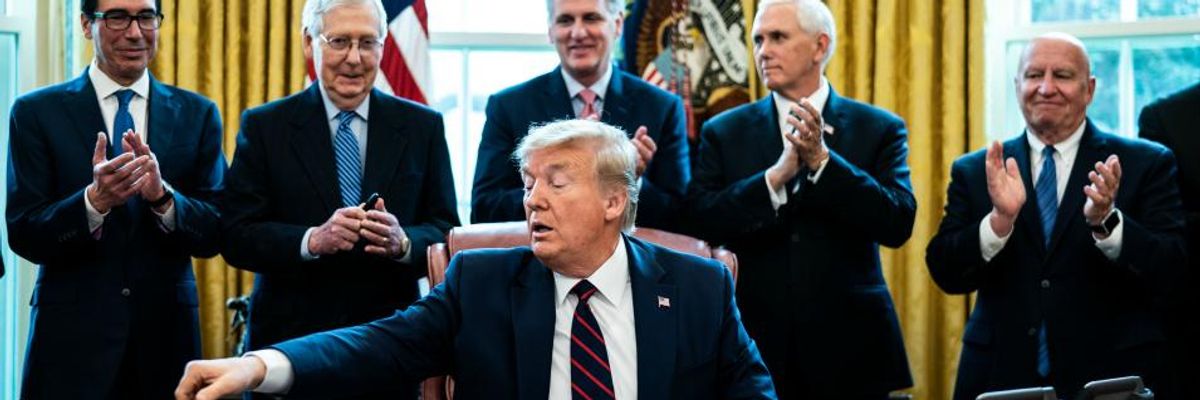
Treasury Secretary Steven Mnuchin, Senate Majority Leader Mitch McConnell (R-Ky.), House Minority Leader Kevin McCarthy (R-Calif.), Vice President Mike Pence and Rep. Kevin Brady (R-Texas) applaud President Donald Trump during a bill signing ceremony on March 27, 2020 in Washington, D.C. (Photo: Erin Schaff-Pool/Getty Images)
As desperate workers, the unemployed, and small businesses struggle to obtain benefits authorized under the multi-trillion-dollar coronavirus stimulus package President Donald Trump signed into law late last month, the White House is reportedly considering an additional slate of aid measures that critics say would disproportionately favor the wealthy while providing little relief for those most in need.
"A capital gains tax cut would be smash-and-grab economics with no value to the economic and medical calamity facing us."
--Zach Carter, HuffPost
The Washington Post, citing two anonymous officials familiar with White House discussions, reported late Sunday that the Trump administration is weighing "a payroll-tax cut, a capital-gains tax cut, creating 50-year Treasury bonds to lock in low interest rates, and a waiver that would clear businesses of liability from employees who contract the coronavirus on the job."
Trump is also considering an infrastructure package, according to the Post, but the idea faces internal opposition from top advisers.
Slashing the capital gains tax, a move that would overwhelmingly reward rich investors, has long been an obsession of the Trump White House and congressional Republicans. Last year, as Common Dreams reported, Trump floated the idea of bypassing Congress to index capital gains to inflation, but never acted amid warnings that such a unilateral change would be illegal.
The Center on Budget and Policy Priorities estimated in a 2018 analysis that 86% of the benefits of indexing capital gains to inflation would flow to the top 1%.
"A capital gains tax cut would be smash-and-grab economics with no value to the economic and medical calamity facing us," tweeted HuffPost senior reporter Zach Carter.
Critics also took aim at the other proposals under consideration inside the Trump White House, including the waiver relieving businesses of liability for workers who get sick on the job.
"Won't somebody please think of the employers who want to coerce their employees into accepting life-threatening workplace conditions without facing legal liability," New York magazine's Eric Levitz tweeted sardonically.
Freelance journalist Jon Walker called the Trump administration's reported proposals "the worst possible set of ideas for dealing with a pandemic."
"We are beyond parody at this point," Walker wrote. "Making it easier for people to get sick at work. Rewarding people for going into work. Rewarding vulture capitalists profiting off a crisis."
"We are entering an economic downturn that could be worse than the Great Depression of the 1930s. In this unprecedented moment in modern American history, it is imperative that we respond in an unprecedented way."
--Sen. Bernie Sanders
White House deliberations over a fresh coronavirus aid package comes as the mammoth legislation Trump signed late last month is failing to get much-needed relief into the hands of people and small businesses, vindicating progressives' warnings that the package amounted to little more than a massive bailout for big corporations replete with goodies for the well-off.
On Friday, the Trump administration launched the $350 billion small business relief program authorized under the $4.5 trillion stimulus package. But the rollout was disastrous as small businesses struggled to apply for loans and some of the biggest banks in the country sat out the process entirely as the Treasury Department failed to provide adequate guidance.
"The estimate is there are 30 million small businesses out there," wrote David Dayen, executive editor of The American Prospect. "About 4.5% of all of them will have a chance to get relief. Half of small businesses haven't paid rent in April, which if I'm doing the math correctly is more than 4.5%. And millions of them will have no federal help, no customers, and really no hope."
Workers and the unemployed, meanwhile, have yet to receive the one-time $1,200 cash payments and expanded unemployment benefits to which they are now entitled under law.
As the Post reported late Sunday, "the law's provision to boost unemployment benefits has become tangled in dated and overwhelmed state bureaucracies, as an unprecedented avalanche of jobless Americans seeks aid."
"Millions of workers are filing for unemployment and businesses around the country are struggling to stay afloat," said Sen. Ron Wyden (D-Ore.). "This crisis isn't going away soon. The rise in jobless claims makes it clear Congress must continue working on the next relief bill to get Americans the help they need."
Sen. Bernie Sanders (I-Vt.), a 2020 Democratic presidential candidate, said Friday that Congress--which is officially on recess until April 20--must move urgently to enact the "boldest legislation in history" to combat the coronavirus pandemic and the resulting economic collapse.
"We are in the midst of a COVID-19 pandemic that could lead to the death of hundreds of thousands of Americans and infect millions of others, and we are entering an economic downturn that could be worse than the Great Depression of the 1930s," said Sanders.
The Vermont senator proposed a number of relief measures, including $2,000 in monthly payments to every person in the U.S. for the duration of the crisis and immediate suspension of all rent and mortgage payments.
"In this unprecedented moment in modern American history," said Sanders, "it is imperative that we respond in an unprecedented way."
Dear Common Dreams reader, It’s been nearly 30 years since I co-founded Common Dreams with my late wife, Lina Newhouser. We had the radical notion that journalism should serve the public good, not corporate profits. It was clear to us from the outset what it would take to build such a project. No paid advertisements. No corporate sponsors. No millionaire publisher telling us what to think or do. Many people said we wouldn't last a year, but we proved those doubters wrong. Together with a tremendous team of journalists and dedicated staff, we built an independent media outlet free from the constraints of profits and corporate control. Our mission has always been simple: To inform. To inspire. To ignite change for the common good. Building Common Dreams was not easy. Our survival was never guaranteed. When you take on the most powerful forces—Wall Street greed, fossil fuel industry destruction, Big Tech lobbyists, and uber-rich oligarchs who have spent billions upon billions rigging the economy and democracy in their favor—the only bulwark you have is supporters who believe in your work. But here’s the urgent message from me today. It's never been this bad out there. And it's never been this hard to keep us going. At the very moment Common Dreams is most needed, the threats we face are intensifying. We need your support now more than ever. We don't accept corporate advertising and never will. We don't have a paywall because we don't think people should be blocked from critical news based on their ability to pay. Everything we do is funded by the donations of readers like you. When everyone does the little they can afford, we are strong. But if that support retreats or dries up, so do we. Will you donate now to make sure Common Dreams not only survives but thrives? —Craig Brown, Co-founder |
As desperate workers, the unemployed, and small businesses struggle to obtain benefits authorized under the multi-trillion-dollar coronavirus stimulus package President Donald Trump signed into law late last month, the White House is reportedly considering an additional slate of aid measures that critics say would disproportionately favor the wealthy while providing little relief for those most in need.
"A capital gains tax cut would be smash-and-grab economics with no value to the economic and medical calamity facing us."
--Zach Carter, HuffPost
The Washington Post, citing two anonymous officials familiar with White House discussions, reported late Sunday that the Trump administration is weighing "a payroll-tax cut, a capital-gains tax cut, creating 50-year Treasury bonds to lock in low interest rates, and a waiver that would clear businesses of liability from employees who contract the coronavirus on the job."
Trump is also considering an infrastructure package, according to the Post, but the idea faces internal opposition from top advisers.
Slashing the capital gains tax, a move that would overwhelmingly reward rich investors, has long been an obsession of the Trump White House and congressional Republicans. Last year, as Common Dreams reported, Trump floated the idea of bypassing Congress to index capital gains to inflation, but never acted amid warnings that such a unilateral change would be illegal.
The Center on Budget and Policy Priorities estimated in a 2018 analysis that 86% of the benefits of indexing capital gains to inflation would flow to the top 1%.
"A capital gains tax cut would be smash-and-grab economics with no value to the economic and medical calamity facing us," tweeted HuffPost senior reporter Zach Carter.
Critics also took aim at the other proposals under consideration inside the Trump White House, including the waiver relieving businesses of liability for workers who get sick on the job.
"Won't somebody please think of the employers who want to coerce their employees into accepting life-threatening workplace conditions without facing legal liability," New York magazine's Eric Levitz tweeted sardonically.
Freelance journalist Jon Walker called the Trump administration's reported proposals "the worst possible set of ideas for dealing with a pandemic."
"We are beyond parody at this point," Walker wrote. "Making it easier for people to get sick at work. Rewarding people for going into work. Rewarding vulture capitalists profiting off a crisis."
"We are entering an economic downturn that could be worse than the Great Depression of the 1930s. In this unprecedented moment in modern American history, it is imperative that we respond in an unprecedented way."
--Sen. Bernie Sanders
White House deliberations over a fresh coronavirus aid package comes as the mammoth legislation Trump signed late last month is failing to get much-needed relief into the hands of people and small businesses, vindicating progressives' warnings that the package amounted to little more than a massive bailout for big corporations replete with goodies for the well-off.
On Friday, the Trump administration launched the $350 billion small business relief program authorized under the $4.5 trillion stimulus package. But the rollout was disastrous as small businesses struggled to apply for loans and some of the biggest banks in the country sat out the process entirely as the Treasury Department failed to provide adequate guidance.
"The estimate is there are 30 million small businesses out there," wrote David Dayen, executive editor of The American Prospect. "About 4.5% of all of them will have a chance to get relief. Half of small businesses haven't paid rent in April, which if I'm doing the math correctly is more than 4.5%. And millions of them will have no federal help, no customers, and really no hope."
Workers and the unemployed, meanwhile, have yet to receive the one-time $1,200 cash payments and expanded unemployment benefits to which they are now entitled under law.
As the Post reported late Sunday, "the law's provision to boost unemployment benefits has become tangled in dated and overwhelmed state bureaucracies, as an unprecedented avalanche of jobless Americans seeks aid."
"Millions of workers are filing for unemployment and businesses around the country are struggling to stay afloat," said Sen. Ron Wyden (D-Ore.). "This crisis isn't going away soon. The rise in jobless claims makes it clear Congress must continue working on the next relief bill to get Americans the help they need."
Sen. Bernie Sanders (I-Vt.), a 2020 Democratic presidential candidate, said Friday that Congress--which is officially on recess until April 20--must move urgently to enact the "boldest legislation in history" to combat the coronavirus pandemic and the resulting economic collapse.
"We are in the midst of a COVID-19 pandemic that could lead to the death of hundreds of thousands of Americans and infect millions of others, and we are entering an economic downturn that could be worse than the Great Depression of the 1930s," said Sanders.
The Vermont senator proposed a number of relief measures, including $2,000 in monthly payments to every person in the U.S. for the duration of the crisis and immediate suspension of all rent and mortgage payments.
"In this unprecedented moment in modern American history," said Sanders, "it is imperative that we respond in an unprecedented way."
As desperate workers, the unemployed, and small businesses struggle to obtain benefits authorized under the multi-trillion-dollar coronavirus stimulus package President Donald Trump signed into law late last month, the White House is reportedly considering an additional slate of aid measures that critics say would disproportionately favor the wealthy while providing little relief for those most in need.
"A capital gains tax cut would be smash-and-grab economics with no value to the economic and medical calamity facing us."
--Zach Carter, HuffPost
The Washington Post, citing two anonymous officials familiar with White House discussions, reported late Sunday that the Trump administration is weighing "a payroll-tax cut, a capital-gains tax cut, creating 50-year Treasury bonds to lock in low interest rates, and a waiver that would clear businesses of liability from employees who contract the coronavirus on the job."
Trump is also considering an infrastructure package, according to the Post, but the idea faces internal opposition from top advisers.
Slashing the capital gains tax, a move that would overwhelmingly reward rich investors, has long been an obsession of the Trump White House and congressional Republicans. Last year, as Common Dreams reported, Trump floated the idea of bypassing Congress to index capital gains to inflation, but never acted amid warnings that such a unilateral change would be illegal.
The Center on Budget and Policy Priorities estimated in a 2018 analysis that 86% of the benefits of indexing capital gains to inflation would flow to the top 1%.
"A capital gains tax cut would be smash-and-grab economics with no value to the economic and medical calamity facing us," tweeted HuffPost senior reporter Zach Carter.
Critics also took aim at the other proposals under consideration inside the Trump White House, including the waiver relieving businesses of liability for workers who get sick on the job.
"Won't somebody please think of the employers who want to coerce their employees into accepting life-threatening workplace conditions without facing legal liability," New York magazine's Eric Levitz tweeted sardonically.
Freelance journalist Jon Walker called the Trump administration's reported proposals "the worst possible set of ideas for dealing with a pandemic."
"We are beyond parody at this point," Walker wrote. "Making it easier for people to get sick at work. Rewarding people for going into work. Rewarding vulture capitalists profiting off a crisis."
"We are entering an economic downturn that could be worse than the Great Depression of the 1930s. In this unprecedented moment in modern American history, it is imperative that we respond in an unprecedented way."
--Sen. Bernie Sanders
White House deliberations over a fresh coronavirus aid package comes as the mammoth legislation Trump signed late last month is failing to get much-needed relief into the hands of people and small businesses, vindicating progressives' warnings that the package amounted to little more than a massive bailout for big corporations replete with goodies for the well-off.
On Friday, the Trump administration launched the $350 billion small business relief program authorized under the $4.5 trillion stimulus package. But the rollout was disastrous as small businesses struggled to apply for loans and some of the biggest banks in the country sat out the process entirely as the Treasury Department failed to provide adequate guidance.
"The estimate is there are 30 million small businesses out there," wrote David Dayen, executive editor of The American Prospect. "About 4.5% of all of them will have a chance to get relief. Half of small businesses haven't paid rent in April, which if I'm doing the math correctly is more than 4.5%. And millions of them will have no federal help, no customers, and really no hope."
Workers and the unemployed, meanwhile, have yet to receive the one-time $1,200 cash payments and expanded unemployment benefits to which they are now entitled under law.
As the Post reported late Sunday, "the law's provision to boost unemployment benefits has become tangled in dated and overwhelmed state bureaucracies, as an unprecedented avalanche of jobless Americans seeks aid."
"Millions of workers are filing for unemployment and businesses around the country are struggling to stay afloat," said Sen. Ron Wyden (D-Ore.). "This crisis isn't going away soon. The rise in jobless claims makes it clear Congress must continue working on the next relief bill to get Americans the help they need."
Sen. Bernie Sanders (I-Vt.), a 2020 Democratic presidential candidate, said Friday that Congress--which is officially on recess until April 20--must move urgently to enact the "boldest legislation in history" to combat the coronavirus pandemic and the resulting economic collapse.
"We are in the midst of a COVID-19 pandemic that could lead to the death of hundreds of thousands of Americans and infect millions of others, and we are entering an economic downturn that could be worse than the Great Depression of the 1930s," said Sanders.
The Vermont senator proposed a number of relief measures, including $2,000 in monthly payments to every person in the U.S. for the duration of the crisis and immediate suspension of all rent and mortgage payments.
"In this unprecedented moment in modern American history," said Sanders, "it is imperative that we respond in an unprecedented way."