SUBSCRIBE TO OUR FREE NEWSLETTER
Daily news & progressive opinion—funded by the people, not the corporations—delivered straight to your inbox.
5
#000000
#FFFFFF
To donate by check, phone, or other method, see our More Ways to Give page.
Daily news & progressive opinion—funded by the people, not the corporations—delivered straight to your inbox.
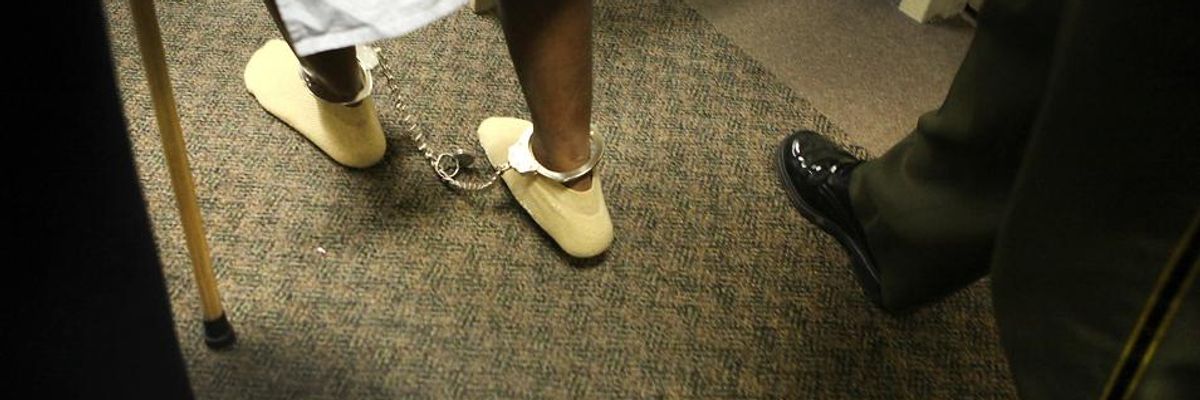
An inmate is escorted to a rehabilitation exercise at a Bay Area hospital Feb. 23, 2011. Two officers guard the chronically ill inmates around the clock every day they are in the facility. (Photo: Brian van der Brug/Los Angeles Times via Getty Images)
Rights advocates and Democrats holding state and federal elected offices across the United States are doubling down on demands for the release of "at-risk" inmates and more preventive measures in jails and prisons to prevent mass outbreaks of the new coronavirus, which has killed at least 473 people and infected over 35,000 nationwide as of Monday morning.
"The only measure that will meaningfully impact the spread and harm of Coronavirus in the jail-system is to depopulate--to release as many as possible to continue their cases in the community--with a focus on those at highest risk of complications."
-- Dr. Jonathan Giftos
Three Democratic congressmembers from New York--Reps. Nydia Velazquez, Hakeem Jeffries, and Jerrold Nadler--joined David Patton of the Federal Defenders, Anthony Sanon of the union representing corrections officers at the Metropolitan Detention Center, correctional medical experts Dr. Brie Williams and Dr. Jonathan Giftos, and New York City Councilmember Brad Lander for a virtual press conference Sunday.
"The COVID-19 pandemic has turned our nation's jails and prisons into ticking time bombs," said Patton during the press conference. "This is no time for business as usual. Unless federal courts and federal prosecutors take immediate and bold action to reduce our federal prison population and limit the intake of new prisoners, we will face a humanitarian crisis of enormous magnitude."
A goal of the event was to pressure the Southern and Eastern Districts of New York to halt new arrests for nonviolent charges and release from federal jails inmates who are at risk of serious illness or death if they contract COVID-19.
The press conference came after House Judiciary Chair Nadler sent a pair of letters to U.S. Attorney William Barr in recent weeks asking how the Federal Bureau of Prisons and U.S. Marshals Service is repsonding to the pandemic. In the latest letter (pdf) Thursday, Nadler and Rep. Karen Bass (D-Calif.) called for considering the release of "vulnerable" inmates, such as "persons who are pregnant, who are 50 years old and older, and who suffer from chronic illnesses like asthma, cancer, heart disease, lung disease, diabetes, HIV, or other diseases that make them vulnerable to COVID-19 infection."
President Donald Trump said Sunday that his administration was weighing the release of some incarcerated people following the first known COVID-19 case involving an inmate--a man at Metropolitan Detention Center in Brooklyn. California officials announced Sunday night that an inmate at California State Prison in Los Angeles County has also tested positive for the virus, after five cases among staff at three other state facilities.
Corrections experts and rights advocates have warned for weeks that, as Maria Morris of the ACLU wrote earlier this month, "prison and jail populations are extremely vulnerable to a contagious illness like COVID-19" because "conditions in correctional facilities are highly conducive to it spreading" and many inmates "are in relatively poor health and suffer from serious chronic conditions due to lack of access to healthcare in the community, or abysmal healthcare in the correctional system."
Williams is a University of California San Francisco professor of medicine who focuses on healthcare in correctional settings, particularly for the elderly and chronically ill. "The possibility for accelerated transmission and poor health outcomes of COVID-19 in prisons and jails is extraordinarily high," she warned. "Coordinated, preemptive, thoughtful, and decisive action around decreasing the population in prisons and jails with public health at its center will save lives in prisons, jails, and in our communities. Business as usual will not."
Noting that first known COVID-19 case involved an inmate in her district, Congresswoman Velazquez called for "rapid, proactive department-wide steps" to protect inmates and staff in correctional facilities, including the "compassionate release of incarcerated people who are elderly or have underlying health conditions, and who pose no risk to public safety."
"Unprecedented times call for rethinking the normal way of doing things, and in this case, it means releasing people who pose little risk to their communities for the sake of public health and the dignity of people who are incarcerated."
--Amol Sinha, ACLU-NJ
Velazquez also urged federal prisons and jails "to implement streamlined procedures to release individuals who have not been convicted of any crimes and are awaiting trial in prison or jail" and pressed the U.S. Attorneys' Offices to "exercise maximum restraint in terms of bringing additional individuals into the court and jail system."
As Giftos, former medical director of Correctional Health Services at Rikers Island, put it: "Jails simply cannot protect patients and staff from a viral pandemic affecting the city." Giftos, now the medical director at Project Renewal, which treats NYC's homeless population, added that "the only measure that will meaningfully impact the spread and harm of coronavirus in the jail-system is to depopulate--to release as many as possible to continue their cases in the community--with a focus on those at highest risk of complications."
Some courts and states have moved to prevent the spread of the virus in correctional settings. Cuyahoga County Court in Ohio ordered the release of certain inmates from the county jail earlier this month and the New Jersey Supreme Court on Sunday approved an agreement (pdf) among the state attorney general's office, county prosecutor's association, the public defender's office, and state's ACLU chapter to release up to 1,000 people in county jails beginning Tuesday.
"Unprecedented times call for rethinking the normal way of doing things, and in this case, it means releasing people who pose little risk to their communities for the sake of public health and the dignity of people who are incarcerated," ACLU-NJ executive director Amol Sinha said in a statement. "This is truly a landmark agreement, and one that should be held up for all states dealing with the current public health crisis."
After a Sunday announcement that a correctional officer at Cook County Jail in Chicago tested positive for COVID-19, Cook County Public Defender Amy Campanelli was scheduled to present an emergency petition Monday demanding the release of "vulnerable" detainees, according to the local ABC News affiliate. The Chicago Sun-Times reported that "several" people deemed "highly vulnerable" to the coronavirus were released from the facility last week.
Local faith leaders planned a socially distanced prayer vigil outside the Cook County Jail for Monday morning ahead of the hearing. Rev. Rachel Birkhahn-Rommelfanger of the Northern Illinois Conference of the United Methodist Church explained in a statement from the Chicago Community Bond Fund that "our faith calls us to advocate for the release of people incarcerated in the jail whose lives are at risk because of COVID-19. We are in an unprecedented crisis that calls for unprecedented action."
Dear Common Dreams reader, It’s been nearly 30 years since I co-founded Common Dreams with my late wife, Lina Newhouser. We had the radical notion that journalism should serve the public good, not corporate profits. It was clear to us from the outset what it would take to build such a project. No paid advertisements. No corporate sponsors. No millionaire publisher telling us what to think or do. Many people said we wouldn't last a year, but we proved those doubters wrong. Together with a tremendous team of journalists and dedicated staff, we built an independent media outlet free from the constraints of profits and corporate control. Our mission has always been simple: To inform. To inspire. To ignite change for the common good. Building Common Dreams was not easy. Our survival was never guaranteed. When you take on the most powerful forces—Wall Street greed, fossil fuel industry destruction, Big Tech lobbyists, and uber-rich oligarchs who have spent billions upon billions rigging the economy and democracy in their favor—the only bulwark you have is supporters who believe in your work. But here’s the urgent message from me today. It's never been this bad out there. And it's never been this hard to keep us going. At the very moment Common Dreams is most needed, the threats we face are intensifying. We need your support now more than ever. We don't accept corporate advertising and never will. We don't have a paywall because we don't think people should be blocked from critical news based on their ability to pay. Everything we do is funded by the donations of readers like you. When everyone does the little they can afford, we are strong. But if that support retreats or dries up, so do we. Will you donate now to make sure Common Dreams not only survives but thrives? —Craig Brown, Co-founder |
Rights advocates and Democrats holding state and federal elected offices across the United States are doubling down on demands for the release of "at-risk" inmates and more preventive measures in jails and prisons to prevent mass outbreaks of the new coronavirus, which has killed at least 473 people and infected over 35,000 nationwide as of Monday morning.
"The only measure that will meaningfully impact the spread and harm of Coronavirus in the jail-system is to depopulate--to release as many as possible to continue their cases in the community--with a focus on those at highest risk of complications."
-- Dr. Jonathan Giftos
Three Democratic congressmembers from New York--Reps. Nydia Velazquez, Hakeem Jeffries, and Jerrold Nadler--joined David Patton of the Federal Defenders, Anthony Sanon of the union representing corrections officers at the Metropolitan Detention Center, correctional medical experts Dr. Brie Williams and Dr. Jonathan Giftos, and New York City Councilmember Brad Lander for a virtual press conference Sunday.
"The COVID-19 pandemic has turned our nation's jails and prisons into ticking time bombs," said Patton during the press conference. "This is no time for business as usual. Unless federal courts and federal prosecutors take immediate and bold action to reduce our federal prison population and limit the intake of new prisoners, we will face a humanitarian crisis of enormous magnitude."
A goal of the event was to pressure the Southern and Eastern Districts of New York to halt new arrests for nonviolent charges and release from federal jails inmates who are at risk of serious illness or death if they contract COVID-19.
The press conference came after House Judiciary Chair Nadler sent a pair of letters to U.S. Attorney William Barr in recent weeks asking how the Federal Bureau of Prisons and U.S. Marshals Service is repsonding to the pandemic. In the latest letter (pdf) Thursday, Nadler and Rep. Karen Bass (D-Calif.) called for considering the release of "vulnerable" inmates, such as "persons who are pregnant, who are 50 years old and older, and who suffer from chronic illnesses like asthma, cancer, heart disease, lung disease, diabetes, HIV, or other diseases that make them vulnerable to COVID-19 infection."
President Donald Trump said Sunday that his administration was weighing the release of some incarcerated people following the first known COVID-19 case involving an inmate--a man at Metropolitan Detention Center in Brooklyn. California officials announced Sunday night that an inmate at California State Prison in Los Angeles County has also tested positive for the virus, after five cases among staff at three other state facilities.
Corrections experts and rights advocates have warned for weeks that, as Maria Morris of the ACLU wrote earlier this month, "prison and jail populations are extremely vulnerable to a contagious illness like COVID-19" because "conditions in correctional facilities are highly conducive to it spreading" and many inmates "are in relatively poor health and suffer from serious chronic conditions due to lack of access to healthcare in the community, or abysmal healthcare in the correctional system."
Williams is a University of California San Francisco professor of medicine who focuses on healthcare in correctional settings, particularly for the elderly and chronically ill. "The possibility for accelerated transmission and poor health outcomes of COVID-19 in prisons and jails is extraordinarily high," she warned. "Coordinated, preemptive, thoughtful, and decisive action around decreasing the population in prisons and jails with public health at its center will save lives in prisons, jails, and in our communities. Business as usual will not."
Noting that first known COVID-19 case involved an inmate in her district, Congresswoman Velazquez called for "rapid, proactive department-wide steps" to protect inmates and staff in correctional facilities, including the "compassionate release of incarcerated people who are elderly or have underlying health conditions, and who pose no risk to public safety."
"Unprecedented times call for rethinking the normal way of doing things, and in this case, it means releasing people who pose little risk to their communities for the sake of public health and the dignity of people who are incarcerated."
--Amol Sinha, ACLU-NJ
Velazquez also urged federal prisons and jails "to implement streamlined procedures to release individuals who have not been convicted of any crimes and are awaiting trial in prison or jail" and pressed the U.S. Attorneys' Offices to "exercise maximum restraint in terms of bringing additional individuals into the court and jail system."
As Giftos, former medical director of Correctional Health Services at Rikers Island, put it: "Jails simply cannot protect patients and staff from a viral pandemic affecting the city." Giftos, now the medical director at Project Renewal, which treats NYC's homeless population, added that "the only measure that will meaningfully impact the spread and harm of coronavirus in the jail-system is to depopulate--to release as many as possible to continue their cases in the community--with a focus on those at highest risk of complications."
Some courts and states have moved to prevent the spread of the virus in correctional settings. Cuyahoga County Court in Ohio ordered the release of certain inmates from the county jail earlier this month and the New Jersey Supreme Court on Sunday approved an agreement (pdf) among the state attorney general's office, county prosecutor's association, the public defender's office, and state's ACLU chapter to release up to 1,000 people in county jails beginning Tuesday.
"Unprecedented times call for rethinking the normal way of doing things, and in this case, it means releasing people who pose little risk to their communities for the sake of public health and the dignity of people who are incarcerated," ACLU-NJ executive director Amol Sinha said in a statement. "This is truly a landmark agreement, and one that should be held up for all states dealing with the current public health crisis."
After a Sunday announcement that a correctional officer at Cook County Jail in Chicago tested positive for COVID-19, Cook County Public Defender Amy Campanelli was scheduled to present an emergency petition Monday demanding the release of "vulnerable" detainees, according to the local ABC News affiliate. The Chicago Sun-Times reported that "several" people deemed "highly vulnerable" to the coronavirus were released from the facility last week.
Local faith leaders planned a socially distanced prayer vigil outside the Cook County Jail for Monday morning ahead of the hearing. Rev. Rachel Birkhahn-Rommelfanger of the Northern Illinois Conference of the United Methodist Church explained in a statement from the Chicago Community Bond Fund that "our faith calls us to advocate for the release of people incarcerated in the jail whose lives are at risk because of COVID-19. We are in an unprecedented crisis that calls for unprecedented action."
Rights advocates and Democrats holding state and federal elected offices across the United States are doubling down on demands for the release of "at-risk" inmates and more preventive measures in jails and prisons to prevent mass outbreaks of the new coronavirus, which has killed at least 473 people and infected over 35,000 nationwide as of Monday morning.
"The only measure that will meaningfully impact the spread and harm of Coronavirus in the jail-system is to depopulate--to release as many as possible to continue their cases in the community--with a focus on those at highest risk of complications."
-- Dr. Jonathan Giftos
Three Democratic congressmembers from New York--Reps. Nydia Velazquez, Hakeem Jeffries, and Jerrold Nadler--joined David Patton of the Federal Defenders, Anthony Sanon of the union representing corrections officers at the Metropolitan Detention Center, correctional medical experts Dr. Brie Williams and Dr. Jonathan Giftos, and New York City Councilmember Brad Lander for a virtual press conference Sunday.
"The COVID-19 pandemic has turned our nation's jails and prisons into ticking time bombs," said Patton during the press conference. "This is no time for business as usual. Unless federal courts and federal prosecutors take immediate and bold action to reduce our federal prison population and limit the intake of new prisoners, we will face a humanitarian crisis of enormous magnitude."
A goal of the event was to pressure the Southern and Eastern Districts of New York to halt new arrests for nonviolent charges and release from federal jails inmates who are at risk of serious illness or death if they contract COVID-19.
The press conference came after House Judiciary Chair Nadler sent a pair of letters to U.S. Attorney William Barr in recent weeks asking how the Federal Bureau of Prisons and U.S. Marshals Service is repsonding to the pandemic. In the latest letter (pdf) Thursday, Nadler and Rep. Karen Bass (D-Calif.) called for considering the release of "vulnerable" inmates, such as "persons who are pregnant, who are 50 years old and older, and who suffer from chronic illnesses like asthma, cancer, heart disease, lung disease, diabetes, HIV, or other diseases that make them vulnerable to COVID-19 infection."
President Donald Trump said Sunday that his administration was weighing the release of some incarcerated people following the first known COVID-19 case involving an inmate--a man at Metropolitan Detention Center in Brooklyn. California officials announced Sunday night that an inmate at California State Prison in Los Angeles County has also tested positive for the virus, after five cases among staff at three other state facilities.
Corrections experts and rights advocates have warned for weeks that, as Maria Morris of the ACLU wrote earlier this month, "prison and jail populations are extremely vulnerable to a contagious illness like COVID-19" because "conditions in correctional facilities are highly conducive to it spreading" and many inmates "are in relatively poor health and suffer from serious chronic conditions due to lack of access to healthcare in the community, or abysmal healthcare in the correctional system."
Williams is a University of California San Francisco professor of medicine who focuses on healthcare in correctional settings, particularly for the elderly and chronically ill. "The possibility for accelerated transmission and poor health outcomes of COVID-19 in prisons and jails is extraordinarily high," she warned. "Coordinated, preemptive, thoughtful, and decisive action around decreasing the population in prisons and jails with public health at its center will save lives in prisons, jails, and in our communities. Business as usual will not."
Noting that first known COVID-19 case involved an inmate in her district, Congresswoman Velazquez called for "rapid, proactive department-wide steps" to protect inmates and staff in correctional facilities, including the "compassionate release of incarcerated people who are elderly or have underlying health conditions, and who pose no risk to public safety."
"Unprecedented times call for rethinking the normal way of doing things, and in this case, it means releasing people who pose little risk to their communities for the sake of public health and the dignity of people who are incarcerated."
--Amol Sinha, ACLU-NJ
Velazquez also urged federal prisons and jails "to implement streamlined procedures to release individuals who have not been convicted of any crimes and are awaiting trial in prison or jail" and pressed the U.S. Attorneys' Offices to "exercise maximum restraint in terms of bringing additional individuals into the court and jail system."
As Giftos, former medical director of Correctional Health Services at Rikers Island, put it: "Jails simply cannot protect patients and staff from a viral pandemic affecting the city." Giftos, now the medical director at Project Renewal, which treats NYC's homeless population, added that "the only measure that will meaningfully impact the spread and harm of coronavirus in the jail-system is to depopulate--to release as many as possible to continue their cases in the community--with a focus on those at highest risk of complications."
Some courts and states have moved to prevent the spread of the virus in correctional settings. Cuyahoga County Court in Ohio ordered the release of certain inmates from the county jail earlier this month and the New Jersey Supreme Court on Sunday approved an agreement (pdf) among the state attorney general's office, county prosecutor's association, the public defender's office, and state's ACLU chapter to release up to 1,000 people in county jails beginning Tuesday.
"Unprecedented times call for rethinking the normal way of doing things, and in this case, it means releasing people who pose little risk to their communities for the sake of public health and the dignity of people who are incarcerated," ACLU-NJ executive director Amol Sinha said in a statement. "This is truly a landmark agreement, and one that should be held up for all states dealing with the current public health crisis."
After a Sunday announcement that a correctional officer at Cook County Jail in Chicago tested positive for COVID-19, Cook County Public Defender Amy Campanelli was scheduled to present an emergency petition Monday demanding the release of "vulnerable" detainees, according to the local ABC News affiliate. The Chicago Sun-Times reported that "several" people deemed "highly vulnerable" to the coronavirus were released from the facility last week.
Local faith leaders planned a socially distanced prayer vigil outside the Cook County Jail for Monday morning ahead of the hearing. Rev. Rachel Birkhahn-Rommelfanger of the Northern Illinois Conference of the United Methodist Church explained in a statement from the Chicago Community Bond Fund that "our faith calls us to advocate for the release of people incarcerated in the jail whose lives are at risk because of COVID-19. We are in an unprecedented crisis that calls for unprecedented action."