SUBSCRIBE TO OUR FREE NEWSLETTER
Daily news & progressive opinion—funded by the people, not the corporations—delivered straight to your inbox.
5
#000000
#FFFFFF
To donate by check, phone, or other method, see our More Ways to Give page.
Daily news & progressive opinion—funded by the people, not the corporations—delivered straight to your inbox.
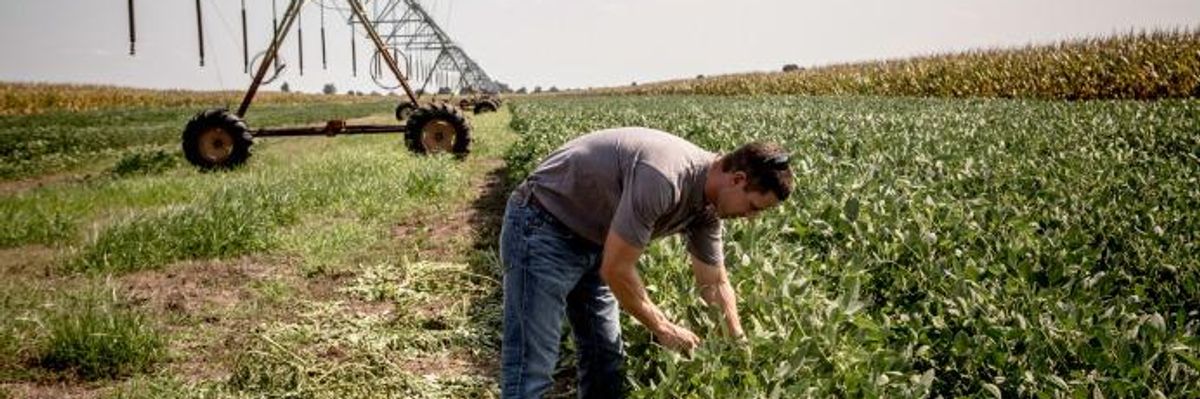
Brad Rose looks at rows of soybean plants that show signs of having been affected by Dicamba use on Aug 9, 2017. He doesn't use it on his crops and he's assured by neighbors within a mile and a half that they haven't used it either. According to him, that means that the chemical had to travel about two miles to reach his crops. Dicamba, a weed killer that has been used for over 50 years, is now having a devastating impact in Arkansas and neighboring states because because the Monsanto is now selling new soybean and cotton varieties that have been genetically altered to tolerate dicamba. (Photo: The Washington Post)
German chemicals giant Bayer announced Monday its intention to "swiftly appeal" a U.S. jury's decision to award a Missouri peach farmer over $265 million in compensation for years of crop losses as a result of drifting dicamba weedkiller.
The legal challenge was the first dicamba suit to go to trial and was brought forth by Bill and Denise Bader, owners of Bader farms. Dicamba is produced by Monsanto, which Bayer acquired in 2018.
Mr. Bader's suit challenged (pdf) Monsanto's "willful and negligent release of a defective crop system--namely its genetically modified Roundup Ready 2 Xtend soybeans and Bollgard II Xtend cotton seeds ("Xtend crops")--without an accompanying, EPA-approved dicamba herbicide."
"Monsanto sold the seeds before the Environmental Protection Agency (EPA) approved the herbicides for market," said the complaint.
The Baders, who did not use dicamba, said they lost over 30,000 trees due to Monsanto's actions, as journlist Carey Gillam wrote earlier this month:
Bader claims Monsanto sold GMO dicamba-tolerant soybean and cotton seeds despite knowing the actions would trigger chemical damage to farm fields that were not planted with the new seeds. The intent, the Bader Farms' lawsuit alleges, was to induce farmers to buy the specialty seeds as a means to prevent crop damage from herbicide drift coming from neighboring farmers who were planting the GMO crops and spraying them with dicamba.
Testing showed that leaves of his dying peach trees carried traces of dicamba. The 5,000-acre family farm, which produced 5 million to 6 million pounds of peaches annually along with corn, soybeans, various berries, apples, and tomatoes, is now struggling to survive, according to Bader.
The jury sided with Bader Farms on Friday and awarded them $15 million in damages, as St. Louis Public Radio reported:
Monsanto and BASF were found liable for negligent design of the products and negligent failure to warn regarding the products. The jury also found that the two companies created a joint venture to manufacture and sell dicamba-resistant seed and low-volatility herbicides, and that they conspired to create an "ecological disaster" to increase profits.
The jury followed up Saturday with a determination that Monsanto and BASF pay $250 million in punitive damages.
The National Family Farm Coalition wondered if the verdict represented the "start of dicamba demise."
In a Saturday tweet, the group called the decision a "victory for farmers which courts will hopefully uphold. Bayer bought #Monsanto with knowledge of these issues and should pay for #dicamba damage."
Pesticide Action Network welcomed the development as well.
"This verdict is just the tip of the iceberg -- there is a long queue of farmers who have been impacted by dicamba drift and deserve their day in court," said Linda Wells, Pesticide Action Network organizing director. "The internal Monsanto (now Bayer) documents uncovered in this case show that the company released a highly destructive and intentionally untested product onto the market, and used its influence to cheat the regulatory system."
"While farmers who don't use the Xtend system are hit with crop damage and yield loss from dicamba drift, Bayer and BASF are reaping the financial gains of an increase in acreage planted to dicamba resistant soybeans, and an increase in use of dicamba formulations," Wells continued. "Bader Farms' victory in this case signals a turning tide, and opens opportunities for farmers to hold Bayer and BASF legally accountable for the dicamba drift crisis more broadly."
As Bloomberg noted Monday, Bayer's legal woes continue "in the face of a hurricane of lawsuits claiming that best-selling weed killer Roundup causes cancer," over 140 cases related to dicamba, upcoming suits related to safety risks of its Essure birth control device, and challenges over PCB-contaminated waterways.
Dear Common Dreams reader, It’s been nearly 30 years since I co-founded Common Dreams with my late wife, Lina Newhouser. We had the radical notion that journalism should serve the public good, not corporate profits. It was clear to us from the outset what it would take to build such a project. No paid advertisements. No corporate sponsors. No millionaire publisher telling us what to think or do. Many people said we wouldn't last a year, but we proved those doubters wrong. Together with a tremendous team of journalists and dedicated staff, we built an independent media outlet free from the constraints of profits and corporate control. Our mission has always been simple: To inform. To inspire. To ignite change for the common good. Building Common Dreams was not easy. Our survival was never guaranteed. When you take on the most powerful forces—Wall Street greed, fossil fuel industry destruction, Big Tech lobbyists, and uber-rich oligarchs who have spent billions upon billions rigging the economy and democracy in their favor—the only bulwark you have is supporters who believe in your work. But here’s the urgent message from me today. It's never been this bad out there. And it's never been this hard to keep us going. At the very moment Common Dreams is most needed, the threats we face are intensifying. We need your support now more than ever. We don't accept corporate advertising and never will. We don't have a paywall because we don't think people should be blocked from critical news based on their ability to pay. Everything we do is funded by the donations of readers like you. When everyone does the little they can afford, we are strong. But if that support retreats or dries up, so do we. Will you donate now to make sure Common Dreams not only survives but thrives? —Craig Brown, Co-founder |
German chemicals giant Bayer announced Monday its intention to "swiftly appeal" a U.S. jury's decision to award a Missouri peach farmer over $265 million in compensation for years of crop losses as a result of drifting dicamba weedkiller.
The legal challenge was the first dicamba suit to go to trial and was brought forth by Bill and Denise Bader, owners of Bader farms. Dicamba is produced by Monsanto, which Bayer acquired in 2018.
Mr. Bader's suit challenged (pdf) Monsanto's "willful and negligent release of a defective crop system--namely its genetically modified Roundup Ready 2 Xtend soybeans and Bollgard II Xtend cotton seeds ("Xtend crops")--without an accompanying, EPA-approved dicamba herbicide."
"Monsanto sold the seeds before the Environmental Protection Agency (EPA) approved the herbicides for market," said the complaint.
The Baders, who did not use dicamba, said they lost over 30,000 trees due to Monsanto's actions, as journlist Carey Gillam wrote earlier this month:
Bader claims Monsanto sold GMO dicamba-tolerant soybean and cotton seeds despite knowing the actions would trigger chemical damage to farm fields that were not planted with the new seeds. The intent, the Bader Farms' lawsuit alleges, was to induce farmers to buy the specialty seeds as a means to prevent crop damage from herbicide drift coming from neighboring farmers who were planting the GMO crops and spraying them with dicamba.
Testing showed that leaves of his dying peach trees carried traces of dicamba. The 5,000-acre family farm, which produced 5 million to 6 million pounds of peaches annually along with corn, soybeans, various berries, apples, and tomatoes, is now struggling to survive, according to Bader.
The jury sided with Bader Farms on Friday and awarded them $15 million in damages, as St. Louis Public Radio reported:
Monsanto and BASF were found liable for negligent design of the products and negligent failure to warn regarding the products. The jury also found that the two companies created a joint venture to manufacture and sell dicamba-resistant seed and low-volatility herbicides, and that they conspired to create an "ecological disaster" to increase profits.
The jury followed up Saturday with a determination that Monsanto and BASF pay $250 million in punitive damages.
The National Family Farm Coalition wondered if the verdict represented the "start of dicamba demise."
In a Saturday tweet, the group called the decision a "victory for farmers which courts will hopefully uphold. Bayer bought #Monsanto with knowledge of these issues and should pay for #dicamba damage."
Pesticide Action Network welcomed the development as well.
"This verdict is just the tip of the iceberg -- there is a long queue of farmers who have been impacted by dicamba drift and deserve their day in court," said Linda Wells, Pesticide Action Network organizing director. "The internal Monsanto (now Bayer) documents uncovered in this case show that the company released a highly destructive and intentionally untested product onto the market, and used its influence to cheat the regulatory system."
"While farmers who don't use the Xtend system are hit with crop damage and yield loss from dicamba drift, Bayer and BASF are reaping the financial gains of an increase in acreage planted to dicamba resistant soybeans, and an increase in use of dicamba formulations," Wells continued. "Bader Farms' victory in this case signals a turning tide, and opens opportunities for farmers to hold Bayer and BASF legally accountable for the dicamba drift crisis more broadly."
As Bloomberg noted Monday, Bayer's legal woes continue "in the face of a hurricane of lawsuits claiming that best-selling weed killer Roundup causes cancer," over 140 cases related to dicamba, upcoming suits related to safety risks of its Essure birth control device, and challenges over PCB-contaminated waterways.
German chemicals giant Bayer announced Monday its intention to "swiftly appeal" a U.S. jury's decision to award a Missouri peach farmer over $265 million in compensation for years of crop losses as a result of drifting dicamba weedkiller.
The legal challenge was the first dicamba suit to go to trial and was brought forth by Bill and Denise Bader, owners of Bader farms. Dicamba is produced by Monsanto, which Bayer acquired in 2018.
Mr. Bader's suit challenged (pdf) Monsanto's "willful and negligent release of a defective crop system--namely its genetically modified Roundup Ready 2 Xtend soybeans and Bollgard II Xtend cotton seeds ("Xtend crops")--without an accompanying, EPA-approved dicamba herbicide."
"Monsanto sold the seeds before the Environmental Protection Agency (EPA) approved the herbicides for market," said the complaint.
The Baders, who did not use dicamba, said they lost over 30,000 trees due to Monsanto's actions, as journlist Carey Gillam wrote earlier this month:
Bader claims Monsanto sold GMO dicamba-tolerant soybean and cotton seeds despite knowing the actions would trigger chemical damage to farm fields that were not planted with the new seeds. The intent, the Bader Farms' lawsuit alleges, was to induce farmers to buy the specialty seeds as a means to prevent crop damage from herbicide drift coming from neighboring farmers who were planting the GMO crops and spraying them with dicamba.
Testing showed that leaves of his dying peach trees carried traces of dicamba. The 5,000-acre family farm, which produced 5 million to 6 million pounds of peaches annually along with corn, soybeans, various berries, apples, and tomatoes, is now struggling to survive, according to Bader.
The jury sided with Bader Farms on Friday and awarded them $15 million in damages, as St. Louis Public Radio reported:
Monsanto and BASF were found liable for negligent design of the products and negligent failure to warn regarding the products. The jury also found that the two companies created a joint venture to manufacture and sell dicamba-resistant seed and low-volatility herbicides, and that they conspired to create an "ecological disaster" to increase profits.
The jury followed up Saturday with a determination that Monsanto and BASF pay $250 million in punitive damages.
The National Family Farm Coalition wondered if the verdict represented the "start of dicamba demise."
In a Saturday tweet, the group called the decision a "victory for farmers which courts will hopefully uphold. Bayer bought #Monsanto with knowledge of these issues and should pay for #dicamba damage."
Pesticide Action Network welcomed the development as well.
"This verdict is just the tip of the iceberg -- there is a long queue of farmers who have been impacted by dicamba drift and deserve their day in court," said Linda Wells, Pesticide Action Network organizing director. "The internal Monsanto (now Bayer) documents uncovered in this case show that the company released a highly destructive and intentionally untested product onto the market, and used its influence to cheat the regulatory system."
"While farmers who don't use the Xtend system are hit with crop damage and yield loss from dicamba drift, Bayer and BASF are reaping the financial gains of an increase in acreage planted to dicamba resistant soybeans, and an increase in use of dicamba formulations," Wells continued. "Bader Farms' victory in this case signals a turning tide, and opens opportunities for farmers to hold Bayer and BASF legally accountable for the dicamba drift crisis more broadly."
As Bloomberg noted Monday, Bayer's legal woes continue "in the face of a hurricane of lawsuits claiming that best-selling weed killer Roundup causes cancer," over 140 cases related to dicamba, upcoming suits related to safety risks of its Essure birth control device, and challenges over PCB-contaminated waterways.