SUBSCRIBE TO OUR FREE NEWSLETTER
Daily news & progressive opinion—funded by the people, not the corporations—delivered straight to your inbox.
5
#000000
#FFFFFF
To donate by check, phone, or other method, see our More Ways to Give page.
Daily news & progressive opinion—funded by the people, not the corporations—delivered straight to your inbox.
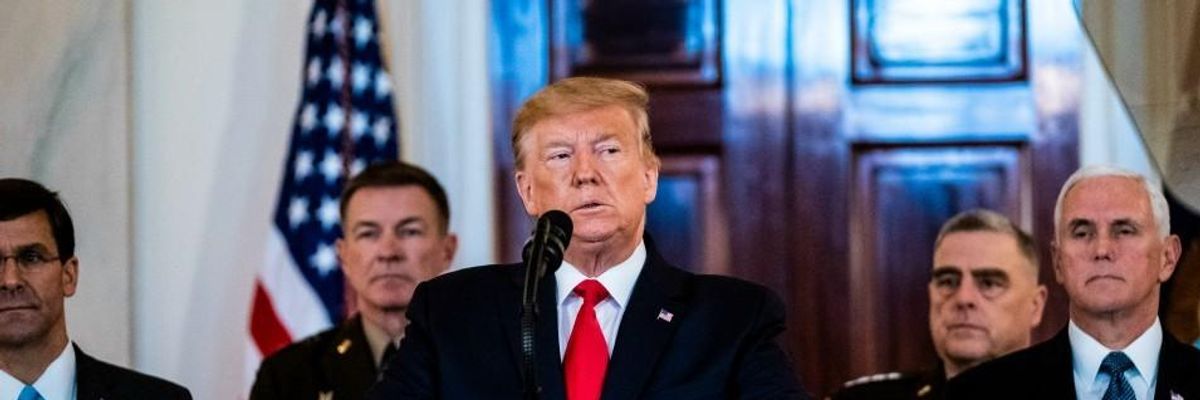
President Donald Trump address to the nation from the Grand Foyer at the White House on Wednesday, January 8, 2020 in Washington, D.C. (Photo: Jabin Botsford/The Washington Post via Getty Images)
New reporting out Monday further erodes the White House narrative that President Donald Trump was justified in ordering the assassination of Iranian Gen. Qasem Soleimani earlier this month because Soleimani posed an "imminent" threat to American targets.
According to NBC News, Trump authorized Soleimani's killing in June--seven months ago--on the condition that Iranian actions resulted in the death of an American. The assassination was pushed by Iran war hawks John Bolton and Mike Pompeo, who wanted the U.S. to carry out the killing in retaliation for Iran shooting down a US. drone in June. Trump responded to the push by responding "that's only on the table if they hit Americans," according to a person briefed on the discussion.
Discussions on targeting Soleimani began even earlier. From NBC:
The idea of killing Soleimani came up in discussions in 2017 that Trump's national security adviser at the time, retired Army Lt. Gen. H.R. McMaster, was having with other administration officials about the president's broader national security strategy, officials said. But it was just one of a host of possible elements of Trump's "maximum pressure" campaign against Iran and "was not something that was thought of as a first move," said a former senior administration official involved in the discussions.
Middle East analyst Juan Cole added to the mounting scrutiny over Trump's "imminent" threat narrative on Monday. Writing at his Informed Comment blog, Cole noted:
[Soleimani] does not appear to have killed or had killed any Americans at all in the past decade, and from 2015 because of the U.N. Security Council nuclear deal with Iran, Soleimani was not an adversary of the US in recent years. In fact, he was often a de facto ally and the U.S. Air Force gave him air support at Tikrit and elsewhere in the campaign against ISIL (ISIS, Daesh). In fact, for a while there Soleimani was fighting ISIL and al-Qaeda-linked militias in Syria in tacit alliance with the Kurds supported by the United States at a time when Israel allied with an al-Qaeda affiliate in the Golan Heights.
Moreover, the entire narrative of the Trump administration was undermined by Iraqi Prime Minister Adil Abdelmahdi, who told Parliament on Jan. 5 when he asked its members to kick out the U.S. military, that he had personally invited Soleimani to Baghdad as part of a back-channel set of negotiations between Saudi Arabia and Iran aimed at cooling down tensions between the two. Soleimani did not sneak into Iraq on a covert mission. He flew on a commercial jet and went through passport control with his diplomatic passport.
While an attempt was made to invade the U.S. embassy on the Wednesday before Soleimani's arrival, that was done by members of the Iraqi militia, the Kata'ib Hizbullah, who were angry that on December 30, the Trump administration bombed its bases in northern Iraq and killed some two dozen of its fighters.
Cole suggested the Trump administration appeared to be taking a page from the George W. Bush administration, which set up the Office of Special Plans to amass sketchy evidence to push the narrative of a threat of weapons of mass destruction posed by Iraq.
Lawmakers from both sides of the aisle have also found evidence presented to them by administration officials to be unconvincing.
Among that group is Sen. Jeff Merkley (D-Ore.), who pointed to Defense Secretary Mark Esper's comments to CBS Sunday that he "didn't see" any specific evidence about four U.S. embassies being targeted by Soleimani.
Speaking on MSNBC's Kasie DC show Sunday, Merkley said, "the whole imminent argument is basically made up and they're trying to backfill and give that some substance."
"But it wasn't there," Merkley said. "It wasn't in the [Senate] brieifing. It wasn't detailed... and there's Secretary Esper trying to square the circle and having a hard time doing it."
Secretary of State Mike Pompeo has also contributed to the doubt over the administration's stated justification, telling Fox News last week that the administration actually didn't know when or where the purported "imminent" attacks were going to take place.
Soleimani's killing has sparked Agnes Callamard, United Nations special rapporteur on extrajudicial executions, to call this month for an impartial probe.
Dear Common Dreams reader, It’s been nearly 30 years since I co-founded Common Dreams with my late wife, Lina Newhouser. We had the radical notion that journalism should serve the public good, not corporate profits. It was clear to us from the outset what it would take to build such a project. No paid advertisements. No corporate sponsors. No millionaire publisher telling us what to think or do. Many people said we wouldn't last a year, but we proved those doubters wrong. Together with a tremendous team of journalists and dedicated staff, we built an independent media outlet free from the constraints of profits and corporate control. Our mission has always been simple: To inform. To inspire. To ignite change for the common good. Building Common Dreams was not easy. Our survival was never guaranteed. When you take on the most powerful forces—Wall Street greed, fossil fuel industry destruction, Big Tech lobbyists, and uber-rich oligarchs who have spent billions upon billions rigging the economy and democracy in their favor—the only bulwark you have is supporters who believe in your work. But here’s the urgent message from me today. It's never been this bad out there. And it's never been this hard to keep us going. At the very moment Common Dreams is most needed, the threats we face are intensifying. We need your support now more than ever. We don't accept corporate advertising and never will. We don't have a paywall because we don't think people should be blocked from critical news based on their ability to pay. Everything we do is funded by the donations of readers like you. When everyone does the little they can afford, we are strong. But if that support retreats or dries up, so do we. Will you donate now to make sure Common Dreams not only survives but thrives? —Craig Brown, Co-founder |
New reporting out Monday further erodes the White House narrative that President Donald Trump was justified in ordering the assassination of Iranian Gen. Qasem Soleimani earlier this month because Soleimani posed an "imminent" threat to American targets.
According to NBC News, Trump authorized Soleimani's killing in June--seven months ago--on the condition that Iranian actions resulted in the death of an American. The assassination was pushed by Iran war hawks John Bolton and Mike Pompeo, who wanted the U.S. to carry out the killing in retaliation for Iran shooting down a US. drone in June. Trump responded to the push by responding "that's only on the table if they hit Americans," according to a person briefed on the discussion.
Discussions on targeting Soleimani began even earlier. From NBC:
The idea of killing Soleimani came up in discussions in 2017 that Trump's national security adviser at the time, retired Army Lt. Gen. H.R. McMaster, was having with other administration officials about the president's broader national security strategy, officials said. But it was just one of a host of possible elements of Trump's "maximum pressure" campaign against Iran and "was not something that was thought of as a first move," said a former senior administration official involved in the discussions.
Middle East analyst Juan Cole added to the mounting scrutiny over Trump's "imminent" threat narrative on Monday. Writing at his Informed Comment blog, Cole noted:
[Soleimani] does not appear to have killed or had killed any Americans at all in the past decade, and from 2015 because of the U.N. Security Council nuclear deal with Iran, Soleimani was not an adversary of the US in recent years. In fact, he was often a de facto ally and the U.S. Air Force gave him air support at Tikrit and elsewhere in the campaign against ISIL (ISIS, Daesh). In fact, for a while there Soleimani was fighting ISIL and al-Qaeda-linked militias in Syria in tacit alliance with the Kurds supported by the United States at a time when Israel allied with an al-Qaeda affiliate in the Golan Heights.
Moreover, the entire narrative of the Trump administration was undermined by Iraqi Prime Minister Adil Abdelmahdi, who told Parliament on Jan. 5 when he asked its members to kick out the U.S. military, that he had personally invited Soleimani to Baghdad as part of a back-channel set of negotiations between Saudi Arabia and Iran aimed at cooling down tensions between the two. Soleimani did not sneak into Iraq on a covert mission. He flew on a commercial jet and went through passport control with his diplomatic passport.
While an attempt was made to invade the U.S. embassy on the Wednesday before Soleimani's arrival, that was done by members of the Iraqi militia, the Kata'ib Hizbullah, who were angry that on December 30, the Trump administration bombed its bases in northern Iraq and killed some two dozen of its fighters.
Cole suggested the Trump administration appeared to be taking a page from the George W. Bush administration, which set up the Office of Special Plans to amass sketchy evidence to push the narrative of a threat of weapons of mass destruction posed by Iraq.
Lawmakers from both sides of the aisle have also found evidence presented to them by administration officials to be unconvincing.
Among that group is Sen. Jeff Merkley (D-Ore.), who pointed to Defense Secretary Mark Esper's comments to CBS Sunday that he "didn't see" any specific evidence about four U.S. embassies being targeted by Soleimani.
Speaking on MSNBC's Kasie DC show Sunday, Merkley said, "the whole imminent argument is basically made up and they're trying to backfill and give that some substance."
"But it wasn't there," Merkley said. "It wasn't in the [Senate] brieifing. It wasn't detailed... and there's Secretary Esper trying to square the circle and having a hard time doing it."
Secretary of State Mike Pompeo has also contributed to the doubt over the administration's stated justification, telling Fox News last week that the administration actually didn't know when or where the purported "imminent" attacks were going to take place.
Soleimani's killing has sparked Agnes Callamard, United Nations special rapporteur on extrajudicial executions, to call this month for an impartial probe.
New reporting out Monday further erodes the White House narrative that President Donald Trump was justified in ordering the assassination of Iranian Gen. Qasem Soleimani earlier this month because Soleimani posed an "imminent" threat to American targets.
According to NBC News, Trump authorized Soleimani's killing in June--seven months ago--on the condition that Iranian actions resulted in the death of an American. The assassination was pushed by Iran war hawks John Bolton and Mike Pompeo, who wanted the U.S. to carry out the killing in retaliation for Iran shooting down a US. drone in June. Trump responded to the push by responding "that's only on the table if they hit Americans," according to a person briefed on the discussion.
Discussions on targeting Soleimani began even earlier. From NBC:
The idea of killing Soleimani came up in discussions in 2017 that Trump's national security adviser at the time, retired Army Lt. Gen. H.R. McMaster, was having with other administration officials about the president's broader national security strategy, officials said. But it was just one of a host of possible elements of Trump's "maximum pressure" campaign against Iran and "was not something that was thought of as a first move," said a former senior administration official involved in the discussions.
Middle East analyst Juan Cole added to the mounting scrutiny over Trump's "imminent" threat narrative on Monday. Writing at his Informed Comment blog, Cole noted:
[Soleimani] does not appear to have killed or had killed any Americans at all in the past decade, and from 2015 because of the U.N. Security Council nuclear deal with Iran, Soleimani was not an adversary of the US in recent years. In fact, he was often a de facto ally and the U.S. Air Force gave him air support at Tikrit and elsewhere in the campaign against ISIL (ISIS, Daesh). In fact, for a while there Soleimani was fighting ISIL and al-Qaeda-linked militias in Syria in tacit alliance with the Kurds supported by the United States at a time when Israel allied with an al-Qaeda affiliate in the Golan Heights.
Moreover, the entire narrative of the Trump administration was undermined by Iraqi Prime Minister Adil Abdelmahdi, who told Parliament on Jan. 5 when he asked its members to kick out the U.S. military, that he had personally invited Soleimani to Baghdad as part of a back-channel set of negotiations between Saudi Arabia and Iran aimed at cooling down tensions between the two. Soleimani did not sneak into Iraq on a covert mission. He flew on a commercial jet and went through passport control with his diplomatic passport.
While an attempt was made to invade the U.S. embassy on the Wednesday before Soleimani's arrival, that was done by members of the Iraqi militia, the Kata'ib Hizbullah, who were angry that on December 30, the Trump administration bombed its bases in northern Iraq and killed some two dozen of its fighters.
Cole suggested the Trump administration appeared to be taking a page from the George W. Bush administration, which set up the Office of Special Plans to amass sketchy evidence to push the narrative of a threat of weapons of mass destruction posed by Iraq.
Lawmakers from both sides of the aisle have also found evidence presented to them by administration officials to be unconvincing.
Among that group is Sen. Jeff Merkley (D-Ore.), who pointed to Defense Secretary Mark Esper's comments to CBS Sunday that he "didn't see" any specific evidence about four U.S. embassies being targeted by Soleimani.
Speaking on MSNBC's Kasie DC show Sunday, Merkley said, "the whole imminent argument is basically made up and they're trying to backfill and give that some substance."
"But it wasn't there," Merkley said. "It wasn't in the [Senate] brieifing. It wasn't detailed... and there's Secretary Esper trying to square the circle and having a hard time doing it."
Secretary of State Mike Pompeo has also contributed to the doubt over the administration's stated justification, telling Fox News last week that the administration actually didn't know when or where the purported "imminent" attacks were going to take place.
Soleimani's killing has sparked Agnes Callamard, United Nations special rapporteur on extrajudicial executions, to call this month for an impartial probe.