SUBSCRIBE TO OUR FREE NEWSLETTER
Daily news & progressive opinion—funded by the people, not the corporations—delivered straight to your inbox.
5
#000000
#FFFFFF
To donate by check, phone, or other method, see our More Ways to Give page.
Daily news & progressive opinion—funded by the people, not the corporations—delivered straight to your inbox.
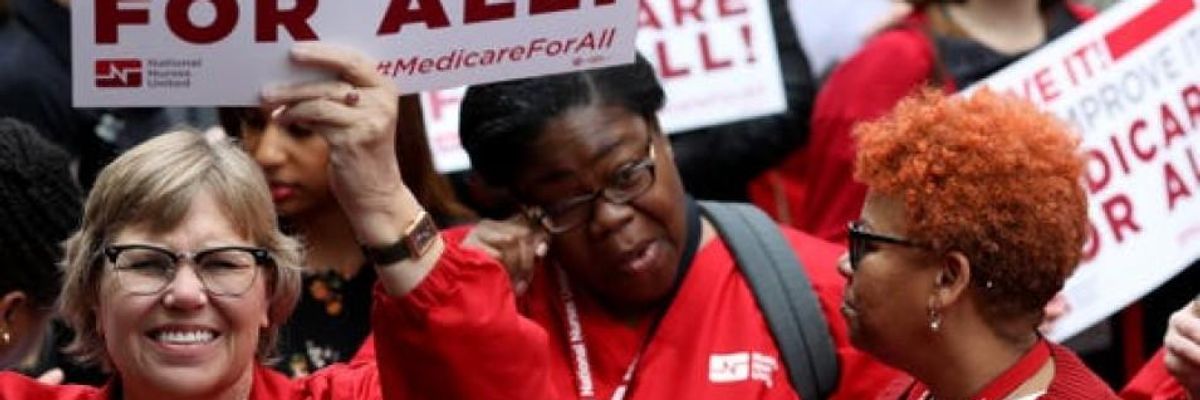
"We can brag we have the most expensive healthcare. We can also now brag that it delivers the worst health of any rich country," economist Anne Case said at the annual meeting of the American Economic Association. (Photo: Win McNamee/Getty Images)
Highlighting the thousands of dollars American households are forced to pay in healthcare costs that people in other wealthy countries save thanks to universal healthcare plans, two top economists wondered aloud this weekend why Americans have accepted increasingly high costs and poor health outcomes for decades.
At the annual meeting of the American Economic Association in San Diego on Saturday, Princeton University economists Anne Case and Angus Deaton said they were "surprised Americans aren't revolting against" the $8,000 per year that U.S. households pay to doctors, hospitals, health insurance companies, the pharmaceutical industry, and the rest of the for-profit healthcare system, compared to what people in other countries.
"A few people are getting very rich at the expense of the rest of us," Case said.
Case and Deaton compared the yearly costs to a poll tax, or head tax, because the costs apply to all Americans regardless of their ability to pay. Americans pay $8,000 a year more than what people in Switzerland pay to that country's system--the second-most expensive healthcare system in the world after the United States.
The payments made to the U.S. healthcare system are "like a tribute to a foreign power, but we're doing it to ourselves," Case said.
Calling the expenditures "a tax" led one single-payer healthcare advocate on social media to question the premise used by many people who oppose Medicare for All on the grounds that some Americans' tax bills would rise slightly to pay for the program.
"I've been trying to get this message across for years now," tweeted former congressional candidate and physician Kathie Allen. "So what if your taxes went up modestly?"
While campaigning for the Democratic nomination in the 2020 presidential race, Sens. Bernie Sanders (I-Vt.) and Elizabeth Warren (D-Mass.) have also rejected the notion that Americans should fear higher taxes under Medicare for All, considering the annual "tax" they essentially pay to the for-profit healthcare industry.
"We are going to increase personal taxes," Sanders said at last month's Democratic debate. "But we're eliminating premiums, we're eliminating co-payments, we're eliminating deductibles, we're eliminating all out-of-pocket expenses, and no family in America will spend more than $200 a year on prescription drugs."
Case and Deaton, who are the authors of an upcoming book called Deaths of Despair and the Future of Capitalism, say skyrocketing healthcare costs over the past two decades have helped drive the rising number of deaths from opioid overdoses, alcohol-related diseases, and suicide.
"We can brag we have the most expensive healthcare. We can also now brag that it delivers the worst health of any rich country," Case said.
Case and Deaton spoke two days before researchers at the University of Michigan released a study showing that because of price-gouging by the for-profit healthcare industry, the cost of childbirth in the U.S. went up by about $1,500 from 2008 when it cost about $3,000 to 2015 when the average rose to more than $4,500--an increase of more than 50 percent.
Although the net costs associated with childbirth remained relatively stable over that time period, the Affordable Care Act's "relative lack of restrictions on things like co-pays and deductibles" allowed insurance companies to "sneakily shift the financial onus onto [patients] by charging them more upfront," according to Claire Lampen at The Cut.
Case and Deaton's statements on healthcare costs led to renewed calls on social media for Medicare for All.
"Nobody should have to choose between their health and providing for their family, yet that is the reality for so many Americans," tweeted Rep. Carolyn Maloney (D-N.Y.).
Dear Common Dreams reader, It’s been nearly 30 years since I co-founded Common Dreams with my late wife, Lina Newhouser. We had the radical notion that journalism should serve the public good, not corporate profits. It was clear to us from the outset what it would take to build such a project. No paid advertisements. No corporate sponsors. No millionaire publisher telling us what to think or do. Many people said we wouldn't last a year, but we proved those doubters wrong. Together with a tremendous team of journalists and dedicated staff, we built an independent media outlet free from the constraints of profits and corporate control. Our mission has always been simple: To inform. To inspire. To ignite change for the common good. Building Common Dreams was not easy. Our survival was never guaranteed. When you take on the most powerful forces—Wall Street greed, fossil fuel industry destruction, Big Tech lobbyists, and uber-rich oligarchs who have spent billions upon billions rigging the economy and democracy in their favor—the only bulwark you have is supporters who believe in your work. But here’s the urgent message from me today. It's never been this bad out there. And it's never been this hard to keep us going. At the very moment Common Dreams is most needed, the threats we face are intensifying. We need your support now more than ever. We don't accept corporate advertising and never will. We don't have a paywall because we don't think people should be blocked from critical news based on their ability to pay. Everything we do is funded by the donations of readers like you. When everyone does the little they can afford, we are strong. But if that support retreats or dries up, so do we. Will you donate now to make sure Common Dreams not only survives but thrives? —Craig Brown, Co-founder |
Highlighting the thousands of dollars American households are forced to pay in healthcare costs that people in other wealthy countries save thanks to universal healthcare plans, two top economists wondered aloud this weekend why Americans have accepted increasingly high costs and poor health outcomes for decades.
At the annual meeting of the American Economic Association in San Diego on Saturday, Princeton University economists Anne Case and Angus Deaton said they were "surprised Americans aren't revolting against" the $8,000 per year that U.S. households pay to doctors, hospitals, health insurance companies, the pharmaceutical industry, and the rest of the for-profit healthcare system, compared to what people in other countries.
"A few people are getting very rich at the expense of the rest of us," Case said.
Case and Deaton compared the yearly costs to a poll tax, or head tax, because the costs apply to all Americans regardless of their ability to pay. Americans pay $8,000 a year more than what people in Switzerland pay to that country's system--the second-most expensive healthcare system in the world after the United States.
The payments made to the U.S. healthcare system are "like a tribute to a foreign power, but we're doing it to ourselves," Case said.
Calling the expenditures "a tax" led one single-payer healthcare advocate on social media to question the premise used by many people who oppose Medicare for All on the grounds that some Americans' tax bills would rise slightly to pay for the program.
"I've been trying to get this message across for years now," tweeted former congressional candidate and physician Kathie Allen. "So what if your taxes went up modestly?"
While campaigning for the Democratic nomination in the 2020 presidential race, Sens. Bernie Sanders (I-Vt.) and Elizabeth Warren (D-Mass.) have also rejected the notion that Americans should fear higher taxes under Medicare for All, considering the annual "tax" they essentially pay to the for-profit healthcare industry.
"We are going to increase personal taxes," Sanders said at last month's Democratic debate. "But we're eliminating premiums, we're eliminating co-payments, we're eliminating deductibles, we're eliminating all out-of-pocket expenses, and no family in America will spend more than $200 a year on prescription drugs."
Case and Deaton, who are the authors of an upcoming book called Deaths of Despair and the Future of Capitalism, say skyrocketing healthcare costs over the past two decades have helped drive the rising number of deaths from opioid overdoses, alcohol-related diseases, and suicide.
"We can brag we have the most expensive healthcare. We can also now brag that it delivers the worst health of any rich country," Case said.
Case and Deaton spoke two days before researchers at the University of Michigan released a study showing that because of price-gouging by the for-profit healthcare industry, the cost of childbirth in the U.S. went up by about $1,500 from 2008 when it cost about $3,000 to 2015 when the average rose to more than $4,500--an increase of more than 50 percent.
Although the net costs associated with childbirth remained relatively stable over that time period, the Affordable Care Act's "relative lack of restrictions on things like co-pays and deductibles" allowed insurance companies to "sneakily shift the financial onus onto [patients] by charging them more upfront," according to Claire Lampen at The Cut.
Case and Deaton's statements on healthcare costs led to renewed calls on social media for Medicare for All.
"Nobody should have to choose between their health and providing for their family, yet that is the reality for so many Americans," tweeted Rep. Carolyn Maloney (D-N.Y.).
Highlighting the thousands of dollars American households are forced to pay in healthcare costs that people in other wealthy countries save thanks to universal healthcare plans, two top economists wondered aloud this weekend why Americans have accepted increasingly high costs and poor health outcomes for decades.
At the annual meeting of the American Economic Association in San Diego on Saturday, Princeton University economists Anne Case and Angus Deaton said they were "surprised Americans aren't revolting against" the $8,000 per year that U.S. households pay to doctors, hospitals, health insurance companies, the pharmaceutical industry, and the rest of the for-profit healthcare system, compared to what people in other countries.
"A few people are getting very rich at the expense of the rest of us," Case said.
Case and Deaton compared the yearly costs to a poll tax, or head tax, because the costs apply to all Americans regardless of their ability to pay. Americans pay $8,000 a year more than what people in Switzerland pay to that country's system--the second-most expensive healthcare system in the world after the United States.
The payments made to the U.S. healthcare system are "like a tribute to a foreign power, but we're doing it to ourselves," Case said.
Calling the expenditures "a tax" led one single-payer healthcare advocate on social media to question the premise used by many people who oppose Medicare for All on the grounds that some Americans' tax bills would rise slightly to pay for the program.
"I've been trying to get this message across for years now," tweeted former congressional candidate and physician Kathie Allen. "So what if your taxes went up modestly?"
While campaigning for the Democratic nomination in the 2020 presidential race, Sens. Bernie Sanders (I-Vt.) and Elizabeth Warren (D-Mass.) have also rejected the notion that Americans should fear higher taxes under Medicare for All, considering the annual "tax" they essentially pay to the for-profit healthcare industry.
"We are going to increase personal taxes," Sanders said at last month's Democratic debate. "But we're eliminating premiums, we're eliminating co-payments, we're eliminating deductibles, we're eliminating all out-of-pocket expenses, and no family in America will spend more than $200 a year on prescription drugs."
Case and Deaton, who are the authors of an upcoming book called Deaths of Despair and the Future of Capitalism, say skyrocketing healthcare costs over the past two decades have helped drive the rising number of deaths from opioid overdoses, alcohol-related diseases, and suicide.
"We can brag we have the most expensive healthcare. We can also now brag that it delivers the worst health of any rich country," Case said.
Case and Deaton spoke two days before researchers at the University of Michigan released a study showing that because of price-gouging by the for-profit healthcare industry, the cost of childbirth in the U.S. went up by about $1,500 from 2008 when it cost about $3,000 to 2015 when the average rose to more than $4,500--an increase of more than 50 percent.
Although the net costs associated with childbirth remained relatively stable over that time period, the Affordable Care Act's "relative lack of restrictions on things like co-pays and deductibles" allowed insurance companies to "sneakily shift the financial onus onto [patients] by charging them more upfront," according to Claire Lampen at The Cut.
Case and Deaton's statements on healthcare costs led to renewed calls on social media for Medicare for All.
"Nobody should have to choose between their health and providing for their family, yet that is the reality for so many Americans," tweeted Rep. Carolyn Maloney (D-N.Y.).