SUBSCRIBE TO OUR FREE NEWSLETTER
Daily news & progressive opinion—funded by the people, not the corporations—delivered straight to your inbox.
5
#000000
#FFFFFF
To donate by check, phone, or other method, see our More Ways to Give page.
Daily news & progressive opinion—funded by the people, not the corporations—delivered straight to your inbox.
Activists demonstrated outside the U.S. Embassy in Madrid Tuesday.
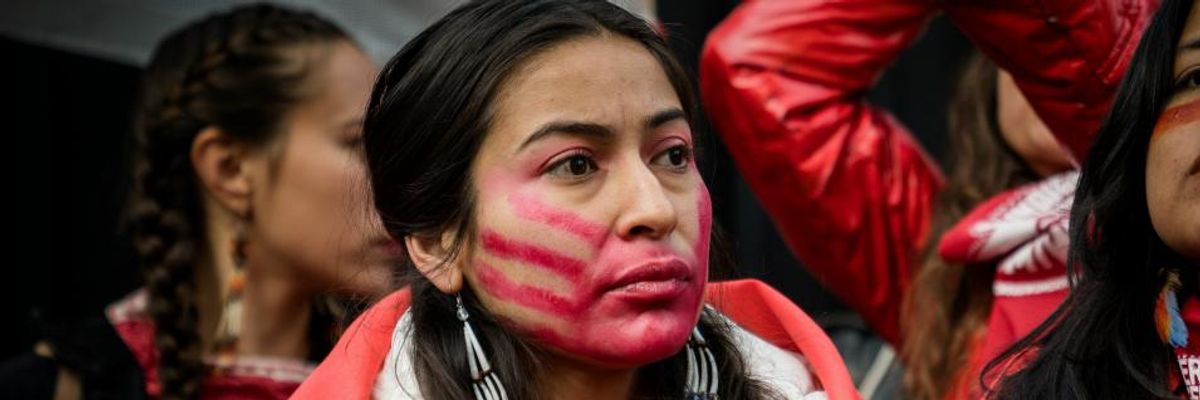
While representatives from governments across the globe gathered in Madrid Tuesday for the ongoing COP 25 climate summit, dozens of activists demonstrated outside the U.S. Embassy in the Spanish capital to demand justice for missing and murdered Indigenous women, girls, and Two-Spirits, as they highlighted the fossil fuel industry's connection to violence against them.
Casey Camp-Horinek of the Ponca Nation in Oklahoma explained that primarily male workers flock to regions near Indigenous lands for job opportunities in extractive industries and often end up living in so-called "man camps."
"Whether in rundown motels or pop-up camps, certain things hold true. There is an influx of transient workers who bring alcohol, drugs, and violence, such as rape, murder, and human trafficking," Camp-Horinek said.
Moneka De Oro of Guam participated in the protest, which Spanish police shut down "within minutes." She told Democracy Now! that "I see that my struggle to protect my land and waters from militarization and from the expansion of U.S. imperialism in my waters and in the whole region of Micronesia is very much connected to the violence and the assaults on the women across North and South America."
Protesters carried signs that read, "Protect Indigenous women, trans, girls, people" and "Protect Mother Earth." One unnamed demonstrator choked back tears while speaking to reporters about "women who have been sacrificed on the altar of the extractive industry" and explaining how the activists aim to bring visibility to the crisis with the protest Tuesday.
"We call on the global community and all peoples of the United States to join our call for action, to join our call for recognition, and to join our demands for the real action it will take to protect and respect Indigenous women," Ozawa Bineshi Albert, movement building coordinator with the Indigenous Environmental Network (IEN), said in a statement.
"This is not a political issue that should be used to generate votes," she added. "It's a matter of life and death, of dignity, which is why all federal initiatives must include local Indigenous communities in positions of leadership that recognize and respect our sovereignty."
In June, the Canadian government's National Inquiry into Missing and Murdered Indigenous Women and Girls (MMIWG) released a report detailing the crisis. Late last month, U.S. President Donald Trump signed an executive order to create the Operation Lady Justice Task Force, which is charged with reviewing unsolved cases and raising public awareness. However, both federal governments also have helped extractive industries continue to expand.
Addressing the connection between fossil fuel production and MMIWG, Albert told Sonali Kolhatkar that "if you think about what we're saying around eco-colonialism, it's the new generation of colonialism and the same sort of mindset that says the land can be exploited for our use, for profit, for exploitation--that that violence that happens on the earth, that same mindset creates the conditions that make it easy to see Indigenous women [as] lesser than or [as] resources to be consumed."
Albert stressed the need for significant improvements when it comes to law enforcement's response to the crisis and collecting data on those missing or killed. The Urban Indian Health Institute noted in a report (pdf) last year that according the National Crime Information Center, "in 2016, there were 5,712 reports of missing American Indian and Alaska Native women and girls, though the U.S. Department of Justice's federal missing persons database, NamUs, only logged 116 cases."
This country and this world are at a monumental crossroads. US voters have an opportunity to beat back the forces of fascism and confront the billionaires who are rigging the economy, our media system, and our democracy, making it increasingly impossible for ordinary people to get by. We’re not just talking about the election. We’re talking about what must be done once these fascist elements are vanquished from power. We need a bolder set of solutions than what either major party has so far been willing to offer and a working-class movement ready to fight like hell for it. Trump didn't emerge from nowhere. The conditions that fueled MAGA authoritarianism were created by decades of radical neoliberal economic policies and a corrupt political system dominated by corporate interests. They slashed taxes on the super-rich, promising that the benefits would trickle down. They said giveaways to the corporate titans would make life more affordable for the rest of us. It was all bullshit. And when a bitter, betrayed populace searches for someone to blame, right-wing demagogues have little trouble finding scapegoats. People know when they're being lied to, but you won't hear any of this from the corporate media. Only independent journalism—powered and funded by people who believe in building a better world—can deliver truly trustworthy daily news. If you share our vision, please contribute whatever you can to sustain our work. |
While representatives from governments across the globe gathered in Madrid Tuesday for the ongoing COP 25 climate summit, dozens of activists demonstrated outside the U.S. Embassy in the Spanish capital to demand justice for missing and murdered Indigenous women, girls, and Two-Spirits, as they highlighted the fossil fuel industry's connection to violence against them.
Casey Camp-Horinek of the Ponca Nation in Oklahoma explained that primarily male workers flock to regions near Indigenous lands for job opportunities in extractive industries and often end up living in so-called "man camps."
"Whether in rundown motels or pop-up camps, certain things hold true. There is an influx of transient workers who bring alcohol, drugs, and violence, such as rape, murder, and human trafficking," Camp-Horinek said.
Moneka De Oro of Guam participated in the protest, which Spanish police shut down "within minutes." She told Democracy Now! that "I see that my struggle to protect my land and waters from militarization and from the expansion of U.S. imperialism in my waters and in the whole region of Micronesia is very much connected to the violence and the assaults on the women across North and South America."
Protesters carried signs that read, "Protect Indigenous women, trans, girls, people" and "Protect Mother Earth." One unnamed demonstrator choked back tears while speaking to reporters about "women who have been sacrificed on the altar of the extractive industry" and explaining how the activists aim to bring visibility to the crisis with the protest Tuesday.
"We call on the global community and all peoples of the United States to join our call for action, to join our call for recognition, and to join our demands for the real action it will take to protect and respect Indigenous women," Ozawa Bineshi Albert, movement building coordinator with the Indigenous Environmental Network (IEN), said in a statement.
"This is not a political issue that should be used to generate votes," she added. "It's a matter of life and death, of dignity, which is why all federal initiatives must include local Indigenous communities in positions of leadership that recognize and respect our sovereignty."
In June, the Canadian government's National Inquiry into Missing and Murdered Indigenous Women and Girls (MMIWG) released a report detailing the crisis. Late last month, U.S. President Donald Trump signed an executive order to create the Operation Lady Justice Task Force, which is charged with reviewing unsolved cases and raising public awareness. However, both federal governments also have helped extractive industries continue to expand.
Addressing the connection between fossil fuel production and MMIWG, Albert told Sonali Kolhatkar that "if you think about what we're saying around eco-colonialism, it's the new generation of colonialism and the same sort of mindset that says the land can be exploited for our use, for profit, for exploitation--that that violence that happens on the earth, that same mindset creates the conditions that make it easy to see Indigenous women [as] lesser than or [as] resources to be consumed."
Albert stressed the need for significant improvements when it comes to law enforcement's response to the crisis and collecting data on those missing or killed. The Urban Indian Health Institute noted in a report (pdf) last year that according the National Crime Information Center, "in 2016, there were 5,712 reports of missing American Indian and Alaska Native women and girls, though the U.S. Department of Justice's federal missing persons database, NamUs, only logged 116 cases."