SUBSCRIBE TO OUR FREE NEWSLETTER
Daily news & progressive opinion—funded by the people, not the corporations—delivered straight to your inbox.
5
#000000
#FFFFFF
To donate by check, phone, or other method, see our More Ways to Give page.
Daily news & progressive opinion—funded by the people, not the corporations—delivered straight to your inbox.
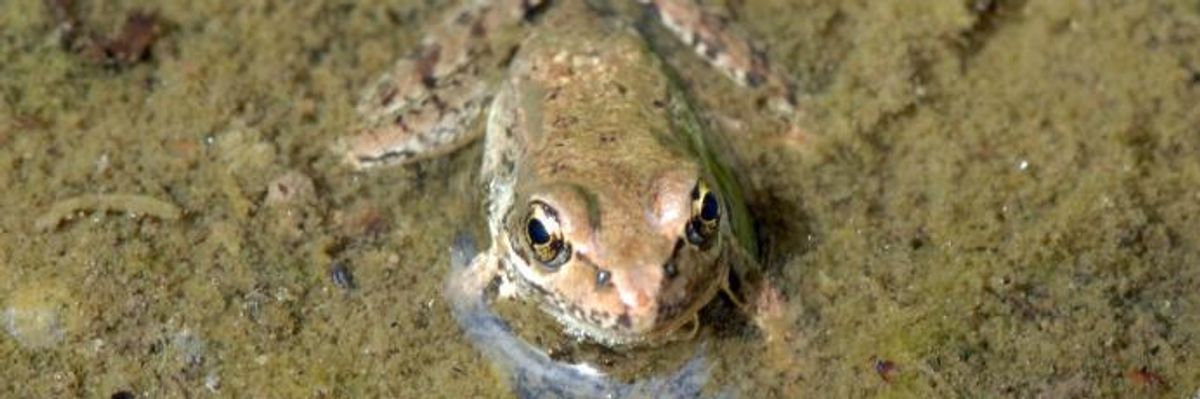
A red-legged frog sits in a backyard pond in Washington state. Trump's EPA proposed Thursday increasing the allowable levels of atrazine in waterways. (Photo: Dan Dzurisin/flickr/cc)
Environmental and public health advocacy groups expressed alarm Friday after the Trump administration moved to increase the allowable level in U.S. waterways of a common herbicide linked to hermaphroditic amphibians and birth defects, cancer, and other harmful health effects in humans.
At issue in the proposal posted yesterday by the EPA is the threshold level of atrazine, the second most widely used herbicide in the U.S. Manufactured by Syngenta, atrazine is primarily used in agriculture as a weedkiller on crops. It is not authorized for use in the European Union, as the body said there wasn't enough data to prove it wouldn't have a harmful effect on groundwater.
"Human exposure to atrazine is linked to a number of serious health effects," according to a factsheet from Pesticide Action Network. "A potent endocrine disrupter, atrazine interferes with hormonal activity of animals and humans at extremely low doses."
The proposed change, said Nathan Donley, a senior scientist at the Center for Biological Diversity, "will likely lead to an increase in atrazine in drinking water, particularly in the Midwest."
As Donley's group and Environmental Working Group (EWG) explain in a press statement, the proposal regards what the EPA calls the Concentration Equivalent Level of Concern (CELOC).
"Atrazine levels above this threshold require mitigations to bring the water body back into compliance. Below, this level, no action is required," as Donley said in tweet.
Trump's EPA is proposing bumping up the level to a 60-day average concentration of 15 parts per billion (ppb) of atrazine, 50% higher than the current level of 10 ppb. In 2016 the agency proposed a level of just 3.4 ppb, but that Obama-era assessment, according to Trump's EPA, was "fundamentally flawed" and failed to take into consideration "the relevance of the individual studies."
Driving the push towards higher acceptable levels of atrazine, according to EWG and the Center, is the administration's goal of appeasing Big Ag and the pesticide industry.
"To please Syngenta, the Trump EPA has rejected decades of independent research showing atrazine can't be safely used at any level," said Donley. "The pro-industry zealots now running the EPA's pesticide office are making a mockery of science and eliminating key safety measures, all for company profits."
Olga Naidenko, EWG's vice president for science investigations, warned of the possible impacts to children.
"Atrazine sprayed on the fields ends up in our drinking water and affects the development of the fetus," said Naidenko. Thus, she said, the proposal should provoke "outrage" as it "will lead to more children being exposed to this toxic chemical."
"With Trump's EPA reversing even the most commonsense protections," added Donley, "our health, and the health of all species, is in serious danger."
Dear Common Dreams reader, It’s been nearly 30 years since I co-founded Common Dreams with my late wife, Lina Newhouser. We had the radical notion that journalism should serve the public good, not corporate profits. It was clear to us from the outset what it would take to build such a project. No paid advertisements. No corporate sponsors. No millionaire publisher telling us what to think or do. Many people said we wouldn't last a year, but we proved those doubters wrong. Together with a tremendous team of journalists and dedicated staff, we built an independent media outlet free from the constraints of profits and corporate control. Our mission has always been simple: To inform. To inspire. To ignite change for the common good. Building Common Dreams was not easy. Our survival was never guaranteed. When you take on the most powerful forces—Wall Street greed, fossil fuel industry destruction, Big Tech lobbyists, and uber-rich oligarchs who have spent billions upon billions rigging the economy and democracy in their favor—the only bulwark you have is supporters who believe in your work. But here’s the urgent message from me today. It's never been this bad out there. And it's never been this hard to keep us going. At the very moment Common Dreams is most needed, the threats we face are intensifying. We need your support now more than ever. We don't accept corporate advertising and never will. We don't have a paywall because we don't think people should be blocked from critical news based on their ability to pay. Everything we do is funded by the donations of readers like you. When everyone does the little they can afford, we are strong. But if that support retreats or dries up, so do we. Will you donate now to make sure Common Dreams not only survives but thrives? —Craig Brown, Co-founder |
Environmental and public health advocacy groups expressed alarm Friday after the Trump administration moved to increase the allowable level in U.S. waterways of a common herbicide linked to hermaphroditic amphibians and birth defects, cancer, and other harmful health effects in humans.
At issue in the proposal posted yesterday by the EPA is the threshold level of atrazine, the second most widely used herbicide in the U.S. Manufactured by Syngenta, atrazine is primarily used in agriculture as a weedkiller on crops. It is not authorized for use in the European Union, as the body said there wasn't enough data to prove it wouldn't have a harmful effect on groundwater.
"Human exposure to atrazine is linked to a number of serious health effects," according to a factsheet from Pesticide Action Network. "A potent endocrine disrupter, atrazine interferes with hormonal activity of animals and humans at extremely low doses."
The proposed change, said Nathan Donley, a senior scientist at the Center for Biological Diversity, "will likely lead to an increase in atrazine in drinking water, particularly in the Midwest."
As Donley's group and Environmental Working Group (EWG) explain in a press statement, the proposal regards what the EPA calls the Concentration Equivalent Level of Concern (CELOC).
"Atrazine levels above this threshold require mitigations to bring the water body back into compliance. Below, this level, no action is required," as Donley said in tweet.
Trump's EPA is proposing bumping up the level to a 60-day average concentration of 15 parts per billion (ppb) of atrazine, 50% higher than the current level of 10 ppb. In 2016 the agency proposed a level of just 3.4 ppb, but that Obama-era assessment, according to Trump's EPA, was "fundamentally flawed" and failed to take into consideration "the relevance of the individual studies."
Driving the push towards higher acceptable levels of atrazine, according to EWG and the Center, is the administration's goal of appeasing Big Ag and the pesticide industry.
"To please Syngenta, the Trump EPA has rejected decades of independent research showing atrazine can't be safely used at any level," said Donley. "The pro-industry zealots now running the EPA's pesticide office are making a mockery of science and eliminating key safety measures, all for company profits."
Olga Naidenko, EWG's vice president for science investigations, warned of the possible impacts to children.
"Atrazine sprayed on the fields ends up in our drinking water and affects the development of the fetus," said Naidenko. Thus, she said, the proposal should provoke "outrage" as it "will lead to more children being exposed to this toxic chemical."
"With Trump's EPA reversing even the most commonsense protections," added Donley, "our health, and the health of all species, is in serious danger."
Environmental and public health advocacy groups expressed alarm Friday after the Trump administration moved to increase the allowable level in U.S. waterways of a common herbicide linked to hermaphroditic amphibians and birth defects, cancer, and other harmful health effects in humans.
At issue in the proposal posted yesterday by the EPA is the threshold level of atrazine, the second most widely used herbicide in the U.S. Manufactured by Syngenta, atrazine is primarily used in agriculture as a weedkiller on crops. It is not authorized for use in the European Union, as the body said there wasn't enough data to prove it wouldn't have a harmful effect on groundwater.
"Human exposure to atrazine is linked to a number of serious health effects," according to a factsheet from Pesticide Action Network. "A potent endocrine disrupter, atrazine interferes with hormonal activity of animals and humans at extremely low doses."
The proposed change, said Nathan Donley, a senior scientist at the Center for Biological Diversity, "will likely lead to an increase in atrazine in drinking water, particularly in the Midwest."
As Donley's group and Environmental Working Group (EWG) explain in a press statement, the proposal regards what the EPA calls the Concentration Equivalent Level of Concern (CELOC).
"Atrazine levels above this threshold require mitigations to bring the water body back into compliance. Below, this level, no action is required," as Donley said in tweet.
Trump's EPA is proposing bumping up the level to a 60-day average concentration of 15 parts per billion (ppb) of atrazine, 50% higher than the current level of 10 ppb. In 2016 the agency proposed a level of just 3.4 ppb, but that Obama-era assessment, according to Trump's EPA, was "fundamentally flawed" and failed to take into consideration "the relevance of the individual studies."
Driving the push towards higher acceptable levels of atrazine, according to EWG and the Center, is the administration's goal of appeasing Big Ag and the pesticide industry.
"To please Syngenta, the Trump EPA has rejected decades of independent research showing atrazine can't be safely used at any level," said Donley. "The pro-industry zealots now running the EPA's pesticide office are making a mockery of science and eliminating key safety measures, all for company profits."
Olga Naidenko, EWG's vice president for science investigations, warned of the possible impacts to children.
"Atrazine sprayed on the fields ends up in our drinking water and affects the development of the fetus," said Naidenko. Thus, she said, the proposal should provoke "outrage" as it "will lead to more children being exposed to this toxic chemical."
"With Trump's EPA reversing even the most commonsense protections," added Donley, "our health, and the health of all species, is in serious danger."