SUBSCRIBE TO OUR FREE NEWSLETTER
Daily news & progressive opinion—funded by the people, not the corporations—delivered straight to your inbox.
5
#000000
#FFFFFF
To donate by check, phone, or other method, see our More Ways to Give page.
Daily news & progressive opinion—funded by the people, not the corporations—delivered straight to your inbox.
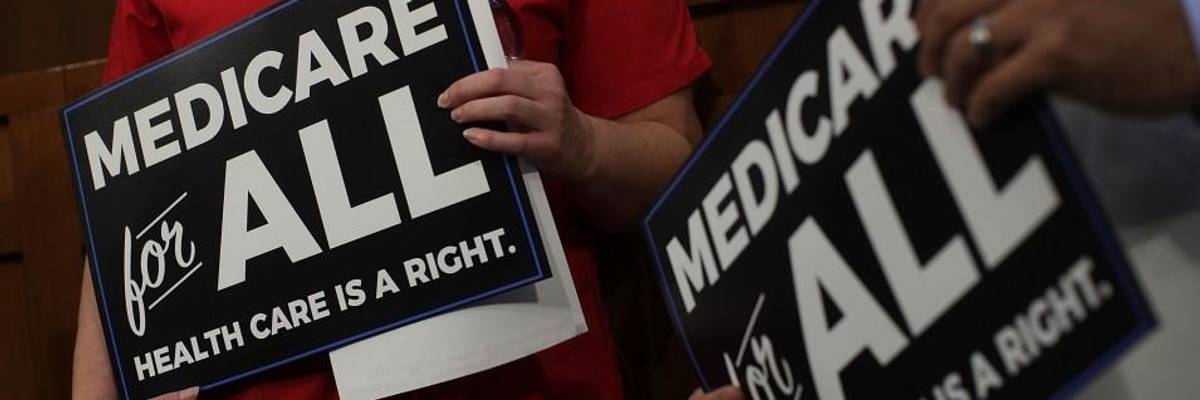
The House Budget Committee held the second-ever congressional hearing on Medicare for All Wednesday. (Photo: Alex Wong/Getty Images)
After Democrats held the first-ever congressional hearing on Medicare for All last month, the House Budget Committee on Wednesday morning invited federal officials to testify at an historic second hearing on the costs replacing the nation's current for-profit system with one that guarantees healthcare as a right for all Americans.
Watch:
Unlike the hearing in April in the House Rules Committee, Wednesday's hearing did not feature outside experts or activists. Instead, all three witnesses are officials from the Congressional Budget Office (CBO), the federal agency that provides budget and economic information to Congress.
Given the hearing's focus on a recent CBO analysis, Susannah Luthi highlighted "five things to listen for as Republicans look for points for 2020 campaign messaging and Democrats try to keep the focus on how to close the coverage gap that persists despite the Affordable Care Act" in an article for Modern Healthcare: cost, hospital ownership, private insurance, rates, and limiting utilization.
The hearing's restrictive witness list did not stop advocates of the Medicare for All Act of 2019 (H.R. 1384)--introduced by Rep. Pramila Jayapal (D-Wash.) in February--from showing their support. On Tuesday, 209 economists signed a public statement which says in part, "the time is now to create a universal, single-payer, Medicare for All healthcare system in the United States."
Jean Ross, Zenei Cortez, and Deborah Burger--co-presidents of National Nurses United, the group that shared the economists' statement--welcomed the hearing on Wednesday, calling it "another step towards passing this vital piece of legislation."
The CBO's report on the bill, the nurses said in a statement, "shows that a Medicare for All system can be designed and implemented in the United States in a way where every man, woman, and child can have guaranteed, safe, therapeutic healthcare and that the country can save trillions of dollars in the process."
Other backers of Jayapal's bill drew attention to the 12 Democratic lawmakers on the committee who have not yet signaled their support for the measure, urging their constituents to put pressure on their elected representatives. As former congressional candidate Amy Vilela put it, "It's time for bold leadership--lives depend on it!"
Dear Common Dreams reader, It’s been nearly 30 years since I co-founded Common Dreams with my late wife, Lina Newhouser. We had the radical notion that journalism should serve the public good, not corporate profits. It was clear to us from the outset what it would take to build such a project. No paid advertisements. No corporate sponsors. No millionaire publisher telling us what to think or do. Many people said we wouldn't last a year, but we proved those doubters wrong. Together with a tremendous team of journalists and dedicated staff, we built an independent media outlet free from the constraints of profits and corporate control. Our mission has always been simple: To inform. To inspire. To ignite change for the common good. Building Common Dreams was not easy. Our survival was never guaranteed. When you take on the most powerful forces—Wall Street greed, fossil fuel industry destruction, Big Tech lobbyists, and uber-rich oligarchs who have spent billions upon billions rigging the economy and democracy in their favor—the only bulwark you have is supporters who believe in your work. But here’s the urgent message from me today. It's never been this bad out there. And it's never been this hard to keep us going. At the very moment Common Dreams is most needed, the threats we face are intensifying. We need your support now more than ever. We don't accept corporate advertising and never will. We don't have a paywall because we don't think people should be blocked from critical news based on their ability to pay. Everything we do is funded by the donations of readers like you. When everyone does the little they can afford, we are strong. But if that support retreats or dries up, so do we. Will you donate now to make sure Common Dreams not only survives but thrives? —Craig Brown, Co-founder |
After Democrats held the first-ever congressional hearing on Medicare for All last month, the House Budget Committee on Wednesday morning invited federal officials to testify at an historic second hearing on the costs replacing the nation's current for-profit system with one that guarantees healthcare as a right for all Americans.
Watch:
Unlike the hearing in April in the House Rules Committee, Wednesday's hearing did not feature outside experts or activists. Instead, all three witnesses are officials from the Congressional Budget Office (CBO), the federal agency that provides budget and economic information to Congress.
Given the hearing's focus on a recent CBO analysis, Susannah Luthi highlighted "five things to listen for as Republicans look for points for 2020 campaign messaging and Democrats try to keep the focus on how to close the coverage gap that persists despite the Affordable Care Act" in an article for Modern Healthcare: cost, hospital ownership, private insurance, rates, and limiting utilization.
The hearing's restrictive witness list did not stop advocates of the Medicare for All Act of 2019 (H.R. 1384)--introduced by Rep. Pramila Jayapal (D-Wash.) in February--from showing their support. On Tuesday, 209 economists signed a public statement which says in part, "the time is now to create a universal, single-payer, Medicare for All healthcare system in the United States."
Jean Ross, Zenei Cortez, and Deborah Burger--co-presidents of National Nurses United, the group that shared the economists' statement--welcomed the hearing on Wednesday, calling it "another step towards passing this vital piece of legislation."
The CBO's report on the bill, the nurses said in a statement, "shows that a Medicare for All system can be designed and implemented in the United States in a way where every man, woman, and child can have guaranteed, safe, therapeutic healthcare and that the country can save trillions of dollars in the process."
Other backers of Jayapal's bill drew attention to the 12 Democratic lawmakers on the committee who have not yet signaled their support for the measure, urging their constituents to put pressure on their elected representatives. As former congressional candidate Amy Vilela put it, "It's time for bold leadership--lives depend on it!"
After Democrats held the first-ever congressional hearing on Medicare for All last month, the House Budget Committee on Wednesday morning invited federal officials to testify at an historic second hearing on the costs replacing the nation's current for-profit system with one that guarantees healthcare as a right for all Americans.
Watch:
Unlike the hearing in April in the House Rules Committee, Wednesday's hearing did not feature outside experts or activists. Instead, all three witnesses are officials from the Congressional Budget Office (CBO), the federal agency that provides budget and economic information to Congress.
Given the hearing's focus on a recent CBO analysis, Susannah Luthi highlighted "five things to listen for as Republicans look for points for 2020 campaign messaging and Democrats try to keep the focus on how to close the coverage gap that persists despite the Affordable Care Act" in an article for Modern Healthcare: cost, hospital ownership, private insurance, rates, and limiting utilization.
The hearing's restrictive witness list did not stop advocates of the Medicare for All Act of 2019 (H.R. 1384)--introduced by Rep. Pramila Jayapal (D-Wash.) in February--from showing their support. On Tuesday, 209 economists signed a public statement which says in part, "the time is now to create a universal, single-payer, Medicare for All healthcare system in the United States."
Jean Ross, Zenei Cortez, and Deborah Burger--co-presidents of National Nurses United, the group that shared the economists' statement--welcomed the hearing on Wednesday, calling it "another step towards passing this vital piece of legislation."
The CBO's report on the bill, the nurses said in a statement, "shows that a Medicare for All system can be designed and implemented in the United States in a way where every man, woman, and child can have guaranteed, safe, therapeutic healthcare and that the country can save trillions of dollars in the process."
Other backers of Jayapal's bill drew attention to the 12 Democratic lawmakers on the committee who have not yet signaled their support for the measure, urging their constituents to put pressure on their elected representatives. As former congressional candidate Amy Vilela put it, "It's time for bold leadership--lives depend on it!"