SUBSCRIBE TO OUR FREE NEWSLETTER
Daily news & progressive opinion—funded by the people, not the corporations—delivered straight to your inbox.
5
#000000
#FFFFFF
To donate by check, phone, or other method, see our More Ways to Give page.
Daily news & progressive opinion—funded by the people, not the corporations—delivered straight to your inbox.
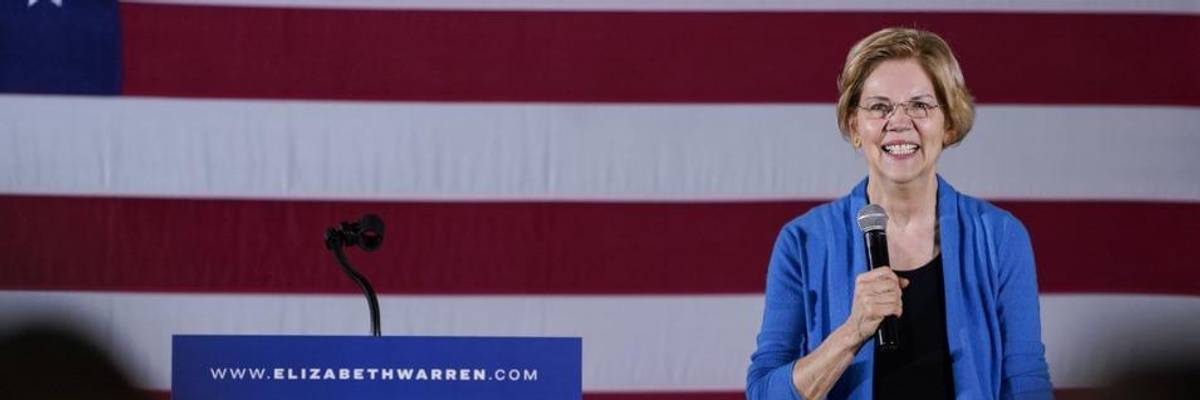
Sen. Elizabeth Warren (D-Mass.) has unveiled a a plan to levy a two percent tax on household assets over $50 million--a proposal which has gained traction with a majority of Americans. (Photo: @ewarren/Twitter)
"Who else is tired of an economy and a tax code that benefits the wealthy and corporations while working Americans are left behind?" the national economic justice movement Tax March asked on Wednesday.
According to recent polling, the answer is "Most Americans."
A poll this month by the New York Times and Survey Monkey showed that most Americans from across the political spectrum support "tax the rich" proposals like the ones put forward by Sen. Elizabeth Warren (D-Mass.) and Rep. Alexandria Ocasio-Cortez (D-N.Y.), with nearly two-thirds of Americans saying that the current economic system--in which the richest 0.00025 percent of the population now owns more wealth than the bottom 60 percent--is immoral.
"They're not paying their fair share," Fred Wood of Williamsport, Pennsylvania told the Times. "It's just not right when folks cannot afford healthcare."
Warren's plan to levy a two percent tax on the assets of Americans with more than $50 million has proven popular, with 75 percent of Democrats and more than half of Republicans supporting the proposal. The "Ultra-Millionaires Tax" would raise $2.75 trillion over a decade, according to economists advising Warren, and would partially be used to pay for the senator's universal childcare plan.
"Across party lines, Americans want the very wealthiest families to pay their fair share so we can have an economy that works for everyone," Warren told the Times.
The newspaper's polling also found that Ocasio-Cortez's proposal to tax income over $10 million at 70 percent is popular with Americans--despite Republicans' and centrist Democrats' attempts to portray the idea as "unrealistic."
Fifty-one percent of respondents supported Ocasio-Cortez's plan, including about a third of Republicans.
The Times pointed out that the public has for decades believed that the government should force the wealthiest Americans and corporations to pay more in taxes--but that they have rarely been given the opportunity to vote for politicians who offer ambitious tax proposals.
"This is about politicians catching up to where Americans have been," political scientist Leslie McCall told the Times.
The poll results followed Sen. Bernie Sanders's (I-Vt.) Tuesday announcement that he was officially entering the 2020 presidential race. As part of his argument for his candidacy, Sanders noted that his condemnation of the outsize wealth of millionaires and billionaires was treated as "radical" by many during his 2016 campaign--but that his demand the richest Americans contribute far more to the common good has now gone mainstream.
Dear Common Dreams reader, It’s been nearly 30 years since I co-founded Common Dreams with my late wife, Lina Newhouser. We had the radical notion that journalism should serve the public good, not corporate profits. It was clear to us from the outset what it would take to build such a project. No paid advertisements. No corporate sponsors. No millionaire publisher telling us what to think or do. Many people said we wouldn't last a year, but we proved those doubters wrong. Together with a tremendous team of journalists and dedicated staff, we built an independent media outlet free from the constraints of profits and corporate control. Our mission has always been simple: To inform. To inspire. To ignite change for the common good. Building Common Dreams was not easy. Our survival was never guaranteed. When you take on the most powerful forces—Wall Street greed, fossil fuel industry destruction, Big Tech lobbyists, and uber-rich oligarchs who have spent billions upon billions rigging the economy and democracy in their favor—the only bulwark you have is supporters who believe in your work. But here’s the urgent message from me today. It's never been this bad out there. And it's never been this hard to keep us going. At the very moment Common Dreams is most needed, the threats we face are intensifying. We need your support now more than ever. We don't accept corporate advertising and never will. We don't have a paywall because we don't think people should be blocked from critical news based on their ability to pay. Everything we do is funded by the donations of readers like you. When everyone does the little they can afford, we are strong. But if that support retreats or dries up, so do we. Will you donate now to make sure Common Dreams not only survives but thrives? —Craig Brown, Co-founder |
"Who else is tired of an economy and a tax code that benefits the wealthy and corporations while working Americans are left behind?" the national economic justice movement Tax March asked on Wednesday.
According to recent polling, the answer is "Most Americans."
A poll this month by the New York Times and Survey Monkey showed that most Americans from across the political spectrum support "tax the rich" proposals like the ones put forward by Sen. Elizabeth Warren (D-Mass.) and Rep. Alexandria Ocasio-Cortez (D-N.Y.), with nearly two-thirds of Americans saying that the current economic system--in which the richest 0.00025 percent of the population now owns more wealth than the bottom 60 percent--is immoral.
"They're not paying their fair share," Fred Wood of Williamsport, Pennsylvania told the Times. "It's just not right when folks cannot afford healthcare."
Warren's plan to levy a two percent tax on the assets of Americans with more than $50 million has proven popular, with 75 percent of Democrats and more than half of Republicans supporting the proposal. The "Ultra-Millionaires Tax" would raise $2.75 trillion over a decade, according to economists advising Warren, and would partially be used to pay for the senator's universal childcare plan.
"Across party lines, Americans want the very wealthiest families to pay their fair share so we can have an economy that works for everyone," Warren told the Times.
The newspaper's polling also found that Ocasio-Cortez's proposal to tax income over $10 million at 70 percent is popular with Americans--despite Republicans' and centrist Democrats' attempts to portray the idea as "unrealistic."
Fifty-one percent of respondents supported Ocasio-Cortez's plan, including about a third of Republicans.
The Times pointed out that the public has for decades believed that the government should force the wealthiest Americans and corporations to pay more in taxes--but that they have rarely been given the opportunity to vote for politicians who offer ambitious tax proposals.
"This is about politicians catching up to where Americans have been," political scientist Leslie McCall told the Times.
The poll results followed Sen. Bernie Sanders's (I-Vt.) Tuesday announcement that he was officially entering the 2020 presidential race. As part of his argument for his candidacy, Sanders noted that his condemnation of the outsize wealth of millionaires and billionaires was treated as "radical" by many during his 2016 campaign--but that his demand the richest Americans contribute far more to the common good has now gone mainstream.
"Who else is tired of an economy and a tax code that benefits the wealthy and corporations while working Americans are left behind?" the national economic justice movement Tax March asked on Wednesday.
According to recent polling, the answer is "Most Americans."
A poll this month by the New York Times and Survey Monkey showed that most Americans from across the political spectrum support "tax the rich" proposals like the ones put forward by Sen. Elizabeth Warren (D-Mass.) and Rep. Alexandria Ocasio-Cortez (D-N.Y.), with nearly two-thirds of Americans saying that the current economic system--in which the richest 0.00025 percent of the population now owns more wealth than the bottom 60 percent--is immoral.
"They're not paying their fair share," Fred Wood of Williamsport, Pennsylvania told the Times. "It's just not right when folks cannot afford healthcare."
Warren's plan to levy a two percent tax on the assets of Americans with more than $50 million has proven popular, with 75 percent of Democrats and more than half of Republicans supporting the proposal. The "Ultra-Millionaires Tax" would raise $2.75 trillion over a decade, according to economists advising Warren, and would partially be used to pay for the senator's universal childcare plan.
"Across party lines, Americans want the very wealthiest families to pay their fair share so we can have an economy that works for everyone," Warren told the Times.
The newspaper's polling also found that Ocasio-Cortez's proposal to tax income over $10 million at 70 percent is popular with Americans--despite Republicans' and centrist Democrats' attempts to portray the idea as "unrealistic."
Fifty-one percent of respondents supported Ocasio-Cortez's plan, including about a third of Republicans.
The Times pointed out that the public has for decades believed that the government should force the wealthiest Americans and corporations to pay more in taxes--but that they have rarely been given the opportunity to vote for politicians who offer ambitious tax proposals.
"This is about politicians catching up to where Americans have been," political scientist Leslie McCall told the Times.
The poll results followed Sen. Bernie Sanders's (I-Vt.) Tuesday announcement that he was officially entering the 2020 presidential race. As part of his argument for his candidacy, Sanders noted that his condemnation of the outsize wealth of millionaires and billionaires was treated as "radical" by many during his 2016 campaign--but that his demand the richest Americans contribute far more to the common good has now gone mainstream.